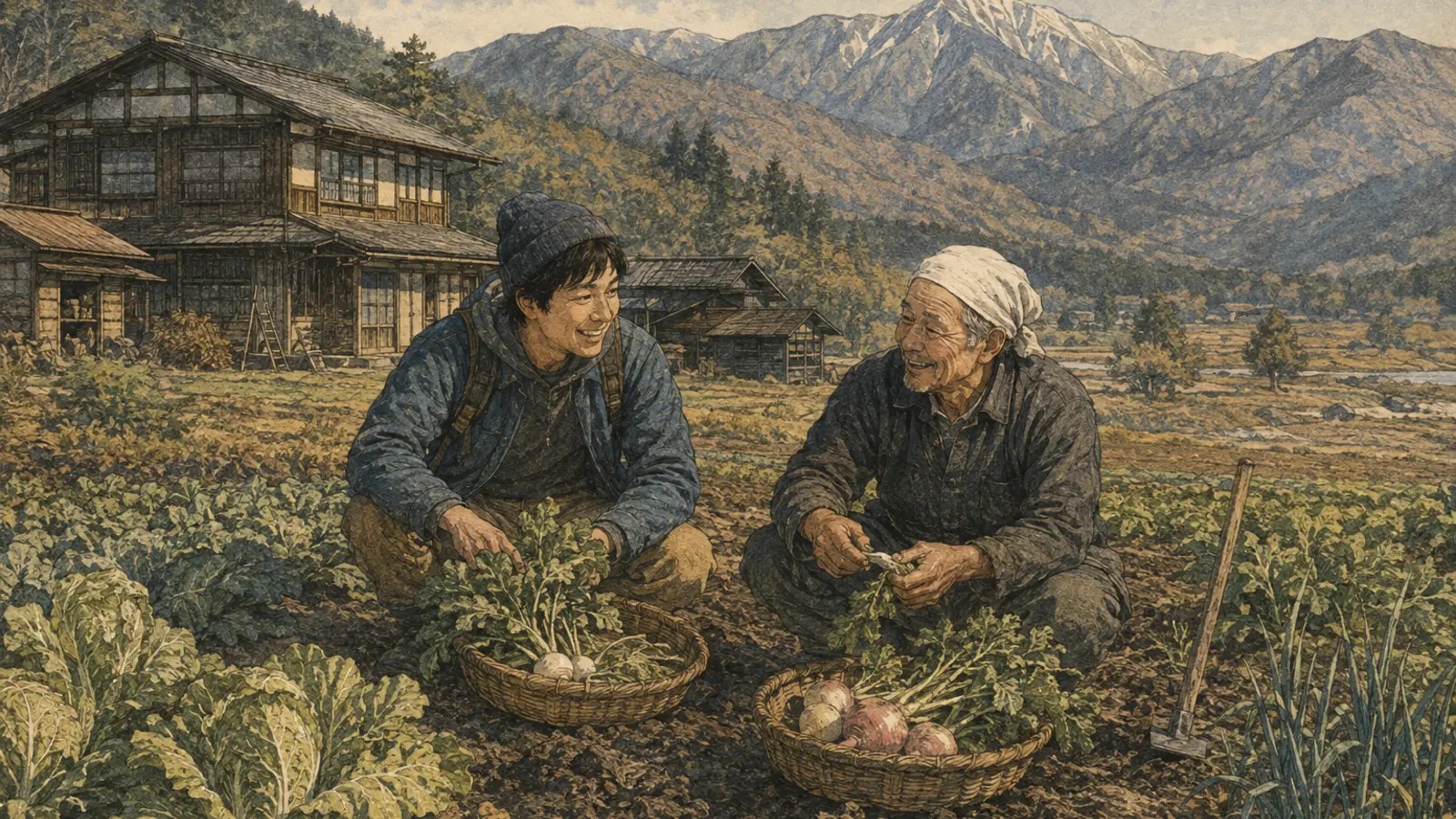
The traveler arrives, but no one hands over a room key and a sightseeing map. There is work first. At a resort about 1,000 meters above sea level in Azumino, Nagano Prefecture, a summer posting calls for cleaning guest rooms, washing dishes and tidying the back of the house. In Assabu, Hokkaido, another asks for help harvesting, sorting and packing a succession of vegetables. Farther south at a highland golf course in Koumi, the day can mean lifting bags, wiping clubs and cleaning carts.
These are not imaginary examples of “authentic Japan.” They were among the jobs in an August 2026 feature published by Otetsutabi, a Japanese matching platform whose name joins otetsudai—helping—with tabi, travel. A host with a seasonal labor gap offers paid short-term work and a place to sleep. A traveler applies, pays the cost of getting there in most cases, works agreed hours and explores during free time.
The proposition is simple enough to fit in a suitcase. Its growth reflects much larger forces: a shrinking rural workforce, tourism businesses struggling to staff busy periods, travel prices rising faster than many household budgets, and a summer climate pushing people to look north or uphill.
Otetsutabi said applications across its platform in June 2026 were 1.7 times the level a year earlier. Among applicants aged 50 and older, the increase was 2.1 times. By July, the company reported more than 110,000 registered users and over 2,900 registered businesses in all 47 prefectures.
The destination is the work
Conventional tourism sells the finished surface: the made bed, the plated dinner, the harvested fruit arranged at a roadside station. A working stay begins on the other side of that surface. The guest room has to be turned over; breakfast dishes have to be cleared; vegetables ripen according to weather, not staffing plans.
That reversal is Otetsutabi’s most consequential idea. A place does not need a celebrated monument to become a destination. It needs a real task, a host willing to receive someone and enough time for two strangers to stop speaking as customer and provider.
The company says listings can run from one night and two days to less than two months, with the average stay around two weeks. Jobs include farm work, hotel service and cleaning, fishery and food processing, campsites, restaurants, guesthouses and sake breweries. Hosts provide pay and lodging; participants generally cover transportation. The platform says workers receive at least the regional minimum wage.
That makes the model more substantial than a free-bed exchange. Work schedules, duties, pay, days off, accommodation and transport access are not atmosphere; they are the trip’s basic facts. For the participant, the experience can be meaningful and still be tiring. A cool mountain morning does not make repetitive cleaning effortless. A beautiful field is also a workplace with lifting, dirt, insects, rain and deadlines.
| What the traveler brings | What the host brings | What must be checked |
|---|---|---|
| Time, labor, travel costs and willingness to enter an unfamiliar routine | Paid work, a sleeping place, instructions and workplace supervision | Contract type, wage, hours, duties, meals, room arrangements and cancellation terms |
| Interest in the region beyond scheduled sightseeing | Local knowledge and access to a community’s daily life | Transport on days off, internet access, medical needs and heat or weather risks |
| Skills where a listing requires them, such as a driver’s license | A lawful and safe workplace | Whether photos and reviews match the actual job and accommodation |
A founder from a place people could not place
Otetsutabi’s history begins with a question that can sting anyone from a town left off the national mental map. Founder Rina Nagaoka was born in Owase, Mie Prefecture, in 1990. When she moved to the Tokyo area for university and told people where she came from, she repeatedly heard a version of: “Where is that?”
Owase was not obscure to her. It was grandparents, mountains, rivers, neighborhood fireworks and summer memory. The gap between a place’s richness to the people who know it and its invisibility to everyone else became the seed of a business.
After university, Nagaoka worked in event planning and later on a project promoting Japanese food culture. She left salaried work in 2017, gave up her Tokyo home and traveled through Japan by night bus, looking for a way to work with regions. Television Tokyo’s account of that journey identifies an encounter with a tomato farmer in Ueda, Nagano, who labored through the summer peak from early morning into evening. The labor shortage was not an abstract chart. It was a person with more ripe work than hours.
Nagaoka’s insight was to treat the shortage as an invitation. Unknown places faced two barriers: travelers did not know why to go, and the cost of visiting could be hard to justify. Work could lower the financial barrier through wages and lodging, while giving the visitor a socially natural reason to meet local people.
She founded the company in July 2018. After field tests, the beta site opened on January 30, 2019. The service passed 50,000 users in April 2024, reported 78,000 and more than 1,000 participating lodging facilities in May 2025, and received an Excellence Award in the fifth Japan Service Awards later that year. By February 2026 it reported 94,000 users; five months later, the figure had crossed 110,000.
2017 · Rina Nagaoka leaves salaried work and travels through regional Japan.
July 2018 · Otetsutabi Co. is established.
January 2019 · The beta matching site opens.
April 2024 · Registered users pass 50,000.
2025 · The service receives an Excellence Award in the fifth Japan Service Awards.
February 2026 · The company reports 94,000 users and 2,200 businesses.
July 2026 · Registrations exceed 110,000; participating businesses exceed 2,900.
August 2026 · A cool-region feature highlights Hokkaido and highland work stays.
The rural labor shortage has a calendar
Japan’s labor shortage is often described as one national condition. In rural business, it has a calendar. A farm may need many hands for a narrow harvest window but cannot employ that number all year. An inn may be quiet in June and overwhelmed during summer vacation, autumn foliage or New Year. A small town cannot instantly manufacture housing and a permanent workforce for a six-week peak.
The structural numbers are severe. Japan’s agriculture minister said the 2025 agricultural census counted 1.021 million core agricultural workers, down 25.1 percent in five years; roughly seven-tenths of that fall came from people aged 65 and older leaving the count. The final census also showed continuing consolidation into fewer, larger operations. In lodging, the Japan Tourism Agency is still funding labor-saving equipment and shared systems in 2026 because it says the recovery of tourism demand has made staffing shortages more visible.
A short-stay worker can be useful precisely where these problems meet: at the peak, for a defined job, in a place that cannot compete with a city on convenience alone. The fifth Japan Service Awards praised Otetsutabi for drawing more applicants on average than the number of positions offered, even in less-known regions.
But a platform does not create labor from nothing. It redistributes people who have flexible weeks, sufficient health, travel money and an appetite for uncertainty. Nor does a stream of temporary helpers solve rural housing, transport, low productivity, succession or the long-term economics of agriculture and hospitality. It is a pressure valve, a recruiting channel and sometimes a first encounter—not a demographic cure.
The summer of working somewhere cooler
In 2026, climate and price sharpened the pitch. The Japan Meteorological Agency said July temperatures were “considerably high” across northern, eastern and western Japan. Even Hokkaido was not exempt: northern Japan’s mid-July average was 3.7 degrees Celsius above normal, tied for the highest in records for that ten-day period dating to 1946.
“Cooler” is therefore relative, not a safety guarantee. Still, elevation and latitude matter to travelers trying to escape dense urban heat. Otetsutabi’s August feature included a Nagano mountain resort at about 1,000 meters, a golf course at 1,300 meters, a hotel in Kiyosato and a Hokkaido vegetable farm. The work ranged from four-to-six-hour room-cleaning shifts to field harvesting and packing.
Money adds a second motive. JTB forecast that a domestic summer trip would cost an average of ¥48,500 per person in 2026, 3.2 percent more than a year earlier, while the number of domestic travelers would fall 4.4 percent to 69 million. In its survey, 41.8 percent wanted to spend less on travel during the next year.
A paid stay changes that arithmetic, but does not erase it. The bed is normally provided and wages can offset costs; the train, flight, fuel and time to reach a remote community are generally the participant’s responsibility. A posting in a poorly connected area may be attractive only to someone who drives. An applicant with a fixed vacation must also find dates that match the host’s entire requested period.
One woman in her 50s told the company’s summer survey that she wanted to “escape midsummer Saitama” for somewhere cool. Another was using highland and Hokkaido listings partly to look for a future home. Those voices capture why applications may grow even when ordinary travel demand softens: the journey is expected to do more than provide rest. It can earn, test a possible relocation and offer belonging.
From visitor to “relationship population”
Japanese regional policy has a term for the space between tourist and resident: kankei jinkō, usually translated as “relationship population.” The Ministry of Land, Infrastructure, Transport and Tourism defines it as people who are neither settled residents nor one-time visitors, but who maintain diverse, continuing involvement with a particular place. One official category is local employment.
Otetsutabi is designed as an entry ramp into that middle ground. Work gives the traveler repeated contact with people rather than only scenery. A farmer explains how to recognize a ripe crop. An innkeeper shows what happens before check-in. Coworkers share the road, shop or bath visitors would never find from a ranking page. By the time someone has been useful, the social distance has changed.
The company’s post-participation survey says 80 percent stayed in a municipality they otherwise had not planned to visit, 49 percent had not known the municipality beforehand, 70 percent were visiting it for the first time and 85 percent wanted to return someday. These results are suggestive, but the company has not published enough methodology with the release—sample size, response rate and question design—to treat them as a national estimate.
There is stronger evidence that local governments see potential. Otetsutabi says it works through agreements or other arrangements with more than 70 municipalities. A 2026 partnership with the Saku regional union covered 11 Nagano municipalities. In northern Shiga, a prefectural project brought participants from their teens through their 60s for a combined 130 days in its previous year. Japan’s agriculture ministry also included an Otetsutabi initiative in Naruto, Tokushima, among the first recipients of a new certificate recognizing corporate contributions to rural communities.
Not a guest, but not permanent staff
The model lives in a delicate boundary. If the experience is marketed only as a bargain holiday, the work can feel like an unpleasant surprise. If the traveler is treated only as replaceable labor, the regional relationship disappears. Good matches require both sides to be candid about what the stay is.
Hosts need to write precise job descriptions, issue the required labor documents, follow wage and safety rules, explain accommodation and provide real supervision. Travelers need to read the conditions rather than the mountain photographs, disclose limitations and understand that free time depends on the schedule. Reviews help, but they cannot remove differences in management, shared-room comfort, transport or physical demands.
There is also a policy question beneath the cheerful portmanteau. Short-term platforms can widen access to work and travel; they can also normalize a workforce built around constant availability and personal mobility. The fair test is not whether participants enjoyed the scenery. It is whether wages and conditions were lawful, whether hosts received useful work without shifting unreasonable costs to travelers, and whether communities gained a relationship rather than a revolving door.
- Confirm the employer, contract type, hourly wage, estimated total hours and pay date.
- Check whether lodging is private or shared, and whether meals, utilities and laundry are included.
- Price the entire trip. Transportation is generally not reimbursed.
- Ask about heat, rain, lifting, protective gear and access to medical care.
- Map free-time transport. “Near” a destination can still mean no bus on a day off.
- Treat company application and survey figures as company-reported indicators, not audited outcomes.
What happens after the last shift
Otetsutabi’s future will be measured in two very different time horizons. The first is short: Did the tomatoes get picked? Were the rooms ready? Was the summer rush staffed safely? These are practical wins that can be counted in hours, boxes and shifts.
The second is longer and harder: Did anyone come back?
A return visit, a seasonal reunion, a purchase made from afar, a new employee, a second home or an eventual move would show that a labor match became a human connection. The company points to cases that progressed to employment, two-region living, migration and entrepreneurship. Those stories matter, but their frequency must be tracked with more than selected examples. Durable public value will require published match and completion rates, repeat-visit measures, host retention, complaints, injuries and the distribution of wages and working conditions.
The service’s widening age range may also change it. About half of participants remain in their teens and twenties, according to the company, but workers over 50 are growing quickly. Retirees and people whose children are grown may have time, skills and a desire for purposeful movement. Students bring long breaks and curiosity. Neither group is interchangeable, and hosts that understand the difference may build better jobs.
At its best, Otetsutabi does not disguise work as leisure. It makes work the door through which a place is understood. The traveler leaves with wages, perhaps sore muscles, and a map drawn from relationships rather than landmarks. The host gets help when the calendar is least forgiving. Somewhere between them, a town previously answered with “Where is that?” may acquire a person who knows exactly how to return.
- Otetsutabi, “A new summer journey” release, August 6, 2026 — application growth, cool-region listings, user and host totals, operating model and company survey.
- Otetsutabi service overview and contract guidance — minimum wage, lodging, transport and employment status.
- TV Tokyo, founder profile and company history.
- Fifth Japan Service Awards, Otetsutabi Excellence Award.
- Japan Meteorological Agency, July 2026 climate summary.
- JTB, 2026 summer travel outlook.
- Ministry of Agriculture, Forestry and Fisheries, 2025 census briefing and rural-contribution certificate announcement.
- Ministry of Land, Infrastructure, Transport and Tourism, definition of “relationship population” and 2026 lodging-industry labor-efficiency program.
Editor’s note: Japan.co.jp did not independently audit Otetsutabi’s registrations, applications, survey results or claimed outcomes. Where methodology was not published, the article identifies the figure as company-reported.