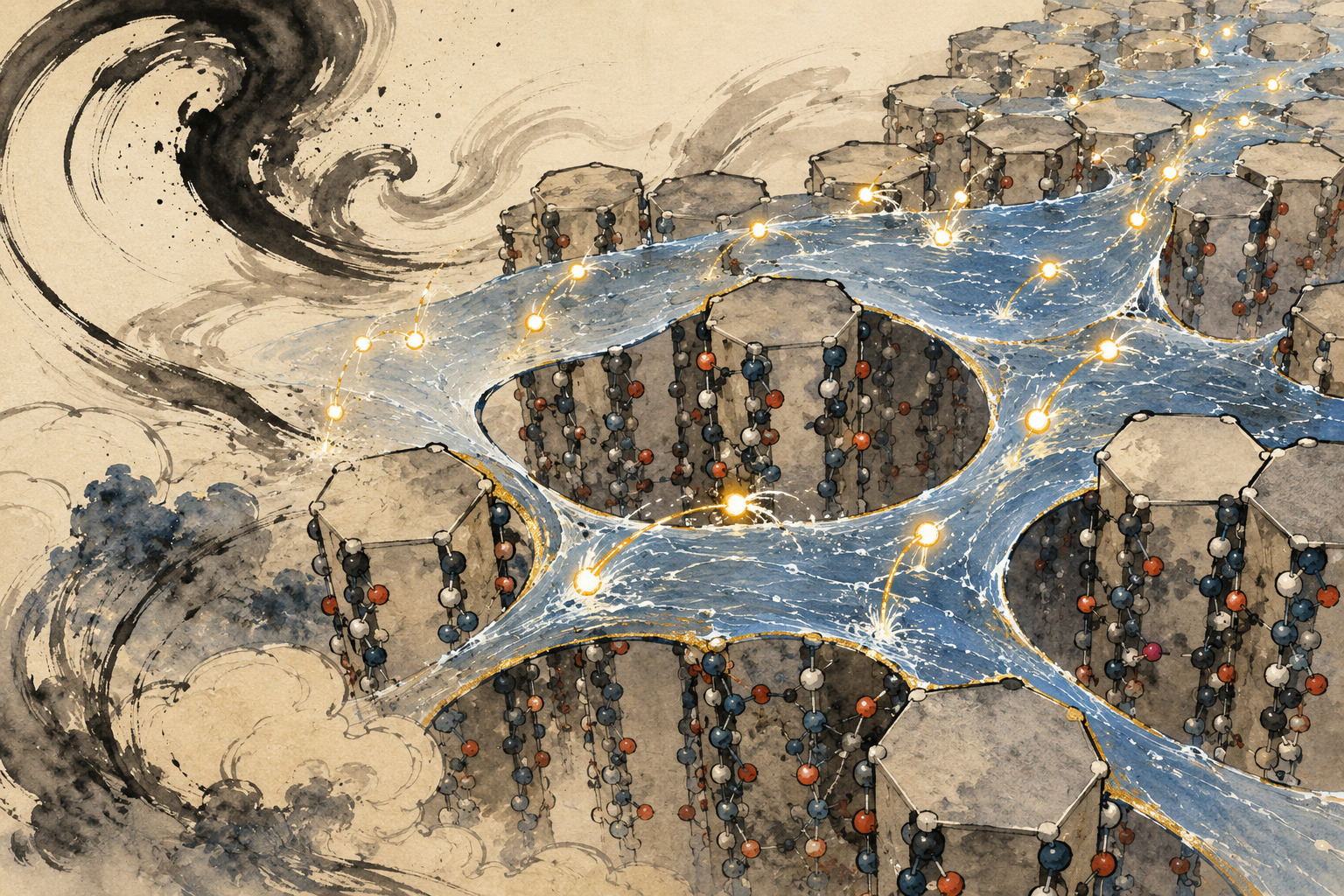
No single proton ran from one edge of the material to the other. One molecular site handed off charge to the next, which handed it to the next—more like a bucket brigade than a traveler crossing a country. The unusual part of the route designed in Koganei, western Tokyo, is that it did not require a broad river of free water. Molecules organized themselves into an interface where acidic stepping stones sat only a few atoms apart.
The material reported in the Journal of the American Chemical Society by Mina Nakazawa, Takeshi Yamada, Yumin Tang, Xiangbing Zeng and Takahiro Ichikawa is a mixture of water and a discotic liquid-crystal molecule called TPES. With the appropriate quantity of water, the discs stack into columns and the columns pack on a hexagonal lattice. Sulfonate groups line the hydrated interface at an average spacing of about 5 Å, or half a nanometer.
At a water content of 53 percent by weight, the mixture reached a maximum proton conductivity of 3.5 × 10⁻¹ S/cm at 30°C. Its apparent activation energy was 6.0 kJ/mol. The manuscript was received on December 11, 2025, accepted on June 2, 2026, published online on June 26 and placed in volume 148, issue 30 of JACS on August 5.
The selectively permeable wall at the heart of a fuel cell
A proton-exchange membrane has a contradictory job. At the anode of a hydrogen fuel cell, a catalyst splits hydrogen molecules into protons and electrons. The membrane blocks the electrons, forcing them around an external circuit where they do useful work. It lets the protons cross. At the cathode, those protons meet the returning electrons and oxygen to form water and heat.
The membrane therefore must conduct ions rapidly while keeping electrons, fuel and oxidant apart. The U.S. Department of Energy says transportation membranes can be less than 20 micrometers thick. Making one thinner lowers electrical resistance but can weaken it and increase gas crossover. High conductivity must coexist with gas selectivity, dimensional stability, chemical durability, good contact with catalyst layers and a manufacturable thickness.
- Carry H+ from the anode to the cathode.
- Block electrons so they must power the external circuit.
- Prevent hydrogen and oxygen from mixing directly.
- Remain thin and intact through humidity, heat, acid and pressure cycles.
Fast proton conductors matter beyond vehicle fuel cells. They can become electrolytes or ionomers in water electrolysis, electrochemical sensors, biosensors and humidity-responsive devices. That is why the immediate claim of the TUAT paper is a new design principle for electrolytes, not a finished next-generation engine.
A correct intuition from 1806, before the formula for water was settled
The story begins just after the invention of the battery. At the end of 1805, Theodor von Grotthuss published a French paper in Rome on the decomposition of water by galvanic electricity. Chemists did not yet have the modern molecular structure of water or a modern theory of ions. Yet Grotthuss imagined charge moving through a chain of bonds breaking and reforming, rather than each carrier traversing the whole liquid.
In the mechanism now carrying his name, an excess proton is relayed through a hydrogen-bond network. Individual water molecules need not cross the device; the position corresponding to H3O+ changes as neighboring molecules accept and release protons. That structural diffusion helps explain why proton charge moves unusually quickly in water. The 2026 JACS paper notes that the repeated cleavage and reformation of hydrogen bonds generally gives the Grotthuss process an activation energy of about 10–15 kJ/mol.
A second route is commonly called the vehicle mechanism: a hydrated oxonium species diffuses while carrying its associated water. Real polymer electrolytes may combine Grotthuss relay, en masse diffusion of hydrated ions and hopping along a surface. Their relative contributions change with water content, acid-site spacing, temperature and morphology.
Nafion has been the benchmark since the 1960s
General Electric introduced the ion-exchange-membrane idea for polymer-electrolyte fuel cells in the 1950s, and NASA’s Gemini program brought the technology into an exacting application in the following decade. Early sulfonated-polystyrene membranes were vulnerable to oxidation and hydrolysis. A more durable answer emerged from DuPont in the 1960s: the perfluorosulfonic-acid material sold as Nafion.
Nafion combines a hydrophobic fluorocarbon backbone, chemically similar in spirit to PTFE, with hydrophilic side chains ending in sulfonic acid. When the material takes up water, the ionic regions form nanoscale water-rich domains. Sulfonic acid supplies protons; the fluorinated skeleton provides chemical and mechanical resilience. Nanoscale phase separation lets one substance divide incompatible duties, which is a central reason the material has remained a standard for more than half a century.
The benchmark has limitations. Conductivity falls as the membrane dries; water and swelling must be managed; the useful temperature window is constrained; and cost remains a concern. Questions around the manufacture and disposal of fluorinated materials add pressure to find alternatives. That does not make the present TPES/water mixture a demonstrated fluorine-free replacement. The JACS abstract does not establish its full composition, life cycle, scalable synthesis or environmental advantage.
From “add more water” to “move the sites closer”
The established design intuition has been to create a continuous water pool inside a membrane so the Grotthuss mechanism can dominate. But calculations published in 2001 highlighted a neglected variable. If fixed sulfonate groups on a hydrophobic wall are about 15 Å apart, the estimated in-plane electrostatic barrier is roughly 30 kJ/mol. Bring them to 5 Å and the model barrier collapses to about 2–3 kJ/mol. Nafion’s sites are commonly estimated to be about 12–20 Å apart, making surface hopping a minor route.
Ichikawa’s laboratory set out to turn that minor route into the main road. TPES is plate-like—a discotic liquid-crystal molecule. Liquid crystals flow like liquids while retaining some of the order of crystals. In water, TPES uses the compatibility and incompatibility of its molecular regions to assemble spontaneously. Discs stack into columns; the columns pack in a hexagonal arrangement.
| Design element | Role in the 2026 material | Why it matters |
|---|---|---|
| Discotic TPES | Self-assembles into a hexagonal columnar liquid crystal. | Molecular order is produced thermodynamically rather than by carving every feature. |
| Sulfonate groups | Form proton departure and arrival sites at an average spacing of about 5 Å. | Short spacing is designed to lower the in-plane hopping barrier. |
| 53 wt% water | Bridges the acid sites. The authors identify the water supporting the fast state as bound water. | The mechanism does not require a bulk-like pool of free water. |
| QENS | Probes hydrogen dynamics across ångström distances and picosecond-to-nanosecond times. | Water motion provides a mechanistic test beyond a conductivity number. |
A proton cannot travel if it is locked to one sulfonate group. Hydration weakens that interaction, and bound water can bridge to the neighboring site. When the sites are close enough, the proton can hop along the interface instead of moving through a bulk-water channel. The team calls the process surface proton hopping conduction, or SPHC.
What 0.35 S/cm and 6.0 kJ/mol actually say
Conductivity in S/cm describes how readily a material carries current across a given geometry: higher conductivity means lower resistance, all else equal. The new value of 0.35 S/cm was obtained near room temperature. It exceeds the order of 10−1 S/cm commonly associated with highly hydrated Nafion. Compared with a published 0.110 ± 0.004 S/cm for recast Nafion at 30°C and 100 percent RH, it is about 3.2 times larger.
But proton-conductivity comparisons depend strongly on temperature, humidity, water uptake, pretreatment, sample direction, electrode configuration and impedance analysis. The new sample is a mixture containing 53 percent water; the comparison is a formed Nafion membrane. The ratio is a useful scale for understanding the measurement, not a product league table.
The 6.0 kJ/mol activation energy tells the more interesting mechanistic story. A lower barrier means temperature supplies less additional energy to enable motion. The value is below the 10–15 kJ/mol range the paper gives for ordinary Grotthuss transport. The authors conclude that dense, periodic sulfonate placement has greatly activated surface hopping.
Watching water that does not behave like a puddle
Bound water is not the same as free water in a glass. Electric fields at ions and polymer surfaces, together with confinement, change its freezing, rotation and diffusion. Across this research program, differential scanning calorimetry has been used to look for the freezing peak near 0°C: its absence supports the conclusion that little bulk-like free water is present.
For the latest study, the researchers quantified bound-water dynamics with quasielastic neutron scattering, or QENS. Neutrons are highly sensitive to hydrogen. Tiny changes in neutron energy after scattering reveal rotations and local jumps occurring over a few ångströms in picoseconds to nanoseconds. Coauthor Takeshi Yamada is based at the Neutron Science and Technology Center of the Comprehensive Research Organization for Science and Society in Tokai, Ibaraki.
QENS is not a movie of one proton’s long-distance route. Researchers compare spectra, often exploiting the contrast between ordinary H2O and heavy D2O, and fit the broadening against models of local motion. Conductivity, temperature dependence, phase structure, thermal analysis and bound-water dynamics must all agree before SPHC can be identified as the principal mechanism.
A 14-year route from a five-ångström water nanosheet
Reading the new measurement as a sudden invention misses half of its meaning. In 2012, Ichikawa, Takashi Kato and Hiroyuki Ohno reported a bicontinuous cubic liquid crystal formed by an amphiphilic zwitterion and an acid. Along its gyroid minimal surface, a small amount of water made an approximately 5 Å-thick, macroscopically continuous water nanosheet.
A gyroid is a triply periodic minimal surface described in a 1970 NASA technical note by Alan Schoen. It separates space into two interwoven labyrinths without dead ends. A water sheet following that surface is not flat paper. It is an extremely thin, soap-film-like interface curved continuously through three dimensions, providing a route in many directions without aligning the whole sample.
In 2019, the team designed a polymerizable amphiphile with two zwitterionic heads. They formed the gyroid liquid crystal and froze its molecular architecture in place with ultraviolet polymerization, producing a self-standing film. At 90 percent RH, the film absorbed 15.6 wt% water and reached conductivity on the order of 10−1 S/cm; at 70°C it measured 9.9 × 10⁻² S/cm. The explanation emphasized a Grotthuss relay through the water nanosheet.
A 2024 Chemical Science paper shifted attention from the interior of the water layer to its surface. A gyroid polymer film with densely ordered sulfonates showed conductivity on the order of 10−2 S/cm at about 15 wt% water. A sample with 15.2 wt% water gave 8.5 × 10⁻³ S/cm and an activation energy of 17.2 kJ/mol. The headline number was lower than in 2019, but QENS and calculations supported the more fundamental claim that bound-water-assisted surface hopping alone could dominate.
1805–1806 — Grotthuss proposes a chain of charge transfer through water.
1960s — Polymer-electrolyte fuel cells enter the space program; DuPont develops Nafion.
1970 — Alan Schoen describes the gyroid in a NASA technical report.
2012 — Ichikawa and colleagues report a three-dimensional, approximately 5 Å water nanosheet in JACS.
2019 — UV polymerization fixes the gyroid into a self-standing film with conductivity on the order of 10−1 S/cm.
2024 — A polymer film demonstrates bound-water-assisted SPHC as its dominant route.
2026 — Hexagonal columns of discotic TPES reach 0.35 S/cm and 6.0 kJ/mol.
The 2026 material sharpens this lineage in a different morphology. It is not the same self-standing gyroid polymer film. It is a TPES/water mixture in a hexagonal columnar liquid-crystal state, with acid sites compressed to about 5 Å and 53 wt% water. The “water nanosheet” description captures the research program, but two five-ångström quantities must not be confused: the 2012 sheet thickness and the 2026 average distance between sulfonate sites are not the same measurement.
Liquid crystals are not only for displays
The accepted birth of liquid-crystal science dates to 1888, when Austrian botanist Friedrich Reinitzer found two apparent melting points in cholesteryl benzoate. The intermediate phase flowed like a liquid but retained crystal-like order. That combination eventually enabled displays, but it can also instruct ions where to move.
In a columnar discotic liquid crystal, plate-like molecules stack like coins and the stacks arrange in a lattice. Separation of hydrophilic and hydrophobic regions, molecular interactions, concentration and temperature determine the architecture. Rather than use a fabrication tool to etch a 5 Å groove, the chemist encodes the instructions in the molecule and lets the mixture settle into the desired order.
Self-assembly offers near-atomic precision over large numbers of molecules. Its weakness is that composition, temperature and impurities can change the phase. A laboratory mixture that finds the correct arrangement in a cell must later preserve that arrangement through casting, polymerization, drying, compression and years of operation.
Ichikawa’s TUAT profile has listed functional gyroid minimal interfaces made from amphiphilic zwitterions as a research theme since 2011. In November 2025, when the latest design was presented at the Japan MRS annual meeting, Nakazawa was a first-year master’s student in biotechnology and life science. TUAT later announced that she had received an encouragement award for building a high-density acidic interface and observing rapid proton transport. The JACS paper joins TUAT, neutron science in Tokai and structural analysis at the University of Sheffield.
What the paper establishes—and what it does not
| Strongly supported by the published evidence | Not yet established |
|---|---|
| A TPES/H2O mixture forms a hexagonal columnar liquid crystal and places sulfonate sites about 5 Å apart on average. | Continuous production of a large-area, thin, defect-free self-supporting membrane. |
| The 53 wt% water sample reaches 0.35 S/cm at 30°C with an apparent activation energy of 6.0 kJ/mol. | Retention of performance through dry air, freezing, temperatures above 80°C, startup and pressure cycles. |
| Analysis including QENS supports fast SPHC assisted by bound rather than bulk-like free water. | Fuel and oxidant crossover, electronic insulation, catalyst-interface resistance and chemical lifetime at device requirements. |
| The five authors declare no competing financial interest. | Lower cost, lower life-cycle impact, longer life or higher complete-cell power than incumbent membranes. |
The largest missing step is turning a liquid-crystal mixture into a component. A substance containing more than half its weight in water can conduct brilliantly yet fail to withstand a gas-pressure differential as a thin film. Crosslinking or polymerization can add strength but may change molecular motion and water uptake, destroying the conductivity that made the material interesting. A porous support can supply shape while blocking routes or adding tortuosity.
Researchers must also separate proton current from other ionic or electronic contributions, measure acid leaching and quantify hydrogen, oxygen or methanol crossover. Only after the material enters a membrane-electrode assembly can it be judged by open-circuit voltage, current and power density, humidity cycling and thousands of hours of operation against a control of the same thickness and catalyst loading.
The experiments to watch next
- Give it form: preserve columnar order in a defect-free, tens-of-micrometers self-standing or composite membrane.
- Control the water: test lower water content, low humidity and subzero startup.
- Measure selectivity: establish proton transference, electronic resistance and hydrogen, oxygen or methanol permeability.
- Build the interface: connect the ion pathway continuously into the catalyst layer.
- Try to destroy it: apply radicals, acid, pressure and repeated wet-dry cycling.
- Compare full cells: run a Nafion control at equal thickness, temperature, humidity and catalyst loading.
- Count manufacturing: measure TPES synthesis yield, solvent recovery, cost per area, reuse and disposal.
If those gates can be crossed, the first application need not be an automobile. A closed, humidified sensor or small electrochemical device may tolerate the 53 percent water state better. The design could also be adapted to an electrolyzer or to the thin ionomer inside a catalyst layer. Materials normally reach market where their weakness is acceptable, not where their peak laboratory number is most dramatic.
The design rule may outlast the record
Materials records are temporary. In 2026 alone, researchers have reported high proton conductivities in covalent organic frameworks, inorganic nanosheets and acid-filled crystalline materials. Comparing numbers across different temperature, humidity, geometry and chemistry rarely produces a meaningful “world champion.”
The durable part of the TUAT result is a causal sequence. Place acidic sites about 5 Å apart. Bridge them with bound water. Use liquid-crystal self-assembly to repeat that arrangement macroscopically. Test conductivity and activation energy, then use neutron scattering to ask whether water dynamics fit the proposed surface-hopping mechanism. That sequence can be transferred to other molecules, acids and methods of fixation.
Two hundred and twenty years ago, Grotthuss imagined invisible charge moving through water as a chain of changing bonds. In 2012, Ichikawa and collaborators confined water to a surface about 5 Å thick. In 2026, Nakazawa and colleagues brought the stepping stones themselves within about 5 Å. The fastest route did not have to be a wider highway. It could be a line of stones close enough that the proton never needed to hesitate.
Reporting ledger: where the numbers and words stop
| Established | Treated cautiously here |
|---|---|
| The JACS abstract states 0.35 S/cm at 30°C and 53 wt% water, about 5 Å site spacing, a 6.0 kJ/mol activation energy, bound water and QENS. | “Three times Nafion” is our calculation against a separate 0.110 S/cm paper, not a direct same-test comparison. |
| The sample is a TPES/H2O hexagonal columnar liquid-crystal mixture. | “Water nanosheet” names the program’s lineage; the 2026 sample is not described as the 2012 gyroid sheet or as a self-standing polymer membrane. |
| Peer-reviewed papers from 2012, 2019 and 2024 document the gyroid water route, polymer fixation and SPHC stages. | Fuel-cell power, lifetime, gas barrier, cost and life-cycle impact remain unestablished in the sources reviewed. |
| TUAT documents Nakazawa’s MRS award and the lab’s continuing work. | Japan.co.jp did not interview the researchers and has not invented quotations for them. |
- Nakazawa et al., JACS, “Extreme Activation of Surface Proton Hopping Conduction Mechanism…” (2026)
- TUAT: Mina Nakazawa receives the 35th Japan MRS annual-meeting encouragement award
- Ichikawa Laboratory, TUAT: publications and achievements
- TUAT Researcher Database: Takahiro Ichikawa
- Ichikawa et al., JACS, “3D Continuous Water Nanosheet…” (2012)
- Kobayashi et al., Chemical Science, “Gyroid structured aqua-sheets…” (2019)
- Ichikawa et al., Chemical Science, “Surface proton hopping conduction…” (2024)
- Ichikawa et al., Polymer Journal, “Gyroid-nanostructured polymer films…” (2026)
- J-PARC: 2024 release on molecular arrangement and proton-conducting polymer films
- Industrial & Engineering Chemistry Research: recast Nafion comparison at 30°C and 100% RH
- U.S. Department of Energy: Parts of a Fuel Cell
- U.S. Department of Energy: Fuel Cells
- Katz, “Electrochemical contributions: Theodor Grotthuss” (2021)
- NASA Technical Note D-5541, “Infinite periodic minimal surfaces…” (1970)
- Kent State University: history of liquid-crystal science
Editor's note: This report is based on peer-reviewed papers and public material from universities, research facilities and government. Japan.co.jp has not independently measured the sample. Values are accompanied by their material state and test conditions; comparisons between studies are identified as approximations. “About three times” is our calculation of 0.35 ÷ 0.110. The exchange rate is supplied for this edition and is not used to evaluate the research.