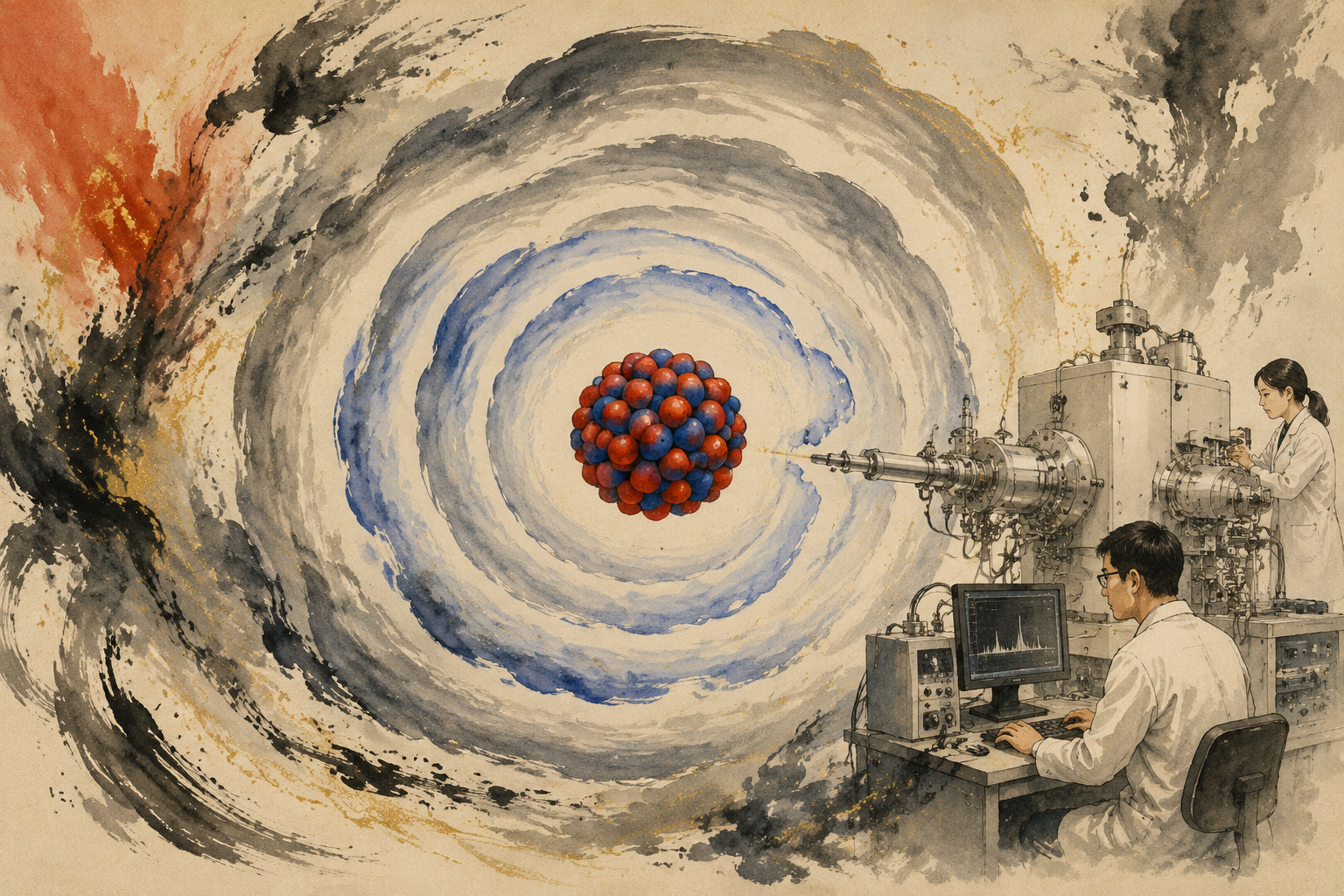
Argon-50 cannot be set on a balance. It has ten more neutrons than argon-40, the stable isotope that makes up nearly all natural argon on Earth, and an evaluated half-life of 106 milliseconds. Half of a sample disappears by beta decay in less time than a blink. But catch the nucleus, cool it and bounce its ion hundreds of times between electric mirrors, and its arrival time becomes a measure of its weight.
An international collaboration led in the paper by C. Y. Fu, W. D. Xian, T. Niwase, M. Rosenbusch and M. Wada used the BigRIPS–SLOWRI system and a multireflection time-of-flight mass spectrograph, or MRTOF-MS, at RIKEN’s Radioactive Isotope Beam Factory in Wako. The team made precision measurements of argon-48, argon-49 and argon-50. Physical Review Letters published the result on August 6, 2026.
The headline is the first direct determination of argon-50’s atomic mass. The deeper scientific impact comes from how one new point changes its neighbors. The team found argon-49 to be 674 keV lower in mass-energy than the value obtained by an earlier magnetic-rigidity and time-of-flight, or Bρ–TOF, measurement. Its precision improved 250-fold. Nuclear physicists read forces and shell boundaries from differences between adjacent masses. One redrawn contour can change the local map.
What nuclear physicists mean by “magic”
A nucleus is made of protons and neutrons, collectively called nucleons. Quantum mechanics does not allow them to take any energy they please. In the shell model, nucleons occupy allowed orbitals from lower energy upward. When a group of orbitals is full and a large energy gap separates it from the next available orbital, the nucleus tends to resist excitation and deformation. A proton or neutron count that completes such a shell is called magic.
The traditional sequence is 2, 8, 20, 28, 50, 82 and 126. A nucleus whose proton and neutron counts both close shells is “doubly magic.” That does not mean immortal. Doubly magic nuclei can be radioactive; the term describes their internal organization, enhanced binding patterns and reluctance to excite, not immunity to decay.
| Observable | Expected closed-shell fingerprint | Why caution is needed |
|---|---|---|
| Mass and separation energy | The growth of binding changes sharply after the shell is crossed. | Pairing, deformation and uncertainties in neighboring masses contribute. |
| First 2+ excitation | Often high in an even-even nucleus because breaking the closure is costly. | One energy level cannot uniquely determine a shell gap. |
| Electromagnetic transitions and collectivity | Weak deformation and a relatively small B(E2) value are common. | These probe cooperative proton-neutron motion, not exactly what mass probes. |
| Radii, momentum distributions and reactions | Kinks or changes in occupied orbitals can occur at a closure. | Every signature need not appear with the same strength or at the same place. |
A magic number is not a serial number engraved on a nucleus. It is a name for the strength of a shell closure seen through several experimental windows.
How a list of abundances became the shell model
After the Second World War, Maria Goeppert Mayer joined work on the origin of the elements at the University of Chicago and Argonne National Laboratory. While organizing isotope abundances, she recognized the exceptional stability associated with 2, 8, 20, 28, 50, 82 and 126 protons or neutrons. Eugene Wigner, reportedly skeptical of the pattern, is credited with the playful term “magic numbers.”
A simple central potential could not reproduce the sequence beyond 20. The decisive clue came when Enrico Fermi asked Goeppert Mayer whether there was evidence for spin-orbit coupling. Strongly coupling a nucleon’s intrinsic spin to its orbital angular momentum splits and reorders energy levels, opening the observed large gaps. Otto Haxel, J. Hans D. Jensen and Hans Suess arrived independently at the same idea in Germany. Their papers appeared in 1949. Goeppert Mayer and Jensen later shared the 1963 Nobel Prize in Physics for discoveries concerning nuclear shell structure.
The shell model did not abolish the liquid-drop model. A nucleus is both a system in which individual nucleons occupy orbitals and a quantum drop capable of collective vibration, rotation and deformation. Argon-50 is compelling because the competition between those descriptions becomes visible far from the valley of stability.
1946–1949 — Goeppert Mayer organizes the magic-number evidence; strong spin-orbit coupling completes the shell model.
1963 — Goeppert Mayer and Jensen share the physics Nobel for nuclear shell structure.
1989 — Argon-50 enters the discovery record; later evaluation gives a 106(6)-ms half-life and a 0+ ground state.
2013 — Precision calcium masses establish a prominent N=32 shell closure.
2015 — Gamma spectroscopy at RIBF reports a 1,178(18)-keV transition in 50Ar assigned to its first 2+ state.
2020 — Broader spectroscopy adds five levels and reopens one early spin assignment.
2024 — The first spectroscopy of 49Ar suggests collectivity emerging beside a spherical closed-shell configuration.
August 2026 — The first direct 50Ar atomic mass and a far more precise 49Ar mass appear in PRL.
Why 32 became a new magic number
N=32 is absent from the traditional list. Near stable nuclei, filling the neutron 2p3/2 orbital does not always leave a large gap to the next orbital. But as protons are removed from nickel through iron, chromium and titanium toward calcium, the attraction between particular proton and neutron orbitals changes. Relative orbital energies move. Near calcium, the gap after 32 neutrons opens. This is shell evolution.
Calcium already has the traditional magic proton number Z=20. Calcium-52 contains 20 protons and 32 neutrons, combining an old proton closure with an emergent neutron closure. That is why the new paper calls it an unconventional doubly magic nucleus. In 2013, direct measurements of calcium-53 and calcium-54 at CERN’s ISOLTRAP showed a prominent change in two-neutron separation energy beyond N=32 and established a strong closure.
Then comes the revealing walk across the nuclear chart. Does N=32 survive when one proton is removed to reach potassium, and when two are removed to reach argon? Removing protons is not simple subtraction. It changes the proton-neutron partners that set orbital energies and alters the competition between staying spherical and gaining correlation energy through quadrupole deformation. Argon-50 is the two-proton-removed test case.
Argon-50 was already visible
Argon-50 entered nuclear data evaluations as a 1989 discovery from an experiment that sent a 55-MeV-per-nucleon calcium-48 beam into tantalum and separated many neutron-rich products. Physicists knew the isotope existed. Counting its creation, however, is different from weighing it precisely.
In 2015, researchers at RIKEN produced argon-50 by removing several nucleons from beams of calcium-54, scandium-55 and titanium-56. They detected gamma rays emitted in flight at roughly 220 MeV per nucleon. A peak at 1,178(18) keV was assigned to the transition from the first 2+ state to the 0+ ground state. A weaker 1,582(38)-keV line was tentatively assigned as 4+ to 2+. Shell-model calculations indicated that the N=32 gap in argon-50 could be comparable with those in calcium-52 and titanium-54.
A wider 2020 campaign confirmed the two known transition energies and presented five additional states. It also found that the tentative 4+ level might instead be another 2+ state. In 2024, researchers knocked one neutron out of argon-50 and performed the first spectroscopy of argon-49, finding signs that collective behavior may emerge alongside the spherical configuration expected near a closure. Argon-50 was not invisible. Different experiments had been drawing different outlines. What was missing was the direct mass that anchors the binding-energy landscape.
Stop a fast fragment and turn it into a clock
RIBF accelerates heavy ions into targets to create rare isotopes through projectile fragmentation or in-flight fission. BigRIPS uses magnets and detectors to separate products and identify them event by event from flight time, magnetic rigidity and energy loss. The newborn radioactive beams travel at hundreds of MeV per nucleon. Precision mass spectrometry first has to remove almost all that motion.
SLOWRI sits downstream of BigRIPS. It stops short-lived nuclei in helium gas, cools them and uses radio-frequency carpets to extract them as low-energy ions. A helium gas catcher and MRTOF mass spectrograph were installed at BigRIPS in 2020. RIKEN says the system has since measured the masses of more than 150 radioactive isotopes.
The MRTOF contains two facing electrostatic mirrors. Inject ions with nearly the same kinetic energy and charge, and lighter ions move slightly faster while heavier ones lag. Reflect them many times inside a compact device, and that minute timing difference accumulates. To a close approximation, flight time t scales with the square root of the mass-to-charge ratio m/q. Known reference ions measured alongside the unknowns correct timing drift and calibrate the final atomic mass.
- Create it: A high-energy nuclear reaction produces short-lived, neutron-rich argon.
- Select it: BigRIPS separates and identifies species using flight time, magnetic rigidity and energy loss.
- Stop it: SLOWRI thermalizes the fast ion in a cryogenic helium gas catcher and extracts it.
- Fold the flight path: Electrostatic mirrors make the ion traverse the MRTOF many times, amplifying mass-dependent timing differences.
- Calibrate it: Comparison with known reference ions converts m/q into an atomic mass.
This is closer to a stopwatch than a balance. As a statement of the instrument platform’s capability—not necessarily the settings of this particular argon run—the ZeroDegree MRTOF at RIBF has surpassed a resolving power of one million within a 12.5-ms total flight time. The paper’s experiment-specific claims are the first argon-50 mass and the 250-fold precision gain for argon-49; those are the figures that should not be conflated with a general performance record.
Mass is the balance sheet of the nuclear force
Add the masses of 18 free protons, 32 free neutrons and the electrons needed for a neutral atom, and the total exceeds the mass of bound argon-50. The missing mass became binding energy through E=mc2. A precise mass therefore measures how much energy the nuclear system gained by assembling.
Along an isotope chain, neighboring mass differences reveal the energy required to remove one neutron, Sn, or a pair, S2n. Pairing strongly affects even nuclei, so two-neutron separation energies often show the smoother trend. Cross a closed shell and the next pair must occupy higher orbitals; S2n can drop abruptly. A common mass indicator, δ2n, measures that drop.
δ2n(Z,N) = S2n(Z,N) − S2n(Z,N+2)
There is an important boundary here. The 2026 argon campaign did not directly measure argon-52 on the far side of N=32. The equations above explain the general diagnostic; they do not imply that this experiment completed every mass needed for an argon δ2n across the closure. The paper’s statement of a weak N=32 shell effect in argon combines the new argon-48 to argon-50 mass surface, established systematics and theory. An unmeasured point should not be written into existence.
Four masses isolate an otherwise hidden interaction
The new argon-50 mass also reaches back to calcium-52. For even-even nuclei, an empirical average proton-neutron interaction δVpn can be formed as a double difference of four binding energies:
For calcium-52 at Z=20 and N=32, the four corners are calcium-52, calcium-50, argon-50 and argon-48. Subtracting changes across rows and columns cancels much of the smooth mass background and leaves an average interaction between the last two protons and last two neutrons. Before argon-50 was directly weighed, one corner of that square depended on an extrapolated mass.
With the new value, the empirical interaction in calcium-52 shows a conspicuous variation across shell closures, similar to the pattern in classical doubly magic nuclei. Calcium-52’s unusual double magicity therefore leaves a trace not only in its first 2+ level and separation energies, but also in a local four-mass interaction filter.
Why 674 keV is not a small correction
In atomic-mass units, 674 keV/c2 is only about 0.00072 u. In nuclear structure it is substantial: shell effects and level spacings live on the scale of hundreds of keV to a few MeV. The previous argon-49 result came from a fast-beam method that inferred mass from Bρ and time of flight. Such measurements can reach many nuclides at once, but calibration and systematic uncertainties may remain at the hundreds-of-keV level for the most exotic species.
The MRTOF result moves argon-49 downward in mass—toward greater binding—by 674 keV relative to the old value. Improving the precision by a factor of 250 also removes a wide refuge for theory. Calculations must now reproduce the odd-even pattern, local binding, deformation and neighboring isotope trends against a much narrower experimental target.
Can a weak shell effect coexist with a large shell gap?
In July 2026, a separate international team reported neutron-unbound excited states in argon-50 and argon-52. Using proton-knockout reactions and invariant-mass spectroscopy, it observed two narrow resonances in argon-50 and three in argon-52 near the neutron-separation threshold. Agreement with calculated level schemes supported models containing large N=32 and N=34 gaps and was described as further evidence for robust subshell closures in neutron-rich argon. One month later, the mass paper called the N=32 shell effect in argon weak.
That need not be a contradiction. A shell gap is an interval between single-particle orbitals. A shell effect in the mass surface is the surviving kink in the total ground-state binding energy after pairing and correlations have done their work. A nucleus can deform and gain quadrupole correlation energy, softening the mass fingerprint even while an underlying single-particle gap remains important. Excited states, reaction cross sections, masses and radii ask different questions of the same nucleus.
Potassium offers a warning against a one-observable verdict. Direct masses published in 2015 indicated an N=32 shell gap of about 3 MeV, only somewhat below calcium. A 2021 charge-radius measurement of potassium-52, however, found none of the radius signature expected for magic behavior at N=32. “Magicity” is not a title awarded by a single vote. The challenge is to explain all those observables with the same nuclear interactions.
| Year and probe | What appeared near argon-50 | What the probe asks |
|---|---|---|
| 2015 · Gamma spectroscopy | A 1,178(18)-keV 2+→0+ transition; shell calculations predicted an N=32 gap comparable to 52Ca. | How costly are low-lying excitations? |
| 2020 · Multi-reaction spectroscopy | Five more levels; an early 4+ candidate may instead be another 2+. | How does the level scheme refine with more reaction channels? |
| 2024 · 49Ar knockout | Collectivity may begin beside a spherical closed-shell configuration. | Which orbitals and angular momenta are occupied? |
| July 2026 · Unbound states | Narrow resonances consistent with theories containing large N=32 and N=34 gaps. | What structure lies above the neutron threshold? |
| August 2026 · Direct masses | First 50Ar mass; 49Ar revised by 674 keV; a weak N=32 shell effect in argon. | What kink survives in total ground-state binding? |
Putting deformation explicitly into ab initio theory
The paper compared the measurements with ab initio calculations. In nuclear physics, ab initio methods seek to start from two- and three-nucleon interactions rather than fitting a separate empirical description for every isotope. Solving all quantum configurations for 50 strongly interacting particles is nevertheless impossible by brute force. Calculations organize expansions, transform interactions and truncate the many-body space in controlled ways.
A spherical nucleus near a closure is relatively amenable to an expansion around a single reference state. In a doubly open-shell system such as argon, both proton and neutron configurations can fluctuate and the nucleus may change shape. A method built only on a spherical reference can miss important quadrupole correlations. The comparison in the new paper demonstrates that ab initio expansion methods can capture those correlations when nuclear deformation is included explicitly.
That is not a declaration that theory is finished. The new argon-49 value is a stringent discriminator, and any successful model must confront masses and spectroscopy together. The real achievement would be to explain with one interaction why the balance between shell closure and deformation shifts as protons are removed from calcium through potassium to argon.
What the experiment establishes—and what it does not
| Supported by the evidence | An overstatement |
|---|---|
| MRTOF-MS directly determined the atomic mass of 50Ar for the first time. | Argon-50 was discovered or created for the first time. |
| 49Ar is 674 keV below the previous Bρ–TOF value, with 250 times better precision. | The earlier technique is generally invalid, or every neighboring mass has changed. |
| A four-mass double difference now gives an empirical proton-neutron interaction in 52Ca. | The experiment uniquely separates every microscopic component of the nuclear force. |
| The new masses support a weak N=32 shell effect in argon isotopes. | N=32 has completely vanished in argon—or has been proved permanently strong. |
| Deformation-aware ab initio expansions can describe key quadrupole correlations. | One calculation has solved all masses, radii, excitations and reactions in the region. |
The next decisive measurements include direct masses of argon-51 and argon-52 beyond N=32, more precise electromagnetic transition strengths, charge radii and knockout data confronted by the same theory. Moving farther down to sulfur at Z=16 and silicon at Z=14 would trace where the N=32 ridge dissolves. The separate prediction that N=34 may strengthen in argon remains another major test.
A beam headed for the dump redraws the map
BigRIPS–SLOWRI has an appealing economy. After a high-energy in-beam experiment, rare ions that might otherwise terminate in a beam dump can be stopped in a gas catcher and reused for a precision measurement at low energy. In 2023, the first high-precision masses from this “symbiotic” arrangement showed that the proposed N=34 magic number disappears in neutron-rich titanium and vanadium. The same platform has now filled the argon-50 gap.
Every ion matters in rare-isotope science. Production rates can be tiny, lifetimes brief and contaminant species abundant. Passing a beam from one energy regime to another turns expensive creation into scientific reuse. SLOWRI is more than a source of slow radioactive ions. It translates between a fast discovery machine and a slow precision clock.
Magic did not disappear; it became terrain
The 1949 shell model gave an astonishingly clear order to the complexity of nuclei. Far from stability, that success creates a harder question: why do old magic numbers fade, why do new ones such as 32 and 34 emerge, and why does their strength change with proton number?
Argon-50’s mass is one small, exact coordinate in the answer. At calcium-52, N=32 leaves an interaction discontinuity reminiscent of classical doubly magic nuclei. Remove two protons, and the shell effect in argon’s mass surface weakens while deformation and collective correlations gain influence. Excited states may still retain the memory of a sizable gap.
Magic numbers are not laws that nature has broken. They are ridgelines in a landscape made by nucleon counts and nuclear forces. From the flight time of a nucleus that survives for only a tenth of a second, RIKEN’s measurement has drawn the slope of that ridge from calcium toward argon.
Research ledger: where the wording stops
| Verified source boundary | Editorial treatment |
|---|---|
| The 2026 PRL abstract states the first 50Ar mass, the −674-keV 49Ar shift, 250-fold precision gain and weak N=32 argon effect. | The full accepted manuscript is embargoed on the APS page until August 2027, so no mass number, lap count or event count absent from the abstract was invented. |
| NUBASE2020 evaluates 50Ar as discovered in 1989, with a 106(6)-ms half-life and 0+ ground state. | The story says “about a tenth of a second” and does not repeat NUBASE’s pre-2026 estimated mass. |
| Spectroscopy papers from 2015, 2020, 2024 and 2026 report different observables and emphases. | Their differences are not scored as winners and losers; shell gaps, collective behavior and mass-shell effects are kept distinct. |
| RIKEN and instrument papers describe BigRIPS–SLOWRI, its gas catcher and general MRTOF performance. | The 12.5-ms, one-million resolving-power figure is labeled a platform capability, not this run’s setting. |
- Fu et al., Physical Review Letters, “Mass Measurements of Exotic 48–50Ar Isotopes…” (2026)
- RIKEN, “SLOWRI Team” research summary
- RIKEN, first BigRIPS–SLOWRI precision-mass results in titanium and vanadium (2023)
- Rosenbusch et al., “A new multi-reflection time-of-flight mass spectrograph for the SLOWRI facility” (2020)
- Steppenbeck et al., PRL, “Low-Lying Structure of 50Ar and the N=32 Subshell Closure” (2015)
- Cortés et al., Physical Review C, “N=32 shell closure below calcium” (2020)
- Linh et al., Physical Review C, “Onset of collectivity for argon isotopes close to N=32” (2024)
- Begala et al., Journal of Physics G, “Study of unbound excited states in 50,52Ar…” (2026)
- RIKEN, “Finding new magic” (2015)
- U.S. National Nuclear Data Center, Nuclear Wallet Cards and NUBASE2020 evaluation
- Wienholtz et al., Nature, “Masses of exotic calcium isotopes pin down nuclear forces” (2013)
- Koszorús et al., Nature Physics, “Charge radii of exotic potassium isotopes…” (2021)
- Otsuka et al., Reviews of Modern Physics, “Evolution of shell structure in exotic nuclei” (2020)
- American Physical Society, “Maria Goeppert Mayer and the Nuclear Shell Model”
- Nobel Prize, “Maria Goeppert Mayer — Facts”
- Haxel, Jensen and Suess, “On the ‘Magic Numbers’ in Nuclear Structure” (1949)
Editor’s note: This report is based on peer-reviewed papers, research-institution releases and evaluated nuclear data. It does not include original interviews. The public APS page provides bibliographic information and the abstract of the 2026 PRL paper; experimental settings and numerical masses not stated there were not inferred. “Weak” follows the paper’s own abstract. The exchange-rate strip is an editor-supplied market reference and was not used to evaluate the cost of this fundamental research.