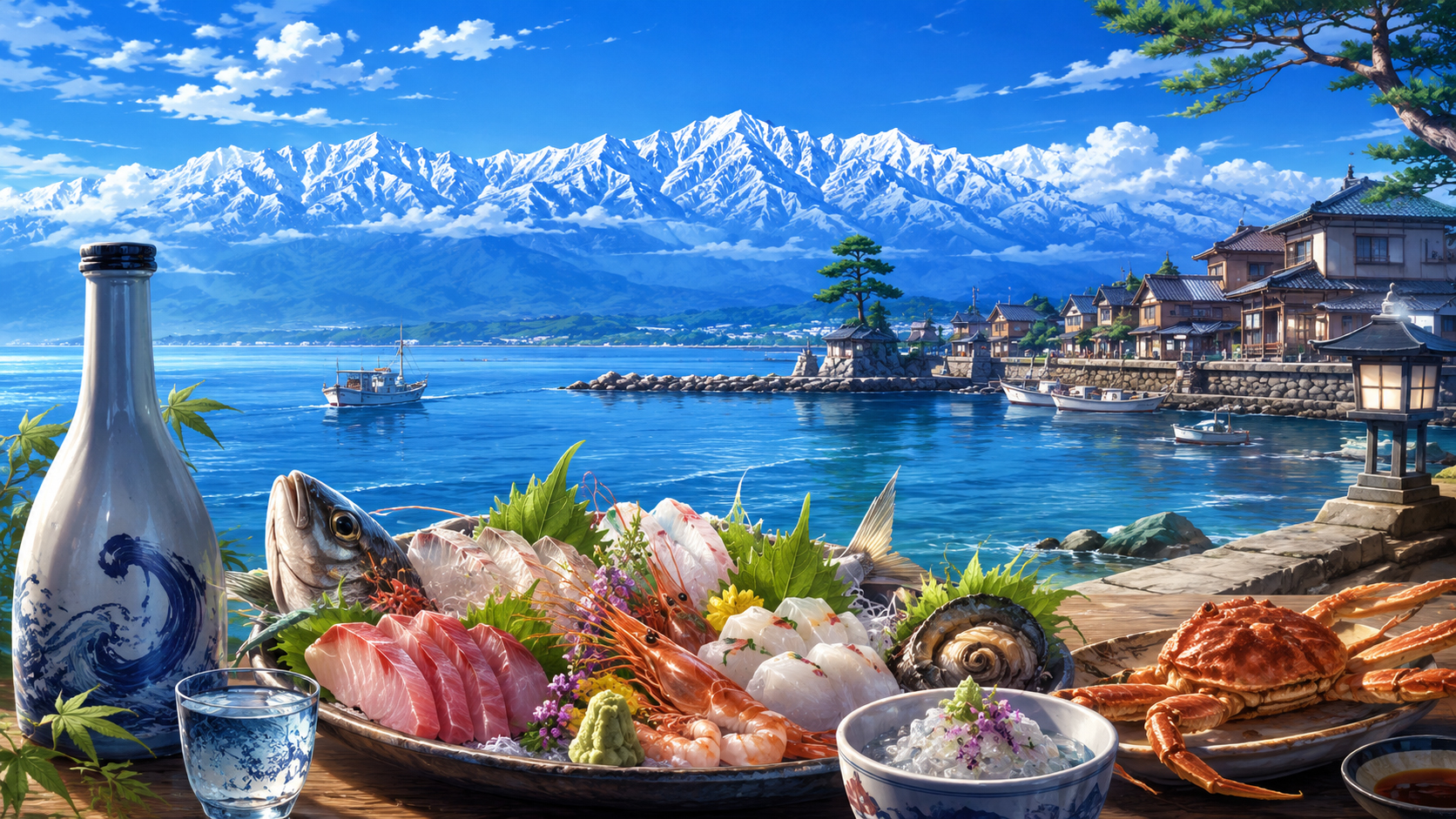
If Pacific beaches are sunglasses, Toyama Bay is a cold glass of sake
The Sea of Japan has a different beach personality. It does not always shout “summer resort” in neon letters. It can be deep, quiet, moody and adult. Toyama is especially that way. Across the water, the Tateyama mountains rise like someone accidentally placed the Alps behind a fishing bay. The seafood behaves as if it went to finishing school. The port town has sake. By evening, the phrase “just one more place” becomes a dangerous regional dialect.
This bonus story fills the missing Sea of Japan slot in the Saturday beach edition. The focus is Toyama: not tropical Okinawa, not crowded Shonan, not a sandal-based social hierarchy. Toyama is where sea, mountains, sushi, sake, trams and old port streets sit almost suspiciously close together. You can look at the bay, ride a canal boat, walk Iwase, eat white shrimp, taste local sake and wake up the next morning with a sincere desire to move here and become “a person who understands buri.”
Toyama Bay opens to the Sea of Japan, but its backdrop is the Tateyama Mountain Range. That is the trick. The coast gives you water; the horizon gives you snow peaks; the table gives you fish. At Amaharashi Coast, Onnaiwa Rock, pine trees, white sand and the 3,000-meter mountains can appear in one view. Cameras become emotional. Travelers become quiet. Even the phone battery seems to understand the assignment.
Amaharashi Coast: mountains beyond the sea
Amaharashi Coast is the essential Toyama seaside view. The official Visit Toyama site describes its view of Toyama Bay against the snowy Tateyama mountains as unforgettable, with Onnaiwa Rock in the foreground and mountains around 3,000 meters high in the distance. It also notes that the coast has been celebrated by poets and writers since the eighth century. In other words, this place has been ruining people’s ability to speak normally for a very long time.
The address is Ota Amaharashi, Takaoka City, Toyama Prefecture. It is about a five-minute walk from Amaharashi Station on the JR Himi Line. By car, use the parking around Roadside Station Amaharashi. In summer, people come for the beach and shallows; in winter and spring, photographers chase the clearest mountain views. Toyama is helpful that way: even bad timing can become an excuse to return.
On many Pacific beaches, the horizon is the main event. In Toyama, the horizon has mountains. The sea gives you fish. The mountains give you snow. Your brain tries to file the experience under “beach” and quickly gives up. This is correct.
Iwase: the port town where sake and food brought the streets back to life
North of Toyama Station is Iwase, an old port town connected with the Kitamaebune maritime trade. It still has historic merchant-town atmosphere, sake, craft, quiet streets and the smell of the sea. Toyama City’s official tourism site says you can take the Toyama Port Line from Toyama Station toward Iwasehama, get off around Higashi-Iwase, and walk into the district. If you plan to drink sake, the tram is not only transportation. It is moral infrastructure.
One key name in Iwase is Masuda Sake Brewery, maker of Masuizumi. Toyama City tourism lists the brewery at 269 Higashiiwasemachi, Toyama City, phone 076-437-9916, with shop hours from 9:00 to 16:00 and closure on Saturdays, Sundays and holidays. Masuizumi is deeply tied to the area, and Toyama’s seafood gives it excellent company: white shrimp, firefly squid, yellowtail, shellfish, kelp-cured fish. The fish is so serious that even the sake sits up straighter.
Iwase has also drawn chefs and craftspeople, making it one of the most interesting small food-and-sake districts on the Sea of Japan coast. The trick is to treat it not as a staged tourist set, but as a living town. Walk softly. Reserve ahead. Eat well. Lower your voice and raise your expectations.
Fugan Canal and Kansui Park: Toyama’s watery front door
Toyama’s water story is not only the sea. Fugan Canal Kansui Park is about a nine-minute walk from Toyama Station, with lawns, water, the Tenmon Bridge, cafés and waterfront views. Toyama City tourism describes it as a place to fall in love with the scenery during your journey. When the tourism board says “fall in love,” we are legally permitted to become sentimental.
From Kansui Park, the Fugan Suijo Line offers a canal cruise toward the port town of Iwase. Visit Toyama says the cruise takes about an hour from Kansui Park to Iwase, passing through Nakajima Lock, a Panama Canal-style lock completed in 1934 that raises or lowers the boat about 2.5 meters. It is a water elevator. Unlike office elevators, no one inside is pretending not to look at anyone.
This route makes Toyama unusually easy to enjoy without a car: Toyama Station, Kansui Park, canal cruise, Iwase, Toyama Bay, then back for seafood and sake near the station. It is elegant, relaxed and dangerous mainly to your dinner budget.
Toyama Bay seafood: the sea as a luxury fish department
Toyama Bay is often called a “natural fish tank.” Official Toyama tourism material says it is home to more than 500 of the roughly 800 species living in the Sea of Japan. The bay’s depth, currents and mountain-fed rivers create a seafood environment that locals discuss with the calm confidence of people who know their dinner has better credentials than yours.
Look for white shrimp, firefly squid, winter yellowtail, whelks, snow crab, kelp-cured fish and Toyama Bay sushi. White shrimp is called the jewel of Toyama Bay; firefly squid glows in spring; yellowtail becomes rich in winter. But once the food arrives, poetry usually pauses. Chewing is more urgent.
If you are arriving by train, you can begin quickly. Shiroebitei is inside Kitokito Market Toya Marche on the first floor of JR Toyama Station at 1-220 Meirincho, Toyama City, phone 076-433-0355. Kaiten Toyama Sushi Toyama Station Main Branch is at 1-4-9 Sakuramachi, Toyama City, phone 076-431-5448. This means you can get off a train and be eating white shrimp or sushi within minutes. Some destinations provide sightseeing. Toyama provides emergency seafood response.
Where to stay, eat, drink and have fun
Toyama is easiest when you use the station area as a base. From there you can reach Kansui Park, Iwase, the Himi Line toward Amaharashi, the tram network, restaurants and bars. For a quieter art-and-onsen retreat, River Retreat Garaku sits away from the bay but belongs to the larger Toyama water-and-mountain story.
- DoubleTree by Hilton Toyama
Address: 1-1-10 Shintomi-cho, Toyama City
Phone: 076-403-9700
Website: https://doubletree-toyama.hiltonjapan.co.jp/
About a three-minute walk from Toyama Station South Exit. Good for travelers who want to drop bags and proceed immediately to fish. - Toyama Excel Hotel Tokyu
Address: 1-2-3 Shintomi-cho, Toyama City, Toyama 930-0002
Phone: +81-76-441-0109
Website: https://www.tokyuhotels.co.jp/en/toyama-e/index.html
Station-side convenience with easy access to trains, trams, restaurants and your next regrettably excellent meal. - ANA Crowne Plaza Hotel Toyama
Address: 2-3 Otemachi, Toyama City
Phone: 0570-04-1080
Website: https://www.anacrowneplaza-toyama.jp/
A central landmark hotel overlooking the Toyama Castle Park area. Good for travelers mixing city walks, museums and evening dining. - River Retreat GARAKU
Address: 56-2 Kasuga, Toyama City, Toyama 939-2224 Japan
Phone: +81-76-467-5550
Website: https://www.garaku.co.jp/english/
An artful riverside retreat with onsen and architecture. Not on the bay, but very much in the deeper Toyama water-and-mountain mood.
- Shiroebitei
Address: Kitokito Market “Toya Marche,” 1F JR Toyama Station, 1-220 Meirincho, Toyama City
Phone: 076-433-0355
Website: https://www.shiroebiya.co.jp/
The white-shrimp bowl stop. You can begin your Toyama trip before your suitcase has emotionally arrived. - Kaiten Toyama Sushi Toyama Station Main Branch
Address: 1-4-9 Sakuramachi, Toyama City
Phone: 076-431-5448
Website: https://r720200.gorp.jp/
Useful, central and serious about local sushi. A conveyor-sushi face with a very Toyama heart. - Local Fish & Local Sake Uokiyo
Address: 1F Ekimae Plaza Building, 1-3-9 Shintomi-cho, Toyama City
Phone: 076-432-8811
Website: https://tabelog.com/toyama/A1601/A160101/16006625/
A station-area izakaya for Toyama fish and local sake. The name is basically the itinerary. - Japanese Restaurant GEJO
Address: 180 Higashiiwasemachi, Toyama City
Phone: 076-471-8522
Website: https://gejo.jp/
A reservation-only counter in Iwase for a special seafood-driven meal. Book ahead and behave like someone worthy of excellent fish. - Oryouri Fujii
Address: 93 Higashiiwase-cho, Toyama City
Phone: 076-471-5555
Website: https://www.oryouri-fujii.jp/
A refined Toyama restaurant focused on the region’s sea and mountain bounty. Not a flip-flop dinner.
- Masuda Sake Brewery
Address: 269 Higashiiwasemachi, Toyama City
Phone: 076-437-9916
Website: https://www.masuizumi.co.jp/
Maker of Masuizumi. Alcohol is for adults 20 and over in Japan; drink moderately, especially if you still need to understand train schedules. - Shaseki
Address: 93 Iwase Omachi, Toyama City
Phone: 080-2962-6683
Website: https://www.masuizumi.co.jp/
A tasting space connected with Masuda Sake Brewery. Think of it as tuning the palate before dinner gets serious. - Bar de Mitomi
Address: MAROOT 1F, 1-231 Meirin-cho, Toyama City
Phone: 076-482-4799
Website: https://mitomi-toyama.com/
A Toyama Station sake bar. Very useful for arrivals, departures and that dangerous hour when the train is later than your curiosity.
- Amaharashi Coast
Address: Ota Amaharashi, Takaoka City, Toyama Prefecture
Phone: 0766-20-1547, Takaoka City Tourism Association
Website: https://visit-toyama-japan.com/en/places-to-go/21011
The signature mountain-over-sea view. Go on a clear day, but do not blame the mountains if they are shy. - Fugan Canal Kansui Park
Address: Minatoirifune-cho, Toyama City
Website: https://www.toyamashi-kankoukyoukai.jp/en/spot/kansuipark/
A station-side waterfront park for walking, coffee, canal views and evening lights. - Fugan Suijo Line
Address: Toyama City area
Phone: 076-482-4116
Website: https://visit-toyama-japan.com/en/things-to-do/80043
A canal cruise connecting Kansui Park and Iwase. A slower way to arrive, which is often the correct way. - Iwase Townscape
Address: Higashi-Iwase-machi area, Toyama City
Website: https://www.toyamashi-kankoukyoukai.jp/en/spot/iwasenomachimami/
An old port district of sake, food, craft and quiet streets. Walk softly. Eat confidently.

A good two-day Toyama Bay plan
Day one: arrive at Toyama Station, drop your bags, eat early at Shiroebitei or Kaiten Toyama Sushi, then walk to Kansui Park. If the season and schedule work, take the Fugan Suijo Line toward Iwase. Walk the old port streets, visit Masuda Sake Brewery or Shaseki if open, then return for station-area fish and sake at Uokiyo, or go all-in with a reserved dinner in Iwase. If you say “Toyama is underrated” three times, do not worry. This is normal.
Day two: take the JR Himi Line to Amaharashi Coast. If the mountains are visible, you may become briefly insufferable on social media. If they are not visible, be gracious. Mountains have office hours too. Afterward, continue toward Takaoka or Himi, or return to Toyama Station for one final sushi punctuation mark before departure.
Toyama’s sea is quiet but strong
Toyama is not only a beach resort. If you want pure swimming, Japan has many louder candidates. Toyama offers something richer: a coast with mountains beyond it, a port town with history, a sake district, a bay full of fish, a canal route, station-area bars and enough seafood to make lunch feel like a civic duty.
Okinawa seduces with color. Shonan seduces with crowds. Toyama seduces with fish, sake and mountains. It may seem understated at first. Then you stand at Amaharashi, walk Iwase, eat Toyama Bay sushi and stop talking. Not because there is nothing to say. Because the next piece has arrived.
The Sea of Japan summer is not only for swimming. It is for looking at the water, walking old ports, drinking a little sake, eating serious fish and watching mountains rise beyond the bay. Toyama translates the beach into something more adult — occasionally in the form of a white-shrimp rice bowl.
Sources and references
This feature is based on public information from Visit Toyama, Toyama City Tourism Association, JNTO and direct hotel, brewery and restaurant sources.