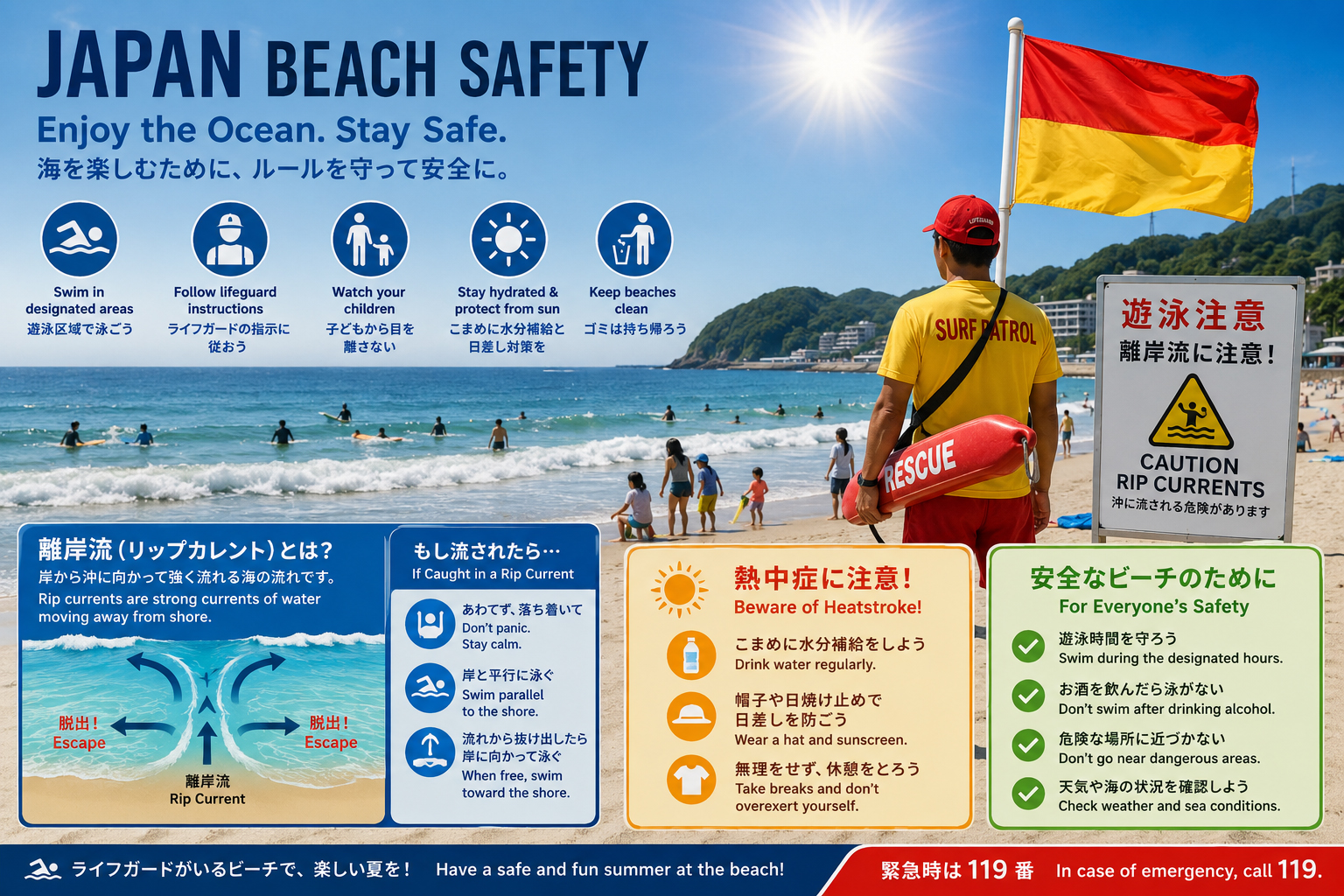
The sea is fun. The sea has not read your itinerary.
A Japanese summer beach can look wonderfully harmless: blue water, shaved ice, yakisoba, umbrellas, inflatable rings, and at least one hat clearly purchased for photographs rather than shade. But the ocean is not a brochure. It has currents. It has wind. It has waves. It has brutal sun. It has jellyfish. And jellyfish, regrettably, do not care that this is your vacation.
This is not a story designed to scare people away from the beach. Quite the opposite. It is a guide for having more fun by avoiding the dumb ways to ruin the day. Japan’s official swimming beaches often have marked swimming zones, lifeguards, first-aid posts, beach houses, showers, flags, announcements, and sometimes jellyfish prevention nets. These things are not decorative. They are the beach’s operating manual.
Knowing safety does not make the beach less joyful. It makes it more joyful. Understand rip currents and you will think twice before swimming too far out. Respect heatstroke and you will become friends with water, salt, shade and rest. Understand jellyfish season and you will choose netted, supervised beaches. Respect typhoon swell and you will know when the correct beach activity is “look at the water while eating ice cream.” That still counts. Emotionally, you swam.
A Japanese swimming beach is not just any stretch of sand
In Japan, many beaches officially open for swimming during a defined summer season. Around umi-biraki, or beach-opening season, local governments and operators prepare water checks, lifeguard systems, first-aid posts, toilets, showers, beach houses and marked swimming zones. A beach that is open for swimming is not the same as a random place where water happens to meet sand.
The Japan Coast Guard’s Water Safety Guide warns that beaches outside officially opened swimming areas may lack lifeguards and safety patrols, protective nets, and marked swimming zones. That means no easy separation from watercraft, no obvious supervised zone and fewer people prepared to help if something goes wrong. The sand may look free and relaxed. The risk profile is not.
For travelers, the practical rule is simple: choose an officially opened swimming beach, look for the flags and signs, and follow the lifeguards. Visit Okinawa’s official safety guidance tells visitors to swim only in designated areas and follow lifeguard instructions, noting that tides, strong currents, undercurrents and venomous marine life can make prohibited or unsupervised areas dangerous. In short: if the local beach system says “not here,” believe it. The ocean has more experience than your vacation brain.
Rip currents: the ocean’s sneaky offshore conveyor belt
A rip current is a strong, narrow flow of water moving away from shore. Waves push water toward the beach; that water has to return seaward somewhere. When it channels into a concentrated flow, it can carry swimmers offshore. The tricky part is that rip currents can be hard to see. Sometimes the dangerous path looks calmer than the breaking waves around it. The ocean is occasionally a very subtle villain.
If you are caught in a rip current, do not try to sprint-swim straight back against it. That wastes energy. The usual advice is to stay calm, float, call or signal for help, and swim parallel to the shore to escape the current before heading back in. This is easy to say while sitting at a desk and harder to do when the beach suddenly feels farther away. That is exactly why swimming near lifeguards matters.
Technology may help in the future. The NTIRE 2026 Rip Current Detection and Segmentation Challenge Report, published in April 2026, focused on automatic understanding of rip currents in images. It described a dataset with material from more than ten countries, multiple camera orientations and varied beach and sea conditions, and reported 159 registered participants with nine valid test submissions. That is exciting: cameras and AI may eventually support beach monitoring. But right now, the flag, the lifeguard, the weather and your own judgment remain the boss. AI is not personally assigned to your floatie.
Heatstroke: the beach is a beautiful hot plate
On a Japanese summer beach, the most dangerous part of the day may not be the water. It may be the sand, the humidity, the reflected sunlight, the train ride, the car traffic, the queue for showers, the lack of sleep, the beer, and the heroic decision to “just push through.” Please do not push through August. August pushes back.
The countermeasures are boring because they work: drink water regularly, replace salt, rest in shade, wear a hat, use sunscreen, watch children and older travelers closely, avoid the hottest hours, and do not swim after alcohol. This is not anti-fun. It is a strategy for still being fun at 4 p.m.
Many day trips to Japanese beaches begin in a big city. By the time visitors arrive, they may already be tired, warm and dehydrated. Then comes the sand, the sun and the sea. Pack water, a towel, a hat, sunscreen, light food and a plan for shade. A little preparation can turn a survival test into a Saturday.
Jellyfish, typhoon swell and the courage to just watch
Jellyfish risk varies by region and season. In Okinawa, venomous marine life is one reason to use designated swimming areas and beaches with jellyfish prevention nets. Visit Okinawa’s beach information pages list facilities by beach, including jellyfish nets, lifeguards, toilets and showers. Those icons are not trivia. They are your beach decision tree.
In parts of mainland Japan, people often warn that jellyfish become more common around Obon in mid-August. Not every jellyfish is dangerous, but getting stung is a poor travel memory. Do not touch jellyfish, including those washed ashore. If stung, leave the water and ask lifeguards or facility staff for help. Do not invent beach medicine from half-remembered internet lore. The lifeguard has probably heard all of it and would like you to stop.
Typhoon swell is another summer issue. A typhoon does not have to be directly overhead to send dangerous swell toward the coast. The sky can be blue while the sea is not safe. If the waves are high, flags say no swimming, or lifeguards tell people to stay out, that is not a suggestion for dramatic people. It is the beach giving instructions. Some days the right answer is to sit, eat something cold, and admire the ocean from a respectful distance.
- Confirm that the beach is officially open for swimming.
- Check lifeguard hours and marked swimming zones.
- Follow flags, signs, announcements and lifeguard instructions.
- If caught in a rip current, do not fight straight back to shore; float, signal for help and swim parallel to shore to escape the flow.
- Do not swim after alcohol. The ocean is unimpressed by tipsy confidence.
- Use water, salt, shade and rest as a heatstroke prevention team.
- Check for jellyfish nets and dangerous marine life information.
- Stay out during typhoon swell, high waves or swimming bans.
Real places to stay and eat for safer beach planning
Good beach safety is partly about where you base yourself. A hotel close to the beach lets you rest, shower, hydrate and retreat when the heat gets too serious. A meal plan keeps people from making poor decisions while hungry, sunburned and emotionally attached to a vending machine. Details change by season, so check official sites before going.
Address: 2260 Seragaki, Onna-son, Kunigami-gun, Okinawa 904-0493 Japan
Phone: +81-98-966-1211
Website: https://www.anaintercontinental-manza.jp/en/
A large Okinawa west-coast resort where travelers can more easily check designated swimming, marine activities and resort safety systems before entering the water.
Address: 1547-1 Shirahama, Shimoda-shi, Shizuoka 415-8525 Japan
Phone: +81-558-22-2111
Website: https://www.princehotels.com/shimoda/
A beachfront Izu base overlooking Shirahama. Good for watching waves, checking conditions and remembering that “not today” can be a wise beach plan.
Address: 1-2-18 Shichirigahama-higashi, Kamakura, Kanagawa 248-0025 Japan
Phone: +81-467-32-1111
Website: https://www.seibuprince.com/kamakura-prince-hotel
A Shonan-area sea-view base near Kamakura and Enoshima. Excellent for beach access, coastal walks and becoming philosophical about Mt. Fuji silhouettes.
Address: 2428 Shirahama-cho, Nishimuro-gun, Wakayama 649-2211 Japan
Phone: +81-739-43-2600
Website: https://www.marriott.com/en-us/hotels/osana-nanki-shirahama-marriott-hotel/overview/
A convenient Shirahama base near the famous white-sand beach, with onsen and hotel facilities that make rest breaks much easier.
Address: 2097 Nakadomari, Onna, Kunigami-gun, Okinawa 904-0415 Japan
Phone: +81-98-965-0870
Reference site: https://gurunavi.com/en/f397300/rst/
A seafood restaurant in Okinawa’s resort zone. After swimming, eating fish is the peaceful version of interacting with the sea.
Address: 1-1-23 Higashihongo, Shimoda-shi, Shizuoka 415-0035 Japan
Phone: +81-558-23-7200
Website: https://1930.bz/en/osyokuji_en.html
A Shimoda seafood stop known for local fish such as kinmedai. Convenient after the beach, when the body demands protein and the soul demands rice.
Address: 2521 Katata, Shirahama-cho, Nishimuro-gun, Wakayama 649-2201 Japan
Phone: +81-739-42-1010
Website: http://www.toretore.info/
A large seafood market in Shirahama. Even on a no-swim day, your stomach can still go to the ocean.

Safety does not ruin summer
Beach-safety advice can sound like someone poured cold water on the party. But safety is not the enemy of fun. Safety is what lets the fun survive the afternoon. Read the flags. Ask lifeguards. Watch the kids. Drink water. Respect jellyfish. Do not argue with typhoon swell. The ocean has been practicing for a very long time.
Japan’s beaches vary wildly: Okinawa’s coral water, Izu’s clear surf, Shonan’s urban energy, Shirahama’s white sand, Setouchi’s calm islands. Each place has different conditions, but one rule travels well: never treat the ocean as scenery only. It is beautiful, but it is not furniture.
The best beach day is not the one where everyone acts fearless. It is the one where everyone comes home laughing, tired, salty, sun-protected and secretly proud of having made good decisions. Summer is short. Do not spend it being rescued from your own confidence.
Sources and references
This feature is based on public information from the Japan Coast Guard Water Safety Guide, Visit Okinawa, JNTO, Japan-guide, the NTIRE 2026 Rip Current Detection and Segmentation Challenge Report, and official/direct hotel and restaurant sources.