One door is closed; the online door remains open
At 10:30 a.m. on Marine Day, the Media Hall at Tokyo International Exchange Center is scheduled to darken for a film about children who refused to treat plastic pollution as an adult problem. The in-person seats have already filled. ACCU’s current event notice, however, still offers free registration for the online morning program—the last public route into a forum whose afternoon workshop is deliberately small.
The distinction matters. The event is not a general walk-in festival and the webcast is not an unrestricted public video page. Registration is required. ACCU’s implementation guide listed July 13 as the deadline for full-day applicants, while the updated organizer page says the venue allocation is full and online applications for the morning film program continue. Readers should use the organizer’s live form and treat whatever status it displays as final.
The official title is “Connect to the Future of the Sea — Sustaining Our Oceans Marine Day Event 2026.” It runs from 10:30 a.m. to 4:00 p.m. at the International Research Exchange University Village’s Tokyo International Exchange Center, 2-2-1 Aomi, Koto Ward. Morning capacity was set at 100 in the hall and 100 online; the afternoon workshop was designed for about 30 middle- and high-school students and educators.
The confirmed program
| Time | Program | Who can still join? |
|---|---|---|
| 10:00–10:30 | Venue reception and online connection. | Only registered participants. |
| 10:30–10:40 | Opening and explanation of the event. | Part of the online morning program. |
| 10:40–11:55 | Microplastic Madness, shown as Microplastic Story: Our 2050 in the Japanese-dubbed edition. | Venue full. ACCU says online-only applications remain available. |
| 11:55–12:30 | Roundtable on moving from thought to action, moderated by Tokai University professor Yutaka Iwamoto. | Included in the published morning schedule; registration required. |
| 12:30–13:30 | Lunch break. | No public program. |
| 13:30–16:00 | AR/VR material trial, workshop and discussion for students and educators in fourth-floor conference rooms. | In-person allocation full; no online afternoon session announced. |
Morning participation is broader than the headline suggests: the flyer says anyone may join, and the implementation guide welcomes people interested in ocean education, conservation and marine biodiversity, especially UNESCO Associated Schools. The afternoon narrows the group to middle- and high-school students, teachers and people prepared to use the material in future classes or workshops. Students attending the full day were required to bring a teacher, guardian or other responsible adult.
A film in which children are investigators
The 75-minute documentary follows fifth-graders at P.S. 15 in Red Hook, Brooklyn, over two years. With the nonprofit Cafeteria Culture, the students investigate plastic pollution, collect data, question experts, speak at City Hall and press for changes that begin in their school cafeteria and spread into the city. Animation explains a material whose convenience in one moment can create an environmental burden lasting far longer than the meal it served.
That story makes a precise opening argument for the Tokyo forum: young people are not decorative “future leaders.” They can produce evidence, identify who has the power to change a system, communicate publicly and test whether an intervention works. The film’s official Japanese site says it has screened in more than 45 countries and been followed by more than 250 discussions. ACCU’s flyer reports selection by 45 film festivals and eight awards.
The Japanese dubbing is itself a youth-participation project. According to the film’s Japanese partner site, 578 children auditioned and 45 were selected as voice performers. Japanese artists, environmental advocates and public figures also contributed. The result does more than translate words: it hands the story’s agency from Brooklyn schoolchildren to young voices heard in Japan.
Cafeteria Culture’s own history explains why the film ends in policy rather than personal purity. Co-director Debby Lee Cohen helped establish the organization’s predecessor after her daughter objected to foam school-lunch trays. The group combined art, student data and advocacy in a campaign that helped remove those trays from New York City schools and other cities. Co-director Atsuko Satake Quirk, a Japanese filmmaker and environmental educator based in New York, joined media production to classroom practice. Their method is the forum’s method: observation, evidence, expression, coalition and institutional change.
The roundtable widens the definition of action
Professor Yutaka Iwamoto of Tokai University’s Department of Human Development will moderate the post-film discussion. His university profile places his work at the intersection of environmental education, Education for Sustainable Development, ethical consumption and the teaching of inquiry. That background should keep the conversation from collapsing into a list of guilt-driven household tips.
The other announced speakers embody different routes from concern to practice. Naomi Arimoto, founder of Plumeria Nail, collects and reworks marine plastic into “sea-litter nails” and accessories while linking environmental work to disability inclusion and employment. Nami Urano of FabCafe Kyoto develops cross-disciplinary communities and projects around the uncontrolled complexity of nature. A student from Shizuoka Prefectural Suruga Sogo High School brings the view of someone who has already tested the project’s Japanese-language materials.
The flyer’s theme is a future in which everyone thinks and acts. That phrasing matters because the panel is not composed only of marine scientists. It joins educational research, waste transformed through design, community-building and student experience. Biodiversity loss is a scientific fact, but responding to it also demands accessible work, persuasive objects, shared places, curriculum design and the confidence to speak.
The afternoon is also a curriculum laboratory
The afternoon workshop is not simply a chance to try a headset. ACCU is developing materials for use in Japanese schools and social-education settings. Participants will experience the pilot edition, discuss how it could fit lessons and inquiry projects, and propose actions they can take now. In other words, the learners are also evaluators of the learning system.
That process began before Marine Day. On March 27, six students and teachers at Jissen Joshi Gakuen trialed UNESCO’s “DIVING LIBRARY” and “OCEAN CHALLENGE” AR/VR content and discussed clarity and classroom use. On May 26, twelve students at Suruga Sogo High School became “one-day researchers” for the first trial after completion of the Japanese-language version. ACCU reported that the translation deepened comprehension and produced more specific feedback about usability.
The Suruga student on the morning panel therefore represents more than a school name. The student carries evidence from the prototype cycle into the public conversation. The afternoon participants continue that cycle: use the material, identify where it confuses or persuades, and imagine where it belongs in real teaching. This is participatory design applied to ocean literacy.
What “microplastic” means—and why biodiversity belongs beside waste
Microplastics are generally defined as plastic pieces smaller than five millimeters. Some are manufactured small; others form as larger items weather and fragment. Small size does not make them disappear. It makes particles harder to retrieve and available to a wider range of organisms and environments.
The harm also changes with scale. Large debris can entangle turtles, seabirds and marine mammals or be mistaken for food. Smaller plastic can be ingested and enter food webs. Lost fishing gear can continue catching animals. Floating litter can transport organisms, while plastic trapped on reefs adds stress to habitats already affected by warming, disease and coastal pressure. UNEP says more than 11 million metric tons of plastic enter the ocean each year and identifies entanglement, ingestion and food-chain disruption among the consequences.
This is why the ACCU program pairs marine litter with biodiversity rather than treating “trash” as a question of beach appearance. Under the Kunming–Montreal Global Biodiversity Framework, Target 7 calls for pollution risks and impacts to fall to levels not harmful to biodiversity by 2030 and specifically includes preventing, reducing and working toward eliminating plastic pollution. A bottle discarded on land, a synthetic fiber released in washing and a fragment on a tidal shore belong to one sources-to-sea system.
UNESCO’s definition of ocean literacy makes the connection reciprocal: understand the ocean’s influence on people and people’s influence on the ocean. Rivers and watersheds carry sediments, nutrients and pollutants toward estuaries and coasts. A Tokyo student does not need to live beside a coral reef to have a relationship with it; consumption, drainage, energy, logistics and policy make inland and urban life part of the sea.
Japan moved from cleaning beaches toward preventing leakage
Japan’s modern marine-litter policy developed in layers. The 2009 coastal-drift-waste law created a national framework for dealing with material washed ashore and supporting local collection and prevention. A 2018 revision explicitly strengthened attention to plastic waste and microplastics. In May 2019, the government adopted both a Plastic Resource Circulation Strategy and a Marine Plastic Litter Action Plan.
At the G20 Osaka Summit the following month, leaders shared the Osaka Blue Ocean Vision: reduce additional pollution from marine plastic litter to zero by 2050. Japan later joined the G7 Hiroshima commitment expressing the ambition to bring that date forward to 2040. The Plastic Resource Circulation Act, effective April 1, 2022, widened policy beyond disposal to product design, reduced use, collection and recycling across the life cycle.
A school cleanup still has value: it removes material, reveals local sources and creates data. But the policy history shows why cleanup alone is not a complete answer. Prevention can require a cafeteria purchasing rule, a reuse system, product redesign, better collection, fishing-gear management or regulation. The Brooklyn students’ move from litter to lunch-tray policy is therefore not an American side story; it is a compact lesson in the life-cycle approach Japan says it is pursuing.
From four biosphere reserves to a Tokyo classroom
“Sustaining Our Oceans” began in 2024 with support from Fast Retailing and leadership from UNESCO’s Bangkok office. It connects young people and educators in Japan, Indonesia, Thailand and Vietnam. In Southeast Asia, the work centers on four UNESCO biosphere reserves: Wakatobi in Indonesia, Ranong in Thailand, and Can Gio Mangrove and Cu Lao Cham–Hoi An in Vietnam. Biosphere reserves serve as “living laboratories” where conservation, livelihoods and learning meet.
Japan’s role is not merely to export a finished lesson. A November 2024 study visit brought educators and conservation officials from Southeast Asia to Itoigawa, Niigata, where they met fishers, students, geopark staff and researchers. Participants studied warming seas, fisheries, full-use food production and microplastic sampling on a beach. The exchange then returned to local education packages for the four reserves.
The project surfaced publicly on Marine Day 2025 at the UN Pavilion of the Osaka–Kansai Expo. Thirty-three middle- and high-school students from UNESCO Associated Schools tried an educational game and questioned filmmaker and UNESCO Goodwill Ambassador Naomi Kawase, Minato Lab founder Yasuhiro Taguchi, university student Natsufune Nakagawa and UNESCO and UNIQLO staff. A week-long Expo exhibition later presented work from all four countries, and an October forum in Okayama connected international exchange with litter collection and a visit to Teshima’s industrial-waste history.
| Date | Step in the project | What carried forward |
|---|---|---|
| 2023–24 | UNESCO–UNIQLO partnership announced; Sustaining Our Oceans begins. | Four-country education centered on UNESCO-designated sites. |
| Nov. 2024 | Itoigawa study visit. | Community fisheries, student enterprise and hands-on microplastic study. |
| July 2025 | Marine Day at Osaka–Kansai Expo. | Thirty-three students test a game and question adult practitioners. |
| Sept.–Oct. 2025 | Expo exhibition and Okayama–Setouchi forum. | International examples meet local waste history and field action. |
| Mar.–May 2026 | Jissen Joshi and Suruga Sogo trials. | Students evaluate AR/VR content and the Japanese localization. |
| July 20, 2026 | Tokyo Marine Day forum. | Film, public discussion and pilot-material workshop converge. |
ACCU’s fifty-five-year path to the forum
The Asia-Pacific Cultural Centre for UNESCO was founded on April 26, 1971. Its early work focused on cultural cooperation, children’s books, publishing and audiovisual materials. Literacy education became a major strand; cultural-heritage protection and teacher and youth exchange followed. Environmental learning did not appear from nowhere in 2026: ACCU’s chronology records environmental learning-package development in 1997, ESD promotion beginning in 2005 and support for Japan’s UNESCO Associated Schools from 2008.
That history explains the forum’s mixture of media, translation and participation. A documentary crosses languages. AR/VR materials connect distant ecosystems to a classroom. Teachers discuss how to use them. Students are not only audiences but translators between an educational product and the reality of school life.
The event also marks Japan’s 75th anniversary as a UNESCO member. Japan joined on July 2, 1951, before the postwar peace treaty took effect; UNESCO was the first UN specialized agency it entered after the war. In 2026, the anniversary has been framed not only around heritage sites but around education, science, culture and the networks that allow a local lesson to travel.
The deeper history: ocean education becomes public policy
UNESCO’s Associated Schools Network began in 1953 as an experiment linking schools in education for life in a world community. Education for Sustainable Development later gave that internationalism an explicit environmental and social task. UNESCO led the UN Decade of ESD from 2005 to 2014; the Global Action Programme followed, and “ESD for 2030” now emphasizes education capable of changing how societies act, not merely what students remember.
Japan embedded a parallel obligation in the 2007 Basic Act on Ocean Policy. Article 28 directs the state to promote ocean-related learning in school and social education so citizens deepen their interest and understanding. The Fourth Basic Plan on Ocean Policy, adopted in 2023, again stresses children and young people, direct contact with the sea and the use of digital technology. ACCU’s forum sits exactly where those lines meet: law, curriculum, international cooperation and an accessible public holiday.
Marine Day itself reaches further back. July 20 commemorated the safe 1876 return to Yokohama of Emperor Meiji aboard the lighthouse tender Meiji Maru. “Marine Memorial Day” was established in 1941; the statutory holiday was enacted in 1995 and first observed in 1996. Since 2003 it has fallen on the third Monday in July. In 2026, calendar and memory coincide: the third Monday is July 20.
The holiday’s legal purpose is to give thanks for the ocean’s benefits and wish for Japan’s prosperity as a maritime nation. The Tokyo forum adds a necessary modern clause. Gratitude without responsibility is incomplete. A nation that receives food, transport, climate regulation and culture from the sea must also understand what flows back into it.
A practical guide for online readers
- Use ACCU’s current event page first. It carries the authoritative “venue full / online morning still open” notice and links to the registration form.
- Do not travel to the venue without confirmation. The Aomi allocation is full; the organizer has not advertised walk-up or cancellation-line entry.
- Register, even for online viewing. The movie is not posted as an unrestricted stream. Connection instructions are tied to the event registration process.
- Plan for the whole morning. The published block runs 10:30 a.m.–12:30 p.m. JST: introduction, film and roundtable.
- Do not expect the afternoon online. The 1:30–4:00 p.m. AR/VR workshop is venue-only and full.
- Recheck the live page. Online capacity was published as 100. Availability can close when that limit is reached.
Questions go to ACCU’s Education Cooperation Department at 03-5577-2852 or the email address published on the official page. Personal details should be entered only through the organizer’s registration form, not sent through social media replies.
What success would look like after the credits
A successful screening is not measured only by whether viewers feel alarmed. It produces a better question. What plastic enters this school? Where is it purchased? Which items are necessary, which are habitual, and who controls the contract? What data can students collect without overstating what it proves? Whose work would a proposed change affect? How will the group know whether it reduced waste rather than moved it elsewhere?
The afternoon materials face the same test. Immersion is not the objective; transfer is. Can a student use the experience to explain how biodiversity, consumption and a watershed connect? Can a teacher fit it into inquiry without turning an uncertain scientific issue into a slogan? Can a class move from a virtual reef to a local drain, river, cafeteria or shoreline?
The forum’s most hopeful idea is also its most demanding: adults have not invited teenagers merely to inherit a damaged ocean later. They are asking them to examine the systems producing damage now—and they are allowing students to critique the very educational tools meant to prepare them.
Primary sources and live access links
- ACCU: “Connect to the Future of the Sea — Sustaining Our Oceans Marine Day Event 2026”: latest capacity notice, venue, audience, free registration and online availability.
- Official implementation guide, revised July 8: capacities, room assignments, schedule, participant conditions and organizers.
- Official event flyer: minute-by-minute morning timetable, film details, speaker roster and afternoon format.
- Official registration form: live status for the remaining online morning allocation.
- Japanese official site for Microplastic Madness: story, educational method, international screenings and discussion history.
- Microplastic Story Ambassadors Japan: Japanese-dub production and youth voice-cast selection.
- Cafeteria Culture film credits and history: directors, classroom work, expert contributors, awards and school-lunch campaign.
- ACCU: Sustaining Our Oceans project: four-country scope, biosphere reserves, Japan secretariat and 2024–26 activities.
- UNESCO: Itoigawa study visit: fisheries, youth projects, geopark learning and microplastic fieldwork.
- ACCU: 2025 Marine Day at Osaka–Kansai Expo: speakers, educational game and 33 student participants.
- ACCU: Okayama–Setouchi ocean-education forum: international exchange, SPOGOMI and Teshima field visit.
- ACCU: Suruga Sogo High School AR/VR trial: twelve student researchers and first Japanese-language pilot.
- ACCU: Jissen Joshi Gakuen AR/VR trial: early classroom feedback on the learning materials.
- Tokai University: Yutaka Iwamoto profile: environmental education, ESD, ethical consumption and inquiry learning.
- Plumeria Nail and Loftwork: Nami Urano: announced panelists’ environmental-design and community practices.
- 3710Lab / Minato Lab: co-organizer’s ocean-education mission and project approach.
- ACCU history: establishment in 1971, environmental materials, ESD and UNESCO-school support.
- MEXT: Japan’s 75th UNESCO membership anniversary and UNESCO country profile: anniversary context and membership since 1951.
- UNESCO: 70 years of the Associated Schools Network and ESD for 2030 Roadmap: the school network’s 1953 origin and the global ESD sequence.
- UNESCO Ocean Literacy and Japan’s Basic Act on Ocean Policy: educational concept and Article 28.
- UNEP: plastic pollution and marine litter and Convention on Biological Diversity: Target 7: global scale, impacts and biodiversity commitment.
- Environment Ministry: Osaka Blue Ocean Vision, Local Blue Ocean Vision programme and Plastic Resource Circulation Act portal: Japan’s 2050/2040 commitments and policy timeline.
- Japan Coast Guard: Marine Day history: Meiji Maru, the holiday’s purpose and the third-Monday rule.
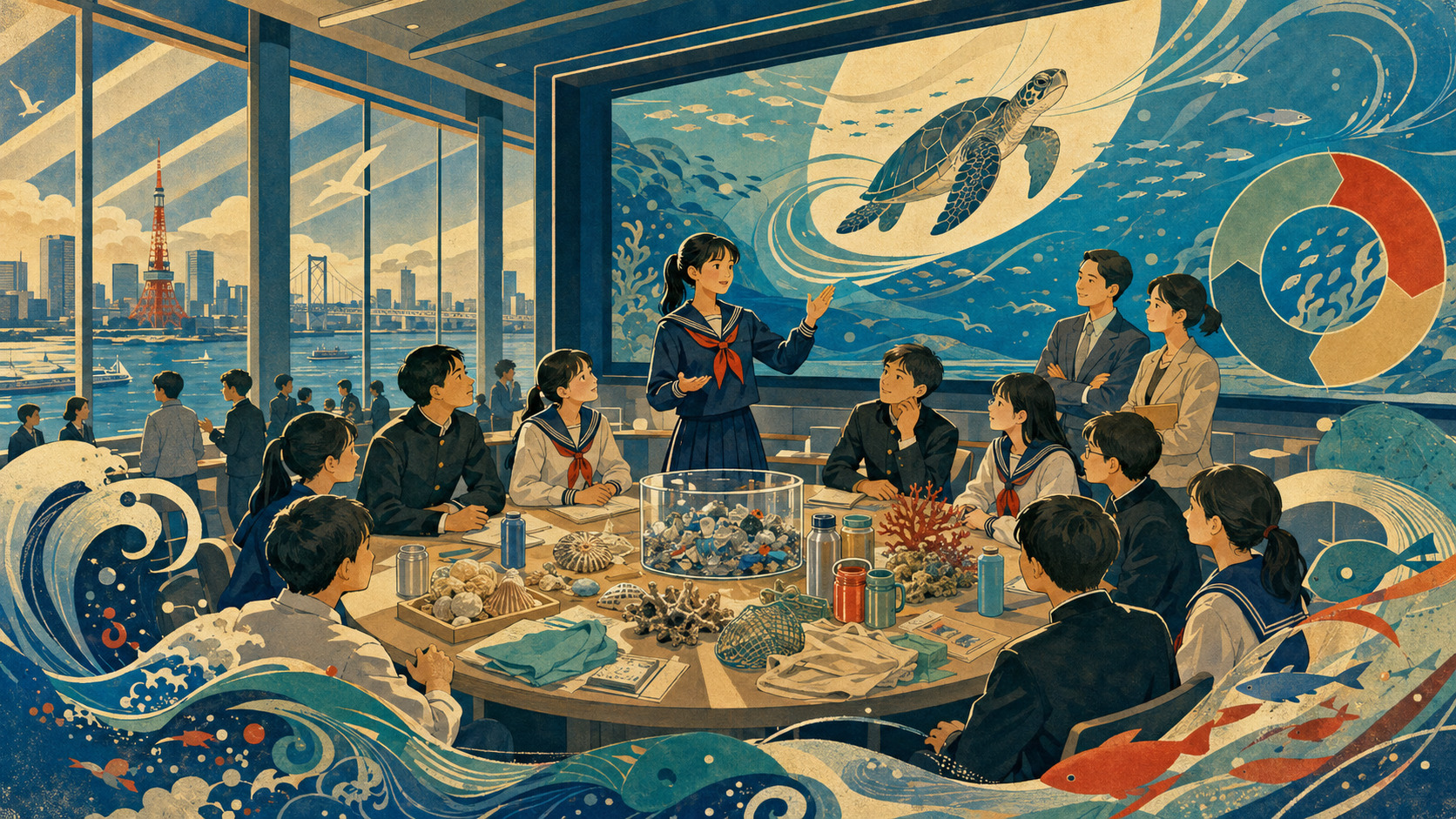
Editor’s note: Reporting and access status were checked at 6:00 a.m. JST on July 18, 2026. This is a pre-event Marine Day edition and does not claim that the July 20 program has already taken place. The publisher should reopen ACCU’s live page before release and update any change to online registration, speakers or streaming instructions. The article does not reproduce the film or imply that it is freely available outside the registered morning program. The hero is editorial art, not an event photograph.