Confirmed—not unrestricted
The national Marine Day register originally described Ishigaki’s program as planned. The local picture is now firmer. Ishigaki City published a dated event page and full poster on July 6, confirming a free two-day Port Festival for Sunday, July 19 and Monday, July 20 at the Euglena Ishigaki Port Remote-Island Terminal, the former remote-island pier and the Coast Guard berth at Hamasaki Marina.
The confirmation does not turn every line on the poster into an open queue. The Japan Coast Guard’s Ishigaki office says the July 19 patrol-vessel cruise has selected participants, that notices were sent by email, and that people who did not apply cannot board. Recruitment for the July 20 patrol-vessel workplace experience also closed July 12. The July 20 yacht sail was advertised as an advance-application lottery for 36 people. Only the terminal’s panel exhibition—and the broader waterfront itself—can safely be described as a general, no-ticket Marine Day visit.
This distinction corrects the shorthand in the headline without discarding its central idea. Ships are being opened to the community, but through small, controlled experiences: a Coast Guard voyage, a workplace tour and two yacht sailings. The public exhibition opens the institutional story to everyone else.
The two-day program, line by line
| Date and program | Published details | Access status at the July 18 edition deadline |
|---|---|---|
| July 19: Port Evening street program | Former remote-island pier. Pedestrian zone, stalls and food trucks 10:00–21:00; shipboard live music 15:00–21:00; fireworks listed without a separate time. | General festival area. Free entry; purchases cost extra. |
| July 19: JCG patrol-vessel experience cruise | 10:00–12:00 from the Coast Guard marina berth; for Ishigaki residents. | Closed. Coast Guard says selected participants were notified and non-applicants cannot board. |
| July 19: small-yacht trial | 10:00–12:00; about 15 minutes; 30 children in grades 3–6, maximum published weight 40 kg; same-day reception from 9:30. | First-come program on July 19. Participants were told to wear clothes that may get wet. |
| July 20: patrol-vessel workplace experience | 10:00–12:00, meet 9:45 at the Hamasaki vessel base. Coast Guard briefing, vessel tour and curry lunch; Ishigaki high-school students and family. | Closed July 12; registered participants only. No parking at the base. |
| July 20: yacht sailing | Departures at noon and 2:00 p.m.; 18 people each; age 10 and above; meet at the terminal’s covered walkway. | Advance application and lottery. Do not assume walk-up vacancies. |
| Both days: panel exhibition | Inside the remote-island terminal: Ishigaki Port, Coast Guard, and Sekisei Lagoon Coral Reef Fund; quizzes and coloring activities advertised for July 20. | General public display. The poster does not publish separate exhibition hours. |
What must be checked on publication morning
Official confirmation is not the same as an operational guarantee. Ishigaki’s harbor program depends on wind, sea state, vessel readiness and summer weather. A patrol ship can be recalled for duty. A sailing organizer can cancel even when a land exhibition continues. Regular island ferries operate independently of the festival and can change their own schedules.
On the morning of July 20, the newsroom and every intending visitor should reopen three live sources: Ishigaki City’s festival page for any general change; the Ishigaki Coast Guard homepage for the workplace program and emergency status; and the event organizer or Yaeyama Yacht Club contact for the two sailings. Absence of a cancellation notice is not permission to join an advance-entry program.
A patrol ship is a workplace, not a festival prop
The official material does not name the patrol vessel assigned to either Coast Guard activity. This article does not infer one from the Ishigaki fleet list. The office operates many named ships and craft, and operational assignments can change. The safe description is the one the organizer uses: a Japan Coast Guard patrol vessel.
The July 20 program is more precise about what participants will do than about the hull. From 10:00 a.m. to noon, local high-school students and their families receive an explanation of Coast Guard work, tour a patrol vessel and share a curry-rice lunch with officers. That last detail turns recruiting into conversation. “Coast Guard curry” is not the substance of the job, but a table can make questions about shift work, training, search and rescue, law enforcement and life aboard easier to ask.
Ishigaki Coast Guard’s public mission statement lists maritime security, safe vessel traffic, marine rescue, prevention of maritime disasters and pollution control. These duties are unusually visible in Yaeyama. High-speed passenger boats cross reefs and channels every day. Diving, snorkeling, fishing, yachts and pleasure craft add seasonal traffic. Typhoons can close the harbor. Reef currents and sudden weather can turn recreation into rescue.
The Coast Guard grew with post-reversion Ishigaki
Ishigaki Coast Guard was established on May 15, 1972—the day Okinawa reverted to Japan—and initially received patrol vessel Chitose. Patrol craft Adan, patrol vessel Yaeyama and lighthouse tender Ayabane followed that year. A communications station began operating in 1973; the office moved in 1985; a navigation-aid center opened in 2005 and a traffic division in 2007.
The chronology also records a major fleet buildup from 2014 through 2016, culminating in what the office calls establishment of the dedicated Senkaku territorial-water patrol system. New patrol vessels named Yaeyama and Hateruma entered service in February 2024. The historical point is not to turn a family festival into a geopolitical display. It is to understand why Ishigaki’s Coast Guard base is large and why access to an operational vessel is controlled.
The July 19 cruise and July 20 workplace tour represent two ways of encountering that institution. One lets residents feel a patrol vessel underway; the other lets teenagers study the occupation. Neither is a general open ship, and neither promises access to every compartment.
From a 2.31-meter dinghy to an island sea
The yacht program introduces a different relationship with water. On July 19, the Ishigaki Sea Cadets and Ishigaki Junior Yacht Club planned approximately fifteen-minute rides for thirty primary-school children. The club’s usual training boat is the Optimist, an internationally recognized introductory dinghy 2.31 meters long and 1.13 meters wide, normally sailed by one child.
A small dinghy removes the distance between decision and consequence. Ease the sheet and the sail changes shape. Shift weight and the hull responds. Look downwind too long and the boat tells you. The junior organization says its aim is not only sport but curiosity, independence, self-protection and practical knowledge of the local sea. Weekend training, beach cleaning and exchanges with young sailors from Taiwan place the boat inside a wider maritime education.
The adult Yaeyama Yacht Club manages the July 20 sailings: two departures, eighteen participants each, open from age ten, by advance application and lottery. A larger yacht adds cooperation. Crew must communicate, watch traffic, read wind against reef-protected water and respect a harbor still carrying scheduled ferries. The passage from a child’s Optimist to a shared yacht is also a passage from individual control to seamanship as a social skill.
The junior club’s own record of the 2024 Port Festival says twenty-five primary-school children tried Optimist sailing and families toured a patrol vessel the next day. The 2026 structure therefore continues a recognizable local formula: learn to control a small boat, then see the professional system that protects people when control is lost.
The most important “ship” in the hall is a reef
Sekisei Lagoon is the body of coral-reef water between Ishigaki and Iriomote islands. Its Japanese name is commonly explained as combining the “Ishi” character from Ishigaki with the “Nishi” character from Iriomote. The Coral Reef Fund describes it as roughly 20 kilometers east to west and 15 kilometers north to south, Japan’s largest coral-reef area. More than 360 species of reef-building coral occur in and around it.
For Ishigaki Port, the reef is not scenery beyond the breakwater. It shapes channels, tourism, fisheries, navigation, waves and the identity of the remote islands the terminal serves. A harbor festival that discussed ships without discussing coral would leave out the physical system in which those ships move.
The two-day terminal display brings together panels on the port, Coast Guard and Sekisei Lagoon Coral Reef Fund. Quizzes and coloring activities are advertised for July 20. That child-friendly form should not obscure the seriousness of the data behind it.
Bleaching is a stress signal; death is the loss that follows
Coral bleaching occurs when heat or other stress disrupts the relationship between coral animals and the microscopic algae that supply much of their energy and color. A bleached colony is not automatically dead. If stressful conditions ease soon enough, it can recover. Prolonged heat raises the risk that bleaching becomes mortality, and dead reef structure is then eroded or overgrown.
Environment Ministry monitoring makes the sequence visible. In September 2024, a major high-temperature event pushed average bleaching across 31 Sekisei Lagoon stations to 84.0 percent. By December, the bleaching measure had eased to 65.5 percent, but average living-coral cover fell from 17.4 to 13.7 percent as some previously bleached colonies died. The agency noted that daily mean water temperature exceeded 30°C on 90 days and reached a maximum of 31.9°C.
The newest nationwide monitoring速報, covering surveys from October 2025 to January 2026, found bleaching at every surveyed site from northern to southern Sekisei Lagoon, with an average bleaching rate of 72 percent. Yet mortality attributed in that survey was 4 percent, far below the previous year’s 32 percent. That is not an all-clear. It means 2025’s visible stress was again widespread, while immediate death was more limited than in the catastrophic prior season.
| Indicator | What it means | Recent Sekisei Lagoon result |
|---|---|---|
| Bleaching rate | Share of previously living coral area classed as pale, fully bleached or killed by bleaching. | 84.0% in September 2024; 65.5% in December 2024; 72% average in 2025 national-site monitoring. |
| Living-coral cover | Share of suitable seabed covered by living coral colonies. | Fell from 17.4% in September to 13.7% in December 2024 across the 31-station natural-restoration survey. |
| Mortality | Colonies recorded dead from bleaching in the survey comparison. | 2025 monitoring reported 4%, compared with 32% the previous year. |
A conservation fund built from a council
The Sekisei Lagoon Natural Restoration Council was established in February 2006 under Japan’s Natural Restoration Promotion Law. The Environment Ministry’s restoration program began that year, following trial monitoring in 2002 and sustained monitoring from 2005. The council created a coral-reef fund in 2008; practical fundraising began in 2009, and donated funds supported projects from fiscal 2010. A nonprofit corporation later took over the fund’s work and assets in 2013.
Early support helped address crown-of-thorns starfish and red-soil runoff. The current organization works across disturbance reduction, habitat improvement, research, monitoring, education and sustainable use. Its recent public activities include high-school snorkeling observation, a “field and sea” coral festival, compost guidance and the Yaeyama Umi-Shima Friendship initiative, which asks businesses and residents to change practices that affect the reef.
The compost work explains why reef conservation reaches far inland. Nutrients and soil do not respect the shoreline. Rain moves them from fields, roads, livestock operations and drains into coastal water. The fund’s phosphorus-reduction effort promotes better circulation of cattle manure through compost rather than allowing excessive nutrients to reach the sea. The coral panel at a port festival is therefore also a land-use panel.
Ishigaki Port: from coal-era call to southern hub
The modern port’s history begins with trade, not tourism. Official city material traces an early steamship call to the discovery of coal on Iriomote in the early Meiji period. A shipping-company office and route were established in 1896. Ishigaki’s first wooden pier arrived in 1924. A 1933 typhoon destroyed it; in 1935 the then-town built a concrete pier capable of receiving vessels up to twenty tons.
The Ryukyu Government designated Ishigaki an important port in 1954. The U.S. Civil Administration conducted a new-port survey in 1958, full construction began in 1960, and a new-port opening ceremony followed in 1963 with the 676-ton Yashio Maru alongside. By 1965, U.S. assistance had produced one 3,000-ton berth, one 1,000-ton berth and three 500-ton berths.
With Okinawa’s reversion in May 1972, Japan designated Ishigaki an Important Port and established the national port office that still develops Ishigaki Port and maintains the Taketomi South Channel. The Coast Guard office dates from the same day. Port building and maritime safety thus entered their current national administrative form together.
The remote-island terminal opened in 2007, consolidating passenger access to boats serving Taketomi, Kohama, Iriomote and other islands. It took the Euglena naming-rights identity in 2018. Ishigaki today is Japan’s southernmost Important Port: large RO-RO ships connect it with Okinawa Island, high-speed boats carry daily island life, and international cruise ships approach from an East Asian maritime neighborhood.
A port plan that says nature and growth must coexist
Ishigaki City’s current port plan sets a mid-2030s target and gives the policy a revealing title: “Connected to the world, coexisting with abundant nature, beautiful Ishigaki Port.” It aims to strengthen logistics, island transport, cruise and large-yacht reception, Coast Guard functions, disaster resilience, decarbonization and environmental coexistence. The planning targets include 1.6 million tons of cargo and 4.45 million passenger boardings.
Those goals can pull against one another. Bigger ships require deeper water, stronger quays and more land-side capacity. More visitors bring income and more pressure. Marina development expands access to the sea while creating new maintenance, waste and anchoring questions. The festival’s four communities—port engineers, Coast Guard officers, sailors and coral conservationists—represent the negotiation the plan itself must make.
A festival with older roots than the 2026 poster
Ishigaki City newsletters document the Port Festival at least as far back as 2005. By 2015, the accompanying Port Evening was in its sixteenth edition. That year’s Marine Day program included yacht sailing, an onboard visit to Superstar Aquarius, fish and mozuku catching for children, and live music on a shipboard stage. The mix of workboat access, sailing, food and local performance is therefore not new.
What changes is the emphasis. The 2024 junior-club report records Optimist trials for twenty-five pupils and a family Coast Guard visit. The 2026 program gives the Coast Guard a cruise on day one and career-focused access on day two, while the reef fund shares equal billing in the terminal display. The festival has become less a collection of attractions than a map of who keeps the local sea usable.
Practical guidance for visitors
- Do not expect a walk-up patrol-vessel visit. Both Coast Guard application windows closed July 12. July 19 cruise participants were selected and notified; the July 20 workplace event is for registered local high-school households.
- Do not expect a walk-up yacht ticket. The noon and 2:00 p.m. July 20 sailings were an advance lottery. Ask the named yacht organizer only if a formal vacancy notice appears.
- Use the exhibition as the general-access core. Port, Coast Guard and coral panels are inside the Euglena remote-island terminal on both days; July 20 adds quizzes and coloring.
- Separate festival activity from regular ferry travel. Island ferries use the same working terminal. Allow extra time, keep gangways clear and follow operator announcements.
- Leave the car if possible. The poster warns of congestion and inadequate parking and recommends walking, bus, taxi or shared rides. The Coast Guard workplace notice explicitly says there is no parking at the base.
- Recheck the morning status. Marine programs can change with weather, sea state or operational need. Verify with the city, Coast Guard and relevant sailing organizer before leaving.
| Question | Official contact | Published number |
|---|---|---|
| Overall festival and panel exhibition | Ishigaki City Port Division / Festival Executive Committee | 0980-82-4046 |
| Coast Guard cruise or workplace experience | Ishigaki Coast Guard Administration Division | 0980-83-0118 |
| July 20 yacht sailing | Yaeyama Yacht Club event representative | 090-1949-0275 |
| July 19 children’s small-yacht trial | Ishigaki Sea Cadets & Junior Yacht Club representative | 090-7986-4595 |
| Port Evening | Minato-dori Association / Anei Kanko | 0980-83-0055 |
What Marine Day means on a reef coast
In Ishigaki, it is impossible to draw a clean line between maritime safety and environmental protection. The Coast Guard rescues people in waters whose currents and shallows are shaped by reefs. Young sailors learn balance inside a living seascape. Port planners build the logistics system on which the remote islands depend, while trying to expand cruise and yacht capacity without degrading the reason many visitors come.
The coral panel is therefore not the quiet indoor option for people who missed a ship place. It may be the festival’s most consequential exhibit. A patrol vessel can respond after danger appears. A healthy reef reduces waves, supports fisheries, sustains tourism and holds biodiversity before an emergency starts. Both are forms of protection; one wears a white hull, the other grows slowly beneath the water.
Principal sources and publication-morning links
- Ishigaki City, official Ishigaki Port Festival 2026 page: July 6 confirmation, dates, venues, free admission, headline programs and contacts.
- Official 2026 festival poster: detailed times, capacities, ages, meeting points, organizers, parking warning and event map.
- Ishigaki Coast Guard homepage: cruise selection notice, no-application/no-boarding warning and closed recruitment status.
- Coast Guard, July 20 workplace-experience notice: 9:45 meeting, briefing, patrol-vessel tour, lunch, eligibility, deadline and no-parking instruction.
- Ishigaki Coast Guard chronology: 1972 establishment, office development, fleet history and dedicated patrol system.
- Ishigaki Coast Guard vessel roster and mission: current named fleet and operational duties.
- Ishigaki Sea Cadets & Ishigaki Junior Yacht Club: educational mission, Optimist dimensions, safety learning and 2024 festival report.
- Sekisei Lagoon Coral Reef Fund: lagoon dimensions, coral diversity, fund mission and current activity reports.
- Ishigaki SDGs Platform, Coral Reef Fund profile: monitoring, education, compost/phosphorus work and Umi-Shima Friendship activities.
- Environment Ministry, December 2024 Sekisei Lagoon bleaching results: 31 stations, 84.0-to-65.5% bleaching change and 17.4-to-13.7% cover decline.
- Environment Ministry, preliminary 2025 Monitoring Sites 1000 results: bleaching at all Sekisei sites, 72% average bleaching and 4% mortality.
- Environment Ministry, Iriomote-Ishigaki National Park management plan: more than 360 reef-building coral species and the area’s ecological significance.
- Ishigaki City, official port-history leaflet: Meiji-era shipping, 1924 pier, postwar construction and post-reversion development.
- Ishigaki City Port Plan: southernmost Important Port role, island routes, policy, environmental coexistence and mid-2030s targets.
- Ishigaki City, 2015 Port Festival report: ship visit, yacht sailing, children’s activities and the 16th Port Evening.
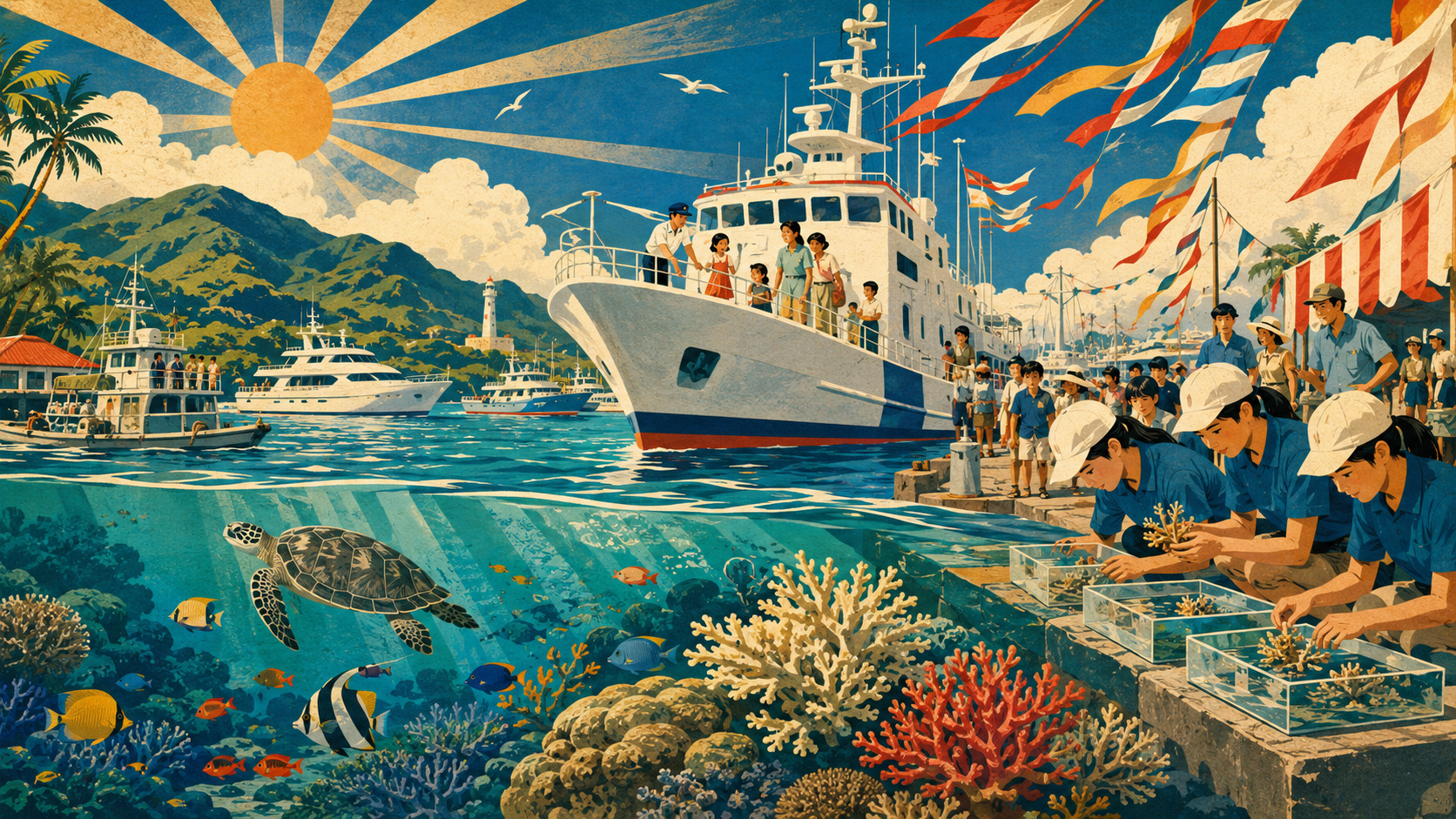
Editor’s note: This article was researched and status-checked on July 18, 2026, Japan time. The city has confirmed the festival, replacing the national guide’s earlier “scheduled” status. This remains a pre-event file: it does not claim that any July 19 or July 20 program occurred. The publication desk must recheck the linked city and Coast Guard pages on July 20 morning and update any cancellation, vessel-assignment or first-day outcome. Coast Guard and yacht access was restricted in advance; do not present either as a walk-up public opening. The hero is an editorial illustration, not a photograph.