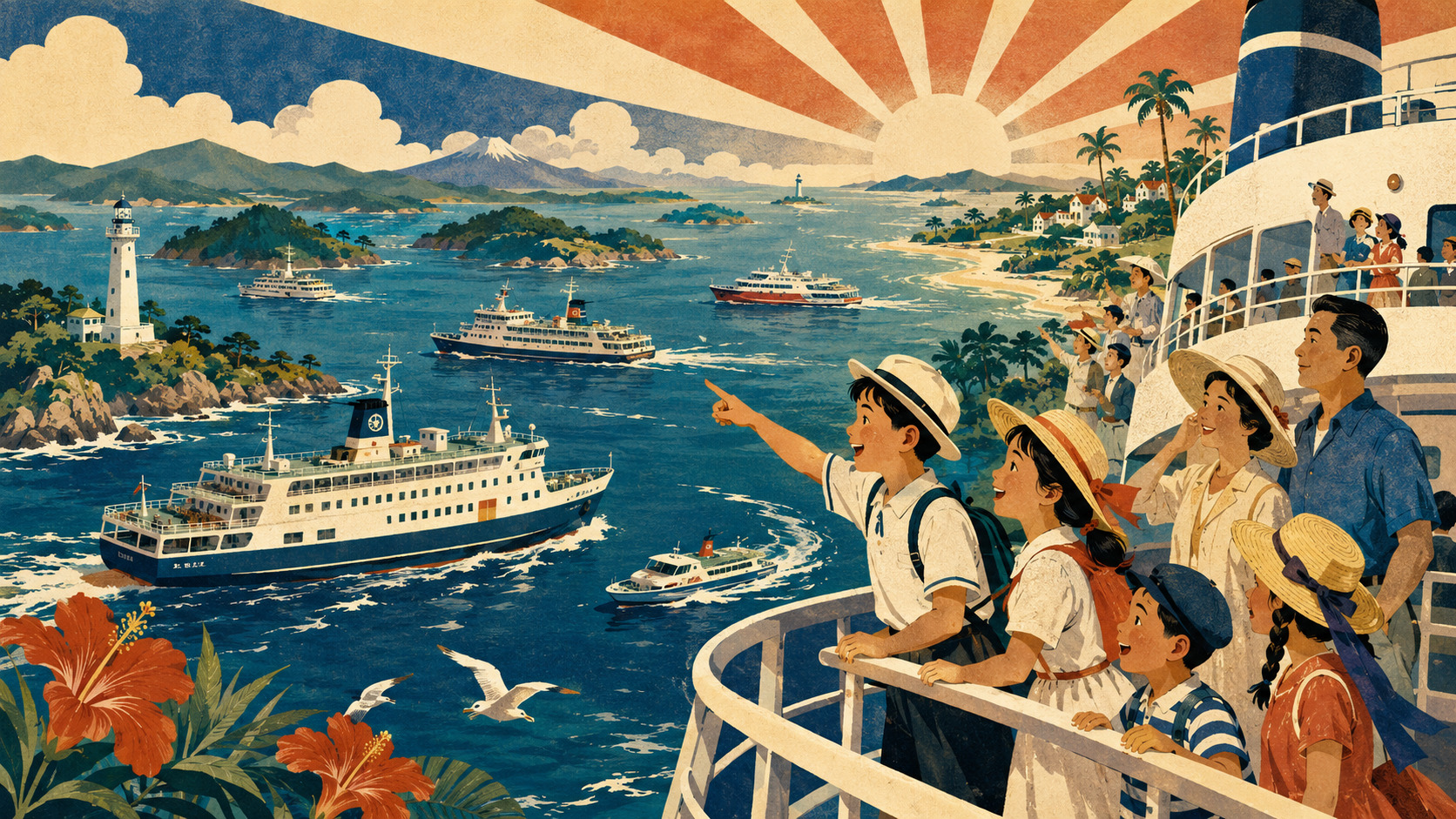
A ticket window becomes a national classroom
At Hakodate and Aomori, the free portion is a child’s passage across the strait. At a small Setouchi landing, it may be the 100- or 200-yen fare that makes an island bus route out of a boat. At Chūzenji, Biwa or Towada, there is no sea at all: Marine Day arrives as a lake cruise. In Osaka and Tokyo, the same campaign enters a city through its bridges, warehouses and skyline.
The Japan Passengerboat Association created the campaign to give children more direct contact with the sea and ships. On July 20, primary-school passengers can use scores of participating services without the ordinary child passenger fare, subject to each operator’s rules. Some participating companies substitute a gift, onboard meal or event for a fare reduction. The official five-page route sheet is therefore the real ticket condition, not the poster’s large word “free.”
The number in the headline is part of the story’s publication history. The June 17 announcement and a June 22 Ministry of Land, Infrastructure, Transport and Tourism regional notice reported 70 operators and 86 routes. By the July 18 edition deadline, the association’s live page and replacement PDFs showed 71 operators and 87 routes. The geographical reach remained 33 prefectures. This article preserves the widely circulated launch count in its headline and uses the revised count for trip planning.
What is free—and what is not
The common center is simple: a primary-school child receives the participating benefit. Everything around it is decentralized. Most fare-waiver operators require a fare-paying adult. Some allow one child per adult; others two, three or five; some say all children in the family may qualify. Many exclude organized groups. A reservation may be compulsory, recommended or unavailable. The benefit may apply to the passenger fare but not a reserved seat, premium cabin, vehicle, bicycle, onboard meal or second day of a return journey.
| Question to ask before leaving | Why it matters | Published examples |
|---|---|---|
| Which date and sailing? | July 20 is the center, not a universal period. | Niijima’s ferry lists July 19; some Izu-island services list July 18 or 21; Shimanami’s Kurushima cruise runs July 18–24. |
| Must an adult travel? | Most free-fare entries require adult accompaniment. | Seikan Ferry requires an accompanying adult; the Shimanami cruise also requires one. |
| How many children per adult? | The cap ranges by operator. | Published limits include one, two, three and five; some family offers set no numerical limit. |
| Are groups eligible? | School, club or tour parties may be excluded. | Seikan excludes groups of 15 or more; numerous route-sheet entries exclude groups. |
| Is the fare actually zero? | Several participants provide a different benefit. | Heartland Ferry and several long-distance operators give goods; MOL Sunflower offers qualifying children free onboard dinner and breakfast instead of a fare cut. |
| What must still be paid? | “Free child passage” is not “free family trip.” | Adult tickets remain payable; operators may separately charge cabins, vehicles, reservations, admission or upgrades. |
A country in one route sheet
The official list is unusually broad because the association’s remit includes transport and tourism on the sea, rivers and lakes. Japanese law defines a passenger ship, for this purpose, as a vessel certified to carry at least 13 passengers. The campaign consequently gathers services that travelers normally place in different mental categories: commuter ferry, island lifeline, car ferry, hydrofoil, restaurant ship, river cruise and lake sightseeing boat.
| Region | Representative participating journeys | What children meet |
|---|---|---|
| Hokkaido and Tōhoku | Lake Shikotsu, Rishiri–Rebun, Hakodate–Aomori, Lake Towada, Miyako’s Jōdogahama, Matsushima, Shiogama and Lake Tazawa. | Caldera lakes, strait ferry, island network, ria coast and working bays. |
| Kantō | Kasumigaura, Lake Chūzenji, Tai-no-Ura, Niijima, Tokyo restaurant and bay cruises, Hakone pirate ship. | Inland water, sacred fish habitat, island transport and the industrial capital from the water. |
| Chūbu and Kansai | Oku-Tadami, Shimoda, Tsu–Chūbu Airport, Toba–Irago, Kashikojima, Lake Biwa, Osaka river cruises, Tomogashima and Kobe harbor. | Reservoir, airport access, bay crossings, inland-sea gateways and urban waterways. |
| Chūgoku and Shikoku | Oki, Maejima, Kasaoka islands, Naoshima, Hiroshima Bay, Miyajima, Onomichi ferries, Kanmon, Naruto, Ōboke and Kurushima Strait. | Japan’s densest ferry geography: island schools, art islands, short community crossings, whirlpools and bridge currents. |
| Kyushu and southern islands | Karatsu–Takashima, Nagasaki harbor, Gunkanjima, Gotō, Kumamoto–Shimabara, Ushibuka–Kuranomoto, Yakushima and Kagoshima–Amami–Okinawa. | Historic ports, archipelagos, volcano crossings and the long southern sea road. |
Northern waters: from a glass-bottom boat to the Tsugaru Strait
In Hokkaido, Star Marine’s Lake Shikotsu sightseeing service publishes a regular primary-school fare of ¥3,000 reduced to zero on July 20, with a fare-paying guardian and a two-child limit. Heartland Ferry, serving Rishiri and Rebun, does not reduce the fare; it gives an original item to primary-school passengers. The distinction immediately shows why the route sheet cannot be collapsed into one fare promise.
Seikan Ferry’s Hakodate–Aomori crossing is a full transport journey. The operator says an accompanying adult is required, parties of 15 or more are excluded, and only the July 20 leg is free. If a family travels out on July 20 and returns later, the return child fare is collected with the applicable return discount. A web customer who already paid the child fare can seek a refund at the counter on sailing day.
That crossing also makes the holiday’s history tangible. On July 16, 1876, Emperor Meiji left Aomori, called at Hakodate and returned to Yokohama on July 20 aboard Meiji Maru. The date became Marine Memorial Day in 1941 and a national holiday first observed in 1996. In 2026 the third Monday and the historic July 20 date coincide.
Farther south, the current sheet includes Lake Towada, Jōdogahama’s scenic coast, the Matsushima–Shiogama landscape and Lake Tazawa. These are not interchangeable rides. One is a long caldera-lake view, another a coastal geology lesson, another a bay-and-island network, another a mountain lake. Together they make “maritime education” larger than ship machinery: navigation always reads a particular body of water.
Tokyo and Kantō: the archipelago enters the metropolis
The Kantō entries move between small and immense scales. Tai-no-Ura takes children to the protected sea-bream waters off Chiba. Lake Chūzenji gives eligible pupils a commemorative boarding card on July 20. Kasumigaura’s excursion service lists a July 18–20 window. At Hakone, the pirate-ship experience turns scheduled lake transport into theatrical sightseeing.
Tokyo’s group includes Cruise Club Tokyo, Tokyo Bay Cruising, Sea Line Tokyo, the village of Niijima and Izu Shoto Development. Their offers differ. Some harbor cruises set the normal child fare to zero with an accompanying adult and numerical limit. Izu Shoto Development does not reduce the fare; it plans novelty goods for a limited number of primary-school passengers on specified island sailings. Niijima’s local ferry lists July 19, not July 20.
That range matters. A city cruise can teach how bridges, floodgates, wharves and reclaimed land fit together. An island ferry teaches something more basic: Tokyo is not only a metropolis on Honshu. Its jurisdiction stretches hundreds of kilometers into the Pacific, and the ship remains public transport.
Setouchi: where a ferry can be a street
The campaign is densest in the Seto Inland Sea. In Okayama and Kagawa, children can encounter Maejima, Kasaoka’s island chain, Naoshima and Shōdoshima routes. Hiroshima’s entries include short crossings from Ujina, Onomichi community ferries, services to Ninoshima and Etajima, Miyajima operators and inter-island links whose regular child fare may be only ¥50, ¥80, ¥100 or ¥200.
The small price does not mean the service is unimportant. On a short island route, the boat may perform the work of a neighborhood bus: carrying pupils, commuters, groceries, mail, bicycles and relatives to a clinic. Removing a ¥100 child fare for one day has little resemblance to discounting a sightseeing cruise, yet it may create a child’s first conscious view of the vessel as public infrastructure.
The route sheet also shows how local rules respond to capacity. Some Setouchi operators accept all eligible family children; others cap the number per adult or exclude groups. Several companies—Miyajima Matsudai Kisen, Aqua Net Hiroshima, Ishizaki Kisen and Setonaikai Kisen among them—offer goods instead of a fare reduction on listed services. At Shimanami’s Kurushima Strait sightseeing boat, the offer runs July 18–24, reduces the published ¥1,000 pupil fare to zero, requires an adult and excludes groups, but sets no numerical cap within a family.
The overnight ships: a different kind of benefit
Long-distance ferries expose the limits of the word “free.” A passage between Osaka or Kobe and Kyushu can include a reserved berth or cabin, restaurant meals and a vehicle. Zeroing one child base fare would not describe the full bill. Some operators therefore use the national campaign as a frame for a different onboard benefit.
MOL Sunflower’s western Japan operation lists no fare discount; instead, primary-school children and preschoolers aged four and above receive dinner and breakfast in the onboard restaurant on qualifying July 19 and 20 departures. City Line’s Osaka–Shinmoji service and Meimon Taiyo Ferry list commemorative goods rather than a fare reduction. Heartland Ferry does the same in Hokkaido. On the Kagoshima–Amami–Okinawa corridor, Marix Line offers goods, while A-Line Ferry and Yakushima Town use events or gifts on their listed services.
Those entries are not exceptions hidden in fine print. They are printed in the operator list itself as “no fare discount.” A responsible family guide should keep them in the national story because they reveal the campaign’s actual design: a coordinated invitation administered locally, not a government-mandated universal tariff.
Why primary school—and why experience?
The association’s stated concern is that children have fewer opportunities to become familiar with the sea. A fare waiver addresses the most direct barrier, but the educational theory is physical. A child feels acceleration, wind and vibration; watches a ramp rise; sees a wake cross a harbor; notices that a captain changes course for traffic and tide. A route on a map becomes a sequence of judgments.
Primary-school age also makes the family the unit of travel. The paid adult requirement on many routes is both a commercial condition and a safety/learning structure: the campaign brings another generation aboard. The downside is that it is not free access for a child whose household cannot afford the adult ticket or reach the port. The campaign removes one fare, not the entire geography of cost.
Gifts, craft activities and bridge tours can extend the lesson, but the ordinary operation is already educational. A vehicle deck shows how islands receive supplies. A tiny passenger launch shows why weather can change a timetable. A restaurant ferry shows that a ship is a hotel, road and logistics platform at once. The strongest outcome is not a souvenir; it is recognizing that a boat is part of how Japan functions.
From a 1951 association to a twice-yearly campaign
The Japan Passengerboat Association’s institutional history begins in February 1951 with the Japan Regular Transport Ship Association. It changed names in 1952 and 1959, becoming the Japan Passengerboat Association, and moved to general incorporated-association status in 2012. Its formal purpose includes transport and tourism on rivers and lakes as well as the sea—explaining the lake cruises in a Marine Day program.
The children’s campaign began in 2013 and has been held around Children’s Day and Marine Day each year. Two editions annually for fourteen years bring the July 2026 program to number 28. The rhythm is deliberate: May 5 makes the child the subject; Marine Day makes the sea and ship the subject. The same free ride connects them.
| Year | Milestone | Meaning for 2026 |
|---|---|---|
| 1876 | Meiji Maru returns to Yokohama on July 20 after a northern voyage. | The historical date behind Marine Day. |
| 1941 | July 20 is designated Marine Memorial Day. | A commemorative observance precedes the national holiday. |
| 1951 | Predecessor of the Japan Passengerboat Association is founded. | The organizer’s postwar institutional starting point. |
| 1996 | Marine Day is first observed as a national holiday. | Gratitude for the sea and hopes for a maritime nation’s prosperity gain a public holiday. |
| 2013 | Twice-yearly primary-school free-voyage campaign begins. | Children’s Day and Marine Day create two annual boarding opportunities. |
| 2026 | 28th campaign; launch count 70/86, revised count 71/87. | The program reaches boarding points in 33 prefectures. |
The ferry as essential public transport
Japan’s passenger-boat sector is much larger than this promotion. The association reports that in fiscal 2023, passenger vessels carried 73.69 million people and transported 10.878 million vehicles. Its mission statement describes pure passenger ships, ferries and high-speed craft as carriers of residents, goods and vehicles across an archipelago about 3,000 kilometers long.
The island context is even sharper. The association describes more than 6,800 islands, over 400 of them inhabited, in the classification used on its island-route page. Many island services operate under severe pressure from depopulation, aging and falling traffic; in some communities the ship is the only public transport link to the mainland. The campaign’s island entries should therefore not be read only as leisure inventory. They introduce children to systems whose continued existence is a public-policy question.
The route sheet juxtaposes a ¥50 child crossing and a ¥3,000 lake excursion, a short riverboat and an overnight ferry. Economically they are different businesses. Civically they share one truth: a road can end at water while the journey continues.
How to use the official list in five steps
- Start with the current association page. Use its one-page operator list and five-page route-detail PDF, not a copied June list.
- Find the exact operator and route. A company may participate on one service but not another, or offer goods instead of free fare.
- Check the operating date. The published window can be July 18–24, one day adjacent to the holiday, or July 20 only.
- Read every condition. Confirm accompanying-adult ratio, group exclusion, reservations, proof of age, cabin/vehicle charges and how a prepaid fare is handled.
- Recheck weather and operations. A campaign does not override cancellations, capacity controls or safety decisions. Contact the operator when the row is ambiguous.
| Family situation | Action before travel | Reason |
|---|---|---|
| Two adults, three primary-school children | Confirm the per-adult child limit. | Some routes allow one or two children per adult; others allow all family children. |
| Round trip crosses midnight or another date | Price each sailing separately. | Seikan Ferry, for example, waives only the July 20 leg. |
| Car or bicycle aboard | Ask whether only the child passenger fare is waived. | Vehicle and bicycle charges are separate tariff items. |
| Web ticket already paid | Read the refund procedure and bring the required record. | Some operators refund at the counter; procedures are not uniform. |
| Club, school or extended group | Do not assume eligibility. | Many entries exclude groups even when every child is of qualifying age. |
| Route offers a gift or meal | Budget the normal fare. | Participation does not always mean a zero child fare. |
One day to see the water between places
The campaign’s value is clearest when the route list is read not as 87 discounts but as 87 different explanations of Japan. Lake Shikotsu says volcanic water is navigable space. Seikan says the strait is a corridor, not a gap. Tokyo’s island services say the capital continues into the Pacific. Onomichi’s crossings say a ferry can be a street. Gotō and Yakushima say an island’s relationship to the mainland is scheduled at a pier.
The late increase from 70 operators and 86 routes to 71 and 87 is small numerically, but editorially useful. It reminds families that this is a living operational program. Routes join, schedules change, weather intervenes and benefits are revised. The correct response is not to distrust the national invitation. It is to read it like a mariner: use the latest chart, understand the local conditions and check again before departure.
Principal sources and trip-planning links
- Japan Passengerboat Association, 28th Primary-School Children Sail Free Campaign: current 71-operator, 87-route, 33-prefecture total and conditions warning.
- Official one-page participating-operator list: current geographical index and non-fare benefits.
- Official five-page route-detail sheet: routes, boarding points, ordinary fares, benefit dates, adult ratios, group rules, events and operator links.
- Official campaign poster: July 20 message and instruction to check route-specific conditions.
- MLIT Kobe District Transport Bureau, June 22 announcement: original 70-operator, 86-route count and Hyogo participants.
- Seikan Ferry campaign notice: adult accompaniment, group exclusion, one-day return handling and prepaid-ticket refund.
- Shimanami Kurushima Strait sightseeing-boat notice: July 18–24 period, ¥1,000-to-zero fare, adult and group rules.
- Japan Passengerboat Association, mission of passenger ships: legal definition, archipelago context, vessel types and essential transport role.
- Japan Passengerboat Association, island routes: inhabited-island context, demographic pressure and lifeline function.
- Japan Passengerboat Association, sector statistics: fiscal 2023 passenger and vehicle totals.
- Japan Passengerboat Association, maritime education: the campaign’s educational purpose and twice-yearly holidays.
- Japan Passengerboat Association, institutional history: 1951 founding, name changes and 2012 status.
- Japan Coast Guard, history of Marine Day: Meiji Maru, 1941 observance, 1996 holiday and third-Monday system.
- Japan Maritime Public Relations Center, national Marine Day guide: nationwide listing and warning that operator dates and conditions differ.
- MLIT, island-route support review: declining traffic, population aging and fuel-cost pressures on lifeline routes.
Editor’s note: Campaign information was checked on July 18, 2026, Japan time. This is a pre-event guide; it does not report that a scheduled sailing or benefit has already occurred. The June launch figure was 70 operators and 86 routes; the organizer’s live page and revised PDFs now say 71 operators and 87 routes. Conditions, availability and operations remain subject to each operator, capacity, weather and safety decisions. Always check the linked route sheet and operator page before travel. The hero is an editorial illustration, not a photograph.