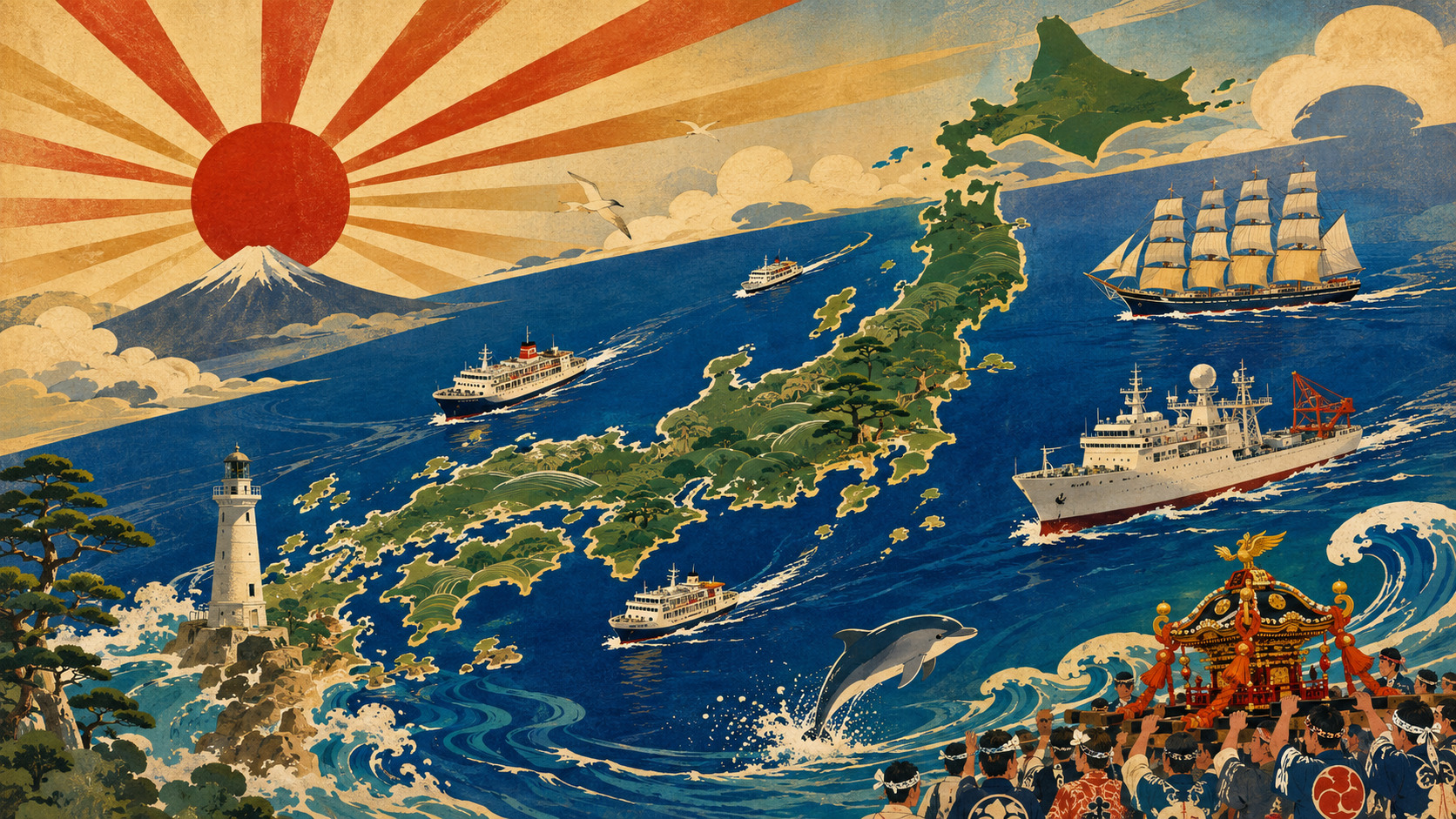
Thirty-eight pages make one maritime country visible
Open the national PDF and Japan reorganizes itself by water. Hokkaido appears as ports, ferries, marinas, aquariums and lighthouses. The Pacific and Sea of Japan coasts fill with patrol-vessel tours and harbor cruises. Inland prefectures enter through river, lake, shipping-education and environmental programs. Farther south, coral, island transport and tropical marine life move to the center of the page.
The 38-page national list, compiled by the Sea Month Promotion Committee’s secretariat at the Japan Maritime Public Relations Center and supported by the Ministry of Land, Infrastructure, Transport and Tourism, is dated June 23, 2026. It first lists events for the general public, then communications and programs aimed at maritime stakeholders. Each row can carry a prefecture, event name, date, venue, description, organizer, website or telephone number, advance-booking status and fee.
That utilitarian structure is its great value. A family can find a free aquarium day. A ship enthusiast can locate a full-sail display or patrol-vessel opening. A student can find a biodiversity workshop. A traveler can discover that a familiar summer festival is also a port’s annual act of thanks to the sea.
The links: national, regional and searchable
Use the complete list for breadth, a regional file for a manageable scan, and the searchable directory for the latest web entries. The regional PDFs repeat nationwide programs relevant to their areas, so they are not five mutually exclusive slices of the 38 pages.
| Coverage | Direct link | Best use |
|---|---|---|
| All Japan | Complete 38-page national PDF | Search across every region and compare programs. |
| Hokkaido | Hokkaido regional PDF | Ports, marinas, aquariums, festivals and northern lighthouse programs. |
| Tohoku / Hokuriku / Shinetsu | Northeast and Sea of Japan regional PDF | Aomori, Miyagi, Niigata, Toyama, Ishikawa and neighboring areas. |
| Kanto / Chubu | Kanto and Chubu regional PDF | Tokyo Bay, Kanagawa, Tokai ports and central Japan. |
| Kinki / Chugoku / Shikoku | Western Honshu and Shikoku regional PDF | Osaka and Kobe through the Seto Inland Sea and Shikoku. |
| Kyushu / Okinawa | Kyushu and Okinawa regional PDF | Passenger routes, port openings, island events and coral programs. |
| Web directory | Search the event database | Find a place or event without paging through a PDF. |
| Download hub | Official regional download page | Check whether the association has replaced any file. |
Read the guide like a timetable, not a promise
The PDF is a planning document frozen on June 23. Some rows say “scheduled,” “under consideration,” “undetermined” or “provisional.” Some supply only a telephone number. At least one Hokkaido row in the 2026 compilation still shows a 2025 date. Weather can cancel a cruise; sea conditions can close a ship; a lottery can end weeks before the holiday; a museum may require a normal admission ticket even when the special program is free.
The safest sequence is simple: find the event in the PDF; follow the organizer link; check the organizer’s newest notice; confirm the date, admission, age rules and reservation status; and check again on the morning of departure. “Free” does not always mean “walk in.” “No advance reservation” does not guarantee space. For ships, wear secure shoes and expect steep gangways, narrow ladders, heat and waiting outdoors.
Today’s national harbor: working ships at Tokyo’s cruise terminal
The official center of the 2026 observance is the Marine Day Commemorative Event 2026 at Tokyo International Cruise Terminal in Aomi, Koto Ward. Admission to the main event is free, from 10 a.m. to 5 p.m. The opening ceremony runs from 10 to 10:30 a.m.; the 19th Awards for Distinguished Contributions to an Ocean-Based Nation follow from 10:30 to 11; and hands-on programs continue throughout the day. The Cabinet Office’s Headquarters for Ocean Policy, MLIT and the Nippon Foundation are co-hosts.
Its visual anchors are two working vessels. The Japan Meteorological Agency’s oceanographic and marine meteorological observation ship Ryofu Maru opens to general visitors, with reception scheduled to close at 2 p.m. MOL’s vehicle carrier Lazulite Ace is also due at the terminal, but its onboard tour required an advance application by June 28 and is no longer a walk-up option. That distinction is exactly why readers should move from the national list to the live event page.
The terminal also becomes a condensed maritime classroom. The announced exhibitors cover shipbuilding, seafarer training, ship operation, passenger vessels, the Coast Guard, diving, marine sports, sustainable seafood and future ocean technology. Visitors can encounter bridge and crane simulators, uniforms, ropework, VR, paper craft and demonstrations. Research presentations range from ocean drones and seabed monitoring to rare-earth mud and marine carbon storage.
The stage gives the day a port soundscape: the Japan Coast Guard Band at about 11:40 a.m.; a Nippon Foundation discussion on the sea’s past and future at 1 p.m.; a live science program at 2:20; and the Japan Maritime Self-Defense Force Tokyo Band’s Dixie ensemble around 3:40. Ships in port are due to sound whistles together at noon. The organizers warn that conditions can change and that there is no public parking.
A prefecture-by-prefecture route through the program
No reader will attend the whole country. The more useful way to understand the list is to sample the different relationships with the sea that appear from north to south. These highlights combine the national PDF with current organizer notices; follow the links before traveling.
| Prefecture | 2026 highlight | What the event opens up |
|---|---|---|
| Hokkaido | AOAO Sapporo’s third anniversary, July 20 | The city-center aquarium marks its anniversary during an eight-day culture program; Marine Day itself pairs nature aquariums with a tea-room collaboration. |
| Aomori | Yasugata Port Festival and “Boat Heaven,” July 17–20 | Port celebration, ship access and family activities make Aomori Bay a long-weekend maritime stage. |
| Miyagi | 79th Shiogama Port Festival, July 19–20 | Fireworks precede the sea procession of mikoshi, land parade and a planned Coast Guard craft opening. |
| Tokyo | Museum Ship Soya Marine Day program, July 20 | Full-dress flags, Antarctic imagery and family crafts connect exploration history with the holiday. |
| Tokyo | Sustaining Our Oceans youth event, July 20 | Film, discussion and workshops address marine litter and biodiversity. In-person places are full; the morning film remains available online by registration. |
| Kanagawa | Chigasaki Hamaori Festival, July 20 | Thirty-eight mikoshi enter the surf before dawn in a nationally recognized folk observance rooted in purification and coastal community. |
| Toyama | Kaiwo Maru Park Festival, July 19–20 | Full-sail display, a harbor circuit cruise, climbing-the-masts salute, full-dress flags and planned public vessels. |
| Aichi | 80th Nagoya Port Festival, July 20 | Floats and mass dancing turn the garden pier into a civic celebration of the port. |
| Aichi | Toyohashi Port Festival, July 20 | A vehicle-carrier interior tour, public-service vessels and waterfront industry booths; some activities require reservations or fees. |
| Kagawa | Takamatsu “Working Ships” program | The oil-recovery vessel Bisan, Coast Guard craft Kurinami and children’s library boat Hon-no-Mori show three forms of public service afloat. |
| Tokushima | Elementary-school children’s free rides | Participating Naruto sightseeing boats and the Oboke Gorge cruise turn a first voyage into the day’s lesson. |
| Yamaguchi | Shimonoseki fishing-park and swimming programs | Children’s free access and water activities connect a major strait city with everyday coastal recreation. |
| Okinawa | Provisional Ishigaki Port Festival, July 19–20 | Planned ship programs sit beside coral-conservation and yacht-club displays; the PDF marks the listing provisional, so reconfirm locally. |
| Okinawa | Churaumi dolphin Muku as one-day Coast Guard chief, July 20 | A dolphin-show appointment, children’s uniform experience and water-safety message meet at Okichan Theater. |
| Nationwide | 28th free passenger-ship campaign for elementary pupils | Seventy operators and 86 routes participate; rules, eligible sailings and accompanying-adult fares differ by operator. |
What the list reveals: the holiday is not one kind of event
The most photogenic entries are tall ships and fireworks, but the guide’s deeper story is access. Commercial ports are usually controlled working environments. Observation ships, vehicle carriers, patrol vessels, oil-recovery ships, training ships and lighthouse compounds are not everyday public spaces. Marine Day creates short windows in which the systems behind an island economy can be seen, boarded and questioned.
A second strand is civic ritual. Shiogama sends mikoshi across the water; Chigasaki carries shrines into the surf; Nagoya dances at its port; ships sound their whistles at noon. These are not interchangeable attractions placed beside the sea. Each city gives maritime gratitude its own body, sound and route.
A third strand is knowledge. Aquariums waive or modify admission, libraries become boats, students debate biodiversity, and technical institutes explain ship handling, navigation and engines. The Tokyo booths place rare-earth recovery, ocean drones and carbon storage beside children’s crafts. That adjacency is deliberate: the holiday is trying to make maritime labor and research imaginable before asking a new generation to enter them.
The fourth strand is responsibility. Coast Guard events teach life jackets and accident prevention. Coral programs and cleanups turn “the blessings of the sea” into obligations. Ferry campaigns introduce vessels not only as leisure but as lifelines connecting islands and coastal communities. The best events do not romanticize the ocean into scenery. They show work, danger, ecology and dependence together.
1876: the voyage behind July 20
The date begins with a ship. Meiji Maru was built in Britain in 1874 as a lighthouse service vessel. During Emperor Meiji’s 1876 tour of Tohoku and Hokkaido, he boarded the civilian government ship at Aomori, traveled through Hakodate and arrived safely at Yokohama on July 20. The voyage was remembered in part because the emperor returned on a vessel other than a warship.
The ship survives at Tokyo University of Marine Science and Technology’s Etchujima campus. The university describes it as Japan’s only surviving iron ship—a material generation before modern steel hulls—and a nationally designated Important Cultural Property. After government service, it was transferred in 1896 to the predecessor of the university and trained about 5,000 seafarers over more than half a century. The physical artifact makes Marine Day unusual: its origin can still be walked around and, on limited occasions, entered.
Yet the modern holiday was not declared in 1876. The voyage accumulated public meaning over decades. In 1941, a vice-ministers’ conference established July 20 as “Marine Memorial Day.” It was an observance, not a national holiday. Maritime organizations then pursued holiday status in several waves beginning in 1959. A second campaign followed in the early 1970s. The decisive movement began in 1991 and spread well beyond shipping circles.
By December 1994, assemblies in all 47 prefectures and 2,281 local governments—about 70 percent of local governments at the time—had adopted statements supporting holiday status. Campaign organizers marked ten million signatures. The Diet passed the amendment in early 1995; it was promulgated on March 8 and took effect on January 1, 1996. Japan observed its first national holiday called Marine Day on July 20, 1996.
From a fixed anniversary to the third Monday
The Holiday Act gives Marine Day a concise civic purpose: to give thanks for the blessings of the sea and pray for the prosperity of maritime nation Japan. That language is broader than the 1876 voyage. It holds shipping and fisheries, coastal culture and science, recreation and environmental stewardship within the same sentence.
Initially the national holiday remained fixed on July 20. A 2001 amendment moved it, from 2003, to the third Monday in July under the “Happy Monday” system. The change made a three-day weekend and untied the holiday from its original calendar date. In response, organizers widened the frame. The older “Sea Ten-Day Period,” July 20–31, became “Sea Month,” July 1–31, so the historical meaning and public programs could travel across a full month even as the holiday’s date changed.
In 2026 the two systems meet neatly: the third Monday happens to be July 20. The current edition therefore lands on the imperial-voyage anniversary while operating as the modern Monday holiday. That coincidence gives this year’s guide an especially clear historical spine.
| Year | Milestone | What changed |
|---|---|---|
| 1874 | Meiji Maru built in Britain | The lighthouse vessel that would give the date its story enters service. |
| July 20, 1876 | Emperor Meiji arrives at Yokohama | The return from Tohoku and Hokkaido becomes the commemorated voyage. |
| 1941 | First Marine Memorial Day | July 20 becomes an official national observance, but not yet a public holiday. |
| 1959–1994 | Three major holiday campaigns | Maritime groups, citizens and local assemblies build national political support. |
| 1995 | Holiday Act amended | The law creating Marine Day is promulgated on March 8. |
| 1996 | First Marine Day national holiday | July 20 becomes a statutory day off with a national civic purpose. |
| 2003 | Third Monday and Sea Month | The movable Monday creates a long weekend; July becomes the wider public frame. |
| 2026 | Third Monday falls on July 20 | The modern holiday and the historic date coincide. |
Why a maritime holiday still matters
A holiday can make dependence visible. An MLIT Marine Day briefing describes Japan’s jurisdictional waters as about twelve times its land area and says 99 percent of the country’s foreign-trade cargo transport is carried by oceangoing shipping. The exact statistics change by year and measure; the underlying structure does not. Food, fuel, raw materials, clothing and manufactured goods reach an archipelago through ports and ships that most consumers rarely see.
The sea is also not merely a transport surface. It is habitat, weather engine, energy frontier, source of food, field of jurisdiction and repository of cultural memory. The official 2026 Tokyo program captures that range: an observation ship beside a car carrier; a Coast Guard band beside seabed-monitoring technology; shipbuilding VR beside sustainable seafood; a national award ceremony beside children learning knots.
This is why the 38-page guide matters as more than a calendar. Read vertically, it tells a family what to do this weekend. Read horizontally, across prefectures, it shows how maritime Japan is organized: national ministries and local festivals, private carriers and public vessels, museums and fishermen, researchers and schoolchildren sharing one month without becoming one institution.
Before leaving home: the five checks
| Check | Question to answer | Why it matters |
|---|---|---|
| Latest notice | Has the organizer changed or cancelled the program? | The national PDF is dated June 23 and is not a live status board. |
| Reservation | Is it walk-up, first-come, lottery or already closed? | The Lazulite Ace tour, for example, closed applications on June 28. |
| Price | Is the event free, or only the special program? | Normal admission, transport and an accompanying adult’s fare may still apply. |
| Access and clothing | Is there parking, shade, barrier-free access or a footwear rule? | Working ships and piers can mean stairs, heat, rain and long outdoor queues. |
| Weather and sea | Where will a same-day cancellation be posted? | Wind, visibility and sea state can stop a sailing even under clear skies ashore. |
Choose one scale of experience. If time is short, make it a working ship, a community ritual, an ocean-learning program or a first ferry ride. Then leave room around it. The most memorable part may be a crew member explaining a bridge instrument, a whistle rolling across a harbor at noon, or the moment a shrine carrier steps into the surf.
A national day made of local shores
The origin story of Marine Day is singular: one emperor, one lighthouse ship, one arrival at Yokohama. Its present is plural. The 2026 guide belongs to every kind of coast and to places far from salt water that still depend on shipping, weather and watersheds. It connects a surviving nineteenth-century iron vessel to a next-generation ocean drone; a sacred sea procession to a vehicle carrier; a child’s free ticket to the continuity of island routes.
That breadth is the point. Giving thanks to the sea is not an abstract instruction. In the official list it becomes hundreds of doors—some literal gangways, some museum gates, some festival streets, some online classrooms. The reader’s task is to choose carefully, verify the live details and step through one.
Sources and official links
- Japan Maritime Public Relations Center: nationwide 2026 Marine Day and Sea Month event list: the complete 38-page PDF, dated June 23, 2026.
- Official regional PDF hub: Hokkaido; Tohoku/Hokuriku/Shinetsu; Kanto/Chubu; Kinki/Chugoku/Shikoku; Kyushu/Okinawa; and the national file.
- Official maritime-event search: searchable web listings.
- MLIT: July is Sea Month in 2026: national framework and regional-event link.
- MLIT: Marine Day Commemorative Event 2026: date, venue, ceremonies, awards and public program.
- Official 2026 Tokyo special site: ships, stage times, booths, access and live cautions.
- e-Gov: Act on National Holidays: the statutory date and purpose of Marine Day.
- Cabinet Office: background to Japan’s national holidays: the 1876 voyage, 1941 observance and legislative history.
- Japan Maritime Public Relations Center: Marine Day history: the campaigns, local-assembly support, 1995 amendment, 1996 first holiday and Sea Month.
- Kyushu Transport Bureau: Marine Day and Sea Month: a concise official history.
- Tokyo University of Marine Science and Technology: Meiji Maru: construction, voyage, training service and Important Cultural Property status.
- MLIT: “Thinking About Maritime Nation Japan”: jurisdictional sea area, shipping dependence and Sea Month background.
- Kobe District Transport Bureau: 2026 free passenger-ship campaign: 70 operators and 86 routes.
- AOAO Sapporo third-anniversary announcement and ACCU’s Sustaining Our Oceans event notice: current organizer details used in the regional highlights.
Editor’s note: Event descriptions and status were checked against official material available by July 18, 2026 JST. The nationwide PDF is dated June 23 and includes provisional, planned and undetermined entries, plus at least one apparent prior-year date; readers should confirm every event with its organizer. The currency timestamp supplied as July 17 at 9:00 PM UTC is displayed as July 18 at 6:00 AM Japan Standard Time. The hero artwork is an editorial illustration, not an official map or photograph.