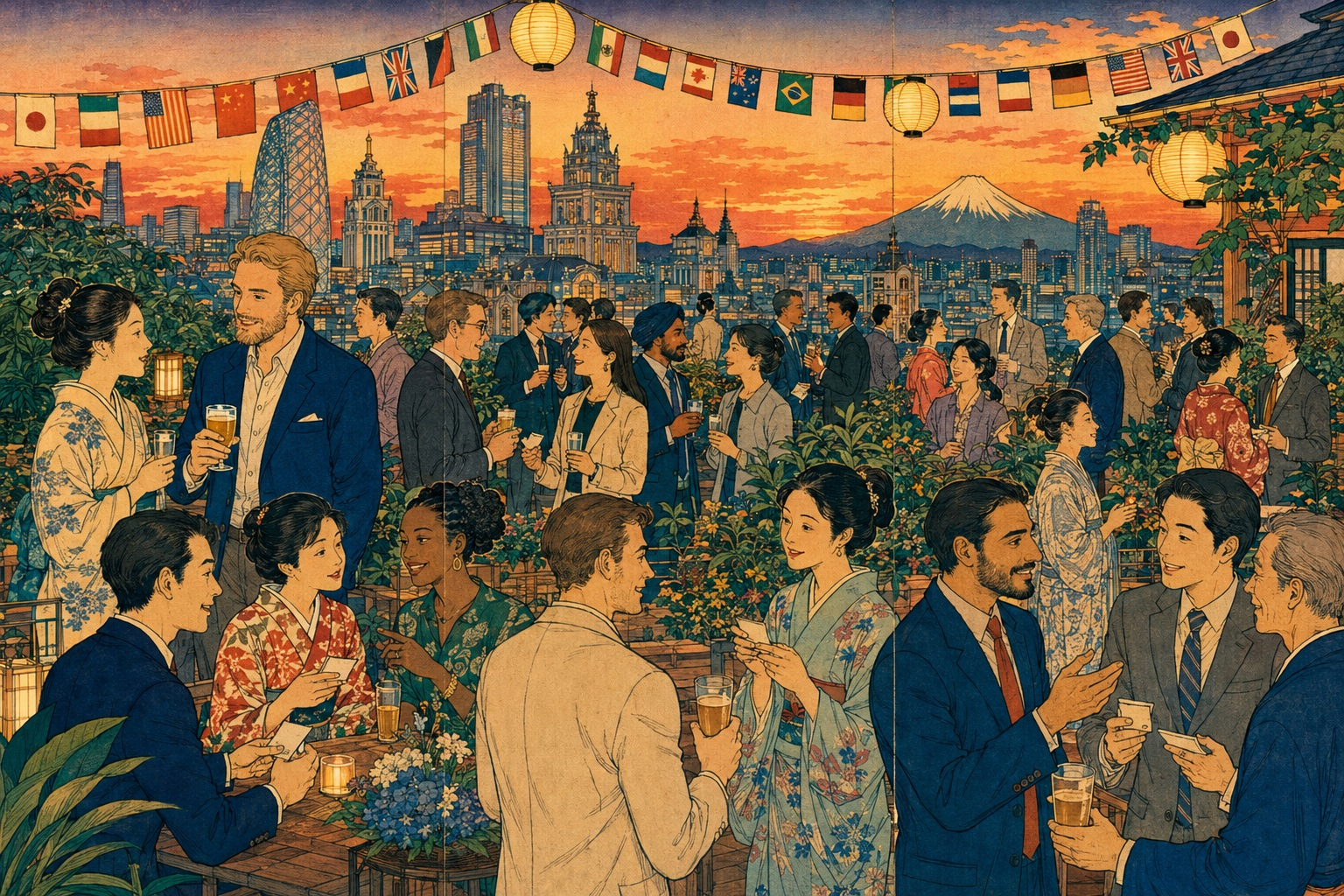
The party is already news before it begins
Eight days after this edition appears, Tokyo’s international business community is scheduled to climb to the rooftop of Hilton Tokyo in Nishi-Shinjuku. The Joint-Chamber Summer Cocktail runs from 19:00 to 21:30 on Wednesday, July 29, with doors at 18:30. Organizers promise free-flow drinks, international food and a crowd of more than 300 drawn from many industries and nationalities.
The practical news for a reader hoping to attend is less festive: BCCJ’s registration page now says the event is sold out, and the common registration and cancellation deadline passed at noon on July 17. Each participating chamber received a limited allocation. ANZCCJ’s page says 20 places per chamber; BCCJ limited its own bookings to members, normally one representative per company and two for Platinum members. Any possible wait-list place must be confirmed directly with the chamber through which a guest qualifies.
The venue is the Beer Garden Terrace on the seventh floor of Hilton Tokyo, 6-6-2 Nishi-Shinjuku, Shinjuku-ku, Tokyo 160-0023. The advertised fee is ¥10,500 for members and ¥14,000 for non-members. In bad weather, the party moves indoors; BCCJ specifies the hotel’s third-floor ballroom. Hilton Tokyo’s official main number is 03-3344-5111, but hotel staff do not control chamber ticket allocations.
Nineteen, twenty—or sixteen?
The headline follows BCCJ’s live event page, which says 19 chambers. ANZCCJ’s current page says “co-hosted by 20 Chambers of Commerce” and then names 20 organizations. IJCC’s page says 16. These are official pages for the same evening, checked on July 18, 2026.
The most auditable current list is ANZCCJ’s because it supplies names. It includes ANZCCJ, ACCJ, the Austrian Business Council, BLCCJ, BCCJ, CCCJ, DCCJ, EBC, CCIFJ, the Finnish chamber, AHK Japan, the Greek chamber, the Irish chamber, the Netherlands and Norwegian chambers, SACCJ, the Spanish, Swedish and Swiss chambers, and the Tokyo Chamber of Commerce and Industry. That is 20 co-hosting organizations.
The pages were evidently not synchronized as the coalition changed, but the public record does not establish exactly when each version was created or which organization the shorter counts omit. It would be speculation to force them into one hidden “correct” roster. For publication, the responsible treatment is to preserve the advertised 19 in the title, publish the full current 20-name list, and disclose the 16-page version rather than treating promotional copy as a formal census.
| Public page | Count shown | What can be verified |
|---|---|---|
| BCCJ registration | 19 chambers | Sold out; 300+ guests; member restrictions; indoor rain venue. |
| ANZCCJ event page | 20 co-hosting organizations | A full 20-name list, price, deadline and 20-ticket allocation per chamber. |
| IJCC event page | 16 chambers | Same date, venue, time, price and 300+ audience; count appears to be an earlier version. |
How a 13-chamber reception became a Tokyo fixture
The reception’s recent growth is measurable. BLCCJ’s archive says the July 2024 event brought together 13 international chambers and more than 200 guests at the same Hilton rooftop, with EBC supporting. Member tickets were ¥8,000, non-member tickets ¥12,000, and BLCCJ had 15 places. The evening was already sold out.
In July 2025 the Swiss and Belgian-Luxembourg records describe 19 international chambers, more than 250 professionals and EBC support. Prices rose to ¥9,000 and ¥13,000. The listed coalition added large non-European chambers and smaller European groups; the Chilean and Italian chambers were among that year’s participants.
For 2026, ANZCCJ’s list reaches 20 co-hosting organizations and more than 300 expected guests, while individual chamber allocations rise to 20. The current list adds the Norwegian chamber and TCCI but no longer names Chile or Italy. The year-to-year movement matters: “the international business community” is not a fixed club. It is rebuilt event by event.
| Edition | Published scale | Member / non-member fee | Coalition note |
|---|---|---|---|
| 2024 | 13 international chambers; 200+ guests | ¥8,000 / ¥12,000 | EBC supported; 15 BLCCJ places. |
| 2025 | 19 international chambers; 250+ guests | ¥9,000 / ¥13,000 | Italy and Chile listed; EBC supported. |
| 2026 | 19 on BCCJ; 20 named by ANZCCJ; 300+ guests | ¥10,500 / ¥14,000 | EBC and TCCI counted as co-hosts; Italy and Chile absent from ANZCCJ’s list. |
Before Summer Cocktail, there was CLIC
Small chambers had already learned to combine their reach. Creative Linking of International Chambers, or CLIC, describes itself deliberately as a “loose organization” of smaller European chambers. Its purpose is to organize inventive networking events and let members exchange ideas beyond a single national circle.
CLIC’s archive begins in 2014 with a presentation by IKEA Business. A 2015 Finnish record counted eight participating chambers and 125 guests at a Lego Japan event. By 2019 the network had 11 members; Ireland joined in 2024, bringing the total to 12: Austria, Belgium-Luxembourg, Denmark, the Netherlands, Finland, Greece, Iceland, Ireland, Norway, Spain, Sweden and Switzerland. Its April 2024 Tetra Pak event combined a business presentation, vegan catering and access across all 12 membership lists.
Summer Cocktail is broader than CLIC. It includes American, British, Canadian, Australian-New Zealand, French and German chambers, South Africa, EBC and now TCCI. But CLIC explains the operating logic. A small secretariat need not build a 300-person audience alone. It contributes a trusted national community, accepts a bounded ticket allocation and gains access to everyone else’s network.
Ireland: a 1973 association becomes a chamber
Ireland’s current organization is the Ireland Japan Chamber of Commerce, IJCC—not ICCJ, despite that abbreviation appearing beside the Irish name on ANZCCJ’s event page. The distinction matters because ICCJ is the Italian chamber.
The Irish institution traces its line to the Japan Ireland Economic Association, founded in 1973 as trade and Japanese investment in Ireland expanded. Early supporters included Japanese manufacturers and investors such as Olympus, Takeda, Alps and NEC. On January 11, 2008, Japan’s Ministry of Economy, Trade and Industry formally established the IJCC as the association’s successor.
Today it mixes business with culture and community: monthly networking, ambassador briefings, the Green Ireland Festival, business awards, speaker events and collaboration with other chambers. Its 2026 program includes a DEI initiative, women’s weekend activities and links to the JET community. This is the small-chamber advantage: the same network can introduce an investor, organize a policy conversation and support Irish film or traditional music without pretending those are identical activities.
Italy’s place—and its empty chair in 2026
The Italian Chamber of Commerce in Japan was founded in Tokyo in 1972 and recognized by the Italian government in 1986. It belongs to Assocamerestero, the worldwide network of Italian chambers abroad, and offers market research, partner searches, promotion, logistics and business-center services in addition to events.
ICCJ participated in the 2024 and 2025 Summer Cocktail rosters. It does not appear in ANZCCJ’s current 2026 list. The public pages do not explain why, so absence should not be turned into a story of dispute or withdrawal. It may reflect event capacity, timing or administrative coordination; none is confirmed. Italy remains active in Tokyo and Kansai, with B2B meetings, food promotion, awards and a December gala on its 2026 calendar.
The missing name is useful evidence. A joint event is not a permanent federation. Participation can change while the underlying chamber remains vigorous.
The Nordic lesson started at the Imperial Hotel
DCCJ’s history reaches back to the late 1950s, when roughly ten people from Danish, Swedish and Norwegian companies met regularly at Tokyo’s Imperial Hotel to exchange opportunities and help Scandinavian newcomers. As attendance grew, separate national clubs emerged in the mid-1960s. The Danish Businessman Club adopted the Danish Chamber of Commerce Japan name and new bylaws in 1990.
The Swedish chamber followed a different institutional timeline. Eight founding companies registered SCCJ with Japan’s trade ministry on March 18, 1992. By its thirtieth anniversary in 2022, SCCJ reported nearly 100 corporate members and 40 individuals. It combines business relationships with advocacy for deregulation and regulatory harmonization, and is now developing an internship bridge to Swedish master’s students.
Finland’s businesses first organized informally, became the Finnish Business Council in 1992 and moved toward a formal chamber after Finland joined the EU in 1995. FCCJ received Japanese government approval in 1999. The Norwegian chamber was established in 2003 and now works across maritime technology, seafood, energy, tourism and business culture. The Nordic chambers still collaborate: a 2026 craft-beer evening and the new Nordic Kansai Business Alliance show that the old Scandinavian instinct to pool knowledge did not disappear when national institutions formed.
Switzerland: large companies and “hidden champions”
SCCIJ was founded on September 29, 1981 and approved by Japan’s Ministry of International Trade and Industry on February 25, 1982. It reports more than 200 members, around two-thirds corporate. The mix includes famous multinationals and smaller Swiss “hidden champions”—specialist firms whose products may be less familiar than their market share.
Its work combines introductions, luncheons, market information, a scholarship relationship and protection of “Swissness” against misleading use of Swiss indications and the white cross. In summer 2026 the chamber moves easily from dentistry and precision manufacturing to a family-oriented National Day gathering and the joint rooftop reception. That breadth is not frivolous: technical trust and social trust are different assets, and a bilateral chamber needs both.
South Africa: a smaller bridge with a continental horizon
SACCJ was established in 2008 to promote trade and commerce while strengthening friendship and cultural understanding. Its membership spans large and small companies, nonprofits, professionals and students. The current board is chaired by publisher and journalist Simon Farrell.
South Africa’s inclusion changes the geometry of a reception otherwise dominated by Europe, North America and Australasia. Its business story includes mining and critical minerals, renewable and green-hydrogen potential, tourism, wine, food and a possible gateway into African markets. A chamber cannot substitute for export finance, due diligence or an embassy. It can provide the first credible introduction and enough community knowledge to stop a company beginning from zero.
The most consequential addition may be Japanese
ANZCCJ’s current list includes the Tokyo Chamber of Commerce and Industry. Founded by Shibusawa Eiichi in 1878, TCCI is a domestic chamber established under Japan’s Chamber of Commerce and Industry Act. It reported 86,138 members across Tokyo’s 23 wards as of March 31, 2025. That is a different order of scale from every foreign bilateral chamber at the reception.
TCCI’s presence can turn “foreigners networking with foreigners” into a more useful bridge to Japanese small and medium-sized enterprises. The value will depend on actual participation: bilingual facilitation, a mix of industries and follow-up after business cards are exchanged. Listing a giant domestic chamber as a co-host is not the same as delivering Japanese counterparties to every guest.
What a cocktail can—and cannot—accomplish
For a small chamber, pooled networking solves three problems. It creates scale without a large permanent staff, lets members test adjacent markets and gives sponsors visibility across communities. For an entrepreneur, a warm introduction from a chamber secretariat can be more useful than hundreds of cold contacts.
But a reception is not a trade agreement, regulator, distributor search or closed business deal. A ¥14,000 non-member price, corporate eligibility rules, English-heavy conversation and a Nishi-Shinjuku schedule can exclude smaller firms, caregivers, regional businesses and people outside established international circles. First-come allocations may also reward members who already understand the system.
The event’s own information quality is part of the test. Counts of 16, 19 and 20, the Irish/Italian acronym confusion and a changing roster make it harder for an outsider to know who is actually represented. A shared, dated organizer page and one canonical list would not make the coalition less informal; it would make it easier to trust.
Verified chamber directory: the featured smaller networks
These contacts were checked on official pages available through July 18, 2026. Some volunteer-led chambers do not publish a telephone or street office. “Not published” is more useful than an old or invented number; contact by the linked official email before visiting.
| Chamber and history | Current public address | Telephone, email and direct website |
|---|---|---|
| Ireland Japan Chamber of Commerce (IJCC) JIEA founded 1973; current chamber formally established 2008. | Ireland House 1-6 Yotsuya Honshiocho, Shinjuku-ku Tokyo 160-0003 | Current page: phone service unavailable during remote work secretariat@ijcc.jp ijcc.jp |
| Italian Chamber of Commerce in Japan (ICCJ) Founded 1972; Italian government recognition 1986. | FBR Mita Building 9F 4-1-27 Mita, Minato-ku Tokyo 108-0073 | 03-6809-5802 iccj@iccj.or.jp iccj.or.jp |
| Swedish Chamber of Commerce and Industry in Japan (SCCJ) Registered 1992 with eight founding companies. | Ark Mori Building 16F 1-12-32 Akasaka, Minato-ku Tokyo 107-6090 | No telephone published on current contact page office@sccj.org sccj.org |
| Swiss Chamber of Commerce and Industry in Japan (SCCIJ) Founded 1981; approved 1982. | Burex Kojimachi 209 3-5-2 Kojimachi, Chiyoda-ku Tokyo 102-0083 | 03-6256-9012 info@sccij.jp sccij.jp |
| Danish Chamber of Commerce in Japan (DCCJ) National club from the mid-1960s; DCCJ name from 1990. | c/o MIDORI.so Nagatacho 2-5-3 Hirakawacho, Chiyoda-ku Tokyo 102-0093 | No telephone published on current chamber page info@dccj.org dccj.org |
| South African Chamber of Commerce in Japan (SACCJ) Established 2008. | No street office published on the current chamber site. | No telephone published info@saccj.com saccj.com |
The wider small-chamber map—and the local host
| Organization | Verified public contact | Direct website |
|---|---|---|
| Austrian Business Council (founded 1996) | c/o ADVANTAGE AUSTRIA, 3-13-3 Motoazabu, Minato-ku 106-0046 03-3403-1777 · tokyo@advantageaustria.org | abc-jpn.net |
| Belgian-Luxembourg Chamber (founded 1978) | Dai 10 Daitetsu Bldg 5F, 23 Arakicho, Shinjuku-ku 160-0007 03-6457-8662 · info@blccj.or.jp | blccj.or.jp |
| Finnish Chamber (approved 1999) | 3-5-39 Minami-Azabu, Minato-ku 106-8561 080-7650-3225 · office@fcc.or.jp | fcc.or.jp |
| Greek Chamber (founded 2016) | Reoma Bldg 7F, 2-10-6 Mita, Minato-ku 108-0073 080-9677-5744 · admin@grccj.com | grccj.jp |
| Netherlands Chamber (founded 1978) | Shinjuku Komuro Bldg 7F-2, 4-1-22 Shinjuku, Shinjuku-ku 160-0022 No public phone · info@nccj.jp | nccj.jp |
| Norwegian Chamber (established 2003) | c/o Trade & Technology Section, Norwegian Embassy, Shiroyama Trust Tower 21F, 4-3-1 Toranomon, Minato-ku 105-6020 No chamber phone published · office@nccj.or.jp | norwegianchamber.com |
| Spanish Chamber (established 2017) | Embassy of Spain 3F, 1-3-29 Roppongi, Minato-ku 106-0032 03-3505-1730 · info@spanishchamber.or.jp | spanishchamber.or.jp |
| Tokyo Chamber of Commerce and Industry (founded 1878) | 3-2-2 Marunouchi, Chiyoda-ku 100-0005 03-3283-7876 | tokyo-cci.or.jp/english |
| Hilton Tokyo (event venue) | 6-6-2 Nishi-Shinjuku, Shinjuku-ku 160-0023 03-3344-5111 · tokyo@hilton.com | official hotel page |
Acronym warning: IJCC is Ireland and ICCJ is Italy. Both the Netherlands and Norwegian chambers use NCCJ in English-language material; check the domain before writing or paying.
Upcoming events found
Official calendars were checked on July 18, 2026. Prices, capacity and venue can change. A listing is not a promise that registration remains open; use the direct organizer page before paying or travelling.
| Date and time, JST | Organizer and event | Published access information |
|---|---|---|
| Sat, Jul 25 | IJCC-supported Japan-Ireland Society lecture: “Ireland Through a Gender Lens” | Seijo University; Japanese-language lecture; ¥500. |
| Sun, Jul 26 17:00–21:00 | Swiss National Day Celebration | Yokohama Country & Athletic Club; ¥5,000 members / ¥7,500 non-members; separate child prices. |
| Wed, Jul 29 19:00–21:30 | Joint-Chamber Summer Cocktail 2026 | Hilton Tokyo; ¥10,500 / ¥14,000. BCCJ page says sold out; deadline passed. |
| Wed, Aug 19 | BLCCJ: Godiva × Bernard-Massard, “A Sparkling Romance” | Godiva Japan office; chocolate and Luxembourg sparkling-wine pairing. Confirm time, price and availability with BLCCJ. |
| Tue, Aug 25 19:00–20:30 | DCCJ: “Traveling Out to Find Home” | Mikkeller Tokyo, Shibuya; ¥2,000 beer option / ¥1,500 non-alcoholic option; public; deadline Aug 21. |
| Thu, Aug 27 17:00–18:00 | Swedish Chambers APAC: “Asia Pacific—Risk or Opportunity” | Online by Zoom; macroeconomic and geopolitical outlook with SEB’s Eugenia Fabon Victorino. |
| Sep 1–Nov 30 | ICCJ B2B Meetings—Orsumella | Various venues; arrange directly with the Italian chamber. |
| Fri, Nov 13 18:30–22:00 | Ireland Japan Business Awards 2026 | Conrad Tokyo; price listed as TBC. |
| Fri, Dec 4 18:30–23:30 | ICCJ Gala Dinner & Concert—Tokyo | Hotel Chinzanso Tokyo; booking details to be confirmed by ICCJ. |
After the business cards
The July 29 reception will succeed socially if the terrace is full. Its institutional test is harder. Did a Danish wind company meet a Japanese supplier? Did an Irish startup find a customer beyond the Irish circle? Did a South African entrepreneur reach a financier, or a TCCI member discover a foreign partner? Those outcomes require curated introductions, bilingual follow-up and chambers willing to share more than logos.
The history suggests they can. Scandinavian executives were pooling knowledge at the Imperial Hotel before several current chambers existed. CLIC turned eight small European networks into a common audience and later 12. Summer Cocktail scaled the idea beyond Europe and, in 2026, placed a large Tokyo institution on the host list.
But growth needs cleaner public information and wider access. A coalition that can coordinate 300 people can maintain one canonical roster. A network that celebrates internationalism can report how many Japanese firms, SMEs, women leaders, young professionals and regional companies enter it. The most persuasive result would be a partnership that continues in August after the rooftop lights go out.
Sources and further reading
- ANZCCJ, Summer Cocktails 2026 details and 20-name co-host list; BCCJ registration page, 19-chamber description and sold-out status; IJCC event page with 16-chamber description.
- BLCCJ, 2024 Summer Cocktail archive; SCCIJ, 2025 Summer Cocktail archive and participant list.
- CLIC history and event archive; SCCIJ description of the 12-chamber CLIC network; IJCC’s first CLIC event report.
- IJCC official history; ICCJ official history and services; DCCJ official Scandinavian and Danish history; SCCJ thirtieth-anniversary history.
- SCCIJ official history and membership; SACCJ history and contact; FCCJ profile; ABC profile; Netherlands chamber profile; Spanish chamber profile.
- TCCI current profile and 2025 member count; TCCI head office and telephone; Hilton Tokyo official contact.
- Official current calendars: IJCC, ICCJ, SCCJ, SCCIJ, DCCJ, BLCCJ and SACCJ.
Editor’s note: Research was checked against official chamber, event, hotel and TCCI pages available through July 18, 2026. Official organizers publish three different counts for the same reception: 16, 19 and 20. This article preserves the requested 19-chamber headline because BCCJ currently uses it, while publishing ANZCCJ’s auditable 20-name list and disclosing all three versions. Italy is covered for its institutional importance and its participation in 2024–25; it is not on ANZCCJ’s current 2026 roster. “Phone not published” means the current chamber contact page offers no number. Event information can change. The supplied exchange-rate display is reproduced exactly—“1 US Dollar = 162.39 Japanese Yen”—and its UTC update has been converted to July 19, 2026 at 4:07 AM JST. The hero is a contemporary digital editorial illustration, not an archival print or documentary image.