A bathhouse is difficult to remember accurately.
Steam edits it.
You enter through a low curtain, remove your shoes, pass the front desk or old-style attendant’s platform, undress, and then the architecture becomes strangely public and private at once. The ceiling may rise far higher than expected. Light comes through clerestory windows. A row of small stools faces faucets. The tubs sit against one side or run across the back. Tile lines make a grid. A painted mountain appears above naked strangers.
When you leave, you remember the feeling better than the dimensions.
Honami Enya does the opposite.
Before opening hours, she measures.
In a 2019 interview about her “Sento Zukai” series, Enya described entering a bathhouse roughly an hour and a half before opening with a laser measuring device. Large dimensions come first: the room, the tubs, major architectural elements. Then a tape measure moves down to smaller things—the rise of a bath edge, the faucet positions, even tile widths. She photographs the space, interviews the owner about history and operations, then returns to the user’s viewpoint by bathing with customers and watching how the room actually feels in use.
Only after that does the drawing begin.
Drafting. Pen. Transparent watercolor. Text added digitally. One finished image can take more than 20 hours.
The method is important because Enya does not draw bathhouses as empty architectural shells.
She draws the system working.
A person is washing here. Someone else sits in hot water there. A child, towel, bucket, drink refrigerator, fan, bench or garden can become as important to the memory of the bathhouse as the roof or tile.
On August 22, that way of seeing moves into a very different kind of building: the basement of Shinjuku Center Building.
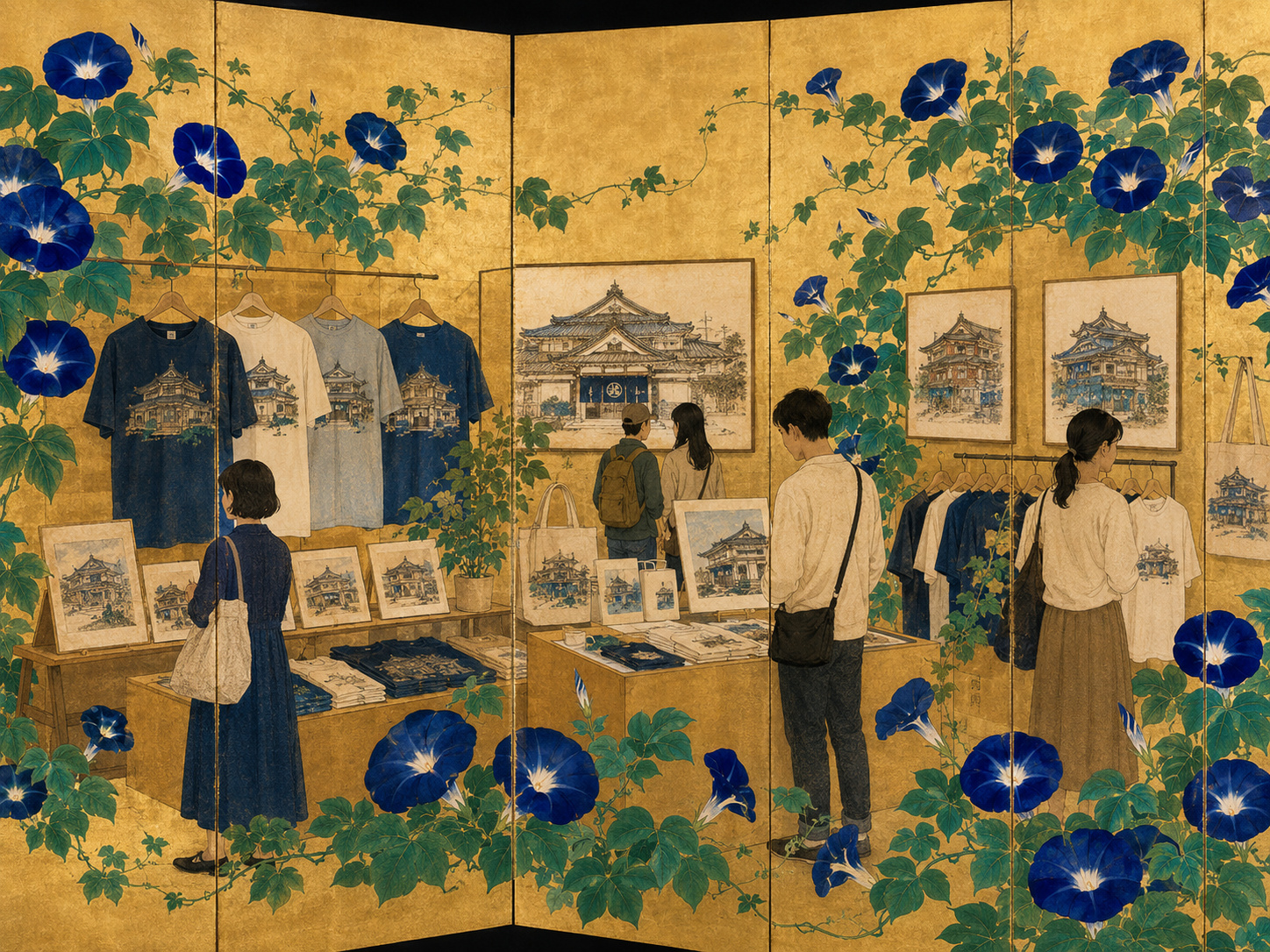
Kinko’s Japan is opening “Sento Zukai Hyakkaten,” a free pop-up exhibition at Tsukuru Work Shinjuku Center Building from August 22 through 30. Panels, newly drawn works and the production process will be displayed. A recreated bandai-style photo area will let visitors leave messages. On August 23, Enya will lead two transparent-watercolor coloring workshops, eight participants per session.
And visitors can do something that would once have been a strange ending for an architectural drawing:
choose a bathhouse and wear it.
Kinko’s on-demand printing system will print a selected Sento Zukai image onto a T-shirt for ¥3,850 while the visitor watches the object being made.
A disappearing room becomes portable.
An architect’s drawing that refuses to remove the people
Isometric drawing was developed to make three-dimensional form legible without ordinary perspective.
Parallel lines remain parallel. Dimensions can be compared. A room can be opened visually so that walls, fixtures and circulation become understandable at the same time.
Enya studied architecture and completed a graduate program in architecture at Waseda University in 2015 before working at a Tokyo design office. The technique she eventually used for Sento Zukai came from that professional vocabulary.
Her version is deliberately not strict drafting.
She has explained that a formal isometric projection normally uses axes separated evenly by 120 degrees, but she changes the angle depending on the bathhouse. The method is adapted to reveal what matters about each place.
This small act of disobedience is the key to the work.
A construction drawing removes ambiguity so a building can be built.
Sento Zukai adds ambiguity back so a building can be remembered.
Transparent watercolor softens surfaces that a CAD model would render perfectly. Tiny human figures return scale and behavior to the room. Handwritten explanations tell the viewer where a particular bath is unusually deep, where light falls, where a customer likes to sit, what the owner changed, or what happens after bathing.
The result is simultaneously more objective and more subjective than a photograph.
The dimensions are measured.
The choice of what deserves attention belongs to Enya.
A floor plan tells you where the bath is. Sento Zukai tries to tell you what it is like for someone to be there.
The first drawing began as an explanation to a friend
The project did not begin as heritage preservation.
It began because Enya wanted to explain a pleasure.
After health problems forced her to take leave from architectural work, she began visiting public bathhouses. She later described the experience as changing her image of sento. What she had associated with old facilities for households without private baths appeared instead as a sophisticated social and architectural space.
She wanted a friend—another architecture graduate who had never been to a sento—to understand why.
A conventional floor plan felt inadequate.
So she drew the room obliquely, opening the building enough to see the internal relationships at once.
She began publishing the drawings on social media in late 2016. Kosugiyu, the long-running bathhouse in Koenji, noticed her work and invited her to make a brochure. After trying to return to architectural-office work and finding that her health still made the workload difficult, she consulted Kosugiyu’s young manager. In March 2017, she chose a path that would once have looked like leaving architecture: she became a bathhouse attendant while continuing to draw.
In retrospect, she had not left architecture.
She had changed the client.
Instead of drawing buildings before they existed, she began drawing them after thousands of ordinary bodies had already given them meaning.
1591 — The earliest recorded public bath in Edo opens near Zenigame Bridge, according to the 1614 Keicho Kenmonroku.
1912 — The first famous Fuji bathhouse mural is said to be painted at Kikai-yu in Kanda Sarugakucho.
1923 onward — After the Great Kanto Earthquake, temple-style “miyazukuri” bathhouses spread in Tokyo during reconstruction.
1948 — Japan enacts the Public Bathhouses Act.
1968 — Tokyo bathhouses reach a postwar peak of 2,687.
1981 — The Act on Special Measures to Secure Public Bathhouses is enacted because ordinary public baths are already declining sharply.
2016 — Enya begins publishing Sento Zukai drawings on social media.
2017 — She joins Kosugiyu in Koenji as an attendant while continuing illustration work.
February 2019 — Chuo Koron Shinsha publishes Sento Zukai, containing 24 bathhouse illustrations.
End of 2025 — Tokyo records 417 ordinary public bathhouses.
August 1, 2026 — Tokyo raises the adult controlled sento price ceiling from ¥550 to ¥600.
August 22, 2026 — “Sento Zukai Hyakkaten” opens in Shinjuku.
Tokyo once needed a bathhouse in almost every neighborhood
The architecture Enya records was created by a city whose housing worked differently.
Bathing in Japan has religious, hygienic and social roots extending far earlier than Edo. Buddhist temples maintained baths, and some eventually opened them to the public. By the late medieval period, commercial bathing businesses were developing.
Tokyo’s own sento story is conventionally dated to 1591.
The Tokyo Sento Association cites the Keicho Kenmonroku, published in 1614, which records that a man from Ise opened a public bath near Zenigame Bridge, around today’s Tokiwa Bridge area, the year after Tokugawa Ieyasu entered Edo.
The city grew quickly.
Early Edo baths were often steam-oriented. Later designs combined steam and hot water. Bathhouses became social spaces as much as washing facilities. Upstairs rooms could offer tea, sweets, games and conversation. Public bathing was integrated into a city in which private household bathing was constrained by fire risk, cost, water and housing form.
The modern sento therefore inherited two jobs.
Wash the body.
Hold the neighborhood.
The building itself became theatrical
Many people abroad imagine a “traditional Japanese bathhouse” as an ancient form.
Some of its most recognizable Tokyo architecture is comparatively modern.
The grand miyazukuri bathhouse—with temple-like roof, dramatic karahafu gable, high ceilings and elaborate carpentry—is generally associated with the reconstruction period after the 1923 Great Kanto Earthquake. The Tokyo Sento Association explains that shrine and temple carpenters brought their skills into the building boom, producing bathhouses whose entrances looked more ceremonial than utilitarian.
The scale performed a social trick.
The customer paid a regulated neighborhood price and entered something that felt almost monumental.
Inside, the high changing-room ceiling made an ordinary routine expansive. Clerestory windows admitted light and helped ventilation. The bathing room often opened into another visual world: tile scenes, gardens or enormous painted landscapes.
Function became spectacle without becoming luxury.
Why Fuji appeared above naked Tokyo
The Fuji mural now seems inseparable from the idea of a Tokyo sento.
It was an invention.
The commonly told history places the first major bathhouse Fuji painting in 1912 at Kikai-yu in Kanda Sarugakucho. The owner reportedly wanted to brighten a bare wall and commissioned painter Koshiro Kawagoe. Mount Fuji became the subject.
The idea spread.
Painted landscapes gave a closed wet room an impossible horizon. The bath became larger in the mind than in the building. Mountain, sea and sky arrived above the steam.
The imagery was never the only sento art. Ceramic tile pictures, mosaic murals, decorative carpentry, gardens and later graphic design all became part of public-bath visual culture. But Fuji acquired extraordinary symbolic power because it joined a nationally recognizable landscape to an intensely local room.
Enya’s drawings invert the relationship.
The old mural put an imaginary landscape inside the bathhouse.
Sento Zukai puts the entire bathhouse inside a picture.
The decline began before nostalgia noticed
Tokyo had approximately 2,900 bathhouses in 1937, according to the bathhouse association’s historical records.
The 1945 air raids reduced the number to roughly 400.
Then the city rebuilt.
By 1968, the count reached 2,687—the postwar peak.
And then the fundamental market changed.
Private bathrooms became normal housing equipment. Nationally, the Health Ministry notes that the spread of home baths reduced demand for ordinary public baths. Operators faced aging buildings, rising costs, valuable urban land and succession problems. A bathhouse whose site could become an apartment building had to justify itself economically against a very different use of the same land.
Tokyo’s decline is stark.
766 bathhouses remained in 2011.
520 in 2019.
430 at the end of 2024.
417 at the end of 2025.
Compared with the 1968 peak, roughly 84% had disappeared.
Nationally, the Health Ministry counted 2,730 “general public bathhouses” at the end of fiscal 2024, down from 3,231 just four years earlier. That category is broader than privately operated neighborhood sento alone, so it should not be read as a perfect national sento count. The direction is unambiguous.
Japan recognized the problem in law decades ago. The 1981 Act on Special Measures to Secure Public Bathhouses states that public baths were “indispensable” in residents’ daily lives and already declining significantly, and it directs national and local governments to take measures to preserve access.
A cultural endangered-species law is not what it is.
It is a public-health law.
That difference is revealing.
Why 417 does not mean “almost dead”
The decline curve tells only half the story.
Tokyo’s own data show something surprising: as the number of bathhouses continued falling, average daily use at the remaining facilities rose.
The metropolitan government estimates 120 users per bathhouse per day in 2011.
By 2019 the figure was 144.
In 2024, 163.
In 2025, 180.
These are calculated averages derived from bathhouse revenue data, not door-counter measurements at every facility. They also do not show profitability—energy, labor, renovation and land costs can rise faster than attendance.
Still, the pattern complicates the idea of a dying custom that nobody wants.
There are fewer sento.
Many of the survivors are busy.
Some have become destinations: renovated architecture, saunas, craft drinks, art, running clubs, local events, tourism and social media have brought in customers who own perfectly good bathrooms at home.
The sento is shifting from necessity toward chosen public life.
That can save some buildings.
It can also change them.
Preservation can require renovation
Architectural preservation often imagines an original state that should be frozen.
Sento rarely have that luxury.
They are wet, heated, heavily used commercial buildings. Boilers fail. Pipes corrode. waterproofing ages. Accessibility expectations change. Customers want showers, saunas, cold baths or better changing rooms. Fuel systems become expensive. Earthquake safety cannot be ignored.
Tokyo’s surviving miyazukuri bathhouses therefore present a practical paradox.
Change too little, and the business may close.
Change too much, and the thing people wanted to preserve may disappear while the business survives.
Recent renovations show both possibilities. Traditional gables and lattice ceilings can remain while reception areas, bathing equipment and mechanical systems are modernized. Other sento deliberately choose contemporary architecture, treating public bathing as a living building type rather than a museum style.
Enya’s archive is valuable partly because it does not require the argument to be resolved first.
She can draw the old bath before renovation.
She can draw the new one after.
The record can contain change.
- Plan and volume: how changing room, bathing room, tubs, wash stations and circulation relate.
- Mechanical culture: faucets, bath edges, fixtures and service details that users touch but architectural histories often ignore.
- Visual culture: murals, tilework, gardens, signs, clocks, refrigerators and small objects.
- Behavior: where people sit, wash, wait, cool down and talk.
- Owner decisions: renovations, services and local practices discovered through interview.
- Atmosphere: watercolor and selected viewpoint reintroduce feeling that measured drawings normally suppress.
Drawing naked people without making them portraits
Public baths pose an unusual documentation problem.
The architecture is at its most alive when photography is at its most intrusive.
A documentary photograph during business hours raises obvious privacy issues. An empty-room architectural photograph avoids those issues but removes the behavior the architecture was designed to hold.
Illustration offers a third route.
Enya can populate the bathhouse without turning identifiable customers into subjects. Figures can represent posture, use and social distance rather than individual identity.
This is one reason Sento Zukai has more in common with historical urban screens or architectural cutaways than with ordinary travel illustration.
It records a public choreography.
Where do strangers look?
How far apart do they sit?
Which edge of a tub becomes a resting place?
How does the wall between men’s and women’s baths divide space while the same mural, roof or building connects it?
These are architectural facts expressed through bodies.
A T-shirt is a strange preservation medium—and an honest one
The Shinjuku pop-up is called a “department-store exhibition.”
That title acknowledges commerce rather than pretending the event is a museum.
Postcards cost ¥440. Acrylic key chains ¥1,100. Handkerchiefs ¥1,210. Canvas-style mounts ¥3,850. The on-demand T-shirt is also ¥3,850. Books are for sale. Online goods continue through September 13.
It would be easy to dismiss this as merchandising a disappearing culture.
But sento themselves have always lived at the intersection of culture and ordinary commerce.
You pay to enter.
Bathing prices for ordinary public bathhouses are still controlled by prefectural government. Tokyo raised the adult ceiling from ¥550 to ¥600 on August 1, 2026 because operators face rising costs. The child prices remain ¥200 for ages 6–11 and ¥100 for younger children.
That controlled ¥600 bath and a ¥3,850 art T-shirt belong to different economic systems, but the contrast is useful.
The bathhouse must heat thousands of liters of water, maintain sanitation, pay staff, repair pipes and preserve a large wet building while charging a politically regulated neighborhood price.
The image of the bathhouse can circulate through books, prints and clothing at market prices.
The representation may sometimes be easier to sustain than the building represented.
That is uncomfortable.
It is also why directing cultural interest back toward actual baths matters.
The shirt turns architecture into a route back to the building
The most useful version of sento merchandise is not a substitute for bathing.
It is an invitation.
Enya’s 2019 book presented 24 baths with descriptions as specific as “the king of outdoor baths,” “a masterpiece of contemporary bathhouse architecture,” “a bathhouse to cry in” and “like going home.” The language refuses to treat sento as interchangeable relics.
Each is a place.
That matters because the economic problem of sento is local. Admiring “Japanese bath culture” in the abstract does not pay the gas bill at a particular bathhouse.
Visiting does.
Buying a drink there does.
Returning does.
A T-shirt that makes somebody ask, “Which bathhouse is that?” can become a map.
The preservation value depends on whether curiosity returns to the real room.
The legal category still says “necessary for daily life”
There is another tension between the cultural image and the legal object.
The Health Ministry divides public baths into categories. Ordinary public bathhouses—the legal category that includes the neighborhood sento—are defined as facilities used because they are necessary for public health in residents’ daily lives, and their basic bathing fee remains price-controlled.
That language comes from a period when many households genuinely had no bath.
Today, private bathrooms are nearly universal. The Health Ministry cites home-bath ownership above 95% in earlier housing statistics and directly identifies home-bath spread, declining users, aging owners and succession difficulty as reasons bathhouse businesses have disappeared.
Yet the 1981 special law has not become meaningless.
Its later provisions explicitly recognize public baths as places that can contribute to health promotion and interaction among residents.
The public value moved.
From “where people can wash” toward “where people can still be public together.”
That does not mean hygiene ceased to matter. It means hygiene is no longer the only reason a neighborhood might care whether the building survives.
What the drawing cannot save
Documentation is often confused with preservation.
They are not the same.
A perfect measured drawing of a closed bathhouse cannot heat water.
It cannot employ the owner’s daughter.
It cannot preserve the smell of wet wood, the temperature gradient between changing room and bath, the neighborhood regular who always arrives at 4:10, or the conversation that occurs because two people happen to sit beside one another.
A drawing can preserve evidence.
That evidence becomes more valuable precisely because it admits loss.
Architectural archives usually privilege monuments, major architects and buildings already judged important. Sento Zukai begins from a different proposition: an ordinary commercial interior used by hundreds of people can deserve the same patience of measurement and representation.
That is a democratic architectural argument.
| Claim | What the evidence supports | What it does not establish |
|---|---|---|
| “Sento are disappearing.” | Tokyo fell from 2,687 bathhouses in 1968 to 417 at the end of 2025; national ordinary public-bath facilities also continue to decline. | That public bathing has no audience or every remaining operator is failing. |
| “Sento Zukai is architectural documentation.” | Enya measures dimensions, photographs, interviews owners and uses an architectural isometric method before watercolor rendering. | That the illustrations are certified measured drawings suitable for construction or conservation engineering. |
| “The pop-up preserves sento culture.” | It displays drawings, process material and books and turns bathhouse images into objects that can reach new audiences. | That selling merchandise directly prevents any bathhouse from closing. |
| “Traditional sento architecture is ancient.” | Public bathing has centuries of history. | That every familiar architectural feature is ancient; Tokyo’s temple-style sento and Fuji mural traditions are largely 20th-century developments. |
The pop-up itself is an act of translation
The event’s three verbs are essentially: see, make, draw.
See the panels and newly created works.
Make a shirt by selecting an image and watching on-demand printing turn a digital artwork into a physical object.
Draw with Enya using transparent watercolor at the August 23 workshop.
Each stage translates the same architecture.
A wet room becomes a measured sketch.
The sketch becomes watercolor.
The watercolor becomes a book page.
The page becomes a panel.
The panel becomes a shirt.
The shirt leaves Shinjuku on a human body.
This multiplication is almost the opposite of the sento’s economic reality.
The image can reproduce indefinitely.
The building cannot.
There is only one plumbing system, one roof, one parcel of land, one owner deciding whether to open again tomorrow.
Tokyo has 417 reasons not to speak of “the sento” in the singular
Decline statistics flatten difference.
Four hundred seventeen sounds like a category.
In reality, it is hundreds of separate negotiations with survival.
One owner keeps an old karahafu roof.
Another replaces the entire building.
One adds a sauna.
Another deliberately does not.
One attracts runners.
One becomes an inbound destination and has to explain why swimsuits do not go into the tub.
One survives because older neighborhood residents still depend on it.
One becomes popular with people in their twenties who have baths at home but want a large tub and a place where phones disappear.
The Tokyo Sento Association’s current map lists hundreds of facilities with different combinations of gardens, hot baths, cold baths, saunas, laundries, traditional attendants and modern front desks.
A useful archive has to preserve that variation.
Enya’s decision to change the viewing angle for each drawing is therefore more than aesthetic.
The viewpoint refuses standardization.
Architecture becomes heritage at the moment somebody notices it may not return
There is a sad rhythm in urban preservation.
Ordinary buildings are often invisible while common.
Only when the number falls do details become “heritage.”
The neighborhood diner’s sign. The public housing stair. The old barber pole. The bathhouse shoe locker. The wicker basket once used instead of a locker. The wooden attendant platform. The curved ceiling. The milk refrigerator.
None was designed to be rare.
Rarity arrived around them.
Sento Zukai intervenes slightly earlier.
It treats the room as worth looking at while it is still doing its job.
That may be the series’ most important preservation instinct.
Do not wait for closure to make the building visible.
The saddest architectural drawing is the one made only after the demolition notice. Enya’s drawings begin while the water is still hot.
On August 22, the drawing leaves the wall
At 11 a.m. on Saturday, if the published schedule holds, the basement pop-up in Shinjuku opens.
The event will run nine days.
Somebody may come because they already know the bathhouse in the drawing.
Somebody else may come because the blue-and-white geometry looks good on a shirt.
One visitor may study the process panels and realize that the tiny faucet spacing was measured, not guessed.
Another may leave a message at the recreated bandai.
Another may buy the 2019 book and discover that a building they have walked past for years contains a garden, a high ceiling or a strange bath arrangement they never knew existed.
That sequence matters.
Architecture usually asks us to enter a building in order to know it.
Enya reverses the order.
She opens the walls first.
Then, if the drawing succeeds, you want to go inside.
For a culture losing bathhouses one address at a time, that may be the useful purpose of the picture.
Not to replace the building.
To make the building difficult to ignore while it is still there.
- Kinko’s Japan — August 20, 2026 announcement of “Sento Zukai Hyakkaten”
- Asahi Shimbun Good Life with Books — 2019 interview with Honami Enya on measurement, isometric drawing, watercolor and Kosugiyu
- Chuo Koron Shinsha — Sento Zukai, 2019; 24 illustrated bathhouses
- National Diet Library — bibliographic record and Enya biography
- Tokyo Sento Association — history of public bathing and Edo sento
- Tokyo Sento Association — miyazukuri architecture, bathhouse art and the 1912 Fuji mural tradition
- Tokyo Sento Association — long-term Tokyo bathhouse count including the 1968 peak
- Tokyo Metropolitan Government — 2025 bathhouse count, user estimates and 2026 controlled bathing price
- Ministry of Health, Labour and Welfare — public-bath industry overview and decline of ordinary public bathhouses
- Ministry of Health, Labour and Welfare — Public Bathhouses Act overview
- Act on Special Measures to Secure Public Bathhouses — 1981 law recognizing public baths as important daily-life and welfare facilities
- Tokyo Metropolitan Government — 2026 adult bath price increase to ¥600 from August 1
Editorial note: “Sento Zukai Hyakkaten” begins August 22 and had not opened when this article was prepared. Event details are therefore reported as scheduled, not as completed attendance or sales results. The Tokyo count of 417 is the Metropolitan Government’s total at the end of 2025; the Tokyo Sento Association’s member and map counts may differ slightly by date and definition. The national figure for “general public bathhouses” is a legal/statistical category broader than privately operated neighborhood sento alone. Enya’s drawings are described as architectural documentation in a journalistic sense because they use field measurement and architectural projection; they are not presented as certified conservation surveys or construction drawings.