The first surprise is not the flower.
It is the absence of everything else.
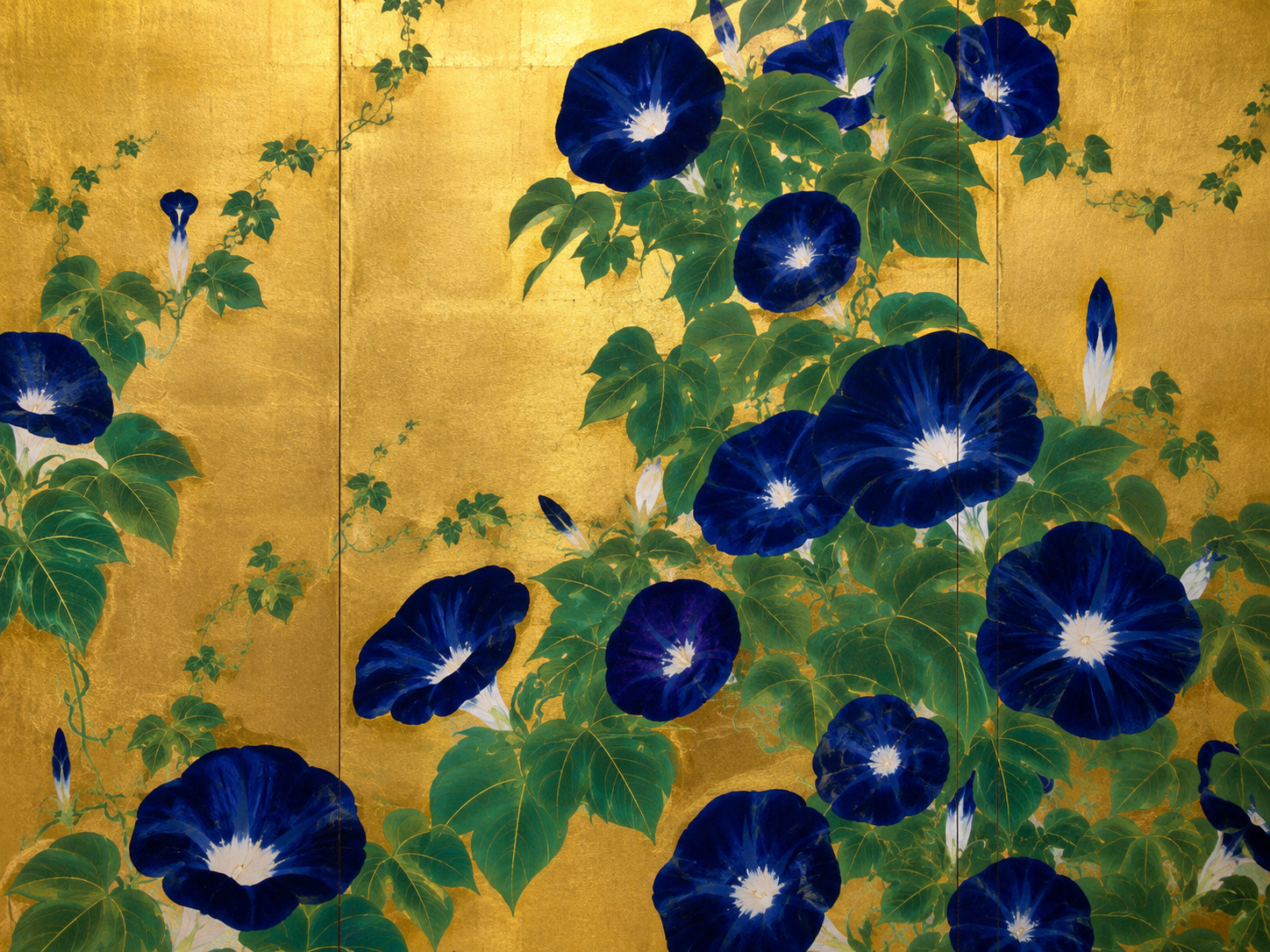
Suzuki Kiitsu’s Morning Glories—Asagao-zu byōbu—is a pair of six-panel folding screens now in the collection of The Metropolitan Museum of Art in New York. The Met gives each painted image as 178.3 centimeters high and 379.7 centimeters wide. Put the pair conceptually side by side and the painted field approaches 7.6 meters across.
Yet Kiitsu does not fill that monumental surface with a monumental story.
There is no court romance, no famous mountain, no birds, no moon, no architecture, no poem written into the image, no human figure to tell us where we are.
There are morning glories.
Deep blue flowers hover against gold. Green leaves move in linked masses. Thin tendrils shoot outward, curl, reverse and reach into empty areas. On the right-hand screen, the growth seems to rise. On the left, it spills downward as if supported by a trellis that Kiitsu refuses to paint.
The Met describes those two movements as carefully orchestrated rather than wild. That distinction matters.
The screen looks as if nature has escaped control.
Its control is actually extraordinary.
A screen so large that the flower becomes architecture
A folding screen is not simply a large flat painting with hinges.
It is furniture, architecture and image at the same time.
Japanese folding screens could divide large interiors, create intimate zones inside reception rooms, block drafts, redirect sightlines and establish a temporary visual environment. The Met notes that Rinpa screens were rotated seasonally and used to set the atmosphere for activities such as poetry and tea.
Gold was especially effective indoors.
In pre-electric rooms, metallic surfaces did not behave like the white wall of a modern gallery. They caught and returned changing light. Candlelight, daylight and the angle between folded panels could make the surface shift.
This is one reason the photograph of Morning Glories can never fully reproduce the original object.
On a screen, the gold is not only a color.
It is light-producing architecture.
The folds matter too. A vine that appears continuous in a flattened museum image would advance and recede slightly in physical space. Blossoms on one panel could turn toward or away from the viewer depending on how the screen was opened.
Kiitsu designed a picture that changes as a room changes.
The morning glories do not sit on a gold background. In the original format, gold, folds, light and vines become the room.
The painting has no garden—yet a gardener is hiding everywhere
The Met uses a Rinpa term, rusu moyō, or “motif of absence,” to help explain works in this tradition.
In Ogata Kōrin’s famous iris screens, human figures from the literary source are omitted. Their absence allows viewers to occupy the scene imaginatively.
Kiitsu’s morning glories perform a related trick.
No trellis is painted.
But the cascading vines imply one.
No gardener appears.
But morning glories of this scale and density belong to cultivation as much as wilderness.
No wall or garden fence establishes a place.
But the plant’s trained movement reveals human intervention.
The unseen support system is one of the painting’s most sophisticated ideas.
Kiitsu removes the object and leaves the behavior it caused.
We see what the trellis did without seeing the trellis.
To understand Kiitsu, go backward through Hōitsu and Kōrin
Rinpa is often called a “school,” but its history does not resemble a simple academy in which one master taught an unbroken line of students.
The movement formed through acts of admiration and reinvention separated by generations.
In early Edo Kyoto, Hon’ami Kōetsu and Tawaraya Sōtatsu developed an aesthetic in which classical literature, calligraphy, gold and silver, bold natural motifs and decorative surface could become a unified environment. Roughly a century later, Ogata Kōrin transformed that inheritance into some of the most famous designs in Japanese art.
Another century passed.
In Edo, Sakai Hōitsu revived Kōrin’s art again.
Hōitsu did more than imitate. He researched, catalogued and republished. His Kōrin hyakuzu—One Hundred Paintings by Kōrin—appeared first in 1815, with sequel volumes in 1826. It functioned as a visual archive and design textbook for an artist who had died a century earlier.
Kiitsu entered that world as Hōitsu’s principal pupil.
The Met says Kiitsu worked closely with him from the mid-1810s and helped prepare the illustrated compendium. The relationship was close enough that late works can raise questions of collaboration and studio practice.
Yet transmission did not flow in only one direction.
The Met has argued that by the 1820s Hōitsu himself appears to have absorbed some of the crisp stylized patterning of the younger Kiitsu, who had trained in textile dyeing.
That is a more interesting artistic lineage than obedience.
Student learns from master.
Master learns from student.
Both learn from an artist dead for a century.
Early 1600s — Hon’ami Kōetsu and Tawaraya Sōtatsu help establish the decorative current later called Rinpa in Kyoto.
1658–1716 — Ogata Kōrin turns that inheritance into a highly influential graphic language of flowers, gold, rhythm and literary allusion.
1761–1828 — Sakai Hōitsu revives and reinterprets Kōrin in Edo, creating what is now often called Edo Rinpa.
1796 — Suzuki Kiitsu is born into a cloth-dyeing family.
Mid-1810s — Kiitsu works closely with Hōitsu and assists with the Kōrin revival project.
1815 — First volumes of Hōitsu’s Kōrin hyakuzu are published.
1826 — Two sequel volumes of Kōrin hyakuzu appear.
1848–1860 — Edo experiences a second major craze for mutant morning glories.
Circa 1850 — The Met dates Morning Glories to around this period in its Rinpa interpretive material.
1858 — Kiitsu dies near the end of the Edo period.
1954 — The Metropolitan Museum of Art acquires the screens through the Seymour Fund.
The textile dyer never left the painter
The visual logic of Morning Glories makes more sense when Kiitsu’s textile background is taken seriously.
The Met describes him as trained as a textile dyer; another Met record notes that he was the son of a cloth dyer. Either way, patterned surface was not an abstract concept to him.
A textile designer thinks differently from a landscape painter.
The edge of the surface matters. Repetition matters. Rhythm matters. A motif can recur without describing a continuous three-dimensional world. Empty ground can be as active as the motif placed on it.
The morning glories behave that way.
They are convincing as plants, but the composition does not ask us to believe that we are looking through a window onto a literal garden.
Leaves overlap because leaves overlap in life—but also because overlapping green shapes make a cadence across gold.
Flowers turn in different directions because blossoms do—but also because blue circles need to pulse across twelve panels.
The vine curls because vines curl—and because a line on gold is one of the oldest pleasures in decorative art.
Nature is observed.
Then redesigned.
Morning glory was the right flower for late Edo obsession
Kiitsu did not choose an obscure plant.
By the time he painted these screens, morning glories were at the center of a horticultural mania.
The National Diet Library traces the plant’s Japanese history back to the Nara period, when morning glories arrived from Tang China or through Baekje as a medicinal plant. They were cultivated for medicinal seed rather than primarily for ornamental display.
Edo changed that.
As urban horticulture expanded, growers became fascinated by variation. The first major morning-glory boom developed in the Bunka and Bunsei eras, especially after exhibitions in 1816. Flowers and leaves that departed from ordinary forms became prized as henka asagao—variant or mutant morning glories.
The second great boom came from roughly 1848 to 1860.
That timing overlaps strikingly with the period in which scholars place Kiitsu’s great screen.
Samurai and professional gardeners competed to produce rare shapes, colors and leaf forms. Catalogues and illustrated books circulated. Flower competitions were held. The National Museum of Japanese History notes that growers maintained astonishing mutant strains through practical knowledge of inheritance long before Mendelian genetics was formulated.
This transforms our reading of Kiitsu.
The screen is seasonal.
It is also contemporary.
He was painting a flower that Edo consumers were breeding, ranking, publishing, buying and obsessing over in real time.
The work belongs to garden culture as much as art history.
And yet he refuses the fashionable freak flower
There is a subtle twist.
The late-Edo morning-glory craze prized extraordinary mutations—strange petals, unusual leaves, colors and forms that could look barely related to the familiar flower.
Kiitsu’s great screens do not primarily celebrate that catalogue of oddities.
They amplify the ordinary form.
One Japanese art-historical analysis counts roughly 150 open blossoms, along with buds and leaves, across the pair. Even without relying on an exact count, abundance is unmistakable.
The innovation is not “look at this rare specimen.”
It is “look what happens when the familiar specimen becomes the whole world.”
That decision may be why the picture ages so well.
A screen full of fashionable horticultural curiosities would document a craze.
Kiitsu instead turns the craze’s most recognizable flower into pure visual force.
Blue, green, white, gold: four colors are enough
The composition is almost brutally limited.
Gold.
Blue.
Green.
White.
The Met describes thick mineral pigments against gold leaf as central to the screen’s decorative effect.
There are subtle variations inside those categories, especially among the blues and greens, but the image reads from a distance as a compressed palette.
This gives the work something close to graphic-design clarity.
Imagine replacing gold with a painted sky and adding soil, fence, clouds and a house.
The morning glories would immediately become smaller.
Not physically.
Conceptually.
They would have to share reality with other things.
Kiitsu gives them no competition.
The gold has another effect. It refuses ordinary depth. A blue blossom does not recede into atmospheric perspective. It sits against a metallic plane, simultaneously botanical form and designed mark.
The flower becomes almost a logo without ceasing to be alive.
Kōrin’s irises are the ancestor standing behind the screen
It is difficult to stand before Morning Glories without remembering Ogata Kōrin’s Irises at Yatsuhashi.
The Met itself places the works in direct dialogue.
Kōrin’s pair, painted after 1709, presents groups of irises and an angular bridge against gold. The subject refers to The Tales of Ise. A knowledgeable viewer could reconstruct the absent traveler, the poem, the journey and longing from the flowers and bridge.
Kiitsu keeps the logic of repetition, gold and botanical concentration.
Then he pushes away more context.
No bridge.
No explicit literary key.
No visible marsh.
The Met curator Sinéad Kehoe has noted that Morning Glories is so detached from a specific reference that pinning it to one literary or religious source is difficult. The seasonal association may be enough.
This is one reason Kiitsu can feel more modern than the work he inherited.
The viewer does not need to solve the iconography before the design works.
Blue, green and gold hit first.
History can arrive afterward.
Rinpa never required realism—and Kiitsu wanted some anyway
Kiitsu is often placed at an edge of the Edo period where visual systems were becoming unusually porous.
The Met describes a tension between naturalism and decoration as central to his art. By Kiitsu’s time, Western drawings, printed materials and approaches to perspective and naturalistic observation had become more available in Japan. Artists associated with the Maruyama-Shijō traditions had also developed forms of close natural observation.
Kiitsu did not abandon Rinpa for realism.
He made the two coexist.
The leaf can feel botanically alert while still functioning as pattern.
A flower can turn convincingly in space while the overall screen denies conventional space.
His late Irises at The Met go even further, combining sharp Rinpa graphic design with a form of realism the museum calls almost surreal and a precursor to later Nihonga hybrids.
The Nezu Museum makes a similar point about Kiitsu’s Mountain Streams in Summer and Autumn: intense reality sits beside something eerily artificial.
This is not a contradiction to solve.
It is the engine of Kiitsu’s modernity.
- No horizon: the gold ground becomes spatially ambiguous.
- No visible trellis: the trained movement of vines makes the missing structure present by implication.
- No human figures: the viewer can enter the garden mentally.
- No narrative scene: color and rhythm work before literary knowledge.
- No broad palette: blue, green, white and gold gain extraordinary visual force.
- No single focal flower: the eye must travel across the whole pair of screens.
The screen has no center because the eye is supposed to move
Western easel painting often trains viewers to search for a focal point.
Morning Glories keeps refusing one.
The Met reminds viewers that Japanese screens are read from right to left. Begin at the right edge and the vines rise. Follow them inward and blossoms accumulate. Across the left screen, growth drops and spreads. Tendrils curl into gold and redirect the eye.
There are pauses.
The empty gold between masses of leaves is not leftover space.
It is rhythm.
This is where the textile logic becomes most visible.
Pattern requires recurrence.
Good pattern also requires interruption.
If every centimeter were covered, there would be no pulse.
Kiitsu makes abundance depend on emptiness.
Gold does not mean what a photograph says it means
Modern screens make gold look like yellow.
Gold leaf is not yellow paint.
The Met’s Rinpa research traces the use of metallic surfaces through earlier Japanese traditions, including decorated papers and Heian-period Buddhist manuscripts. In later screens, gold could serve luxury, status, refinement, abstraction and illumination at once.
Kiitsu inherited that history.
But Morning Glories uses gold almost ruthlessly.
There is so much of it that it ceases to feel like precious ornament applied to a picture.
It becomes the condition in which the picture exists.
Gold also refuses weather.
The morning glories are seasonal flowers, associated with late summer and early autumn, but there is no blue sky telling us the time of day. No rain. No cloud. No shadow describing afternoon.
The flower’s season is specific.
The gold’s time is not.
The most temporary flower receives the most permanent-looking ground
Morning glories open early and fade quickly.
Edo poetry knew the point.
A circa-1843 Hiroshige print in The Met combines morning glories with a haikai poem that reflects on flowering plants whose whole lives seem to pass while we watch.
Kiitsu’s gold screens create an almost opposite sensation.
These flowers do not appear to be about to disappear.
They look arrested at maximum life.
Gold gives an ephemeral bloom the visual authority of something permanent.
That is not botanical truth.
It is painting’s power.
The flower dies in a day.
The screen makes the morning last.
Why the work feels like Art Nouveau before Art Nouveau
Modern viewers regularly describe Kiitsu as startlingly contemporary.
The temptation is to turn that reaction into a false prediction: Kiitsu “anticipated” modernism or Art Nouveau.
He did not need to predict Europe in order to be radical in Edo.
Still, the visual resemblance is understandable.
Long vegetal lines curl across flat surfaces. Repetition creates total design. Figure and ground exchange importance. Natural motifs become pattern without becoming geometric. Empty space has structural force.
Japanese art would, after Kiitsu’s death, exert real influence on European design through Japonisme. But the better way to understand Morning Glories is not as an accidental prelude to Western modernity.
It belongs to its own lineage of textile, screen, lacquer, poetry and seasonal design.
Its modernity comes from how completely Kiitsu understood that lineage—and how little he feared simplifying it.
The museum owns the object; nobody owns the image anymore
The Met acquired Morning Glories in 1954 through the Seymour Fund. The object numbers are 54.69.1 and .2.
The museum currently lists the screens as not on view.
But in one modern sense, the picture is more accessible than ever.
The Met identifies the work as Public Domain and provides its image through the museum’s Open Access program for unrestricted commercial and noncommercial use without a permission fee.
That matters for an artwork built around reproduction and design.
A screen once commissioned for an interior can now become a classroom slide, a phone wallpaper, a scholarly detail, a design study or an art feature on a website in seconds.
Of course, digital access creates the paradox we have already encountered.
The flattened file makes the image available everywhere.
It removes the folds, scale and reflected light that made the physical screen what it is.
Open access gives us the picture.
It cannot give us the room.
| Claim | What the evidence supports | What it does not establish |
|---|---|---|
| “Kiitsu was a textile dyer.” | The Met describes him as trained as a textile dyer and elsewhere as the son of a cloth dyer; textile design clearly informs its interpretation of the screens. | A complete documented reconstruction of his early dyeing career from the sources used here. |
| “Morning Glories dates to 1850.” | The Met’s Rinpa interpretive essay dates it circa 1850; the collection record uses the broader “early 19th century.” | An exact year of execution. |
| “The screens depict Edo’s mutant-morning-glory craze.” | The probable date overlaps the 1848–60 boom, and morning-glory culture was highly fashionable in late Edo. | That Kiitsu intended the work as a botanical catalogue of specific mutant cultivars. |
| “The work has no human presence.” | No human figure is depicted. | That cultivation is absent; the implied trellis and trained vines suggest human intervention. |
| “The image is public domain.” | The Met explicitly labels the work Public Domain and offers Open Access images. | That the physical screens are free of museum ownership, handling or exhibition restrictions. |
Kiitsu’s last decade makes the screen even stranger
Place the work around 1850 and the historical background changes.
Edo is still Edo.
But not for long.
American warships will arrive in 1853. Japan’s treaty system and political order will begin to shift. Kiitsu will die in 1858, only ten years before the Meiji Restoration ends the Tokugawa shogunate.
His late work already contains a visual world becoming more porous.
Western naturalism is available as one source among others. Edo horticulture is producing strange new forms. Publishing circulates design histories. Hōitsu’s project has made Kōrin portable through printed books. Urban consumers are intensely aware of fashion, flowers and surface.
Kiitsu takes all of that and paints something that feels almost timeless only because he removes the evidence of time.
No ship.
No city.
No shogun.
No technology.
Just a fashionable flower growing with impossible confidence across gold.
Why this is our August 22 Art Choice
The August 22 edition of Japan.co.jp is full of systems people are trying to redesign.
A plastic designed to become fertilizer.
A satellite constellation trying to see Earth more frequently.
AI designed to learn with less data.
A molecular antenna designed to collect light more effectively.
A reuse center trying to catch an object before it becomes waste.
Plant factories controlling light and nutrition.
Koyasan asking whether technology should begin from nature rather than from humanity alone.
Kiitsu belongs beside those stories for an unexpected reason.
He is also redesigning a system.
He inherits a visual language from Kōrin through Hōitsu: gold, flowers, repetition, absence, screen architecture, seasonal culture.
He does not preserve it by freezing it.
He removes more.
He magnifies more.
He lets botanical observation and flat pattern push against each other.
He turns the surface into an environment.
That is how traditions remain alive.
Not by looking identical.
By continuing to produce something that could not have existed before.
Kiitsu did not paint morning glories on a gold screen. He made a gold screen surrender to morning glories.
The final trick: the flowers are everywhere, and nowhere
Stand far away and the image is simple.
Blue flowers.
Green leaves.
Gold.
Come closer and the simplicity breaks.
One vine passes another. A tendril circles into empty air. Leaves turn. Blossoms shift from dark to bright blue. White centers flash. The implied trellis appears and disappears in the mind.
There is no single place where the painting “happens.”
That may be why it stops the reader.
Most images tell us where to look.
Kiitsu gives the eye a garden with no path.
The only way through is to follow the vines.
- The Metropolitan Museum of Art — Suzuki Kiitsu, Morning Glories, object record, dimensions, medium and Public Domain status
- The Met — curator interview on Morning Glories, naturalism, textile background, gold and seasonal imagery
- The Met — “The Rinpa Experience of Nature,” Kōrin, Hōitsu, Kiitsu, rusu moyō and circa-1850 dating
- The Met — Designing Nature: The Rinpa Aesthetic in Japanese Art
- The Met — Suzuki Kiitsu, Irises, biography, collaboration with Hōitsu and late-style naturalism
- Suntory Museum of Art — Suzuki Kiitsu: Standard-bearer of the Edo Rimpa School
- Nezu Museum — Kiitsu’s Mountain Streams in Summer and Autumn and his combination of realism, design and fantasy
- National Diet Library — Edo and Meiji morning-glory booms, 1816 exhibitions and 1848–60 revival
- National Museum of Japanese History — late-Edo mutant morning glories and practical inheritance knowledge
- National Diet Library — illustrated morning-glory books and the second Edo boom
- artscape — Japanese visual analysis of Morning Glories, composition, pigment identification and approximate flower count
- The Met — Utagawa Hiroshige, Morning Glories, circa 1843, and the flower’s association with transience
Editorial note: The Metropolitan Museum of Art’s collection record dates Morning Glories broadly to the early 19th century, while its later Rinpa interpretive material dates the work circa 1850. This article therefore uses “around 1850” rather than asserting a precise execution year. The connection to the 1848–60 mutant-morning-glory boom is a historical contextualization based on that dating; there is no evidence in the sources reviewed that Kiitsu intended the screens as a catalogue of named mutant cultivars. The approximate 150-blossom count and specific pigment identifications come from a Japanese art-archive analysis and are treated as secondary scholarship rather than The Met’s object record. The hero illustration used by Japan.co.jp is an editorial homage, while the actual Met artwork reproduced within the article is Public Domain under The Met’s Open Access policy.