A thousand years is usually a metaphor.
On Mount Koya, it is a planning horizon with evidence behind it.
The monastic center founded by Kūkai in 816 has endured for more than twelve centuries. Buildings have burned and been rebuilt. Forests have been cut, replanted, restricted and managed. Religious institutions have changed legal form. Roads, railways, tourism and modern administration arrived. The surrounding Kii Mountains were inscribed on UNESCO’s World Heritage List in 2004 not as isolated monuments, but as a cultural landscape in which sacred sites, pilgrimage routes and forest are inseparable.
Against that background, the central question of Koyasan Conference 2026 sounds less extravagant than it would in a convention center:
What should people living now leave to a world 1,200 years from now?
The three-day conference runs from August 20 through 22 at Kongobu-ji and Koyasan University. It is organized by the University of Tokyo’s Research Center for Advanced Science and Technology, with the Social Value Co-Creation Forum as special co-host and Wakayama Prefecture, Koya Town, Hashimoto, Katsuragi, Koyasan University and Kongobu-ji among the co-hosts.
Its declared theme is “thinking about the future 1,200 years from now from a Nature-Centered perspective.” The organizers define that perspective broadly: human beings are not outside nature directing it, but part of the natural world and dependent upon relationships within it.
The program deliberately refuses to stay in one discipline. A cast-iron craftsman and designers discuss inheritance and transformation. Clean energy and inclusive design appear beside questions of social value. A former president of the International Court of Justice joins a session on war. Space scientists, artists and strategists discuss Earth from the perspective of space. Business executives and local leaders discuss identity and sustainability. Former hurdler Dai Tamesue leads a session beginning from the body rather than metrics. The final symposium, marking Koyasan University’s 140th anniversary, places science, art and esoteric Buddhism into the same conversation about education.
This is easy to romanticize.
A Buddhist mountain does not automatically solve climate change. A scientist does not become wiser simply by speaking inside a temple. A corporate executive does not become “Nature-Centered” because the conference program says the words.
The more interesting claim is smaller.
Place can change the question.
Why 1,200 years is not just a slogan
Kūkai was born in 774, entered Buddhist practice, traveled to Tang China in 804 and studied esoteric Buddhism in Chang’an. After returning to Japan, he sought a mountain site for religious training. In 816, imperial permission was granted for the establishment of the monastic center at Koyasan.
The choice of mountain was not incidental.
Koyasan lies within the Kii Mountain Range, a landscape of steep terrain, forests, streams and pilgrimage routes. UNESCO’s description of the wider “Sacred Sites and Pilgrimage Routes in the Kii Mountain Range” emphasizes precisely this fusion: Buddhism, Shinto traditions rooted in nature worship, sacred mountains and routes that have remained in active religious use for more than a millennium.
The World Heritage property includes Koyasan alongside Yoshino and Omine and Kumano Sanzan, linked through pilgrimage routes to ancient capitals. UNESCO does not describe the forest as scenery surrounding the heritage.
The forest is part of the heritage.
That distinction is useful for understanding why this particular mountain lends weight to a Nature-Centered argument.
At Koyasan, the cultural object is not only the temple inside the forest. The forest, the paths, the buildings, the rituals and the movement of people between them form one historical system.
The mountain learned sustainability through fire
“Nature” at Koyasan has never meant untouched wilderness.
That is one of the most important correctives to an easy environmental reading of the site.
Kongobu-ji’s own forestry history records a catastrophic fire in 994 that destroyed much of the monastic complex. Rebuilding required enormous quantities of timber and left the surrounding mountain badly depleted. Between 1011 and 1015, large-scale planting of hinoki cypress is said to have been carried out as part of the reconstruction.
The lesson repeated because the fires repeated.
Temples needed timber for repair and rebuilding. The mountain therefore developed forestry practices that tried to preserve a future timber base: selective cutting rather than indiscriminate clear-cutting, followed by replanting with useful species.
By 1813, six trees important to Koyasan—cedar, hinoki cypress, umbrella pine, red pine, fir and hemlock—were designated as the “Koya Six Trees.” Cutting them was restricted largely to the maintenance and reconstruction of temple architecture.
This was not ecological preservation in the modern scientific sense.
It was resource governance.
The forest was sacred, practical and economic at once. Trees protected the mountain landscape, but they were also future roofs, pillars and repairs. Long-term continuity depended on not consuming tomorrow’s temple to rebuild today’s.
The Meiji period disrupted that system. Much of the surrounding forest was nationalized. Forestry practices shifted as modern logging and transport expanded. From 1918 to 1945, large tracts of national forest were again managed by Kongobu-ji under a special managed-forest arrangement, and in 1920 the temple established a forestry division.
Today, Kongobu-ji still describes forest management as part of transmitting the sacred landscape to future generations. In 2015, about 125 hectares connected to traditional building materials and forest culture received recognition as a cultural asset supporting historic structures.
This history makes Koyasan a more interesting place to discuss sustainability than a pristine nature reserve would be.
It shows sustainability as maintenance after damage.
Use, loss, restriction, replanting, institutional change, repair.
Not purity.
774 — Kūkai is born.
804 — He travels to Tang China and studies esoteric Buddhism in Chang’an.
816 — Imperial permission is granted for the monastic center at Koyasan.
994 — A major fire devastates much of the mountain complex.
1011–1015 — Large-scale hinoki planting is associated with the reconstruction effort.
1813 — The “Koya Six Trees” are placed under special cutting restrictions for future temple needs.
1886 — The modern predecessor of Koyasan University, Kogi Daigakurin, opens.
1920 — Kongobu-ji establishes a forestry division.
1926 — Koyasan’s higher-education institution gains university status under the University Ordinance.
2004 — Koyasan becomes part of UNESCO’s Sacred Sites and Pilgrimage Routes in the Kii Mountain Range.
September 2020 — University of Tokyo RCAST signs cooperation agreements with Koya Town, Kongobu-ji and Koyasan University.
November 2021 — The first Koyasan Conference is held.
2024 — The Youth Koyasan Conference begins as a spin-off for younger generations.
2026 — The sixth Koyasan Conference coincides with Koyasan University’s 140th anniversary and the centenary of its 1926 university status.
The conference began with an institutional handshake
Koyasan Conference did not emerge as a stand-alone festival of ideas.
On September 4, 2020, the University of Tokyo’s Research Center for Advanced Science and Technology entered cooperation agreements with Koya Town, Kongobu-ji and Koyasan University. The stated goals included academic advancement, human-resource development, industrial development and the creation of a distinctive, energetic local community.
The first conference followed in November 2021, led by RCAST’s Advanced Art Design field. From 2022 onward, RCAST itself became the organizer.
The founding phrase was deliberately long-term: think about the world 1,200 years from now.
The conference’s logic was that a place that had already transmitted ideas, institutions and cultural practices across roughly that span could challenge the normal time horizon of research, policy and business.
Most institutions optimize for much shorter intervals.
A quarterly earnings report may look three months ahead. A product roadmap, three years. An elected government often works within an election cycle. A research grant may have a five-year horizon. A university can plan decades, but its budgets are annual.
Twelve centuries is almost useless for forecasting.
That is precisely why it can be useful for values.
No one at Koyasan can reliably predict the technologies of 3226. The first conference organizers have said as much in substance: the point is not to predict distant gadgets, but to ask what values should remain legible through radical change.
“Nature-Centered” begins as a criticism of a very successful idea
Human-centered design was an important achievement.
It forced engineers and designers to stop assuming that users would adapt to whatever technology produced. Interfaces should fit people. Buildings should account for human bodies. Services should respond to actual needs.
The Koyasan framing does not need that history to be a mistake in order to ask whether it is complete.
A system can be exquisitely optimized for the immediate human user and still externalize costs onto forests, rivers, atmosphere, nonhuman species or future generations.
A delivery service can be effortless for the customer and resource-intensive in the logistics network. A car can be comfortable while the urban system built around it consumes land. An AI system can save human time while using substantial electricity and water elsewhere. A material can solve a packaging problem while creating an end-of-life problem decades later.
“Nature-Centered,” as the Koyasan Conference uses the phrase, changes the unit of design.
The user is no longer the only entity in the frame.
The river, energy system, forest, future resident, animal habitat and disposal pathway become part of the design situation.
This does not tell engineers what answer to choose.
It tells them that the problem boundary may be too small.
Kūkai is not an environmental scientist
Modern institutions often borrow historical religious language because it gives sustainability arguments moral depth.
That can become careless very quickly.
Kūkai did not write environmental policy for the 21st century. Shingon esoteric Buddhism is not a historical version of contemporary ecological systems science. Concepts developed inside a religious-philosophical tradition should not be reduced to slogans for corporate sustainability.
The 2026 conference itself provides a safer route.
Its opening session asks Koyasan University President Junkei Matsunaga to introduce concepts including jiri-rita—self-benefit and benefit to others—and enyu, an idea of interpenetration or harmonious inclusion within a Buddhist philosophical context. The organizers then use those ideas as provocations for a change of viewpoint rather than as scientific findings.
The distinction matters.
Science can measure carbon, ecosystems, radiation, energy systems and human physiology. Art can make relationships perceptible in forms science may not capture. Religious traditions can ask what should matter and how the self is situated relative to others. Business can determine whether a technology survives contact with capital, operations and customers. Government can create rules at scale.
None of these disciplines is a substitute for the others.
That is the point of putting them in the same room.
The program is designed to make disciplines uncomfortable
The seven numbered sessions and opening program are not variations on one sustainability seminar.
The first day begins with Buddhist chant at Kongobu-ji, then an opening discussion on the value of speaking at Koyasan. “WA Art and Design” moves into craft, inheritance, transformation and Nature-Centered design. “Art Design for All” connects clean energy, inclusive design and forms of social value that conventional economic accounting may underprice.
The second day becomes more politically difficult.
“Why War?” asks why conflict persists despite dramatic advances in science and technology. The speaker list includes Hisashi Owada, former president of the International Court of Justice, neuroscientist and technology thinker Hideaki Koizumi, Idemitsu Kosan president Noriaki Sakai, Buddhist priest Ryusho Soeda, former diplomat Manlio Cadelo and economist Yosuke Yasuda.
The same afternoon, “Space and Earth” moves outward: solar activity, planetary environments, space art, space design and commercial space strategy. Its premise is almost photographic—seeing Earth as one small planet in a larger environment may change how people understand the place they already inhabit.
The day closes with “Regional Identity and Sustainability,” explicitly asking what can change and what must remain in a community that has persisted for 1,200 years. The participants include University of Tokyo RCAST director Masakazu Sugiyama and JERA president Hisahide Okuda, placing an energy executive inside a conversation about inherited identity and long time horizons.
On the final morning, former world-championship medalist Dai Tamesue leads a session beginning with the body. Its description questions the tendency to optimize society around indicators—GDP, life expectancy, well-being scores—because measurement can erase things that do not fit the chosen scale.
Then comes Koyasan University’s 140th-anniversary symposium: science, art and esoteric Buddhism as different ways of forming people and seeing the world.
The conference closes with the planned Koyasan Declaration 2026.
The breadth is a strength.
It is also a risk.
Interdisciplinary conversation can become a room full of metaphors
Putting a physicist, artist, monk, executive and athlete together does not automatically create knowledge.
They may use the same word to mean different things.
“Energy” has a physical definition in science and a metaphorical one in ordinary speech. “Resilience” can mean engineering redundancy, ecological recovery, psychological adaptation or institutional continuity. “Harmony” can describe musical relation, social peace or a philosophical ideal. “Nature” itself can mean ecosystems, everything nonhuman, all biological life, or the total physical world including humans.
A conference that celebrates interdisciplinarity without exposing these differences can produce elegant language and little else.
Koyasan Conference’s opportunity is the opposite: use the differences as friction.
If an energy-system researcher says “sustainable,” a monk can ask, sustainable for whom and toward what end. If a designer says “inclusive,” an engineer can ask how to measure exclusion. If a business leader says a solution must scale, a craftsperson can ask what is destroyed when scale removes place-specific skill. If a religious thinker invokes interdependence, a scientist can ask which causal relationships are actually observable.
The disciplines become useful when they refuse to collapse into each other.
Why a forest is a better conference table than a blank room
Koyasan’s forest history provides a concrete example of what “Nature-Centered” can mean without abstraction.
The temple needed wood.
If it treated the forest only as a stockpile, it could maximize timber extraction in the present and destroy future repair capacity. If it treated the forest as untouchable nature, it could not maintain the wooden religious complex whose presence shaped the forest’s cultural meaning.
The actual system had to operate between those positions.
Trees were used. Trees were protected. Species were selected for future architecture. Fires forced emergency extraction. Political change altered ownership. Modern forestry introduced new pressures. Preservation became active management.
That history resembles many contemporary sustainability problems more than the language of “living in harmony with nature” suggests.
Energy transition uses minerals. Renewable infrastructure occupies land. Forest conservation affects livelihoods. Tourism finances cultural preservation while also producing congestion and environmental pressure. Data centers make digital life possible while consuming energy and water.
There is rarely a choice between “use” and “do not use.”
There is usually a design problem about rates, limits, replenishment, governance and who bears the costs.
- Expand the system boundary: include ecological and future impacts that the immediate user does not see.
- Lengthen the time horizon: ask whether a solution still makes sense after replacement cycles, maintenance and resource depletion.
- Preserve plurality: do not assume one metric can fully represent social, cultural and ecological value.
- Treat maintenance as innovation: continuity often depends on repair, stewardship and institutional memory, not only new technology.
- Keep disciplines distinct: ethical or religious insight should not be presented as scientific evidence; scientific measurement should not be mistaken for a complete value system.
- Leave room for refusal: a system that cannot say “enough” remains human-centered even when its marketing language turns green.
The university itself is a lesson in institutional time
Koyasan University adds a second clock to the conference.
Its religious educational lineage is tied to Kūkai and the monastic tradition of the mountain. As a modern educational institution, however, the university traces its beginning to May 1, 1886, when Kogi Daigakurin opened. In 1926 it gained university status under the University Ordinance.
That makes 2026 a double anniversary: 140 years since the modern institution’s opening and 100 years since its elevation to university status.
The final conference session uses that anniversary not simply to celebrate longevity but to question education’s time horizon.
The official session description argues that education cannot be judged only by the immediate abilities demanded by today’s labor market. What people teach and learn shapes values that propagate across generations. Children, adults, universities, companies and communities are all treated as participants in that circulation rather than as fixed categories of teacher and taught.
This is where the 1,200-year metaphor becomes demanding.
If education is designed only for the next job category, it may become obsolete when technology changes.
If it can also teach people how to change viewpoint, compare incompatible values and revise assumptions, its useful life may be longer.
The body returns when AI takes the symbols
The final morning’s session led by Dai Tamesue makes an unexpected move.
Instead of discussing artificial intelligence primarily as a productivity tool, the program asks what remains distinctly human as AI becomes increasingly capable of handling symbolic, measurable intelligence.
The session description is skeptical of optimization itself.
GDP, life expectancy and even well-being measures can help compare societies. But every metric standardizes. To put different lives on one scale, something that does not fit the scale gets discarded.
The session therefore begins from the body—the first-person world of pain, pleasure, movement, limitation and perception that cannot be completely replaced by an external metric.
This is not anti-science.
It is a scientific and philosophical warning about proxies.
The map is not the territory. The performance indicator is not the person. The carbon number is not the forest. The AI score is not intelligence in every human sense.
A Nature-Centered approach can make the same warning at ecological scale.
A forest is not only tonnes of carbon.
It is also watershed, habitat, timber, cultural landscape, pilgrimage route, shade, memory and future material for rebuilding.
Looking at Earth from space—and the danger of the perfect overview
The conference also turns its gaze outward.
Its “Space and Earth” session argues that space is not a remote elsewhere. Solar activity affects Earth’s magnetic environment. Planetary atmospheres tell scientists something about planetary evolution. Radiation matters to technology and life. Private companies are making access to orbit increasingly routine.
Space photography has also created one of modern environmentalism’s most powerful visual habits: seeing Earth as a single fragile object.
That overview can be morally useful.
It can also create its own illusion.
From space, borders disappear. So do local histories, property conflicts, indigenous claims, sacred places and unequal exposure to environmental harm. The whole planet becomes visually unified in a way politics is not.
Koyasan creates an interesting counterweight.
The cosmic view says: Earth is one small planet.
The sacred-mountain view says: a place can remain itself only through very specific acts of care.
One expands scale.
The other restores detail.
“1200 years later” is an ethical trick
No policy analyst can model society accurately to the year 3226.
No company can forecast a market that far ahead. No climate model is designed to produce a detailed social scenario for a particular town twelve centuries from now. Even the Japanese language, institutions and categories used in this article will change beyond recognition.
So why ask?
Because impossibly long horizons disable some familiar excuses.
Quarterly profit becomes obviously temporary. Political victory becomes temporary. A technology platform becomes temporary. Even nations in their present form become difficult to assume.
The question shifts from “What will happen?” to “What kinds of relationships would we regret destroying because we could not rebuild them quickly?”
Soil fertility. Species. Trust. Skills passed through apprenticeship. Languages. Institutions that protect knowledge. Forests old enough to provide traditional building materials. The habit of allowing different disciplines to disagree without treating disagreement as failure.
These are not guaranteed to last because they lasted before.
Koyasan itself proves the opposite.
Continuity required intervention.
| Claim | What the evidence supports | What it does not prove |
|---|---|---|
| “Koyasan has lasted 1,200 years.” | The monastic center dates to 816 and the sacred-mountain tradition has persisted through repeated disruption and rebuilding. | Unbroken institutions, buildings or forest conditions remaining unchanged for twelve centuries. |
| “Nature-Centered is a Buddhist principle.” | The conference explicitly connects its framing with Koyasan’s religious philosophy and a view of humans as part of wider relationships. | That “Nature-Centered” is a classical Shingon doctrinal term or that Buddhist thought is equivalent to modern ecological science. |
| “The conference brings science, art, religion and business together.” | The published 2026 program includes researchers, designers, artists, monks, executives, diplomats, public officials and educators across seven sessions. | That interdisciplinarity automatically produces valid solutions or consensus. |
| “Koyasan is a preserved natural landscape.” | Forest landscape is integral to the World Heritage property and long-term management has supported cultural continuity. | That the forests are untouched wilderness; they have been burned, harvested, planted, nationalized and actively managed. |
There is a danger in using old places to decorate new ideas
A conference at a temple can use history as branding.
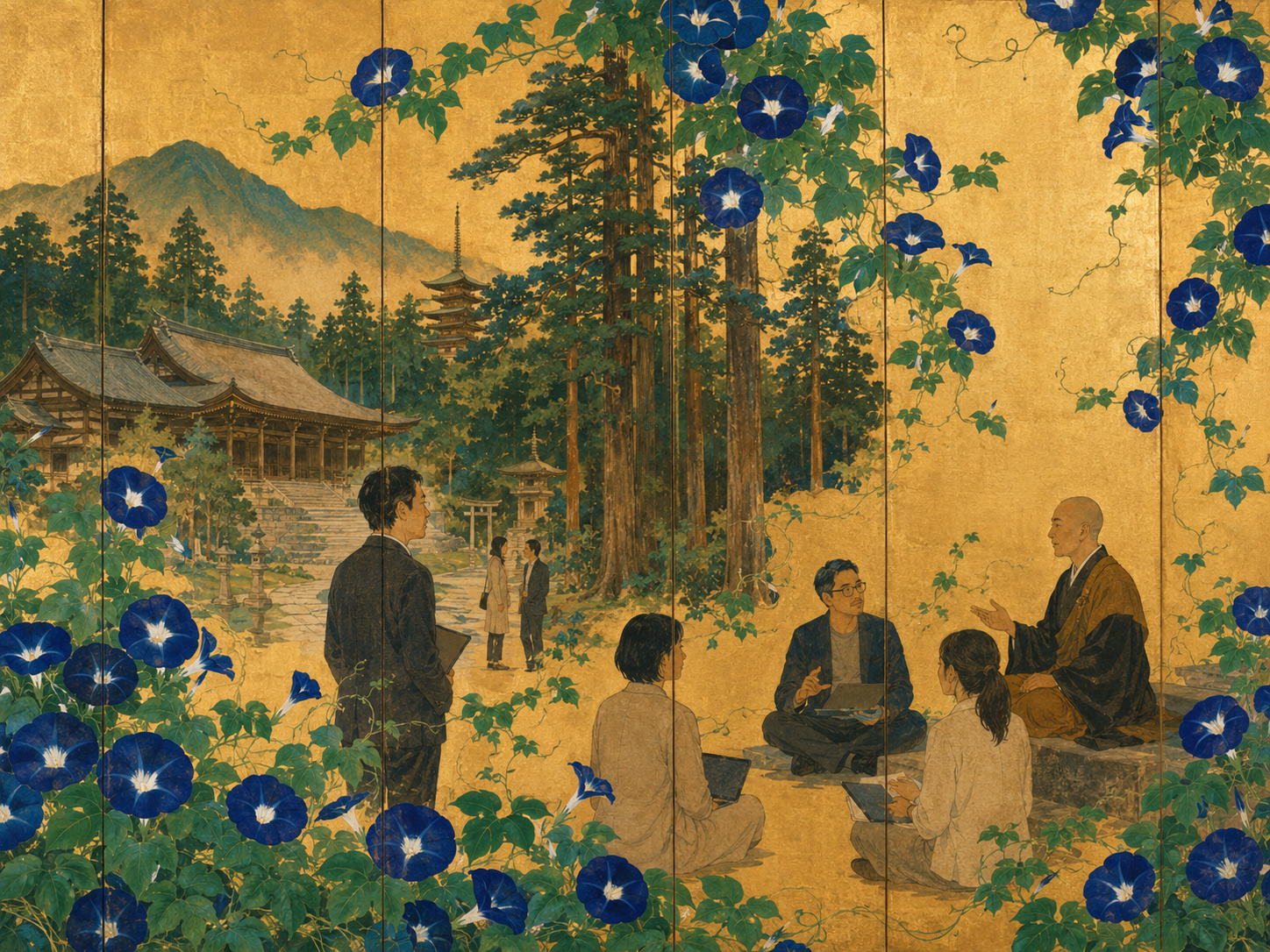
The stone path, cedar trunks, chanting and gold screens can make almost any modern proposal look deeper than it is.
Koyasan Conference should therefore be judged by a harder standard than visual atmosphere.
Does “Nature-Centered” change research questions?
Does it alter what companies count as value?
Does the war discussion produce sharper institutional ideas rather than generalized wishes for peace?
Does a session on regional identity identify practices that can actually be transmitted when population falls?
Does the youth program give younger participants real agency rather than a ceremonial role?
Does the Koyasan Declaration become a record against which later conferences can be judged?
The conference began in 2021. Six meetings are long enough to establish a tradition.
They are not long enough to prove one.
A forest does not survive because people admire it
The most convincing object at the conference may not be in any presentation.
It is outside.
Koyasan’s forest survived in recognizable form not because every generation held the same ideas, but because generations made decisions about use.
After fire, people replanted. When timber mattered, they classified important trees. When governance changed, they negotiated management. When buildings required bark and lumber, they preserved trees old enough to provide them. When the landscape became World Heritage, preservation acquired another legal and international layer.
That history is neither perfectly “natural” nor perfectly “human.”
It is relational.
The temple changed the forest. The forest made the temple possible. Pilgrims changed the paths. The paths made pilgrimage possible. Modern visitors sustain local livelihoods and create pressure on the place they came to see.
That is a more demanding version of Nature-Centered thinking than simply loving nature.
It asks what a system permits humans to take, what it requires them to return, and how the rules survive beyond the people who wrote them.
The opposite of human-centered is not human-hating. It is remembering that the human story has always had other characters.
On August 22, the conference ends; the horizon does not
The final day begins with a session on the body, moves through poster presentations, and culminates in Koyasan University’s 140th-anniversary symposium on science, art and esoteric Buddhism. At 2:35 p.m., the program schedules the closing and the Koyasan Declaration 2026.
At the time this feature was prepared, that declaration had not yet been issued.
That matters.
A conference about the future is especially vulnerable to being reported through promises. The most responsible way to cover it before conclusion is to distinguish the published questions from the answers the participants may eventually give.
We know what the organizers are asking.
Can design move beyond an exclusively human frame? Can clean energy and inclusive design create forms of value conventional markets miss? Can international order manage difference without demanding uniformity? Can looking outward to space make Earth more visible? Can a region change enough to survive without becoming interchangeable with every other place? Can education prepare people for a world whose required job descriptions cannot yet be known?
And underneath all of those questions:
What deserves to last?
Koyasan has no simple answer.
If it did, the mountain would be a museum.
Instead it offers something more useful: evidence that continuity is a practice.
In 816, nobody at Koyasan could imagine semiconductors, satellites, artificial intelligence, carbon markets, global tourism or the University of Tokyo.
They did not need to.
The question for 2026 is not whether we can imagine 3226 accurately.
It is whether we can build relationships, institutions and landscapes that leave people in 3226 something worth inheriting.
- Koyasan Conference 2026 — official three-day program
- Koyasan Conference 2026 — opening session, Nature-Centered framing, jiri-rita and enyu
- Session 1 — WA Art and Design: inheritance, transformation and Nature-Centered design
- Session 2 — Art Design for All, clean energy, inclusive design and co-existence value
- Session 3 — Why War?
- Session 4 — Space and Earth
- Session 5 — Regional Identity and Sustainability
- Session 6 — The body and a more human society
- Session 7 — Koyasan University 140th Anniversary: science, art and esoteric Buddhism
- University of Tokyo RCAST — September 2020 cooperation agreements with Koya Town, Kongobu-ji and Koyasan University
- University of Tokyo RCAST — first Koyasan Conference in 2021 and origin of the 1,200-year question
- University of Tokyo — Koyasan Conference history and Youth Koyasan Conference
- Koyasan tourism association — Kūkai, 816 foundation and Koyasan history
- Kongobu-ji — historical forest management, fires, replanting and Koya Six Trees
- UNESCO — Sacred Sites and Pilgrimage Routes in the Kii Mountain Range
- Koyasan University — 2026 university directory, 1886 origin and 1926 university status
- Wakayama Prefecture — July 27, 2026 Koyasan Conference announcement
Editorial note: Koyasan Conference 2026 runs through August 22. This feature was prepared while the conference was underway and before the scheduled Koyasan Declaration 2026. It therefore reports the official program, stated themes and documented historical context rather than inventing conclusions from sessions that had not yet finished. “Nature-Centered” is treated as the conference’s conceptual framing, not as a standardized scientific term or as a classical Shingon doctrinal label. Historical Buddhist concepts are described in the context in which conference organizers invoke them and are not presented as substitutes for empirical environmental science.