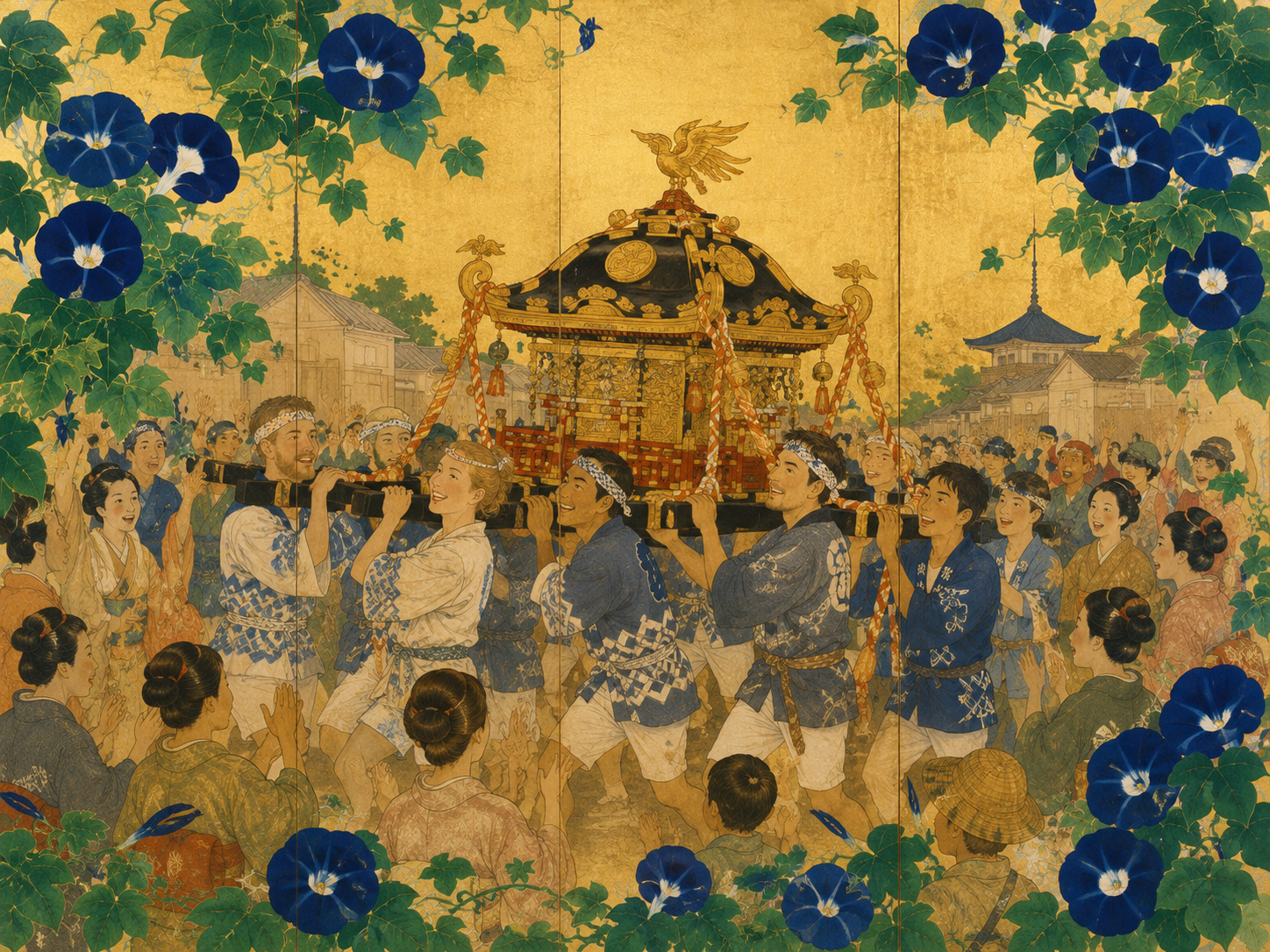
A festival looks very different from underneath the beam.
From the sidewalk, a mikoshi procession is spectacle: shouted rhythm, white tabi, indigo happi coats, sweat, drums, ropes, polished wood and gold ornament moving through a street that has temporarily stopped behaving like an ordinary street.
From the shoulder, the same procession is weight, timing and responsibility. The person next to you matters. The chant matters. The corner matters. The people who have carried the same route for years know when to lift, when to lower, when to stop and where the shrine is going next.
Matsuri Technologies, a Tokyo lodging and property-technology company founded in 2016, is trying to move some of its private-lodging guests from the first position toward the second.
On August 20, the company announced PROJECT YAGURA, a program under which its employees and willing lodging guests will participate in neighborhood festivals in areas where the company operates accommodations. From late August through September, it plans to take part in roughly ten events across four Tokyo wards—Sumida, Shinjuku, Toshima and Shibuya—with continuation beyond that period envisioned.
The headline-grabbing possibility is that guests may become mikoshi bearers.
But the quieter parts of the project are more revealing. At one festival the appropriate role may be carrying. At another it may be helping operations. At another it may be providing lanterns, making an offering or sponsorship, or simply opening a nearby lodging facility's toilet to exhausted carriers. Matsuri Technologies says those roles are determined after hearing the wishes of the neighborhood association or residents’ group responsible for the festival.
That condition changes the meaning of the project.
It is not “buy a room, get a sacred-cultural experience.” It is an attempt—still unproven—to use a lodging operator as an intermediary between people who arrive from elsewhere and communities that already have their own rules about who does what.
A mikoshi is not a float with handles
To understand why that distinction matters, the object itself has to be taken seriously.
A mikoshi is commonly translated as a “portable shrine.” That is useful but incomplete. In many Shinto festivals, the kami of a shrine is ritually transferred into the mikoshi and carried through the community. The procession brings the sacred presence outside the fixed shrine precinct and into streets, commercial districts and residential neighborhoods.
Regional practice varies enormously. Some mikoshi move with solemn steadiness. Others are rocked, bounced, plunged into rivers, taken onto boats or even deliberately battered as part of a local ritual tradition. The object may resemble a miniature shrine building, but what gives the procession meaning is not the architecture alone. It is the relationship between shrine, deity, neighborhood and people.
The Sanja Matsuri in Asakusa offers a particularly clear historical example. The oldest surviving description of its festival dates to 1312. The divine spirits of Asakusa Shrine were placed in mikoshi, moved to Sensōji, and then carried across the Sumida River and through the community. Modern Sanja Matsuri still fills the neighborhood with scores of local mikoshi, while the shrine’s three great mikoshi remain the ritual center.
Kyoto’s Gion tradition reaches back further. The Gion goryō-e emerged in the ninth century amid epidemics and natural disasters, with rites intended to pacify dangerous spirits and protect the city. A mikoshi carrying the deity moved through Kyoto. Over centuries, such processions became embedded in local calendars across Japan, though every festival developed its own form.
The point is not that all mikoshi share one origin or one rulebook. They do not.
The point is that carrying one can be an act inside a ritual system, not merely participation in street entertainment.
The beam is physical, but membership is social. The difficult part is not only lifting the mikoshi. It is knowing who invited you to stand underneath it.
The neighborhood is part of the machinery
A festival can look spontaneous because the preparation is mostly invisible by the time visitors arrive.
Someone has negotiated road use. Someone has stored and inspected equipment. Someone has collected contributions. Someone has arranged food and water, placed lanterns, coordinated priests, contacted residents, handled children, cleaned afterward, staffed rest points and answered the small emergencies that appear whenever hundreds of people occupy a street.
In Tokyo, much of this work has historically passed through neighborhood associations, shrine parishioner groups, festival associations, shopkeepers and other local networks. During the Kanda Matsuri, for example, temporary mikisho shelters do more than hold portable shrines: they become refreshment stations for carriers and collection points for donations, maintained by local organizations with roots in older community structures.
This infrastructure is under pressure.
A Ministry of Internal Affairs and Communications study on local communities, assembled in 2021–22, described neighborhood associations as central actors in local communication, environmental maintenance, disaster response, welfare and community facilities while also warning that declining membership, aging leadership, lifestyle change and shortages of people willing to take on roles were weakening sustainability.
Matsuri Technologies cites one statistic from that study in explaining PROJECT YAGURA: among 624 municipalities responding to the relevant survey, average neighborhood-association membership rates fell by roughly 6.9 to 7.6 percentage points between 2010 and 2020, depending on how the municipalities were grouped.
The number should not be converted into a simple claim that “Japanese festivals are dying.” Some festivals attract enormous crowds and have more people wanting to carry than places available. Others are thriving tourist events. Some rural communities are indeed shrinking. Some urban neighborhoods have plenty of residents but fewer people willing or able to spend weekends doing unpaid organizational work.
The problem is uneven—and that is exactly why a project like YAGURA cannot impose one participation model across Tokyo.
Japan has already learned that visitors can participate
The idea that a foreign traveler must remain outside the rope is not a universal rule of Japanese festivals.
Japan’s own national tourism organization tells international visitors that some matsuri welcome participation. Bon odori dances are often open to everyone. Some festivals explicitly allow visitors to help carry mikoshi. Hanamaki Matsuri in Iwate, for example, has promoted opportunities for visitors to carry portable shrines alongside local participants.
At the same time, other festivals restrict participation sharply. Himeji’s Nada Fighting Festival limits particular mikoshi roles by age and sex. Famous urban festivals may have neighborhood-based teams, established carrying groups, clothing requirements or relationships that cannot be reproduced by simply arriving at the route.
Both facts can be true: Japanese festivals can be welcoming, and access can be governed.
PROJECT YAGURA’s test is therefore not whether a foreigner is physically capable of putting a shoulder under a beam. Thousands plainly are. The test is whether the invitation is issued through the right social channel, with enough explanation that participation strengthens rather than disrupts the event.
The rise of minpaku put the visitor inside the neighborhood
This problem did not exist in quite the same form when most international visitors slept in large hotels.
A hotel concentrates outsiders in a building explicitly designed to receive them. Private lodging distributes visitors into apartment blocks, side streets and residential neighborhoods. A traveler may leave the front door carrying a suitcase while the next door is taking out recycling, walking a child to school or preparing a festival lantern.
Japan’s modern legal framework for private lodging grew partly because this proximity produced both opportunity and conflict.
The Private Lodging Business Act was enacted in 2017 and took effect on June 15, 2018. It created a national notification and management regime for what became widely known as the “minpaku new law.” Under that system, qualifying residential properties can be used for paid lodging for up to 180 days a year, subject to national requirements and possible additional local restrictions.
The government’s own explanation of the law is unusually candid about why regulation was needed. Rapid growth of private lodging had helped answer rising accommodation demand and interest in residential stays, but safety and hygiene were not always assured, while noise and garbage problems with neighbors had become a social issue. Operators were therefore required to address hygiene, explain noise-prevention rules to guests, respond to neighborhood complaints and, in owner-absent properties, use registered management arrangements.
In other words, the legal history of modern minpaku is already a history of negotiating the boundary between guest convenience and resident life.
9th century — Kyoto’s Gion goryō-e develops amid epidemics and disasters; a mikoshi procession becomes part of rites associated with what evolves into the Gion Festival tradition.
1312 — Oldest surviving description of the Sanja Matsuri tradition records the Asakusa deities being carried in mikoshi.
2010–2020 — Government community research later records substantial average declines in neighborhood-association membership among responding municipalities.
2016 — Matsuri Technologies is established in Tokyo.
June 2017 — Japan enacts the Private Lodging Business Act.
June 15, 2018 — The national minpaku law takes effect, including the 180-day annual ceiling for notified private-lodging businesses.
July 2026 — Matsuri Technologies says 16 guests from six countries join a bon-odori event in a pilot preceding PROJECT YAGURA.
August 20, 2026 — PROJECT YAGURA is announced.
Late August–September 2026 — Roughly ten festival engagements are planned across four Tokyo wards.
Tourism is no longer a small external force
Scale changes the ethics of hospitality.
Japan welcomed 21,084,800 international visitors in the first half of 2026, according to the Japan National Tourism Organization. June alone brought 3,148,600 people even though the month was down from the previous year. Tourism is now too large to be treated as something that happens only at airports, hotels and famous sightseeing sites.
Visitors ride neighborhood trains. They buy breakfast at local convenience stores. They roll luggage past apartment entrances. They use laundromats, parks and garbage rooms. In residential private lodging, the tourist economy is literally inserted into housing stock.
This has created a policy paradox.
Japan wants visitors to disperse beyond the most crowded attractions, stay longer, spend in local economies and encounter more of daily life. Yet the more tourism enters ordinary neighborhoods, the more it must operate inside systems that were not designed as tourism products.
A local festival sits directly on that boundary. It may be culturally compelling precisely because it is not staged mainly for tourists. Turning it into an “experience” can generate attention and perhaps new hands—but it can also move decision-making away from the community that gives the event meaning.
That is why YAGURA’s language about neighborhood consent matters more than the photograph of foreign carriers would.
The company is trying to change its own role
Matsuri Technologies describes itself as building lodging solutions for a future society with labor shortages. Its business combines software, property operations, private lodging and real estate. Like other operators in this sector, it faces a structural question: if a company earns revenue by bringing temporary residents into a neighborhood, what obligations does it acquire toward the permanent residents?
PROJECT YAGURA is one answer.
The company says its employees will participate alongside guests and act as a bridge between visitors and residents. Nearby accommodation properties may offer toilets to people supporting the festival—a small detail that reveals the practical nature of community events. Carrying a mikoshi generates sweat; dozens of people moving for hours need rest, hydration and bathrooms. A residential property that ordinarily introduces transient people into the area can, for one day, become useful infrastructure for the people already there.
The name “YAGURA” was chosen for a similar symbolic reason. A yagura at a festival is a raised structure around which people gather, especially familiar as the central tower at many bon-odori events. Matsuri Technologies says it wants to create a comparable meeting point among local residents, guests and its own staff.
The symbolism is neat. Whether the social engineering works will be messier.
Six countries, sixteen guests, one July evening
The company did not invent the project entirely on paper.
Before the August announcement, Matsuri Technologies says it conducted a July pilot in which 16 lodging guests representing six countries participated in a bon-odori event with local residents.
Bon odori is an easier threshold for this experiment than mikoshi carrying. Many bon dances are intentionally repetitive and communal; newcomers can enter the circle, watch the movements and gradually imitate them. National tourism guidance explicitly describes bon odori as commonly open to participation.
A mikoshi is different.
It is heavy. The rhythm of the group affects safety. Local carrying styles differ. Clothing may matter. Alcohol may be present. Routes may be crowded. Children may be nearby. In some festivals, the object is treated with deliberate violence or vigorous shaking. A guest who sees only “Japanese festival fun” can easily miss the ritual, physical and organizational context.
This makes employee mediation important. The company is not merely sending a link to an event. Its stated model puts staff into the same festival, where they can explain expectations and translate between hosts and guests.
Whether that is sufficient will depend on execution.
Participation cannot become a transaction
There is a danger hidden inside every successful cultural-tourism idea: once something attracts demand, the market wants to package it.
A restaurant seat can be sold. A museum ticket can be sold. A guided tour can be sold. The logic becomes more complicated when the “experience” is participation in a community ritual whose organizers are unpaid residents and whose sacred object is not owned by the lodging company.
PROJECT YAGURA’s strongest design feature, at least on paper, is that it does not promise the same product everywhere. The company says each neighborhood decides the appropriate relationship. That preserves the possibility of saying: help with setup, but do not carry; donate lanterns; provide toilets; join the dance; carry this mikoshi but not that one; only ten guests; no guests this year.
If that local discretion erodes, the concept changes.
The foreign guest must not become replacement labor delivered to a festival simply because community membership has fallen. Nor should a neighborhood feel pressured to open a ritual because tourism money is nearby. And participation should not become a premium amenity attached to a room rate unless the community itself has consciously designed that arrangement.
The company’s current announcement does not say it is selling mikoshi access as a paid add-on. Invitations are sent to guests staying nearby; participation is voluntary and can be limited by lottery. That is materially different from a commercial “carry a shrine for ¥X” product.
| Claim | What the evidence supports | What it does not establish |
|---|---|---|
| “Foreign guests will carry mikoshi.” | Mikoshi carrying is one of the possible roles in PROJECT YAGURA where the local organizers agree. | That every guest, every festival or every participating neighborhood will allow mikoshi carrying. |
| “The project solves festival labor shortages.” | Community organizations face documented participation and leadership pressures, and outside participants may add hands. | That ten events can reverse national demographic or neighborhood-association decline. |
| “Minpaku integrates tourists into communities.” | Private lodging physically places visitors in residential areas and YAGURA deliberately creates contact with local events. | That proximity automatically creates trust; modern minpaku law itself arose partly in response to neighborhood conflict. |
| “Festivals need outsiders.” | Some communities actively welcome additional participants. | That all festivals lack bearers or want tourists inside ritual roles. |
What makes a participant different from a spectator?
A spectator can remain anonymous.
He photographs the procession, buys food, watches the dancers and leaves. The festival may never learn his name. He can admire without becoming accountable to anybody inside the event.
A participant enters a different relationship.
She is told where to stand. Someone lends or approves clothing. Someone explains what not to do. If she is carrying, her movement affects the shoulders beside her. If she volunteers, somebody depends on her being at the assigned place. If she enters a dance, she follows the circle rather than demanding the circle rearrange itself for her photograph.
Participation, then, is not defined by physical closeness. It is defined by accepting constraints from the group.
That is why “authentic experience” is a poor way to describe the most interesting possibility in YAGURA. Authenticity suggests the visitor is consuming a purer version of Japan. Responsibility is closer. The visitor is temporarily accepting instructions from people whose neighborhood continues after the traveler checks out.
The deepest difference between tourism and participation may be simple: a tourist asks, “What can I experience?” A participant also has to ask, “What does this group need me to do?”
The restroom may be more important than the photograph
One of PROJECT YAGURA’s least glamorous proposals may be its most credible.
Matsuri Technologies says nearby lodging properties can make toilets available to festival supporters and mikoshi bearers. Anyone who has organized a large street event understands why that matters. Traditional culture survives through logistics: keys, water, storage, shade, chairs, batteries, trash bags, first aid and toilets.
This is a useful test of the company’s claim that it wants to behave as “a member of the town.”
If participation is measured only by how many foreign guests appear in happi coats, YAGURA risks becoming marketing. If company staff also show up early, help carry equipment, lend facilities, give money where appropriate, clean up and return next year, the relationship looks more like membership.
Communities tend to remember the second kind of contribution.
There is a larger question hiding behind ten festivals
Japan’s tourism strategy increasingly asks how visitors can support communities rather than simply pass through them. At the same time, local organizations are being asked to do more—disaster preparedness, welfare, child safety, neighborhood communication—with fewer conventional members.
Those two trends create an obvious temptation: convert tourists into “relationship population,” temporary volunteers or cultural participants.
Sometimes that may work beautifully.
A repeat visitor may return to the same neighborhood every year. A guest may learn the names of residents, support shops and later bring friends. A foreign resident or long-stay visitor may discover the community organization that was previously invisible. A lodging operator that has daily contact with outsiders may become a useful translator and coordinator.
But community cannot be simulated by headcount.
A town association is valuable not because it can assemble fifty bodies for one afternoon, but because some people answer the phone the next morning. They manage garbage rules, disaster drills, elderly residents, complaints, paperwork, money and relationships that continue when the drums stop.
PROJECT YAGURA can contribute to that fabric. It cannot substitute for it.
After the guest checks out
The success of the project will not be visible in the first photograph.
A photograph can prove that a guest carried a mikoshi. It cannot show whether the neighborhood wanted the arrangement repeated.
The useful questions come afterward.
Did local organizers feel that the extra participants reduced burden or created more supervision work? Did guests understand the ritual rather than treating it as costume? Were instructions translated clearly? Were injuries avoided? Did the company help with the unphotogenic work? Did residents who were skeptical about private lodging feel differently after meeting the guests? Did complaints increase or decrease? Did anyone return the following year?
Matsuri Technologies says it will publish reports on implementations through its corporate site and intends to continue the program. Those follow-ups will matter more than the launch announcement.
Because the underlying problem is reciprocal.
Private lodging asks a neighborhood to tolerate strangers sleeping inside residential space. A festival invitation asks the neighborhood to do something more intimate: teach some of those strangers how to stand inside a tradition.
That cannot be automated.
It requires introduction, permission, repetition and the possibility of refusal.
The company called the project YAGURA because a festival tower creates a place where people gather. But the structure itself does not make a community. The community is the pattern of people around it—who built it, who dances, who pours water, who gives directions, who stays after the music ends.
If a traveler enters that circle for one night, the most meaningful outcome may not be that the visitor gets closer to Japan.
It may be that, for a few hours, the visitor stops being the center of the experience.
- Matsuri Technologies — August 20, 2026 announcement of PROJECT YAGURA
- Ministry of Internal Affairs and Communications — local community policy and research
- MIC — Report of the Study Group on Local Communities, April 2022
- Japan Tourism Agency — Private Lodging Business Act
- MLIT — 2018 tourism white paper: why the private-lodging regime was created
- JNTO — June 2026 visitor arrivals and first-half total
- JNTO Travel Japan — how visitors can participate in local festivals
- JNTO Travel Japan — festivals that explicitly welcome participation
- JNTO Travel Japan — Sanja Matsuri and neighborhood mikoshi
- Nippon.com — Sanja Matsuri history and the 1312 record
- Nippon.com — Gion goryō-e, epidemics and the history of mikoshi procession
- Nippon.com — Kanda Matsuri mikisho, carrier support and neighborhood organizations
- JNTO Travel Japan — an example of a festival with specific participation restrictions
Editorial note: PROJECT YAGURA was announced before the late-August/September 2026 implementation period described by Matsuri Technologies. Except for the July bon-odori pilot, this article therefore describes planned participation, not completed results. The company says approximately ten events are planned, but the number may change through coordination with neighborhood and residents’ associations. Mikoshi participation differs by festival and should not be generalized to all Japanese shrine festivals.