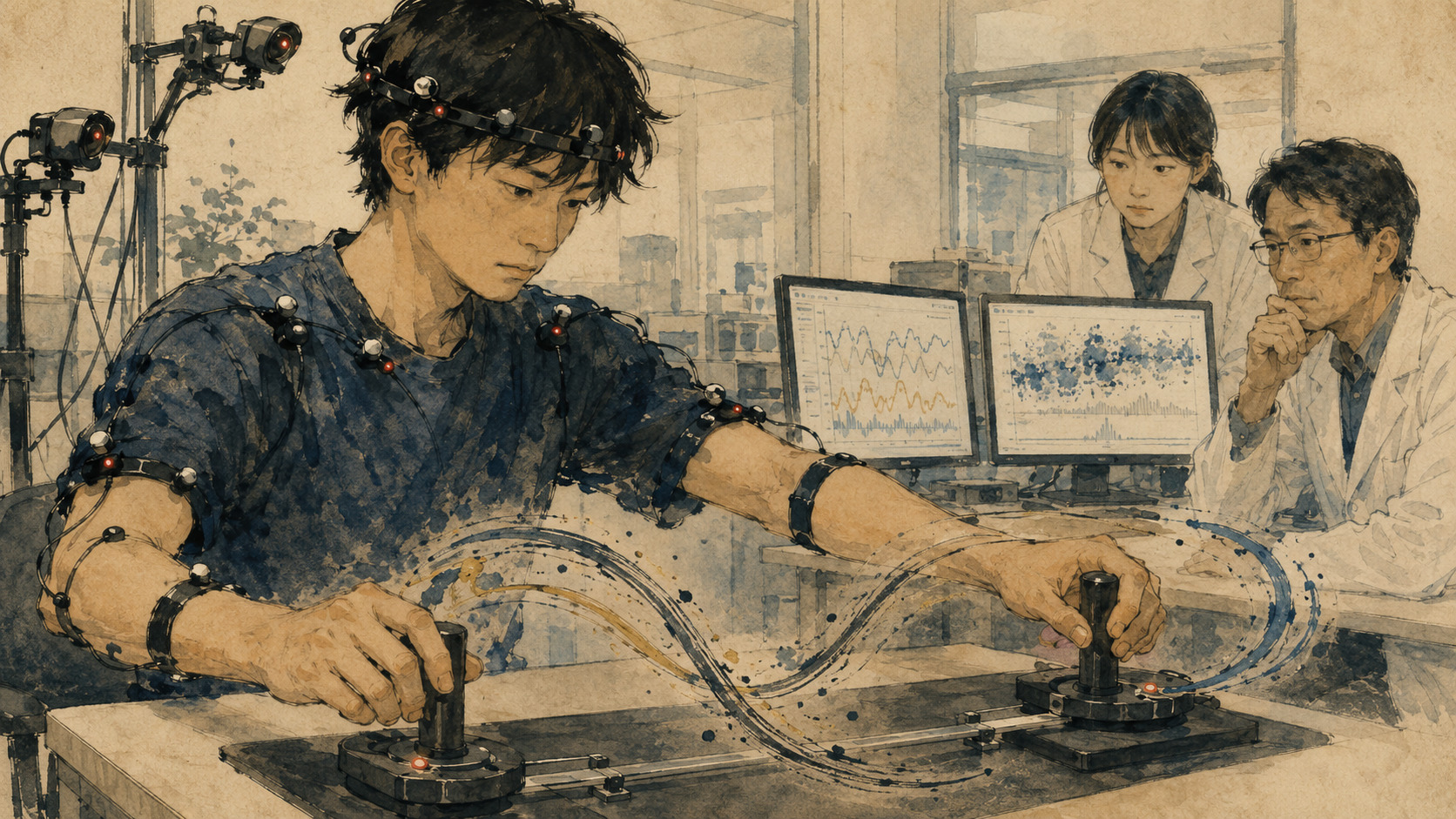
Button a shirt. Tie a shoelace. Hold a jar with one hand while the other turns the lid. At a piano, let the left hand sustain an accompaniment while the right runs through a melody. Most two-handed actions are simultaneous but not identical. Even when a laboratory strips the task down and asks both hands to repeat the same simple movement, the hands do not behave like twins.
A team led by Professor Kazutoshi Kudo, Project Lecturer Kohei Miyata and doctoral researcher Kazumi Azuma-Takeshita at the University of Tokyo’s Graduate School of Arts and Sciences, with Project Associate Professor Wataru Kurebayashi of Osaka University, refused to average that difference away. They measured right and left hands separately, used regression to unpack differences among people, and then built the asymmetry into a mathematical system. Their 2026 paper in the Journal of Neurophysiology is important precisely because the two sides were allowed to remain unequal.
Ten seconds, maximal speed, four ways to move
The participants were 73 healthy right-handers. Their task was to flex and extend an index finger as fast as possible for 10 seconds. They did it with the left hand alone, the right hand alone, both hands in a mirror-symmetric pattern and both hands moving in the same direction through external space. Each condition was repeated three times. From the finger-angle time series, the researchers calculated movement frequency—how many cycles occurred in a given time—and amplitude—the size of each excursion.
The terminology can mislead. “In-phase” in this experiment meant mirror symmetry: both fingers flexed inward together and extended outward together, allowing homologous muscles to act at similar times. “Anti-phase” meant the two fingers traveled in the same visible direction, so one flexed while the other extended. The latter can look parallel to an observer, yet it is anatomically asymmetric and ordinarily less stable.
| Condition | What the body and observer see | Why it matters |
|---|---|---|
| Right alone / left alone | Each index finger cycles at maximal speed by itself | Establishes a personal baseline for each hand’s frequency and amplitude |
| Bimanual in-phase | Mirror symmetry: both fingers flex, then both extend | A relatively stable pattern that reveals how unequal speeds converge |
| Bimanual anti-phase | Parallel in external space: one finger flexes while the other extends | A less stable pattern that exposes trade-offs among speed, amplitude and phase |
Deficit and facilitation inside the same person
When the volunteers moved in mirror symmetry, the dominant right hand became slower than it had been alone. That is a change in the direction known as bilateral deficit. The nondominant left hand, however, became faster—a bilateral facilitation. Its amplitude also became smaller.
An average could summarize this as “the hands’ speeds converged,” and that would be true but incomplete. The faster right hand yielded while the slower left hand was pulled upward. The two sides did not make the same adjustment in the same direction. Deficit and facilitation coexisted within one person.
Anti-phase movement produced a different solution. Frequency dropped substantially in both hands while amplitude increased in both. The system traded speed for a larger, easier-to-distinguish trajectory, a plausible way to preserve a fragile phase relation. Simple fatigue would not readily explain why amplitude enlarged bilaterally and specifically in the more difficult coordination pattern.
| Bimanual condition | Dominant right | Nondominant left | System-level pattern |
|---|---|---|---|
| In-phase | Frequency decreased | Frequency increased; amplitude decreased | Speeds converged by two different routes |
| Anti-phase | Frequency decreased sharply; amplitude increased | Frequency decreased sharply; amplitude increased | Both hands slowed and moved farther to protect an unstable relation |
Bimanual coordination is not the act of placing two fast hands side by side. It is the conversion of two unequal capacities into one stable relationship.
Different predictors for the right and left
The team used multivariate regression to ask what predicted each hand’s change from unimanual to bimanual performance. For the dominant hand, an important predictor was the gap between the participant’s maximum right- and left-hand frequencies when each moved alone. The larger the starting mismatch, the more room there was for the right hand to be constrained when the pair synchronized.
For the nondominant hand, the change in amplitude from unimanual to bimanual movement was important. By shortening its excursion, the left finger may have shortened each cycle and approached the faster right-hand tempo. Speed and distance are not independent dials: reducing the path can make more repetitions possible in the same interval.
Regression does not prove cause. It cannot establish a one-way chain in which smaller amplitude caused faster left-hand movement; a common control process may have altered both. That is where the mathematical model enters.
Writing two hands as coupled oscillators
Pendulum clocks placed on the same support can exchange tiny forces and settle into a common rhythm. Flashing fireflies, cardiac cells and the alternating legs of gait can all be represented as oscillators that influence one another. A finger moving back and forth can likewise be described by a natural frequency, amplitude and phase.
The model gave the right and left oscillators their own movement properties and coupled them according to relative phase. Standard formulations often begin with symmetrical components. This extension placed the observed difference—the right hand was generally faster alone—inside the model from the start. The same framework could then reproduce the in-phase convergence, with the right slowing and the left speeding, as well as the anti-phase combination of bilateral slowing and amplitude enlargement.
- Natural speed: the frequency each hand can reach on its own.
- Asymmetry: the two baselines are not identical in right-handed participants.
- Coupling: interaction that draws the hands toward a stable phase relation.
- Amplitude and stability: changing distance, not only speed, can help prevent coordination from collapsing.
Reproducing the data does not mean the brain literally contains these equations. Different physiological mechanisms can generate similar trajectories. A dynamical model is valuable not as a microscopic copy of neurons, but as a compact, testable account that connects phenomena which otherwise look unrelated.
In 1984, a movement pattern suddenly jumped
The mathematical history of two-handed movement has a famous turning point. In 1984, J. A. Scott Kelso reported an experiment in which people oscillated their index fingers in a prescribed phase relationship. As an asymmetric pattern grew faster, variability rose until the motion abruptly—and unintentionally—switched into stable mirror symmetry. Lowering the speed did not immediately restore the old pattern, a form of history dependence known as hysteresis.
In 1985, Hermann Haken, Kelso and Hermann Bunz expressed the transition through the relative phase of two nonlinear oscillators. Their HKB model treated speed as a control parameter: change it far enough and the stable organization of movement changes, much as cooling water changes its state. Human action became more than a queue of commands from a central executive. Order could emerge from interacting components under constraints.
1961 Henry and Smith report that a simultaneous maximal bilateral contraction can produce less force than the sum of separate unilateral contractions, an origin point for “bilateral deficit.”
1979 Kelso, Southard and Goodman show that laws of bimanual movement cannot simply be extrapolated from one-hand movement.
1984 Kelso documents a spontaneous phase transition as bimanual movement speed increases.
1985 Haken, Kelso and Bunz publish the coupled-oscillator HKB model.
2001 Mechsner and colleagues transform visual feedback, showing that people can execute a difficult 4:3 hand rhythm when the visible goal is simple.
2010 Kudo and colleagues compare professional drummers and nondrummers, studying how practice and asymmetry shape rapid bimanual rhythm.
2022 Iwama and colleagues connect premovement beta-band coupling in the motor cortices with subsequent anti-phase stability.
2026 Azuma-Takeshita and colleagues unite asymmetry, speed, amplitude and stability in one model.
Not only muscles—and not one “two-hand center”
For years, a leading explanation for mirror symmetry was the ease of co-activating homologous muscles. But a 2001 experiment by Franz Mechsner and colleagues complicated that account. Hidden hand cranks drove visible flags through gearing. When the flags had a simple synchronized visual goal, participants could produce a 4:3 frequency ratio in the unseen hands—a pattern that would be extraordinarily difficult for untrained people to generate explicitly. Coordination depended on the perceived goal, not only the muscle combination.
Neuroscience has also moved beyond a single “bimanual center.” Stephan Swinnen’s influential 2002 review described a distributed network including primary motor and sensory cortices, premotor regions, supplementary motor area and cingulate motor areas. A 2022 Japanese study linked premovement beta-band phase synchrony between the two primary motor cortices, among other measures, with the stability of later anti-phase coordination. Information across the corpus callosum, sensory feedback, visible goals and learning history all converge on the action.
The new Tokyo study did not record brain or muscle activity. It therefore cannot assign the right-hand slowdown or left-hand acceleration to a particular cortical region or to interhemispheric inhibition. Its strength is different: it states the behavioral rule without filling the biological gap with speculation.
Dominant does not mean universally superior
The group average—faster right, slower left—does not make the right hand better at every task. In real bimanual work, one hand may stabilize an object while the other manipulates it. The roles demand different precision, force and timing. Handedness is not a single league table; it is a division of labor built through neural organization and years of use.
Because every participant was right-handed, the experiment cannot separate being on the right side of the body from being the dominant hand. Would left-handers show a mirror image? What happens in mixed-handed people, children, older adults, musicians or elite athletes? Until those groups are tested, this result cannot be converted into a general story about the “left brain” and “right brain.”
What drummers, pianists, dancers and athletes can take from it
Kudo’s laboratory has a long research program spanning rapid tapping by professional drummers, focal hand dystonia in a pianist, paired tapping and sport skills. Experts do not merely erase left-right differences. They exploit or suppress asymmetry in order to stabilize the phase, amplitude and force a task requires.
The new model suggests that an apparently similar “lag” can have different sources. One learner begins with a large gap in natural hand speed. Another does not adjust amplitude effectively. A third loses anti-phase stability. If future work can estimate reliable personal model parameters, practice might eventually target the limiting relation instead of prescribing the same metronome drill to everyone.
That remains a hypothesis. The study compared no training methods and measured no improvement in musicians or athletes. It does not support prescriptions such as “increase amplitude to improve” or “make the nondominant hand faster.” Ten seconds of maximal index-finger cycling is far removed from performance that includes vision, force, tools, strategic choices and fatigue.
The rehabilitation connection is a gap in theory and measurement
After stroke, difficulty can extend beyond the paretic arm to the organization of two arms around a common purpose. A 2020 systematic review and meta-analysis found large impairments in kinematic and kinetic control during symmetrical and asymmetrical bimanual tasks when people with stroke were compared with age-matched controls. A one-hand clinical test cannot capture every demand of daily life.
Yet a 2024 systematic review exposed a serious gap. Of 789 records, 20 studies met its criteria. Although bimanual training was the most common approach, most studies did not explicitly examine bimanual coordination. Only eight used kinematic analysis, only three examined interlimb organization, and none made explicit inferences to established theories of interlimb coordination.
That is where a model like this could eventually matter. If a paretic hand lags, is the less-affected hand slowing to preserve stability? Is the paretic hand shortening its path to catch up? Are both arms reducing speed to protect a difficult relative phase? The same task score could hide different processes. Separating frequency, amplitude and relative phase may allow researchers to ask what changed after therapy, not only whether the participant completed more repetitions.
What the study establishes—and what it does not
| Supported by the study | Not yet supported |
|---|---|
| In 73 healthy right-handers, in-phase maximal-speed movement combined a right-hand deficit with left-hand facilitation. | The same laterality in left-handers, older adults, patients, other joints or functional tasks. |
| Anti-phase movement produced bilateral slowing and larger amplitude. | A specific brain area, muscle signal or neural pathway causing those changes. |
| Different predictors were associated with the right- and left-hand changes. | That those statistical predictors are themselves the causes. |
| An asymmetric coupled-oscillator model reproduced the principal patterns. | That the model is the unique biological mechanism. |
| The work offers a theoretical foundation relevant to skill and clinical measurement. | That a particular exercise, coaching method or rehabilitation treatment works. |
The task created an intentionally narrow world: maximal speed, 10 seconds and one index finger on each hand. That simplicity made the speed-amplitude relationship visible. It excluded precision grip, graded force, objects, visual targets, divided attention and prolonged fatigue. A short burst is not a model of an entire workday or musical performance.
Next steps include replication in left-handers, older adults and patient groups; simultaneous muscle and brain measurement; longitudinal tracking across practice; and cooperative tasks closer to daily life. For a personalized model to become useful, its parameters must remain reliable across days and predict something the original fitting data did not—learning, breakdown or recovery.
Not two solos, but one relationship
When we watch a skilled two-handed action, it is tempting to imagine two independently perfect performers. But an orchestra is not beautiful because every player produces a personal maximum at once. Coordination is not the sum of each hand’s solo record. One slows, the other accelerates; sometimes both sacrifice speed and move farther.
The 73 volunteers showed that asymmetry is not merely a failure of coordination. It is the starting condition that coordination must solve. The equations recorded that negotiation among speed, amplitude, phase and stability. When the brain and body use two hands to make one action, they do not need two identical performers. They need one relationship that does not break.
Study at a glance
| Paper | Asymmetric Bilateral Deficit and Facilitation in Maximal-Speed Bimanual Finger Coordination |
|---|---|
| Journal | Journal of Neurophysiology, 2026. doi:10.1152/jn.00326.2025 |
| Authors | Kazumi Azuma-Takeshita, Kohei Miyata, Wataru Kurebayashi and Kazutoshi Kudo |
| Participants | 73 healthy right-handed volunteers; study approved by the University of Tokyo Graduate School of Arts and Sciences human-research ethics committee |
| Task | Ten seconds of maximal-speed index-finger flexion-extension: left alone, right alone, bimanual in-phase and bimanual anti-phase; three trials per condition |
| Main result | In-phase: right frequency decreased, left frequency increased and left amplitude decreased. Anti-phase: both frequencies decreased and both amplitudes increased |
| Model | An asymmetrical coupled-oscillator model reproduced speed convergence and the anti-phase speed-amplitude adjustment |
| Funding | JSPS fellowships 22J15228 and 22KJ0979; KAKENHI 24K02825; Embodied Information Network endowed research division and related support |
| Main limits | Healthy right-handers only; short, simplified finger task; no neural or muscle measurement; no intervention or clinical outcome |
- University of Tokyo Graduate School of Arts and Sciences, “Mechanism of asymmetric left-right changes during bimanual movement”
- Azuma-Takeshita K. et al., “Asymmetric Bilateral Deficit and Facilitation in Maximal-Speed Bimanual Finger Coordination,” Journal of Neurophysiology
- University of Tokyo Dexterity Lab, “Publications”
- Kelso J.A.S., “Phase transitions and critical behavior in human bimanual coordination,” American Journal of Physiology
- Haken H. et al., “A theoretical model of phase transitions in human hand movements,” Biological Cybernetics
- Swinnen S.P., “Intermanual coordination: From behavioural principles to neural-network interactions,” Nature Reviews Neuroscience
- Mechsner F. et al., “Perceptual basis of bimanual coordination,” Nature
- Fujii S. et al., “Intrinsic Constraint of Asymmetry Acting as a Control Parameter on Rapid, Rhythmic Bimanual Coordination,” Journal of Neurophysiology
- Iwama S. et al., “Beta rhythmicity in human motor cortex reflects neural population coupling that modulates subsequent finger coordination stability,” Communications Biology
- Liu Y. et al., “Bimanual Coordination in Individuals Post-stroke,” International Journal of Exercise Science
- Kantak S. et al., “Bimanual Coordination Functions between Paretic and Nonparetic Arms,” Journal of Neurologic Physical Therapy
- Škarabot J. et al., “Bilateral deficit in maximal force production,” European Journal of Applied Physiology
Editor’s note: “In-phase” and “anti-phase” follow the anatomical convention used in the paper and university release. Mirror-symmetric and parallel movement are stated explicitly to avoid confusion with the everyday phrase “same direction.” Bilateral deficit and facilitation in this paper primarily concern movement-frequency changes and are not identical measurements to bilateral force-deficit studies. Rehabilitation is discussed as a connection to existing reviews, not as a treatment claim. The exchange-rate display is an editorially supplied value.