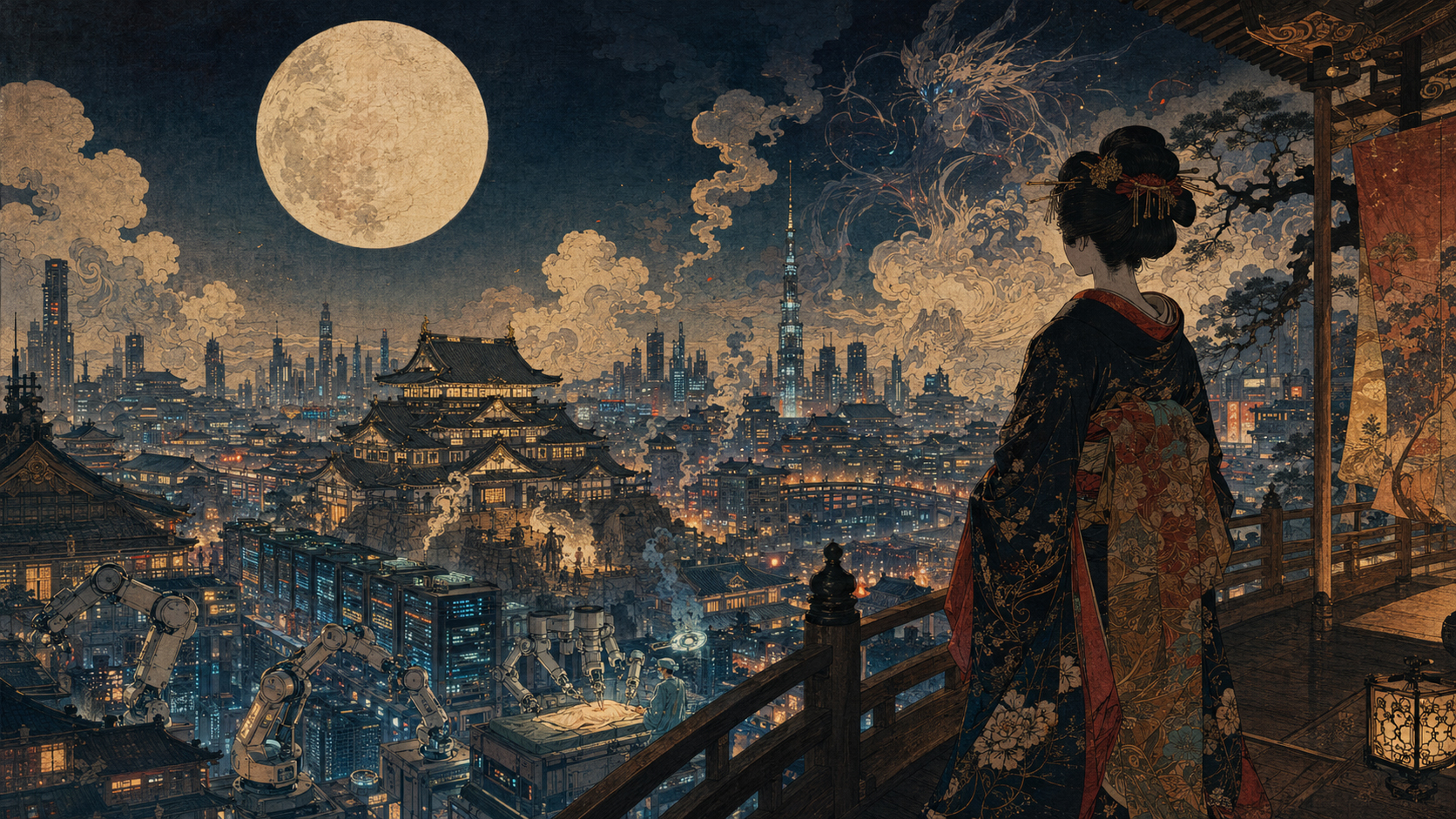
The moon is older than the machines, older than the Imperial House and older than the name Tokyo. In this picture, however, it is not background decoration. Its circle places a woman dressed in inherited forms and an AI factory that has not yet been built under the same light. It compresses lunar calendars, machine clocks, cellular cycles and shifting seasons into a single disc—a seemingly fixed point above a society accelerating beneath it.
The eye rises first to the moon, passes through the woman’s upright figure and falls into a dark valley of Tokyo. Factory, hospital and city overlap below even though they could never be seen together from one real hill. That impossible geography is the point. This is not a visitor’s map. It is an editorial map of the July 18 edition.
Today’s major reports concern a planned national-scale AI factory with 27,500 Nvidia Rubin GPUs, a healthcare push spanning surgical support and virtual cells, a proposal concerning imperial women’s status after marriage, summers becoming longer and more dangerous, and a Jujutsu Kaisen attraction that translates a supernatural story into games, food and physical experience. The beats are different. Yet each story tests a boundary: between institution and body, memory and invention, the visible world and forces that are difficult to see.
How to read the image: six lights, six arguments
The woman occupies the hinge between moon and city. She joins the apparent permanence above to the acceleration below through the fact of a human body. She does not reject artificial intelligence. She does not command the robots. She looks. That act of looking is close to the narrative work done by figures in Yoshitoshi’s moon prints. In One Hundred Aspects of the Moon, looking upward, waiting, fighting, composing music or remembering often carries more of the story than the moon itself.
Her clothing is not an archaeological specimen. She is not identified as an empress, an imperial princess, Murasaki Shikibu or a geisha. She is an editorial allegory for continuity and agency. Because the image touches the Imperial House story, turning her into the likeness of a living member would be especially misleading. The institutional question should not be collapsed into an invented statement about one woman’s private wishes.
Why Tsukioka Yoshitoshi?
Tsukioka Yoshitoshi was born on April 30, 1839, and died on June 9, 1892. The National Diet Library records his birth name as Yoshioka Kinzaburō. Around 1850 he entered the studio of Utagawa Kuniyoshi. He became widely known through the 1866 series Twenty-Eight Famous Murders with Verse, created with fellow Kuniyoshi pupil Ochiai Yoshiiku. He concentrated on historical subjects in the final years of the shogunate and early Meiji, then illustrated newspapers including the Yūbin Hōchi Shinbun, E-iri Jiyū Shinbun and Yamato Shinbun.
Yoshitoshi is often called “the last master of ukiyo-e.” The phrase is memorable and incomplete. It can make him sound like the custodian of a sealed old form, standing with his back to modern life. The British Museum’s biography gives a different picture: from 1874 he illustrated color woodblock newspapers and a growing number of novels, while incorporating elements associated with Kikuchi Yōsai and European art into a personal historical style. He was not merely watching print culture die. He was adapting a mass woodblock medium to modern subjects, distribution and speed.
His lifetime crossed Japan’s structural rupture. He was born under the Tokugawa shogunate, was a teenager when Commodore Perry arrived, and was 29 in the year of the Meiji Restoration. Edo became Tokyo. The warrior status order was dismantled. Railways, telegraphy, newspapers, brick architecture, Western clothes and industrial machinery entered the same streets as inherited festivals and trades. Yoshitoshi did not compare “tradition” and “modernity” from the safety of hindsight. He lived where they collided.
| Year | Yoshitoshi and the changing city |
|---|---|
| 1839 | Yoshitoshi is born in Edo, the castle city of the Tokugawa shogunate. |
| c. 1850 | He enters Kuniyoshi’s studio; his earliest known triptych is dated 1853. |
| 1866 | Twenty-Eight Famous Murders with Verse brings attention through extreme late-Edo violence. |
| 1868 | The Meiji era begins; the political and symbolic meaning of Edo changes as it becomes Tokyo. |
| 1872 | Japan’s first railway opens between Shimbashi and Yokohama; post-fire Ginza is rebuilt in brick. |
| From 1874 | Yoshitoshi works for illustrated newspapers and novels, joining woodblock craft to news circulation. |
| 1885–1892 | Publisher Akiyama Buemon issues the 100 designs of One Hundred Aspects of the Moon. |
| 1892 | The series is completed in the year Yoshitoshi dies, aged 53. |
It is equally limiting to define him only by blood and violence. He crossed warrior pictures, beauties, actors, history, journalism, ghost stories and literature. In later work, space and stillness often grew more powerful. Records of his periods of mental illness are part of his biography, but the art should not be reduced to a medical symptom. His line, staging and narrative choices also came from training, collaboration, market pressures and a sustained historical imagination.
One Hundred Aspects of the Moon: not 100 pictures of an object, but 100 stories joined by it
The principal historical reference for today’s image is Yoshitoshi’s late series One Hundred Aspects of the Moon. The Fitzwilliam Museum and Library of Congress record that publisher Akiyama Buemon issued its 100 designs in batches between 1885 and 1892. Its material ranges across Japanese and Chinese history and literature, Kabuki and Noh, legends and contemporary Tokyo. Warriors, women, birds, animals, goblins and ghosts appear. The one formal bond is the moon.
Even that bond is flexible. The moon need not always dominate as a giant full circle. It may be a crescent, a glow behind clouds, a reflection on water or a presence sensed beyond the frame. Its phase and placement tune anticipation, loneliness, resolve, dread or humor. The moon is both an astronomical body and a device for setting the emotional weather.
The Metropolitan Museum of Art’s painting of Murasaki Shikibu at Ishiyamadera reveals something about Yoshitoshi’s method. He searched literature and legend for famous moonlit scenes, then reshaped rather than mechanically copied their settings. In the Murasaki composition, geological outcrops are emphasized even though the precise real view does not match the picture. Narrative recognition mattered more than topographical transcription.
That principle carries into today’s illustration. Rubin GPU racks, surgical instruments and the implied Imperial Palace do not need to occupy one physical district. They share the landscape because they explain one edition of Japan. Where Yoshitoshi allowed ancient China, Heian literature, warrior legend and Meiji Tokyo to coexist under the moon, this picture joins the Imperial House, compute infrastructure, the cell, climate and anime within one impossible night.
The Fitzwilliam Museum says buyers queued before dawn for new designs and could still find them sold out. What now appears to us as contemplative classical art was also popular media: serialized release, publisher strategy, skilled production and an audience waiting for the next image. It is not the same system as streaming episodes, limited merchandise or timed-entry fandom, but the appetite for “the next design” feels distinctly modern.
Japan’s moon: viewing, harvest, literature and the uncanny
The moon carried multiple meanings long before Yoshitoshi. The Japanese moon-viewing custom known as tsukimi is said to have arrived from China more than a thousand years ago. It is associated with the fifteenth night of the eighth lunar month, pampas grass, round rice dumplings and seasonal produce. Refined viewing and gratitude for harvest occupy the same ritual.
In waka poetry and narrative, moonlight calls up absent people, travel, love, impermanence and the change of season. In ghost stories, it thins the border between the ordinary world and another one. Yoshitoshi drew on that accumulated literacy. The moon could carry explanation without a caption; its form and a figure’s posture could make viewers feel the temperature of the night, the slowness of waiting and the possible presence of something unseen.
Today’s giant full moon is not an astronomical record of Tokyo’s sky on July 18. Nor does it claim that the scene is a precisely dated autumn moon-viewing. It is a deliberately enlarged symbol. Yet the history of tsukimi keeps the scene from becoming generic science fiction. Beneath machines that count in fractions of a second, another kind of time—seasonal, literary and remembered—remains visible.
A full-color print was never the work of one genius alone
Yoshitoshi’s name sits on the surface, but a nishiki-e was a collaborative technology. A publisher conceived and financed the project. The artist supplied the design. A carver translated lines into cherry wood. A printer aligned separate blocks and pressed pigment into paper. The Library of Congress record for One Hundred Aspects of the Moon identifies named engravers alongside Yoshitoshi.
In the traditional sequence, a drawing on thin paper is pasted face down to a block. The key lines are carved, a proof receives color instructions and separate blocks are prepared. Registration marks align the sheet. Pigment is brushed onto the block, then transferred by pressure from a baren, one layer at a time. Yoshitoshi’s preparatory work sometimes shows an exploratory red drawing overlaid by decisive black lines. The stillness of a finished print rests on revision, physical skill and coordinated judgment.
Contemporary digital imagery also involves planning, editing, image design, models, processors, color work and distribution. The analogy has limits. Cutting wood and pressing pigment into washi have a material irreversibility unlike the repeatability of computation. The shared lesson is narrower and stronger: visual culture is produced not only by the person whose name is most visible, but by hidden skills, materials, infrastructure and channels of circulation.
When Edo became Tokyo, tradition was not erased; it was edited
In 1868, Edo became the capital Tokyo under a new government. Japan’s first railway opened between Shimbashi and Yokohama in 1872. Following the great Ginza fire that year, the government developed a brick district intended as a fire-resistant model of the modern nation. The Rokumeikan, opened in 1883, became a symbol of Westernization. Cropped hair, Western food, clocks, banks, newspapers and factories entered the vocabulary of city life.
But the Edo-Tokyo Museum emphasizes that ordinary life did not modernize everywhere at once. New schooling retained roots in the terakoya tradition, and hybrid architecture placed Western appearances over established building knowledge. Tokyo was a city of seams, not clean replacement.
Yoshitoshi worked in those seams. He pictured warriors and court literature while participating in the new circuit of newspapers. He represented history while absorbing elements of imported visual practice. Synthetic pigments intensified late nineteenth-century prints; a “traditional” process was already changing through new materials. Applying his moonlit grammar to AI in 2026 is therefore more than wrapping technology in old-looking paper. It responds to an artist who himself used inherited stories to understand technological and political change.
The lower city in 2026: is the AI factory a new industrial moon?
The data center below the woman abstracts today’s report on Noetra’s planned infrastructure. The announced design calls for 27,500 Nvidia Rubin GPUs, 13,750 Vera CPUs and a facility drawing as much as 140 megawatts, with operations targeted for 2028. It is a future plan, not capacity already delivered.
In woodblock production, color was constrained by blocks, pigments, paper and impressions. In AI, training and generation are constrained by accelerators, electricity, cooling, data, networks and capital. Large-scale compute is not an immaterial “cloud.” It occupies land, generates heat and connects to the grid. The image turns the racks into an artificial light source beneath the moon so that the infrastructure cannot disappear behind software metaphors.
The two lights are not equivalent. No one owns the moon. Compute has owners, access rules, energy costs and unequal availability. To paint only beautiful blue light would conceal the industrial and environmental account. The data center is partly submerged in darkness to leave the price of its brightness unresolved.
Surgical robots and virtual cells: do not turn the machine into a monster
The slender mechanical arms in the lower right refer to today’s healthcare AI story. Surgical support, hospital logistics, AI-assisted imaging, drug discovery and virtual-cell research bring computation close to the body. In silhouette, those arms could resemble the elongated limbs and uncanny forms of Yoshitoshi’s supernatural images. That resemblance demands editorial discipline.
A medical robot is not a creature with intent. Announced assistance should not be inflated into an “autonomous doctor.” These systems operate within human control, validation, trials, regulation and hospital procedure. A virtual cell is a research platform for modeling biological responses, not a patient’s actual body. Its circular visualization can rhyme with the moon without turning visual poetry into scientific proof.
Accordingly, the robotic arms do not attack the woman. They work below, placed between moonlight and surgical light. The real question is not whether the machine is good or evil. It is which tasks people delegate, how errors will be found and who retains final responsibility.
Imperial women: whose life sustains tradition?
The woman’s presence most delicately touches the edition’s Imperial House story. That report concerns a legal path under which female members could retain imperial status after marrying commoners, while leaving the present male-line, male-only succession rule untouched. The image is not a diagram of the bill. It brings the institutional weight back to a human scale.
Tradition is not an abstract noun. It is maintained through rules about who performs public duties, who leaves the family upon marriage, and how spouses and children are classified. If a woman is placed in a picture only as a beautiful emblem of continuity, her agency and burden disappear.
Here she carries the moon behind her but looks down at the city as a subject, not an ornament shipped from the past. The connection to the royal story is institutional allegory. The figure is not Princess Aiko or any other named person. Nothing about her face, costume or pose should be read as evidence of a real individual’s views.
Heat after dark: moonlight no longer promises relief
Classical moonlit scenes often carry an implied escape from daytime heat: a pleasure boat, evening wind, insects, the approach of autumn. Today’s climate report breaks that assumption. Recent research describes summer-like conditions lasting longer across the midlatitudes, with observed and reanalysis data showing the season’s expansion in and around Japan. Heat stored by buildings and pavement, humidity and weak wind can prevent recovery after sunset.
The sky in this picture is indigo, but the horizon bends in red. A full moon does not make the city look cool. The unease is not a rejection of summer beauty; it is a warning against assuming that night is safe. For older people, infants, outdoor workers and households unable to use sufficient cooling, a longer summer is a problem of emergency medicine, electricity, housing and labor rules.
The AI and climate stories therefore belong together. Large compute facilities require power and cooling while extreme heat raises electricity demand. Hospitals receive heat-illness patients. Urban design changes night temperatures. One band of shimmer makes technology policy, healthcare and climate adaptation visibly interdependent.
Yoshitoshi’s ghosts and Jujutsu Kaisen: an echo, not a bloodline
Yoshitoshi treated ghosts, demons and supernatural legends in the 1865 series One Hundred Ghost Stories of Japan and China and the late New Forms of Thirty-Six Ghosts. One Hundred Aspects of the Moon also includes goblins, ghosts and inexplicable presences. They were not created as silent museum classics. They translated stories, theater and fears familiar to contemporary buyers into popular prints.
Today’s Jujutsu Kaisen attraction similarly translates invisible curses and techniques into games, food, displays, photography and merchandise. The two share a cultural rhyme: fear made into a form that people can buy, exchange and experience together. There is, however, no basis for claiming a simple line of descent from Yoshitoshi to modern anime. Manga and animation also carry histories of cinema, photography, postwar publishing, television, overseas comics, games and digital production.
The violet light in the illustration does not mean Yoshitoshi predicted Jujutsu Kaisen. It marks the recurrent way uncanny stories return through the media of their time. A dawn queue for a limited print is not the same as a timed reservation for a branded event, but both reveal a desire to possess, share and bodily enter a story.
From the vertical ōban to a horizontal news screen
Most images in One Hundred Aspects of the Moon use a vertical ōban format, exploiting the distance between a figure and the moon. Today’s hero image is a wide digital composition. Because the format cannot be copied, the vertical relationship has been translated into three tiers: moon above, woman at the hinge, machine-city below. The expanded width carries the tensions between robotics and medicine, inheritance and invention, natural and artificial light.
Yoshitoshi’s character cannot be reduced to aged paper, black outlines, indigo and red. More important are the choice of a moment just before or after an action, the control of empty space, the direction of a glance, partial obstruction and tension inside quietness. We do not know whether the robots have begun work or stopped, whether the woman is leaving or keeping watch, whether the moon blesses or warns. That uncertainty gives the viewer time to judge.
| Historical principle | Translation in today’s image | What the image avoids |
|---|---|---|
| The moon tunes a story’s mood | One full moon places five news beats in the same emotional night | Confusion with an astronomical chart of the July 18 moon phase |
| Vertical distance between person and moon | A three-level structure: moon, woman, machine-city | One-to-one copying of a specific historical print |
| Literature, history and contemporary life coexist | Imperial continuity, AI, medicine, climate and anime are editorially layered | Presenting the montage as a real place or observed event |
| Darkness and empty space carry meaning | Unsettled costs and uncertain technology remain in shadow | Promotional certainty that the future is unconditionally bright |
| The uncanny is sensed before it is explained | Violet light and machine silhouettes hold social unease | Treating science, medicine or engineering as superstition |
The ethics of historical style: respect begins with the label
Yoshitoshi’s works are in the public domain, and institutions including the National Diet Library and Library of Congress make high-resolution images accessible. Availability, however, does not make an artist’s name a context-free atmosphere tag. If the name supplies only a look, the life, collaborative craft, publishing economy and political transformation of Meiji disappear.
This work therefore follows several rules. First, it says “inspired by” and distinguishes the composite from an authentic Yoshitoshi object. Second, it identifies the history of One Hundred Aspects of the Moon. Third, it treats current news elements as symbols rather than photographic evidence. Fourth, it does not claim to represent the appearance or thoughts of real royals, patients, doctors or engineers. Fifth, it does not convert corporate plans into completed achievements.
An Art Choice is not a substitute for news photography. Its role is to make relationships between stories visible and propose a historical frame for reading one day’s news. Facts should be checked against the linked reporting and primary sources; the image should deepen the questions.
Conclusion: under the moon, return the subject of progress to people
In Yoshitoshi’s lifetime, Edo became Tokyo, steam trains arrived, brick rose in Ginza and newspapers accelerated information. Old stories did not vanish. They were edited for new blocks, pigments, readers, distribution and politics. The success of One Hundred Aspects of the Moon shows tradition not frozen against modernization, but redistributed through it.
Japan in 2026 holds a related question at much higher speed. The AI factory aims to give intelligence to machines acting in the physical world. Healthcare AI makes the body more computationally legible. The Imperial House negotiates continuity and individual lives. Climate change moves the edges of the seasons. Anime culture turns invisible fear into shared experience.
This image does not place the past on top of the future as decoration. Nor does it offer the simple comfort that looking at the moon makes everything stable. By having the woman look back at the city, it returns the grammatical subject of progress from machines to people. The number of GPUs, the precision of a robot, the age of an institution, the length of summer and the size of a fandom do not decide a country’s future on their own. The future depends on what they are for, whom they protect and who is asked to carry their costs.
Sources and further reading
- National Diet Library, “Tsukioka Yoshitoshi”: dates, training under Kuniyoshi, newspaper work and principal series.
- National Diet Library Image Bank, “One Hundred Aspects of the Moon”: subjects and digitized designs.
- Fitzwilliam Museum, “One Hundred Aspects of the Moon”: publisher, dates, material, use of lunar phases and contemporary reception.
- Library of Congress, “One Hundred Aspects of the Moon”: album, engravers, images, provenance and rights information.
- British Museum, “Tsukioka Yoshitoshi”: biography, newspaper and novel illustration, stylistic influences and preparatory drawings.
- Metropolitan Museum of Art, “Murasaki Shikibu at Ishiyamadera Temple”: Yoshitoshi’s search through literature and legend and his remaking of setting.
- Nippon.com and the Adachi Institute, “Modern-day Artisans Carry On the Ukiyo-e Tradition”: block preparation, carving, registration, baren printing and color layers.
- Japan National Tourism Organization, “Tsukimi, Moon Viewing in Japan”: the fifteenth night, offerings and moon-viewing custom.
- Edo-Tokyo Museum, permanent exhibition: Edo’s transformation into Tokyo, Ginza Bricktown, the Rokumeikan and continuities in ordinary life.
- Ministry of Land, Infrastructure, Transport and Tourism, “First Railway Day”: the October 14, 1872, opening of the Shimbashi–Yokohama railway.
- Sony Group and Noetra announcement: planned domestic multimodal foundation model and physical-AI infrastructure.
- Nvidia Newsroom, “Japan Government, Industrial Leaders and NVIDIA Launch the World’s First National AI Infrastructure”: 13,750 Vera CPUs, 27,500 Rubin GPUs and 140 MW; cited as a corporate announcement containing forward-looking statements.
- Nvidia, “Japan Bring Full-Stack AI and Robotics to Every Industry”: robotics, healthcare AI and compute infrastructure; cited as a corporate account.
- Imperial Household Agency, “The Imperial Succession”: the present male-line, male-only eligibility rule.
- Environmental Research Letters, peer-reviewed study on longer midlatitude summers: scientific background to today’s climate report.
- University of Tokyo Ocean Alliance, “Japan’s summers are getting longer?”: research explanation on summer-season expansion.
- Bandai Namco Experience, “JUJUTSU KAISEN WORLD” announcement: the 2026 immersive attraction; cited as the organizer’s account.