This is more than a GPU order
Noetra, backed by a core group of Sony Group, SoftBank, NEC and Honda, formally began work on a Japan-developed multimodal foundation model on July 16. The Tokyo-based company has received investment from 44 businesses. Engineers from the National Institute of Advanced Industrial Science and Technology, or AIST, Preferred Networks and participating companies are expected to form the center of the research effort.
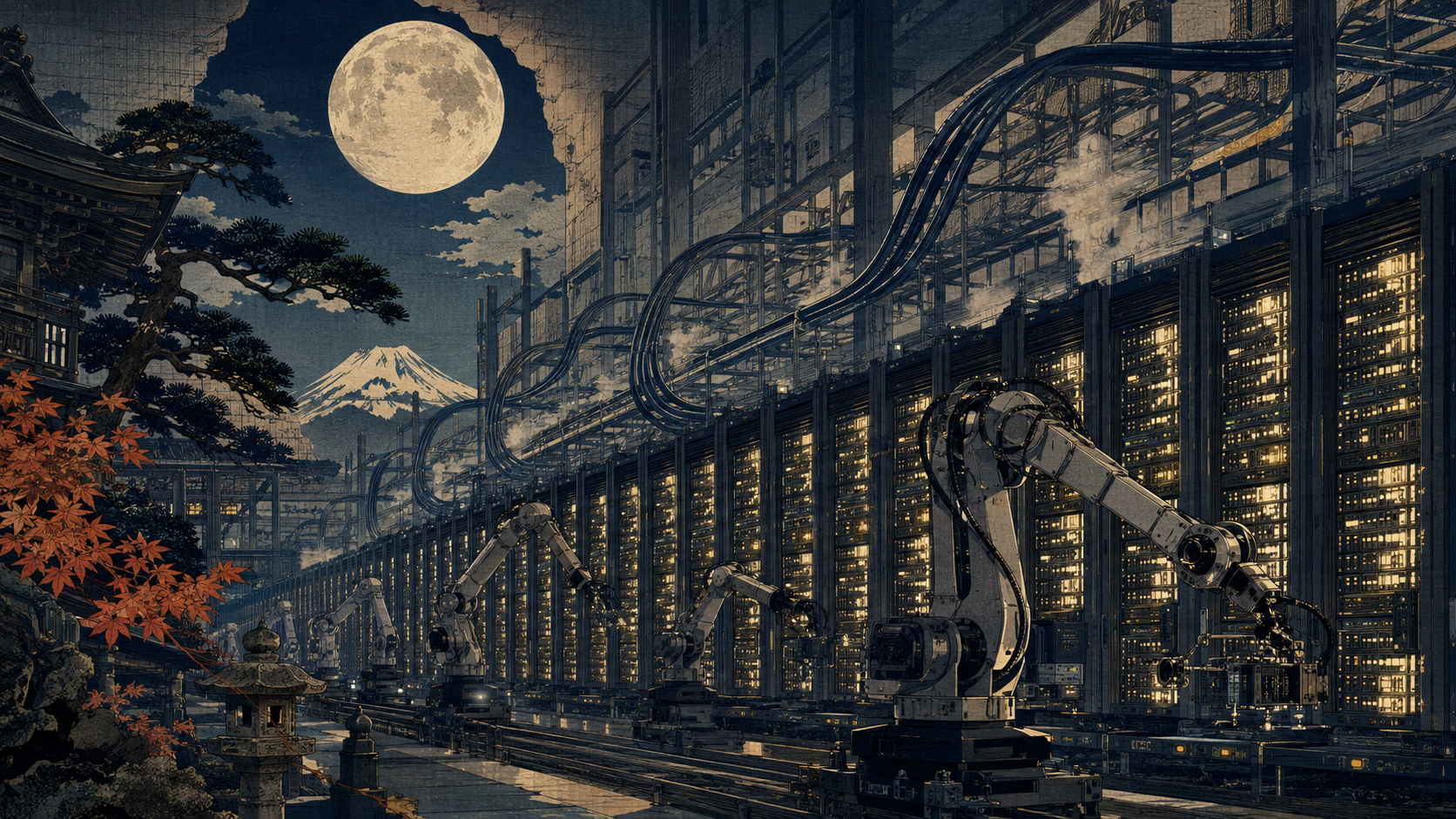
Development is not waiting for the new facility. Noetra says it will begin on computing infrastructure already operated by domestic providers. Construction of the Rubin-based system is scheduled to start in April 2027, with operations planned from June 2028. The announced configuration includes approximately 27,500 Rubin GPUs and 13,750 Vera CPUs, using NVIDIA’s NVL72 racks, DSX AI-factory design, Spectrum-X Ethernet networking and BlueField data-processing units. NVIDIA puts the planned data-center capacity at 140 megawatts.
NVIDIA describes the project as the world’s first national infrastructure dedicated to physical AI. That is the vendor’s characterization, not an independently certified category. The harder and more consequential fact is that Japan’s government-backed FRONTia program, a consortium spanning much of Japanese industry and NVIDIA’s next-generation compute platform are being assembled into a single development system.
What does an “AI factory” manufacture?
A conventional factory transforms materials into products. An AI factory transforms data and electricity into trained models, inferences and usable digital intelligence. GPUs perform the dense numerical work of training and serving models. CPUs, storage and networks prepare and move data, run simulations, evaluate results and deliver the models to users. The factory label is metaphorical, but the economics resemble manufacturing: input quality, process design, yield, utilization, downtime, energy per unit and product quality all matter.
A Vera Rubin NVL72 rack links 72 Rubin GPUs and 36 Vera CPUs with NVIDIA’s high-bandwidth NVLink fabric. Dividing the headline GPU count by 72 produces the equivalent of roughly 382 NVL72 GPU racks, but that should not be mistaken for a disclosed floor plan. Noetra’s number is rounded, and the companies have not said how the system will be phased or whether every GPU will sit in an identical rack. Storage, control servers, network switches, electrical gear and liquid-cooling equipment are not visible in the GPU total.
NVIDIA says the Rubin platform can deliver up to ten times the large-scale agent throughput of the preceding Grace Blackwell generation. This is a vendor performance claim under NVIDIA’s stated configurations; it is not a forecast of Noetra’s production performance. For industrial models, theoretical accelerator speed can be overwhelmed by slow data pipelines, network congestion, low utilization, evaluation bottlenecks and downtime.
Physical AI: after language, space and cause
Large language models are good at predicting and organizing language. Physical AI needs more. It must infer position, shape, speed, weight, friction and risk from cameras and sensors. It must anticipate how an action will change the next state of the world. A robot needs a closed loop: perception, reasoning, action and observation of the consequence.
A mistaken sentence can often be corrected on a screen. A robot that drops a component, a mobile machine that approaches a worker or a medical device that chooses the wrong location can cause physical harm. That changes the engineering problem. Simulation, digital twins, synthetic data, safety constraints, independent validation and reliable stop mechanisms become part of the system, not optional layers added at the end.
Noetra’s roadmap reflects that progression. From fiscal 2026, it plans a reasoning foundation model with advanced Japanese comprehension, logical reasoning and instruction-following abilities. In fiscal 2028, it aims to combine language, images, video and audio in an “omnimodal” model. By fiscal 2030, it intends to create what it calls “real-world-native AI,” able to understand spatial relationships and physical properties for use outside the screen.
| Timing | Noetra milestone | Practical meaning |
|---|---|---|
| FY2026 onward | Reasoning model for Japanese, logic and instruction following | A common base for domestic AI agents and language systems. |
| April 2027 | Construction of the Rubin compute platform begins | Power, cooling, networking and racks must be integrated as one system. |
| June 2028 | Planned start of AI-factory operations | Large-scale training and domestic model access are expected to expand. |
| FY2028 | Language, image, video and audio become omnimodal | Factory video, abnormal sounds and work instructions can be modeled together. |
| FY2030 | Real-world-native AI | A foundation for robots, vehicles and equipment acting in physical environments. |
A new version of “Japan Inc.”
Noetra’s shareholders are not merely AI developers. They include robot and automation groups such as FANUC, Yaskawa Electric, Kawasaki Heavy Industries, Omron and Mitsubishi Electric; manufacturers and infrastructure companies including Tokyo Electron, Murata Manufacturing, JFE Steel, Nippon Steel, Daikin, Okuma and JERA; and businesses in logistics, construction, pharmaceuticals, telecoms, banking and insurance. The companies that possess the data and will deploy the models are entering the same capital structure as the companies building them.
That is a genuine advantage. Japan’s most distinctive AI assets may not be the quantity of text on the public internet. They are production settings, equipment logs, failure records, skilled-worker movements, quality inspections, logistics routes and research data accumulated in the physical economy. A common model could turn know-how trapped inside one factory or one machine type into reusable capabilities.
It is also a difficult governance experiment. Each company uses different sensors, terminology, contracts and confidentiality rules. Competitors must decide how much data they can share, who owns capabilities learned from pooled information and how to prevent a model from reproducing trade secrets. The consortium can solve the access problem only if it creates trust that survives commercial rivalry.
NVIDIA says pretrained weights from Noetra’s multimodal models will be made broadly available to domestic developers and enterprises. Noetra’s own announcement says external provision and publication will proceed in stages as research and deployment mature. The word “open” remains undefined. It could mean freely downloadable weights, a Japan-only license, controlled access inside the facility or an API. That choice will decide whether public support creates a competitive ecosystem or a privileged club.
1982: Japan has tried to lead an AI era before
The plan has a deep prehistory. In 1982, Japan’s Ministry of International Trade and Industry launched the Fifth Generation Computer Systems project. The ambition was to build computers that processed knowledge and performed inference, rather than merely calculating. A dedicated institute, ICOT, coordinated work on logic programming, massively parallel processing and prototype parallel inference machines.
According to the Computer History Museum of Japan, operated by the Information Processing Society of Japan, the program invested about ¥54 billion over 11 years. It did not establish a mass commercial standard, and the main project ended in 1992. That has made it easy to label the effort a failure. The record is more complicated. It produced advanced parallel machines, programming systems, open software and more than 2,000 papers, while prompting counterprograms in the United States and Europe. Its research output was real; the missing bridge was from specialized prototypes to a widely adopted commercial software ecosystem.
The technical path was different from today’s machine learning. Fifth Generation researchers sought intelligence through specialized logic languages and inference hardware. Modern AI grew through data, gradient-based learning, general-purpose GPU acceleration and open software frameworks. Yet the institutional resemblance is striking: a government-backed parallel computer, a consortium of major companies and a stated goal of machines that reason.
The most useful historical lesson for Noetra is not that national projects always fail. It is that a remarkable machine is not an industry. A system changes an economy only when developers can use it, companies can deploy it, customers can afford it and the tools improve through repeated commercial use.
From 50.3% in 1988: the semiconductor leadership Japan lost
When the Fifth Generation project was active, Japanese chipmakers stood at the center of the global semiconductor industry. Japan’s trade ministry says their share of worldwide semiconductor sales peaked at 50.3% in 1988. By 2019 it had fallen to about 10%.
No single treaty, foreign rival or boardroom error explains that decline. The center of value moved from a Japanese strength in memory to personal-computer processors, fabless chip design, foundry manufacturing, mobile devices, cloud platforms and software ecosystems. Capital cycles, slow specialization, corporate consolidation and competition from American, South Korean and Taiwanese companies compounded one another. Japan retained critical positions in materials, semiconductor equipment, sensors and NAND flash, but it no longer controlled the processors or software platform at the center of AI computing.
The order for 27,500 Rubin GPUs is therefore rich in historical irony. Japan is using the strongest available foreign chips and software because it needs world-class AI capacity quickly. It is trying to keep other layers—models, data, operations, governance and industrial applications—under domestic control. This is not semiconductor self-sufficiency. It is an attempt to redefine sovereignty as a layered question: which parts of the stack must a country control, and which dependencies can it manage?
The card Japan still holds: it builds the world’s robots
Japan entered the generative-AI boom behind the United States and China, but it begins the physical-AI contest from a different position. The International Federation of Robotics describes Japan as the predominant robot-producing country, responsible for 38% of global production. Its 2025 report says 44,500 industrial robots were installed in Japan in 2024 and approximately 450,500 were in operation. Manufacturing robot density reached 446 units per 10,000 employees, fourth in the world.
The advantage is larger than a unit count. FANUC, Yaskawa, Kawasaki, Mitsubishi Electric and others have accumulated decades of expertise in motors, servos, controls, machine tools, safety certification and maintenance. Japanese automotive, electronics, steel, chemical, air-conditioning and logistics operations contain records of failure, adjustment and quality control. Those are potential training assets that frontier text-model developers do not automatically possess.
But no victory is guaranteed. China is already the world’s largest market for robot installations and its domestic suppliers are gaining share. American companies lead in AI models, accelerators, cloud systems and simulation. Japan must persuade established robot makers to move beyond closed control systems and embrace frequent software updates, shared models and a broad developer ecosystem without weakening industrial safety.
ABCI, Fugaku and GENIAC: the intervening decades were not empty
Japan’s compute policy did not disappear between the Fifth Generation program and Noetra. AIST opened the AI Bridging Cloud Infrastructure, or ABCI, for full operation in August 2018. It was designed as open computing infrastructure for AI research and the transfer of AI into industry. ABCI 2.0 followed in 2021 and ABCI 3.0 in January 2025.
RIKEN and Fujitsu’s Fugaku supercomputer entered shared use in March 2021. Built around the Japan-designed A64FX CPU, Fugaku supported scientific computing, disaster modeling, drug discovery, climate research and industrial simulation. It was not a general generative-AI cloud, but it demonstrated that Japan retained the ability to design, operate and allocate a national-scale computing resource.
METI and the New Energy and Industrial Technology Development Organization launched GENIAC in February 2024, supplying computing support and a developer community for domestic foundation-model builders. The first phase backed 10 projects, the second 20 and the third 24. A broader AI and semiconductor support framework calls for more than ¥10 trillion in public support through fiscal 2030, intended by the government to induce over ¥50 trillion in public and private investment across ten years.
Noetra can therefore be read as a next step, not an isolated megaproject. ABCI established open AI compute, Fugaku preserved national high-performance computing capacity and GENIAC helped train model-building teams. FRONTia and Noetra attempt to connect those capabilities to industrial data, commercial deployment and robotics.
| Year | Japanese computing milestone | Meaning for today |
|---|---|---|
| 1982 | Fifth Generation project begins | Knowledge processing and parallel inference become a national program. |
| 1988 | Japanese companies reach 50.3% of global chip sales | The high point of Japan’s hardware leadership. |
| 1992 | Main Fifth Generation project ends | The gap between research prototypes and a commercial ecosystem becomes the lesson. |
| 2018 | ABCI enters full operation | AI computing is opened to research and industry. |
| 2021 | Fugaku enters shared use | Japan operates national HPC built around a domestic CPU. |
| 2024 | GENIAC begins | Domestic foundation-model teams receive compute support. |
| 2026 | Noetra and FRONTia launch | Compute, models, industrial data and robotics are brought together. |
The electricity and economic reality of 140 megawatts
Accelerators are not the only scarce input. If the full announced 140-megawatt capacity were used continuously for a year, simple multiplication produces about 1.23 terawatt-hours of electricity. That is an upper-bound illustration, not a consumption forecast. Actual use will depend on what the capacity number includes, utilization, cooling efficiency, maintenance and the pace of installation.
Even with that caveat, the scale makes grid connections, substations, backup power, liquid cooling, water, waste heat and relations with the host community central parts of the AI strategy. Japan imports much of its energy, while a weak yen raises the local-currency cost of fuel and imported equipment. The market strip for this edition—¥162.43 to the dollar as of 10:37 a.m. Japan time on July 17—also matters to the yen cost of GPUs, networking and electrical infrastructure.
Noetra and its partners did not disclose the site, total capital cost, amount of government support, electricity mix, renewable share, water demand or user pricing in the July 16 announcements. These are not peripheral details. They will determine the cost and carbon intensity of each model run, resilience during disasters and whether a Japanese startup can afford meaningful access.
The NVIDIA dependency inside “domestic AI”
Noetra’s models are intended to be developed in Japan around Japanese language and industrial data. The infrastructure, however, is deeply tied to NVIDIA’s vertically integrated stack: Vera CPUs, Rubin GPUs, NVLink, Spectrum-X, BlueField, DSX and CUDA. Japan gains performance and development speed, but becomes exposed to one supplier’s availability, prices, compatibility decisions and product cadence, as well as American export controls.
Sovereignty is not binary. A country may be unable to fabricate the leading accelerator yet still control the facility, data location, encryption keys, access rights, training code, model weights, evaluation criteria and industry applications. Conversely, placing GPUs on Japanese soil does not create sovereignty if developers, data and service revenue move elsewhere.
The practical test is substitutability. Can training data be moved to another platform? Can models be stored in standard formats? Could domestic accelerators or another supplier’s hardware be incorporated later? Can the facility continue operating during a supply interruption? An open model ecosystem could turn some hardware dependence into bargaining power. A closed system would deepen it.
The hardest problems are data governance and safety
Factory data are not like web text. Machine types, sensor rates, quality definitions and operating environments differ. Failures and accidents—the examples most needed for safety learning—are rare. Skilled workers often make judgments that were never recorded. Workplace video contains people, while healthcare data require much stricter protection.
A shared model needs both contracts and technology that allow companies to contribute without surrendering trade secrets. Will raw data be centralized, or will training occur inside each company with only updates shared? How will memorization and leakage be tested? Who audits the model? Who is liable after an accident? Will investors receive preferential access? If public money supports the facility, how much access will universities and smaller companies receive?
Physical-AI safety also reaches beyond the content filters used by chatbots. It includes functional safety, cybersecurity, human-machine separation, emergency stopping, behavior after a network failure and recertification after a model update. A model operating machinery must be capable, but also predictable, stoppable and traceable when something goes wrong.
Seven tests of success
Large computer announcements are an easy way to display national ambition. Success should be measured by useful output, not the installed GPU count. By and after 2028, Noetra and the government will need verifiable operating measures.
| Question | Evidence to watch |
|---|---|
| Is the compute actually used? | Utilization, queue times, outages and effective cost per training run. |
| Who gets access? | Usage by universities, startups and smaller manufacturers—not only consortium giants. |
| Are the models genuinely open? | License terms, weight access, redistribution, commercial use and published evaluations. |
| Do factories improve? | Changes in defects, downtime, logistics time, energy use, accidents and deployment cost. |
| Can safety be demonstrated? | Independent tests, incident reporting, reproducible audits and reliable stopping systems. |
| Does efficiency improve? | Electricity per training and inference task, cooling efficiency and power mix. |
| Is dependency managed? | Supply-continuity plans, data portability, hardware alternatives and domestic expertise. |
The historical fork: turning hardware into results
The Fifth Generation project asked an important question before much of the world, but it did not turn its technical achievements into a mass commercial ecosystem. After Japan’s 1988 semiconductor peak, the country lost leadership in chip sales. ABCI, Fugaku and GENIAC rebuilt computing infrastructure and developer capacity. Noetra now tries to reconnect those efforts to the part of the economy in which Japan remains unusually strong: machines and the physical production system.
The planned 27,500 Rubin GPUs are a globally significant number. But when the facility begins operating in 2028, construction will not be finished in the economic sense. The AI factory will have produced something only when reliable data flow into it, developers can use it on fair terms, models work safely in real facilities and measurable productivity or social value comes out.
Japan’s wager is not necessarily to build the largest language model. It is to join language, images, sound, space and machine motion into a reusable form of intelligence, preserving industrial knowledge that is now locked inside particular workers, factories and control systems. If that works, Japan can narrow the lead it surrendered in the first act of generative AI during the second act of physical AI. If it fails, the country will own an immense, expensive research installation filled with the world’s most advanced foreign computing equipment.
History will not render its verdict on the day the GPUs are ordered. It will do so when the physical world changes.
Sources and further reading
- Noetra, Sony Group and partners: Launch of Japan-developed multimodal foundation-model work: 44 investors, research structure, the FY2026–FY2030 roadmap and the April 2027/June 2028 infrastructure schedule.
- NVIDIA: Japan Government, Industrial Leaders and NVIDIA Launch the World’s First National AI Infrastructure: 13,750 Vera CPUs, 27,500 Rubin GPUs, 140 MW, FRONTia and proposed distribution of model weights.
- NVIDIA: Rubin platform AI supercomputer: Rubin architecture, NVL72, networking, availability and vendor performance comparisons.
- Ministry of Economy, Trade and Industry: AI Robotics Strategy: Government direction, sector roadmaps and implementation package.
- METI ministerial briefing on the AI Robotics Strategy: The 2040 deployment goal, 18 priority fields and the Noetra-AIST consortium.
- METI: AI and Semiconductor Industrial Infrastructure Framework: Public-support and public-private investment targets through fiscal 2030.
- METI: White Paper on International Economy and Trade 2023: Japan’s semiconductor sales share, from 50.3% in 1988 to about 10% in 2019.
- Information Processing Society of Japan, Computer History Museum: Fifth Generation Computer Project: The 1982 launch, ICOT, parallel inference machines and approximately ¥54 billion over 11 years.
- AIST and AIST Solutions: About ABCI: The 2018 launch, ABCI 2.0, ABCI 3.0 and the role of open AI infrastructure.
- RIKEN: Shared use of Fugaku begins: Completion and public use of Japan’s flagship supercomputer in March 2021.
- METI: GENIAC third-phase selections: The February 2024 launch and compute support for domestic foundation-model developers.
- International Federation of Robotics: World Robotics 2025: Japan’s robot installations, operational stock and global position.
Editor’s note: Facility scale and performance projections reflect company announcements available in Japan on July 17, 2026. Undisclosed location, cost, power mix and access terms are treated as open questions. The annual electricity figure is a simple conversion of the announced 140-MW capacity, not a usage forecast.