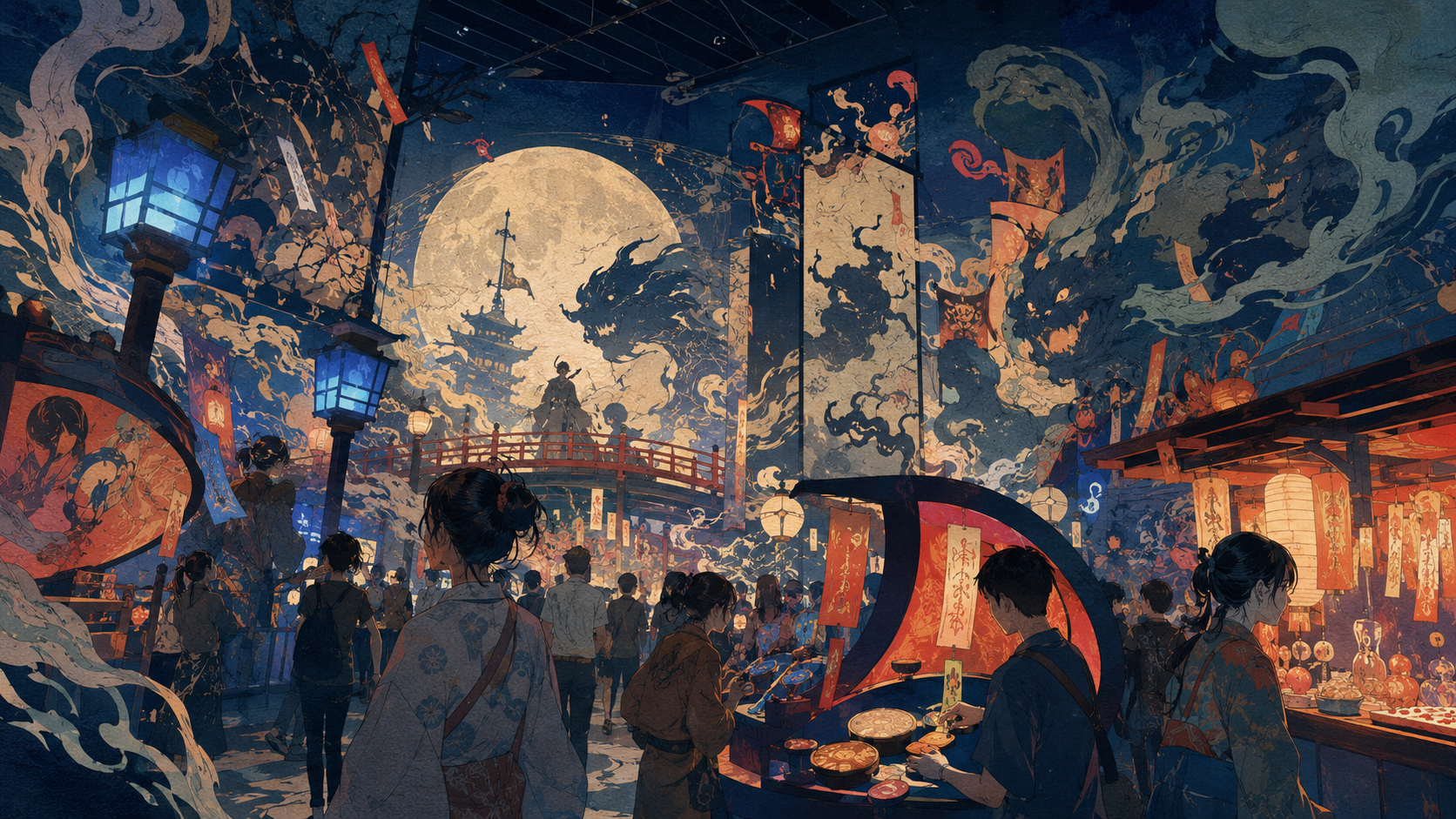
Make a shadow puppet with your hands. Drive a hammer downward. Turn a giant lottery drum shaped like a rice ball. The signature language of Megumi Fushiguro, Nobara Kugisaki and Toge Inumaki is being converted from animation into visitor movement. This is not a permanent, fully reconstructed Jujutsu Kaisen theme park. It is a compact work of experiential retail: story, play, food, photography and collecting assembled into one rapid physical loop.
Bandai Namco Experience announced on July 16 that JUJUTSU KAISEN WORLD will run from August 7 through September 27 at Bandai Namco Cross Store Tokyo, on the third floor of Sunshine City’s World Import Mart Building. Its narrative core extends from the anime’s first season through season two’s “Shibuya Incident.” It does not attempt to stage the entire completed manga or the newest television material. Instead, it selects the portion of the story shared by the broadest global audience and re-edits it for a commercial venue.
“Immersive” is the organizer’s term, but no use of virtual or augmented reality has been announced. What has been confirmed is a role-based paid attraction, three gesture-driven games, a story exhibition, recreated interiors, photo sets, food and merchandise. The immersion is not necessarily technological. It comes from giving the visitor a sequence of things to do inside the fiction.
JUJUTSU KAISEN WORLD in four numbers
Free admission does not mean a free event. Visitors can enter the area and see its atmosphere without an admission charge, but the trial-enrollment attraction costs ¥1,100 and each of three games costs ¥700. Playing all four once costs ¥3,200. At the edition’s quoted rate of ¥162.43 to the dollar, that is approximately $19.70, before card or exchange fees.
Activities, food and merchandise are separately priced. Adding the ¥1,600 pizza to all four games makes a ¥4,800 visit, or about $29.55 at the same simple conversion. Choosing the ¥1,800 cake set instead brings it to ¥5,000, about $30.78. Transport and merchandise remain outside those totals. No all-day pass or combined activity bundle has been announced, so families and collectors should set a ceiling before they enter.
Trial enrollment: when the story turns toward “you”
The principal attraction is “Jujutsu High Trial Enrollment — Challenge the Cursed Spirit Exorcism Mission.” A visitor becomes a provisional student and joins Yuji Itadori, Kento Nanami and Satoru Gojo on an exorcism assignment. The price is ¥1,100. Every participant receives one mission report from six designs and one result sheet from 21 variants determined by the outcome.
The important design choice is the visitor’s institutional identity. Jujutsu Kaisen is built from schools, ranks, assignments, techniques, barriers, domains and binding rules. “Trial enrollment” inserts an ordinary customer into that structure without requiring the fiction to pretend that the visitor is already a powerful sorcerer. The paperwork received at the end is both a souvenir and an in-world certificate that the episode happened.
The July 16 announcement does not state the experience’s duration, group capacity, difficulty, strength of sound or lighting effects, minimum age, wheelchair procedure or companion policy. Visitors with young children, mobility needs or sensory sensitivities should check for updates and ask the venue before making a fixed plan. Those unknowns are operationally important, not minor footnotes.
Three techniques become three games
| Game | What the visitor does—and may receive | Price |
|---|---|---|
| Megumi’s Rabbit Escape fortune game | Form a shadow puppet and summon “Rabbit Escape.” The result leads to an acrylic block, die-cut board, or one random fortune-style sticker from 17 designs. | ¥700 |
| Nobara’s Straw Doll Technique roulette | Use a hammer to channel cursed energy. The result leads to an acrylic board, foil A3 poster, or one random die-cut sticker from seven designs. | ¥700 |
| Inumaki’s salmon-onigiri lottery | Turn a large onigiri-shaped garapon drum. The ball color determines a pouch, POP stand, or one random die-cut sticker from seven designs. | ¥700 |
These games choose immediately recognizable motion instead of an expensive full simulation. Megumi is reduced to a hand sign, Nobara to her hammer, Inumaki to the rice-ball vocabulary that lets him communicate without accidentally activating cursed speech. Each compresses a complicated power into one photographable action that can be completed quickly and attached to a physical prize.
Some rewards depend on performance and some are random. The announcement does not publish the odds of the prize tiers, and a visitor cannot assume a preferred character or design can be selected. The fee purchases a game, not a guaranteed collectible. Adults bringing children can avoid an open-ended “play until we get it” loop by agreeing on the number of attempts in advance.
Edible episodes: food as a shortcut to memory
The venue’s tenants are turning specific scenes, not only faces, into dishes. A ¥1,600 pizza evokes the first-year students relaxing after the exchange event; its toppings change by city. A ¥1,300 sparkling drink pairs Nanami and Gojo, with Gojo’s technique presentation also changing from venue to venue. A ¥1,800 cake set based on Kenjaku and Sukuna turns a line from the “Shibuya Incident” into a dark dessert title. The menu makes eating function like rewatching: a flavor, color or name summons the scene.
Tokyo-only items announced so far include a ¥1,500 Yuji-and-Todo “best friend” hot dog, ¥1,700 Panda curry, ¥1,300 Gojo-and-Geto dorayaki, a ¥1,700 dumpling set inspired by the “Juju Stroll” anime shorts, a ¥1,200 Choso blueberry drink and a ¥1,200 Yuta “pure love” drink. There is also ¥600 custom soft serve, a ¥790 fortune latte and a ¥1,200 soft drink with an acrylic coaster.
Eligible food includes one illustration sheet per item, but the custom soft serve, fortune latte and acrylic-coaster drink are excluded. Menus differ by venue. Allergy information must be checked with staff or on the in-store menu; photographs are not a safe basis for ingredient decisions. Food is outside the launch-week event reservation, so a reserved event entry does not reserve a table, dish or food benefit.
Merchandise lets the visitor carry the new art home
New full-size illustrations feature Yuji, Megumi, Nobara, Nanami, Gojo, Kenjaku and Sukuna. Illustrator Tomoya Mizoguchi has also created mini-character art. Character-selectable foil acrylic stands are ¥1,900 each, and a Prison Realm cookie box is ¥1,100. But many smaller products are blind: ¥660 hologram badges and ¥660 clear cards contain one of seven random designs, while ¥990 mini-character acrylic keychains also contain one of seven.
This pricing builds a low-cost entrance and a potentially deep collecting exit. Choice-based goods sit beside products whose contents are unknown until opened. That can make trading social and exciting, but it transfers the cost of duplicates to the customer. The organizer warns that products, prizes and benefits are limited and may sell out. A reservation does not guarantee inventory. Some original items are also scheduled for Premium Bandai, so visitors can check online eligibility before treating the venue as the only possible purchase point.
Tokyo reservations: scheduled to open 23 minutes after the edition time
Some launch-weekend time slots require a free advance lottery. It covers all of August 7 and 8, and entry sessions through 2:30 p.m. on August 9. Applications are scheduled from 11:00 a.m. on July 17 through 11:59 p.m. on July 26, with results at 5:00 p.m. on July 27. From August 10 onward, the plan is admission without advance reservations, although crowd controls or same-day timed tickets may still be used.
This article’s market timestamp is 10:37 a.m. JST on July 17. The lottery was therefore scheduled to open 23 minutes after the reporting cutoff; it was not yet “open” at the moment represented by this edition. Readers arriving later must use the official page for current status.
The reservation grants access to the event area, photo spot, attraction, games and merchandise area. It excludes the café. It also does not guarantee activity capacity, timed tickets, prizes, products or benefits. Individual queues may close depending on crowds, especially for later arrivals. “May enter” and “can do everything” are not equivalent promises.
A 13-month, four-city itinerary
| City | Venue | Dates |
|---|---|---|
| Tokyo · Ikebukuro | Bandai Namco Cross Store Tokyo Sunshine City World Import Mart Building, 3F | August 7–September 27, 2026 |
| Osaka · Umeda | Bandai Namco Cross Store Osaka Umeda HEP FIVE, 8F and 9F | October 9–November 23, 2026 |
| Hakata | Bandai Namco Cross Store Hakata Canal City Hakata South Building, B1F | December 4, 2026–February 23, 2027 |
| Yokohama | Bandai Namco Cross Store Yokohama Yokohama World Porters, 2F | May 21–June 27, 2027 |
The tour is not necessarily a carbon copy in four rooms. Pizza toppings and the expression of Gojo’s technique are designed to change by city, and some dishes are explicitly Tokyo-only. Local variation creates a reason to revisit, but it also means a traveler should not assume every menu or benefit moves unchanged. Reservation methods, menus and operating details for Osaka and later venues await further announcements.
Cross Store Tokyo normally operates from 10:00 a.m. to 9:00 p.m., but hours vary by area. Event cutoffs, café service and sold-out notices must be checked separately. The long gap before Yokohama also makes reconfirmation essential; schedules and content can change between the announcement and a 2027 visit.
The beginning: four chapters in 2017, a weekly series in 2018
This was not born as a 150-million-copy master plan. Gege Akutami debuted in 2014 with Kamishiro Sōsa, then published the short series Tokyo Metropolitan Curse Technical School in Jump GIGA in 2017. Its four chapters centered on Yuta Okkotsu and Rika Orimoto, while already establishing Jujutsu High, Satoru Gojo, Suguru Geto and much of the later world’s basic structure.
Jujutsu Kaisen began in Weekly Shonen Jump in March 2018. The earlier work was collected that December as Jujutsu Kaisen 0: Tokyo Metropolitan Curse Technical School and retrospectively took its place as a prologue. The franchise’s history is therefore not one of a huge finished universe released in order. A compact prototype expanded through serialization, and the prototype itself was reread in a new context.
The main manga concluded in September 2024 after six and a half years and 30 volumes. Worldwide series circulation passed 100 million at the ending; the rights holders’ July 2026 announcement says it now exceeds 150 million, including digital editions. A short near-future spinoff, Jujutsu Kaisen ≡ (Modulo), written by Akutami and drawn by Yuji Iwasaki, began in September 2025 and has been collected in three volumes. Completion ended Yuji’s main serialization, not the brand’s ability to change era and perspective.
From paper to moving image: anime made a global common language
The MAPPA-produced first television season began in October 2020 and ran through March 2021. It translated Akutami’s velocity, rule-heavy techniques, sudden violence and bursts of ordinary humor into color, music, voice and motion. For a vast international audience, streaming anime—not the Japanese magazine—became the first encounter with the story.
Jujutsu Kaisen 0 opened in Japanese cinemas in December 2021. It turned the 2017 prototype into a feature film and ultimately recorded ¥26.5 billion in worldwide box office. Season two aired from July through December 2023, moving from the young Gojo and Geto in “Hidden Inventory / Premature Death” into the world-altering “Shibuya Incident.”
The theatrical program of 2025 deliberately revisited the chronology: a “Hidden Inventory / Premature Death” compilation in May, a revival of Jujutsu Kaisen 0 in October, and a November feature joining a special edit of “Shibuya Incident” to an advance presentation of the third season’s opening episodes. Season three, “Culling Game Part 1,” aired from January to March 2026. A fourth season, “Culling Game Part 2,” has been announced, but its broadcast date remained unpublished at the July 17, 10:37 a.m. cutoff.
WORLD focuses its exhibition on seasons one and two while also offering merchandise tied to season-three characters. That produces a two-level entry: the narrative space remains legible to the largest audience, while current viewers still have something new to collect.
The story had already begun invading physical Japan in 2020
Physical expansion began almost alongside the anime. A reproduction-drawing exhibition opened in Ikebukuro in August 2020. That November, an Atre Akihabara character pop-up and Jujutsu Kaisen PLAZA events in Shibuya and Umeda combined newly drawn art, exclusive goods and photo spots. A temporary Jujutsu High shop followed at Tokyo Station in December. These were simpler than WORLD, but they established the basic grammar: new art, buyable objects and a background that placed the fan inside a recognizable frame.
In 2021, Animate, Sega and exhibition-linked cafés in Tokyo, Osaka and Nagoya converted characters into dishes and coaster benefits. Yomiuriland wrapped rides, added a puzzle game, sold drinks from a themed truck and produced park-specific goods. An animation exhibition in Shibuya split season one into two halves and promised visitors a “re-experience” through key animation, storyboards and scenography. Fan behavior moved from watching to eating, traveling, solving, photographing and collecting.
The first 2.5-dimensional stage production played Tokyo in July 2022 and Osaka in August. Human performers and projection mapping moved manga and anime speed into live theater. A second production ran in Tokyo and Hyogo from December 2023 into January 2024. The audience did not control the action, but watching embodied humans perform the techniques brought the fiction one step closer to “being there.”
Universal Studios Japan got there first: 4-D, coaster and food
The decisive large-scale turn came with the first Universal Studios Japan collaboration, which ran from September 2022 to July 2023. Jujutsu Kaisen: The Real 4-D paired original 3D animation with seat vibration and water effects. Hollywood Dream — The Ride synchronized a voiced story with a roller coaster. Food extended the setting through a Jujutsu High cafeteria, Nanami’s favorite casse-croûte and a popcorn bucket representing Gojo.
From January 30 through August 18, 2026, USJ has revived the 4-D show with a completely new story and is operating a new story ride. Its final 11 days overlap the start of WORLD in Ikebukuro. Osaka’s park emphasizes large-scale images and physical effects; the Tokyo retail venue emphasizes player gestures, prizes and collecting. The same franchise supports two different meanings of immersion.
The Japan-developed experience also traveled abroad. In spring 2025, Universal Studios Hollywood included Jujutsu Kaisen: Hunger of the Cursed in its after-hours Fan Fest Nights. NBCUniversal described the film-based experience as one that first debuted in Japan. Anime was no longer only being exported as screen content. A location-based format designed in Japan had become exportable too.
The manga exhibition shows process instead of only product
The Gege Akutami Jujutsu Kaisen Exhibition opened at Shibuya Hikarie in July 2024. It traveled through Osaka, Fukuoka and Sendai and, as of this edition, is running in Nagoya, with Iwate to follow in September. It does more than hang finished pages. The exhibition shows storyboards, rough drafts, instructions to assistants, background work, digital drawing processes and extensive commentary from the creator.
Alongside material from the 2017 Tokyo Metropolitan Curse Technical School, it displays part of the storyboard for Jujutsu Sōsen, a prototype developed afterward. It reveals that the finished brand rests on discarded ideas, editing, collaboration and digital production. WORLD invites the visitor to enter the fiction. The manga exhibition invites the visitor to enter the creator’s decision-making.
Game adaptation: cursed techniques were rules from the beginning
The mobile RPG Jujutsu Kaisen: Phantom Parade launched in Japan in November 2023, added a PC version in April 2024 and expanded globally in nine languages outside mainland China that November. By September 2025, it had exceeded 25 million downloads. It retells season one while adding an original Fukuoka story, inserting a new place and cast into space left open by the source material. It also turns the franchise into a daily, continuously operated service.
The first console title, Jujutsu Kaisen Cursed Clash, arrived in February 2024. Its 2-versus-2 3D combat system translated partner combinations, rising cursed energy, techniques and domain expansions into rules for 16 playable fighters. Its story covered season one and Jujutsu Kaisen 0, then expanded with “Hidden Inventory / Premature Death” and “Shibuya Incident” content.
Jujutsu Kaisen adapts readily to games because its powers have conditions, not merely appearances: who may act, at what distance, in what sequence and at what cost. Barriers and domains change the rules of space; ranks and missions provide goals. WORLD’s three games are the smallest possible version of the same translation. An immense rule system is compressed into one gesture, one result and one prize.
Why a Cross Store? The shop becomes a medium
Bandai Namco Cross Store began with Yokohama and Hakata locations in July 2022; the Ikebukuro flagship opened in March 2023. The group defines the format as a “real touchpoint” where visitors can see, touch and experience characters, products, events and food. Official shops, event space, arcades, capsule toys and cafés sit near one another, allowing one IP to become several memories—and several forms of spending—during one visit.
Streaming reaches the world faster, but a physical event offers scarcity of time and place, shared reaction with friends, photographable scenery, paper proof of participation, prizes that exist only there and taste as a form of memory. The operator can observe fan response directly and move visitors among an attraction, food, amusement and retail.
There is also a danger: “immersion” can become a flattering name for a sales funnel. If most of the experience is waiting and buying, the fictional world thins out. Strong operation gives the free exhibition real substance, trains staff in the narrative role, communicates wait times and makes each game satisfying even when the most desirable prize is gone. Quality is measured by what a visitor can say they did—not only by what sold out.
Blind goods and scarcity: where play becomes pressure
Badges, cards, keychains and some game rewards use random selection. This is common in Japanese character merchandising and can make opening, trading and completing a set into social play. But for a customer who wants only one character, it transfers price uncertainty from seller to buyer. A ¥660 item does not guarantee any preferred design, and seven purchases do not guarantee a complete seven-design set.
The activity budget has a clear ¥3,200 stopping point; a collection budget grows until the visitor stops it. Operators should clearly separate selectable and blind goods, post purchase limits and stock status early, and disclose any game conditions that work like odds. Parents can agree on money and attempt limits before entering. Fans should exchange in safe public settings and remember that resale prices are not official prices. Satisfaction should not depend entirely on drawing a scarce image.
A practical visitor guide
| Check | Why it matters |
|---|---|
| Recheck the official event and reservation pages on the day | Entry rules, timed tickets, hours and sold-out notices can change. A reservation does not guarantee every activity or item. |
| Budget activities, food and goods separately | Admission is free, but the four activities total ¥3,200. Food and blind merchandise can change the final cost sharply. |
| Choose one non-negotiable priority | The mission, games, food and shop may have separate lines. Timed tickets can run out for late arrivals. |
| Ask about allergens at the venue | Menus vary by city and some items do not earn the illustration benefit. Do not infer ingredients from a photograph. |
| Confirm accessibility in advance | Duration, capacity, age, wheelchair procedure, sensory effects and companion rules were not in the first detailed release. |
| Do not assume English support | The extent of translated signs, audio and staff assistance has not been announced. Bring a translation option. |
| Know the spoiler boundary | The exhibition runs through the “Shibuya Incident” and may reveal important events to viewers who have not finished season two. |
Sunshine City is reached on foot from Ikebukuro Station. Tokyo’s August heat should be part of the plan even for an indoor event: allow extra travel time and carry water. Visitors expecting to buy large goods should think about luggage, hotel delivery and flight capacity in advance, and check storage guidance for food or fragile acrylic products.
International fans may recognize dates, prices and character names while still finding a mission difficult if its instructions and voice lines are only in Japanese. Until multilingual support is confirmed, do not promise yourself a fully English-language experience. Much of the physical play and photography may remain enjoyable without fluent Japanese, but the amount of comprehension required is one of the most important unanswered questions.
Immersion that belongs to the story—and immersion that merely consumes it
Jujutsu Kaisen imagines curses as forms born from human negative emotion. Fear, regret, loneliness and loss become visible beings and rules that can be fought. There is inevitable tension when that darkness is made into bright desserts and cute mini-characters. A painful scene can become approachable when it is named on a cake, but its pain can also flatten into decoration.
Yet fan culture often manages heavy stories through shared humor, food, exchange and commemorative photography. The anime itself inserted the comic “Juju Stroll” shorts into an otherwise dangerous world; the franchise has always moved between dread and lightness. A good collaboration does not erase the darkness. It understands the meaning of a relationship or scene, then opens a different emotional door into it.
By that standard, WORLD’s most interesting feature is not the number of products. It is the act of briefly borrowing Megumi’s shadow, Nobara’s hammer or Inumaki’s rice-ball vocabulary. The work’s specificity survives in movement. A generic dish with a logo, or a queue pursued only for inventory, could be transferred to any franchise and would therefore be less immersive.
What should be measured besides attendance?
The tour’s success cannot be understood only through sales and sellouts. Useful measures would include lottery winners who actually attend, wait time, completion rate, conversion from free entry to paid play, return visits across cities, visitor languages, accessibility accommodations, allergy communication and satisfaction after a desired prize has sold out. A sellout proves demand, but it also counts people who could not have the announced experience.
For the story, the question is whether newcomers want to watch season one, whether established fans understand a character differently, and whether friends or families leave with something to discuss together. For the venues, the question is whether a four-city tour spreads spending beyond Tokyo and gives shopping centers meaningful dwell time. Internationally, the test is whether a non-Japanese speaker feels not only that they bought something, but that they participated.
Rights holders must also distinguish the end of a story from the longevity of a brand. Producing an unlimited number of objects is not the same as keeping a narrative loved. Manga, anime, games, theater, exhibitions and attractions become genuine expansion only when each adds a new perspective instead of exhausting the same images.
Conclusion: writing new rules outside the manga
Nine years after the four chapters of Tokyo Metropolitan Curse Technical School, Jujutsu Kaisen has become a 30-volume main manga, a ¥26.5 billion worldwide film, three television seasons, stage productions, two major forms of video game, a touring creator exhibition and theme-park experiences in Japan and the United States. The 150-million circulation figure proves scale, but it does not explain longevity by itself. Characters, dread, humor and intricate rules that invite understanding have created different doors in every medium.
JUJUTSU KAISEN WORLD compresses that history into one retail space. Enter for free, pay to receive a role, imitate a technique with the body, receive a paper result, eat an episode, photograph a set and carry new art home. It is an intelligent commercial design. It becomes more than a slogan only when the operator manages queues, stock, randomness, language, budget and accessibility honestly.
The best experience will not be the one that sends a guest home with the greatest quantity of merchandise. It will be the one that lets someone say: I summoned Rabbit Escape with my own shadow; I completed the mission with a friend; that dish brought back that scene. Manga builds a world inside a reader’s mind. If WORLD succeeds, it will create rules that let strangers share that world in physical space for a few minutes without breaking it.
Sources and further reading
- Bandai Namco Experience: JUJUTSU KAISEN WORLD announcement (July 16, 2026) — activities, prices, rewards, goods, food, four-city schedule and current franchise figures.
- Official JUJUTSU KAISEN WORLD site — current venue, operating, merchandise and food information.
- NAMCO Parks: August 7–9 Tokyo advance lottery — application timing, covered sessions, access scope and non-guarantees.
- Official Jujutsu Kaisen anime site: detailed event announcement — the rights holders’ event notice.
- Gege Akutami Jujutsu Kaisen Exhibition: highlights — 2017 prologue, prototype, storyboards, digital process, creator history and 150-million circulation.
- Gege Akutami Jujutsu Kaisen Exhibition: itinerary — touring history from Tokyo in 2024 through Nagoya and Iwate in 2026.
- Official anime site: Jujutsu Kaisen PLAZA (2020) — early newly drawn retail events and photo spots.
- Legs: Jujutsu Kaisen Café and Animation Exhibition (2021) — cafés in Tokyo, Osaka and Nagoya and a season-one re-experience exhibition.
- Yomiuriland: Jujutsu Kaisen collaboration (2021) — ride overlays, puzzle activity, food and park merchandise.
- Nelke Planning: Jujutsu Kaisen stage production (2022) — record of the Tokyo and Osaka live adaptation.
- Official anime site: USJ’s Jujutsu Kaisen: The Real 4-D (2022) — 3D film, vibration, water effects and original story.
- Universal Studios Japan: Universal Cool Japan 2026 — new 4-D story, story ride and the park’s integrated experience model.
- NBCUniversal: Universal Fan Fest Nights 2025 — the Hollywood presentation of a Jujutsu Kaisen film experience that debuted in Japan.
- Sumzap: Phantom Parade passes 25 million downloads — Japan, PC and nine-language global release history.
- Bandai Namco Entertainment: Jujutsu Kaisen Cursed Clash — first console game, 2v2 design, story scope and platforms.
- Bandai Namco Cross Store: concept — the “real touchpoint” connecting retail, events, food, amusement and capsule toys.
- Bandai Namco Amusement: first Cross Stores open (2022) — the format’s history beginning in Yokohama and Hakata.
Editor’s note: Reporting was checked through 10:37 a.m. Japan Standard Time on July 17, 2026. The Tokyo advance-entry lottery was scheduled to begin at 11:00 a.m. that day and had not begun at the edition cutoff. Free admission does not make the attraction, games, food or merchandise free. Approximate dollar conversions apply the supplied ¥162.43 rate mechanically and exclude card or exchange fees. The initial detailed announcement did not specify attraction duration, capacity, age rules, accessibility procedures or multilingual support; this article treats those points as unpublished. Dates, content, prices, stock and entry procedures can change, so visitors must recheck official information.