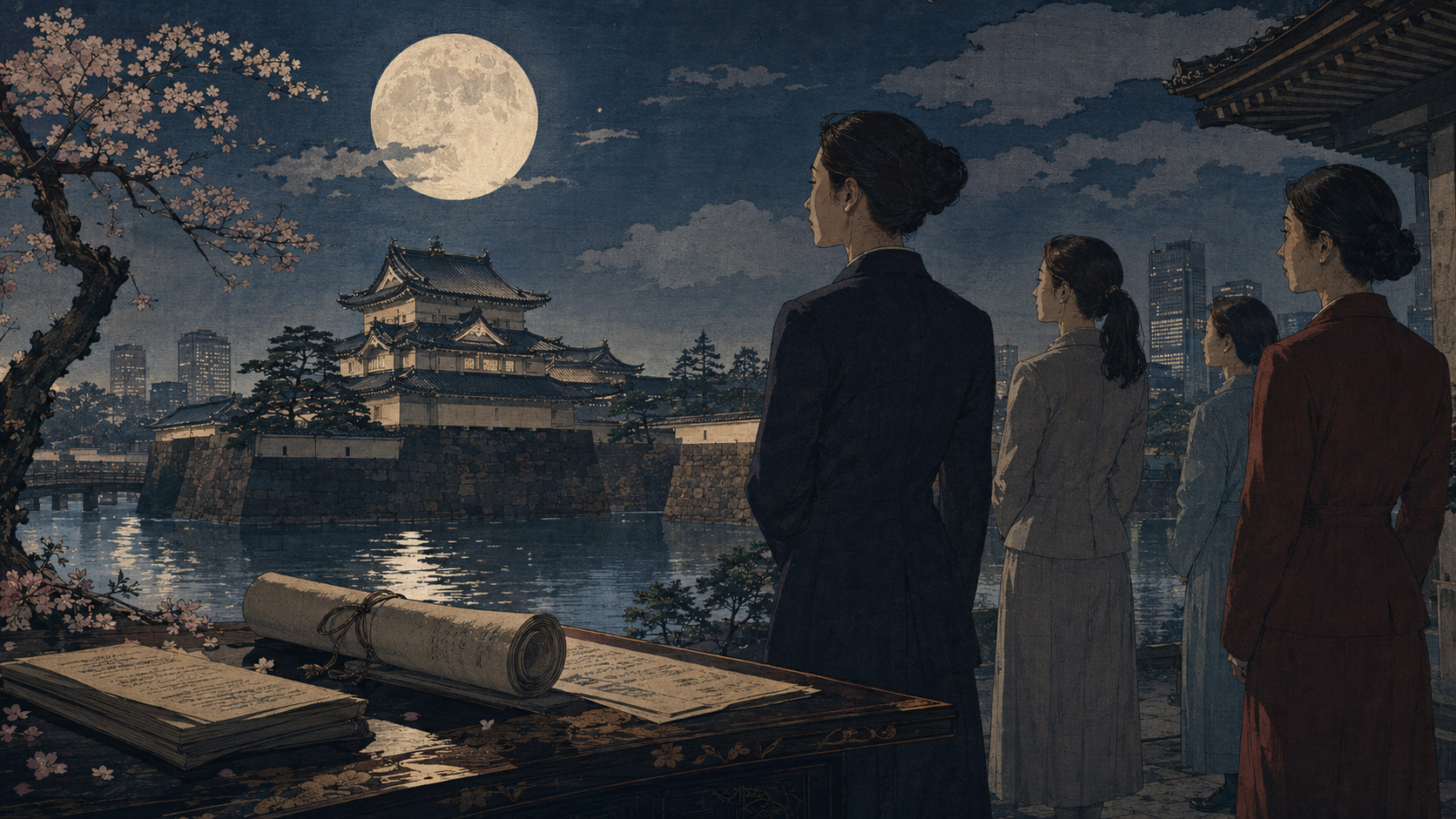
An Imperial princess may remain in the family after marriage. Her husband and children will not become Imperial Family members. She may continue public duties, but she cannot become emperor. Put those three propositions together and the advance—and the unresolved contradiction—in Japan’s 2026 Imperial House Law bill becomes clear.
The government submitted its “Bill to Partially Amend the Imperial House Law and Related Acts” to the 221st Diet on June 30. The House of Representatives passed it on July 10. A special committee of the House of Councillors approved it on July 16, and at this report’s editorial cutoff it was expected to receive a final vote in the full upper chamber on July 17. It would be the first substantive alteration to the main body of the 1947 law.
The bill has two pillars. First, naishinnō and joō—princesses in the closer and more distant degrees of the Imperial line—could retain Imperial Family status after marrying a man who is neither the emperor nor an Imperial Family member. Second, eligible male-line male descendants from the 11 collateral branches that left Imperial status in 1947 could be adopted into a present Imperial household. The adoptee would not enter the line of succession, but a male-line son born after the adoption could become eligible.
Both measures are presented as ways to secure enough Imperial Family members, but they perform different political work. The first keeps women who were raised in the institution and already perform public duties from being expelled by marriage. The second creates new male members from families that have lived as private citizens for almost eight decades. Broad agreement formed around retaining the women. Disputes persisted over the adoptees’ descendants and over the status of a married princess’s husband and children.
What the 2026 bill changes—and what it leaves alone
| Question | What the bill does | Practical meaning |
|---|---|---|
| A woman’s marriage | She can retain Imperial status after marrying a commoner. Present female members receive a transitional choice, reflecting the expectations under which they have lived. | Marriage no longer automatically terminates her public role. |
| Husband and children | They remain private citizens, not Imperial Family members. The bill also applies the resident-registration system to a married female member. | A household may contain one Imperial member and family members with ordinary civic status. |
| Succession | Article 1’s restriction to “male offspring in the male line” remains intact. | Princess Aiko, Princess Kako and all other women remain outside the succession order. |
| Former-branch adoption | An eligible male-line man descended from the 11 former branches—generally at least 15 and without a spouse or children—may be adopted into an Imperial household. | The state gains a route to add male members from collateral lines. |
| Adoptee and sons | The adoptee has no succession eligibility. A male-line son born after adoption may become eligible. | A membership measure can affect succession in the next generation. |
| Review | The system can be reviewed every 30 years when necessary, considering the size and circumstances of the family. | The law acknowledges that this may not be a permanent settlement. |
In the upper-house committee, the Constitutional Democratic Party proposed deleting the former-branch adoption provisions and requiring legislation on the status of a female member’s husband and children before implementation. Its amendment failed. The government bill passed with the ruling parties and support from the Democratic Party for the People, Komeito and Sanseito. The CDP, Japanese Communist Party and Reiwa Shinsengumi opposed it. Critics also objected that substantive deliberation in the two chambers totaled only a little over six hours.
The precise effective date, transitional administration and implementing rules depend on the final enacted text and promulgation. This report was prepared before the official Diet tracker recorded a full upper-house result. It therefore distinguishes a scheduled vote from enactment rather than writing tomorrow’s legal status as though it had already occurred.
What it means for Princess Aiko
The most closely watched person is Princess Aiko, the only child of Emperor Naruhito and Empress Masako. Born in 2001, she graduated from Gakushuin University and works at the Japanese Red Cross Society while taking on ceremonies, visits and other Imperial duties. Under the current Article 12, she must leave the Imperial Family if she marries a commoner. The revision opens a path for her to marry and continue serving as a princess.
Four other unmarried women could face the same choice: Princess Kako, Princess Akiko, Princess Yoko and Princess Tsuguko. The transitional approach recognizes that present members planned their lives under a rule that promised departure on marriage. Future female members would grow up with continued membership as the new default.
But Princess Aiko does not enter the succession order. The three present heirs remain Crown Prince Fumihito, Emperor Naruhito’s younger brother; Fumihito’s son Prince Hisahito; and the emperor’s elderly uncle Prince Hitachi. The bill leaves Article 1’s male-line male condition untouched.
This creates the bill’s starkest asymmetry. The emperor’s daughter, raised in the Imperial household and publicly familiar to the country, remains ineligible because she is a woman. A man adopted from a former branch would also be ineligible himself, but a son born to him afterward could qualify. Supporters call this a way to reconcile continuity in the male line with institutional necessity. Critics see a widening gap between social recognition and legal dynastic legitimacy.
A female emperor is not the same as a female-line emperor
Two Japanese terms are frequently collapsed in English. A josei tennō is a female sovereign: the person on the throne is a woman. If her connection to earlier emperors runs through her father, she remains part of the male line. Princess Aiko would be such a case.
A jokei tennō, often translated as a matrilineal or female-line emperor, derives the dynastic connection through the mother. The sovereign could be a man or a woman. If a female emperor had a child with a husband who had no male-line dynastic connection and that child later took the throne, the child would be a female-line sovereign.
The questions can legally be separated. A country could permit a woman in the existing male line to reign while setting a different rule for her children. Japan’s political debate often links the two because opponents fear that admitting the first will make the second unavoidable. The 2026 bill resolves neither.
| Term | Meaning | Position under the 2026 bill |
|---|---|---|
| Female Imperial Family member | A princess or other woman who already belongs to the Imperial Family. | May retain membership after marriage. |
| Female emperor | A woman occupies the throne. Japan has had eight women across ten reigns. | Still prohibited; Princess Aiko gains no succession eligibility. |
| Female-line emperor | The dynastic link passes through the mother; the sovereign may be male or female. | Still prohibited and left for future debate. |
| Female-headed branch | A policy concept in which a married woman remains as head of an Imperial household. | The woman remains, but excluding husband and children makes this narrower than earlier family-unit proposals. |
The Diet’s immediate objective is described as securing a sufficient number of Imperial Family members, not finally determining stable succession. Legislators separated the workforce that performs ceremonies and public duties from the line that may inherit the throne. That separation made the compromise possible.
Japan has had women on the throne
Female sovereignty is not absent from Japanese history. The officially recognized sequence contains eight women across ten reigns: Suiko; Kōgyoku, who reigned again as Saimei; Jitō; Genmei; Genshō; Kōken, who returned as Shōtoku; Meishō; and Go-Sakuramachi. Empress Suiko took the throne in 592. Empress Go-Sakuramachi, the last woman to reign, ruled from 1762 to 1771.
All were women of the male line—their fathers belonged to the Imperial line. No child founded a continuing line through an Imperial mother and an outside father. Defenders of the male-line tradition also stress that many women reigned during disputes or while a suitable male successor was young, describing them as transitional sovereigns.
Yet treating every female reign as a passive interlude flattens the record. Suiko’s reign coincided with major state formation and missions to Sui China. Jitō was central to the consolidation of the ritsuryō order and Fujiwara capital. Genmei’s reign saw the move to Heijō-kyō. Shōtoku exercised strong authority in the politics of Buddhism. Meishō and Go-Sakuramachi occupied the throne within the different constraints of early-modern court and shogunate. Women were exceptional sovereigns, but they were sovereigns.
The decisive legal closure came in the modern state. Article 2 of the 1889 Meiji Constitution reserved the throne to Imperial male descendants, and the old Imperial House Law specified male-line male succession. Article 44 of that law generally removed a female member who married a subject. The marriage rule was therefore not invented after World War II; the 1947 law inherited a patriarchal dynastic structure formalized in the Meiji era.
1947: a symbolic emperor and a smaller family
Japan’s postwar Constitution took effect on May 3, 1947. Article 1 made the emperor “the symbol of the State and of the unity of the people,” deriving the position from the will of the people, in whom sovereign power resides. Article 2 declared the throne dynastic but left the succession rules to an Imperial House Law enacted by the Diet. The emperor ceased to be the source of sovereignty and holds no powers related to government.
The Imperial House Law that took effect the same day reserved succession to “a male offspring in the male line belonging to the Imperial Lineage.” Article 12 required a female member to leave when she married anyone outside the Imperial Family. A private woman, by contrast, enters the family when she becomes empress or marries a male member. Male households can expand; female households flow out.
In October 1947, 11 collateral branches descended from the Fushimi line lost Imperial status as the postwar institution and its finances were reduced. The men covered by the 2026 adoption plan are descendants of those families. They were all born as private citizens, and their closest shared dynastic ancestor with the present Imperial family is distant. That creates questions not only of genealogy but consent and public acceptance.
The women who left through marriage
Numerous princesses have left the postwar Imperial Family upon marriage. Princess Takako, the daughter of Emperor Shōwa, became Takako Shimazu in 1960. Princess Yasuko of Mikasa became Yasuko Konoe in 1983. Princess Noriko of Takamado left in 2014, and her sister Princess Ayako left in 2018.
A particularly visible transition came in 2005, when Princess Sayako, Emperor Akihito’s only daughter, married Tokyo official Yoshiki Kuroda. She became Sayako Kuroda and entered a civic world of residence registration, voting, taxation and ordinary household administration from which Imperial members are separated. In the same year, a government panel recommended female and female-line succession, gender-neutral primogeniture and continued membership after marriage.
Princess Mako’s marriage to Kei Komuro in 2021 made the human cost still more visible. Intense scrutiny, abusive commentary and her disclosed complex post-traumatic stress disorder turned the marriage into a debate about personal dignity and media ethics as well as constitutional design. She declined the usual one-off payment associated with departure and moved with her husband to the United States.
The 2026 bill does not automatically restore women who have already left. It changes the choice facing future brides. Those earlier cases also show that remaining is not simply the preservation of privilege. It means keeping marriage, work, residence, speech, security and family privacy inside a public institutional framework.
2001–2006: Aiko’s birth and the reform that disappeared
When Princess Aiko was born in 2001, no male had been born into the Imperial Family since Prince Fumihito in 1965. Prime Minister Junichiro Koizumi created an advisory council in 2005 to examine stable succession. Its report concluded that maintaining a male-only male line would become extremely difficult and recommended admitting female and female-line sovereigns, with succession by birth order regardless of sex.
That model could have placed Aiko, then the crown prince’s first child, at the head of her generation’s succession order. It also required women to remain members after marriage and their households to be incorporated into the dynasty. The panel rejected restoration from former branches as its preferred solution, noting that the families had lived as ordinary citizens for almost 60 years and shared a remote ancestor with the immediate Imperial line, making broad public acceptance uncertain.
In 2006, the birth of Prince Hisahito to Prince and Princess Akishino halted the political drive for legislation. A male birth eased the immediate deadline. It did not change the mathematics. Two decades later, Hisahito is the only young male member, and the future of the line is concentrated in his eventual marriage and children.
2012, 2017 and 2021: from succession to headcount
Prime Minister Yoshihiko Noda’s government considered female-headed branches in 2012, allowing married women to continue Imperial activities. The idea did not survive the change of government, but the problem had already moved beyond who might reign. It concerned who would perform the institution’s work.
In 2017, the Diet enacted a special law permitting Emperor Akihito’s one-time abdication. Supplementary resolutions in both chambers asked the government to examine stable succession and issues including female branches without delay and report back. The abdication occurred in 2019; the broader inquiry moved much more slowly.
An expert panel convened under Prime Minister Yoshihide Suga and completed under Fumio Kishida reached a different conclusion from 2005. Its December 2021 report said the succession through Prince Hisahito should not be disturbed and deferred fundamental change. It instead offered two ways to secure membership: let women remain after marriage, and allow male-line men from former branches to enter through adoption.
The report reached the Diet in 2022. Speakers and deputy speakers of both chambers then worked through the positions of parties and parliamentary groups in meetings across 2024, 2025 and 2026. Continued female membership drew wide agreement. Whether husbands and children should join, how adoption should work and whether an adoptee’s son should acquire succession eligibility remained contested. The 2026 bill converts the agreement into law and turns the disagreements into boundaries.
| Year | Milestone | Meaning for today |
|---|---|---|
| 592 | Empress Suiko takes the throne | The first officially recognized female sovereign. |
| 1762 | Empress Go-Sakuramachi takes the throne | The most recent female sovereign. |
| 1889 | Meiji Constitution and old Imperial House Law | Male succession and female departure on marriage are formalized in modern law. |
| 1947 | Postwar Constitution, present law and departure of 11 branches | The emperor becomes a symbol; the family shrinks while the gender rules remain. |
| 2001 | Princess Aiko is born | The succession question becomes immediate. |
| 2005 | Koizumi advisory panel | Recommends female and female-line succession and gender-neutral primogeniture. |
| 2006 | Prince Hisahito is born | Legislation stops; one young male carries the future line. |
| 2017–19 | Abdication law and Akihito’s abdication | The Diet formally demands work on succession and female branches. |
| 2021 | Expert-panel report | Preserve the order; retain women and add a former-branch adoption route. |
| 2026 | Imperial House Law amendment bill | Membership reform advances while female succession is deferred. |
A family of mixed legal status
Keeping the woman while excluding her husband and children is a political firewall. It preserves public-duty capacity without making female-line succession an immediate possibility. It also creates a household divided by legal status, producing practical questions that the headline cannot answer.
Imperial Family members do not have ordinary family registers; their status is recorded in the Imperial Genealogy. By convention and law, they do not exercise voting or candidacy rights and face distinctive constraints around employment, political speech, gifts and property. A husband and children would have family and resident registers, vote, work, pay taxes and possess the ordinary rights and obligations of citizens. Applying resident registration to the married princess helps connect one household to civic administration, but the combination is novel.
Whose name appears on a home? How far does state security extend to a private spouse? How are conflicts involving his employment managed? What privacy applies to a child’s school, medical information and image? What happens after divorce, widowhood, inheritance or a move overseas? Which household expenses belong to the princess’s public allowance and which are private family costs? General legal categories do not resolve these details.
For fiscal 2026, the statutory annual allowance basis for an Imperial prince or princess with an independent household is ¥30.5 million. The revision addresses differences in the calculation for male and female members. Public money supports the dignity and duties of the Imperial member, but a mixed household will require rules that preserve both accountability and family privacy.
Adoption from the 11 former branches: genealogy versus recognition
The adoption plan has a coherent dynastic logic. A man whose paternal ancestry runs through a former Imperial branch can be added without abandoning the male line. Withholding succession rights from the adoptee avoids placing someone raised as a private citizen directly into the order. A son later born and raised as an Imperial Family member could then qualify.
But a genealogical category does not provide volunteers. Potential men were not born royal. They may have careers, partners, relatives, political views and lives outside the palace. Who identifies them, asks for consent, evaluates suitability and matches them with an adopting household? They require a genuine right to refuse, and their wider families require privacy.
Article 14 of the Constitution prohibits discrimination because of family origin. The government argues that the former branches’ distinctive relationship to the Imperial line—including status after the present Constitution and law took effect—provides a rational basis for limiting eligibility to their male-line men. Critics question the constitutionality and legitimacy of selecting private citizens on ancestry and giving a future son a qualification denied to Aiko.
Even perfect genealogy cannot substitute for social recognition. Article 1 grounds the emperor’s position in the will of the people. A successful adoption system requires consent, preparation for public duties, political neutrality and enough time for citizens to recognize the new member as part of the symbolic institution.
The case for the bill—and the cases against it
Supporters call the bill the smallest workable reform. It preserves the experience of women already performing public duties and removes marriage as an automatic retirement deadline. It adds a male-line route from former branches without rewriting the dynastic principle. Rather than divide the country over the throne, it begins with a staffing problem on which a parliamentary consensus can be built.
Criticism comes from several directions. Supporters of female succession argue that the bill retains women’s labor while withholding authority: women can perform duties, but cannot reign; their husbands and children remain outside. Excluding the publicly known daughter of the emperor while allowing a hypothetical future son of an adoptee to qualify places sex and paternal descent above public familiarity and service.
Some defenders of the male line have the opposite concern. A married woman continuing in an Imperial role may resemble a female-headed branch and become a bridge to later recognition of her husband, children or female-line succession. Keeping husband and children private is designed as a barrier against that development.
A rights-based critique asks how equality operates inside a hereditary institution that is exceptional by definition. The answer cannot simply be to treat Imperial people as instruments of continuity. Marriage and childbirth must not become assignments for a national objective. A “quiet environment” for discussion is valuable, but it must not become a mechanism for discussing people’s lives while denying them agency.
Public opinion: support for a woman on the throne is not the same question
Major polls have consistently found large Japanese majorities willing to accept a female emperor. A Kyodo survey reported in 2026 put support at 83%. An earlier 2024 Kyodo mail survey reported 90%, while a Yomiuri survey reported 69% in 2025. Methods and wording differ, so the figures should not be treated as one time series. The durable pattern is that female succession attracts substantially more support than the current male-only rule.
But permitting women to remain after marriage, adopting men from former branches, allowing a female emperor and allowing a female-line emperor are four different survey questions. The bill enacts the first and creates the second. It does not answer the third or fourth. Support for the bill cannot be read as full approval of male-only succession; support for a female emperor cannot automatically be read as support for all female-line descendants.
A symbolic institution grounded in popular will requires the Diet to measure these options carefully. It should also avoid turning succession into a popularity contest among individuals. Japan needs a general rule that remains legitimate even when detached from affection for Princess Aiko or any other person.
Other monarchies—and why Japan still needs its own vocabulary
Britain, Sweden, the Netherlands, Belgium, Norway and other European monarchies have moved to succession by birth order regardless of sex. They also regulate spouses’ titles, children’s eligibility, public finance and withdrawal from royal duty in different ways. Their direction is to stop placing a younger son ahead of an elder daughter solely because of gender.
Japan cannot copy those systems line by line. The male-line/female-line distinction occupies a unique place in Japanese politics and historical argument, and the emperor is a constitutionally defined symbol without governing power. The useful comparative lesson is institutional: succession, membership, spouses, public money, privacy and the option to leave must be designed together.
Eight questions the bill leaves behind
| Unresolved question | Why it matters |
|---|---|
| Status of husband and children | Family registration, residence, security, property, inheritance and speech inside one mixed household. |
| Employment for Imperial women | Whether professional and academic work may continue and how conflicts with public duties are managed. |
| Divorce, widowhood and remarriage | Consequences for status, housing, custody, children and public allowances. |
| Consent in former-branch adoption | Transparent recruitment, a meaningful right to refuse, and privacy for candidates and relatives. |
| Succession order for an adoptee’s son | Where a newly born eligible boy would rank relative to existing lines. |
| Female emperor | Historical precedent and high public support exist, but the bill does not address it. |
| Female-line succession | Whether descendants through an Imperial mother can qualify; this can be debated separately from a female sovereign. |
| Timing of another review | A 30-year wait could leave the burden concentrated on Hisahito’s generation before a succession solution is reached. |
Evaluation must also go beyond counting people. Did public duties become more sustainable? Did women gain a real freedom to marry? Were families protected from destructive scrutiny? Were private adoption candidates free from pressure? Did citizens understand and accept the resulting institution? Those outcomes determine whether the legal repair works.
Conclusion: membership advances, succession waits
The 2026 revision is small in scope and historic in direction. For the first time, it partly reverses the one-way structure formalized in 1889 and continued in 1947: women move out through marriage while men’s families move in. Princess Aiko and other women would no longer have to choose automatically between marriage and Imperial service.
At the same time, the bill entrenches the male-line male rule. A woman may stay but may not succeed. Her husband and children may share her home but not her status. A former-branch adoptee may not succeed, but his future son might. The lines are an exercise in political realism—and a map of the next dispute.
The Imperial institution has not endured by remaining legally motionless. Japan has enthroned women, created collateral branches, codified a modern house law, transformed the sovereign into a postwar symbol and enabled abdication through special legislation. Tradition is also the history of deciding what must change so something else can continue.
This bill may answer how the family retains enough people to carry out duties. It does not answer how the throne will pass stably through future generations. So long as Aiko may remain a princess after marriage but cannot inherit from her father, the distinction between membership and succession will remain visible to every citizen.
Under the moonlight, the outline is not a final settlement but the next fork in the road. Having decided that women may remain inside the Imperial Family, Japan must eventually decide whether it sees them only as custodians of the institution—or also as possible custodians of the throne.
Sources and further reading
- House of Representatives: Bill No. 64, 221st Diet — official submission, lower-house passage, upper-house committee result and party positions.
- House of Councillors: Bill to Partially Amend the Imperial House Law and Related Acts — official legislative record and submitted bill.
- House of Councillors: July 15 special-committee deliberation — official record of the chief cabinet secretary’s explanation and questioning.
- Jiji Press / nippon.com: Upper-house bill schedule — provisions on women, adoption, adoptees’ sons and the 30-year review.
- Jiji Press / nippon.com: Upper-house committee approval — the vote, proposed amendment, family status and length of deliberation.
- House of Councillors: Diet response on stable Imperial succession — the chain from the 2017 abdication resolutions through cross-party meetings in 2024–26.
- Cabinet Secretariat: 2021 expert-panel report — retaining married women, adopting male-line former-branch descendants and deferring succession change.
- Cabinet Secretariat: official background documents — summaries of the 2005 panel, 2012 options and 2017 supplementary resolutions.
- Imperial Household Agency: Members of the Imperial Family — present acquisition and loss of status under Articles 5, 6 and 11–15.
- Imperial Household Agency: The Imperial Succession — male-line male eligibility and statutory order.
- Imperial Household Agency: Current Imperial Family — family structure and official biographies.
- Imperial Household Agency: Emperor Naruhito, Empress Masako and Princess Aiko — Aiko’s birth, education and family position.
- Imperial Household Agency: Finances of the Imperial House — allowances, Imperial household property and Diet appropriations.
- National Diet Library: The Constitution of Japan — symbolic status, popular sovereignty and succession under a Diet-enacted law.
- National Diet Library: Constitution of the Empire of Japan — the 1889 male-descendant provision.
- Imperial Household Agency: Official list of imperial mausolea — the official sequence of emperors, including female sovereigns.
- nippon.com: Comparing the 2005 and 2021 expert reports — female succession, primogeniture and the former-branch option.
- Associated Press: Japan’s imperial family is diminishing — the 2026 bill, non-royal spouses and children, public opinion and criticism.
- Imperial Household Agency: Crown Prince Akishino and family — Mako’s 2021 marriage, Princess Kako and Prince Hisahito.
Editor’s note: This report was completed on the morning of July 17, 2026, before the official Diet page recorded a final upper-house plenary result. It distinguishes expected enactment, enactment, promulgation and commencement, and does not treat continued Imperial status as permission for female or female-line succession.