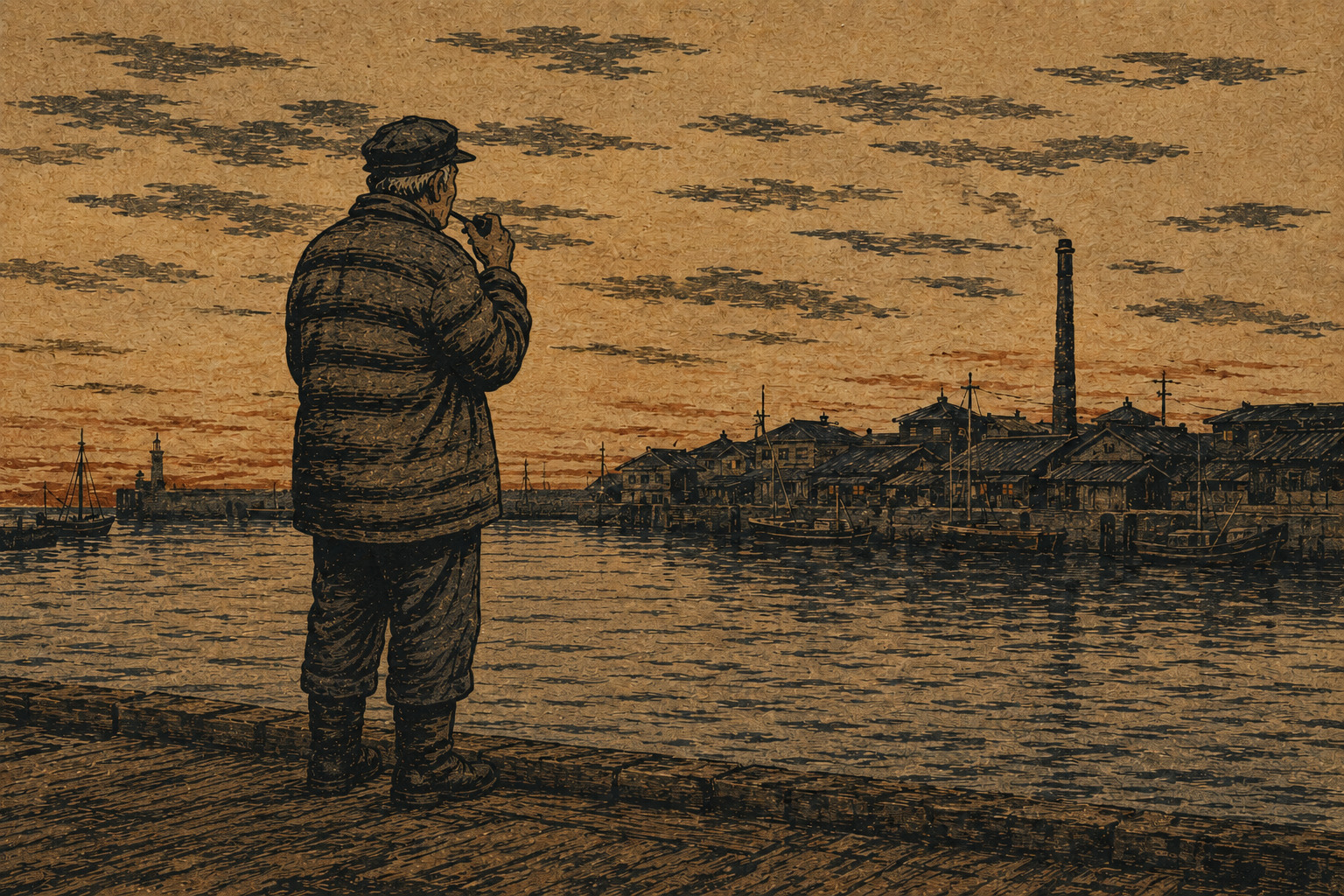
Yamamoto Kanae — Fisherman
An old man turns away from us, pipe raised, looking across a harbor. He is neither hero nor beauty. Yet the gouge marks surrounding him cut into the system that determined who counted as a print's author. In 1904, a 22-year-old art student designed, carved and printed this modest image himself. It became the emblematic beginning of Japan's creative-print movement.
We barely see the man's face. He holds a pipe near his cheek, wears a heavy coat and looks toward water, low buildings and a distant chimney. The sky is not polished into neutrality. Short cuts record wind, smoke, light—or simply the fact that a hand removed wood.
Yamamoto Kanae's Fisherman is a quiet laborer's image. Its art-historical violence lies in how it was made. Instead of relying on a publisher, a designer, a professional carver and a printer, Yamamoto conceived, cut and printed the sheet. It anticipated the sōsaku-hanga principles of jiga, jikoku, jizuri: self-drawn, self-carved, self-printed.
The Cleveland Museum of Art offers its impression online as an open-access work and describes the image as the beginning of that movement. Our choice is not simply a visually arresting black print. Within it, the modern ideal of a single author collides with Japan's collaborative print tradition, magazine culture, European influence, children's education and the economics of rural craft.
How to look at a back facing the harbor
The fisherman does not explain his labor to us. By turning him away, Yamamoto places the viewer at his shoulder, looking in the same direction. Horizontal black cuts give the coat weight. A few marks establish the head cloth and pipe. Buildings shrink in the distance, water remains pale and one chimney rises vertically.
Cleveland emphasizes Yamamoto's deliberate retention of gouge traces. A specialist carver reproducing a finished design might have suppressed the wood's resistance. Here those cuts remain visible in the sky and border. They do more than describe objects; they record where the maker's hand traveled. Reproductive technique becomes an image of making.
We should also resist turning the fisherman into an uncomplicated emblem of noble folk simplicity. The sitter's personal history is not recorded. His averted body grants privacy, but also holds the modern solitude projected by a young urban art student onto a worker. The picture stays powerful because it leaves that distance unresolved.
The black marks describe an old fisherman. They also describe the young hand that cut him. Two kinds of labor inhabit the print.
Learning to carve at ten
Yamamoto was born in Okazaki, Aichi, in 1882 and moved to Tokyo as a child. Around age ten he began a long apprenticeship in Sakurai Kyōun's workshop, learning Western-style wood engraving used to reproduce illustrations for newspapers and books before photomechanical printing became dominant. Accuracy, fine lines and fidelity to somebody else's image were the job.
After completing his term and working for the Hōchi Shimbun, he entered the Western painting course at Tokyo School of Fine Arts in 1902. A trained artisan now sought recognition as a painter. In the developing modern hierarchy, oil painting and sculpture occupied “fine art,” while carving blocks was easily treated as reproductive labor.
Fisherman was therefore not an untrained painter's charming do-it-yourself experiment. A person disciplined for years to engrave other people's drawings reclaimed that skill for direct observation. Keeping the gouge visible moved value from perfect reproduction to the maker's decision.
In 1904, a magazine made a small sheet an event
Yamamoto reportedly sketched the fisherman near Chōshi, Chiba, around the Tone River's mouth. Back in Tokyo he cut the image. Ishii Hakutei recognized its significance and placed it in the art-and-literary magazine Myōjō, calling this new work tōga—a “blade picture”—and presenting its refusal of the usual artist-artisan separation as revolutionary.
The magazine mattered. Even if Yamamoto pulled only one or two early impressions, readers encountered the picture and the argument through publication. The origin of modern Japanese printmaking occurred not only in an exhibition room but in a mixed media space where poetry, criticism, design and reproduced images circulated together.
In 1905 Yamamoto and friends founded the short-lived Heitan, where the word hanga appeared as a name for creative printmaking. In 1907 he joined Hakutei and Morita Tsunetomo in Hōsun. Small coterie magazines functioned as laboratories: artists showed work, invented language and educated an audience before official institutions accepted them.
Not a rejection of ukiyo-e, but a new organization of authorship
The familiar history makes sōsaku-hanga a heroic escape from old ukiyo-e division of labor. That is too simple. The publisher, designer, carver and printer system was not artistically inferior. Carvers translating Hokusai or Hiroshige and printers controlling gradation and registration made sophisticated judgments. Collaborative authorship is still authorship.
Yamamoto's innovation did not make collaboration worthless. It made “print artist” a different possible role. Cutting and printing ceased to be transparent delivery systems for a finished design and became acts of thought. Later shin-hanga maintained specialist collaboration while creating modern works; sōsaku-hanga privileged one maker's contact with material. They were competing answers to how authorship should be organized, not simply old versus new.
| Production model | Structure | Primary value |
|---|---|---|
| Ukiyo-e / shin-hanga | Publisher, designer, carver, printer | Specialist collaboration and publishing vision |
| Sōsaku-hanga | Ideally self-drawn, self-carved, self-printed | Maker's direct engagement with material |
| Fisherman | Former artisan apprentice controls every stage | Gouge trace becomes visible judgment |
From Japan to the West—and back again
The broad dark figure and unmodulated setting have been connected to British printmaker William Nicholson. Yet Nicholson's own bold flatness was indebted to Japanese woodcuts. Influence did not run in one direction from a modern West toward a receiving Japan. Ukiyo-e changed European art; Japanese artists then saw those altered European prints and rediscovered possibilities inside wood.
Yamamoto left for France in 1912, studying etching and painting in Paris and traveling in Brittany. War disrupted Europe. On his 1916 return through Moscow, he saw exhibitions of children's creative art and rural crafts. The encounter expanded his question from “who may author a print?” toward “who may create at all?”
From one printmaker to children and farmers
Back in Japan, Yamamoto opposed classroom drawing based on copying prescribed textbook models. His Free Drawing movement encouraged children to observe nature and express what they saw. He founded the Japan Children's Free Drawing Association in 1919, helping normalize the practice of taking children outdoors to draw.
In Ueda, Nagano, he also promoted a peasant-art movement. Farmers could carve and make regional crafts during the winter agricultural lull, producing supplementary income and preserving—or inventing—local design. The goal was not to copy Russian or European peasant goods but to develop work from local materials and life.
The principle of Fisherman widened socially: rather than reproduce an expert's model correctly, a child or farmer could look, decide and shape something with their own hand. These ventures faced financial and institutional difficulty, and Yamamoto accumulated debts. Their democratic impulse nevertheless shares the creative print's root.
In 1918, an experiment becomes a movement
Yamamoto, Oda Kazuma, Tobari Kogan and others founded the Japan Creative Print Association in 1918. Its first Mitsukoshi exhibition in 1919 reportedly displayed 277 works by 26 artists and attracted around 20,000 visitors. The debate migrated from little magazines into an organization and public show.
Making a living remained difficult. Prints ranked below oil painting in Japan, while some foreign buyers preferred the polished, recognizably “Japanese” collaborative production of shin-hanga. Artists such as Onchi Kōshirō, Hiratsuka Un'ichi and Munakata Shikō opened distinct paths. Sōsaku-hanga gained far greater international prestige after the war through biennials, collecting and contact with Americans during the Occupation.
1882 — Born in Okazaki.
c. 1892 — Begins wood-engraving apprenticeship.
1902 — Enters Tokyo School of Fine Arts.
1904 — Makes Fisherman; published in Myōjō.
1907 — Co-founds Hōsun.
1912–16 — Studies in Europe; returns through Russia.
1918 — Japan Creative Print Association.
1919 — Free Drawing Association and peasant-art work.
1931 — Helps establish Japan Print Association.
1946 — Dies in Ueda.
1960 — Hashimoto prints commemorative edition from old block.
When the first impressions disappear, the block still speaks
Printmaking complicates the word “original.” Is the work the sheet, the block, the design, or only an impression pulled by the artist? Scholarship suggests Yamamoto may have printed only one or two early sheets and that none is securely known to survive. The woodblock, however, remained with the Ishii family and eventually entered Ueda's collection.
In 1960, printmaker Hashimoto Okiie pulled about 40 commemorative impressions from it. Carnegie clearly catalogs its sheet as designed in 1904 and printed by Hashimoto in 1960. Ueda labels its example a 1988 later printing. A later impression lacks Yamamoto's choices of ink, paper, pressure and registration, so it is not equivalent to an artist-pulled sheet. It still returns the physical block's marks and the lost image to public memory.
Cleveland currently displays “1906” in its object record while its interpretation identifies the 1904 publication as the movement's start. The museum also cautions that object information may not be fully current. Catalogs are authoritative starting points, not machines that erase uncertainty. Placing institutional records side by side reveals the print's multiple times.
What to look for today
Begin with the turned back. Move to the horizontal cuts of the coat, the pale water and distant chimney. End in the gouged sky and border. That is where attention shifts from what is represented to how it was made.
- Back: Look with the figure rather than at his face.
- Pipe: A tiny black-and-white shape suspends time.
- Harbor: Houses, water and chimney define the world of labor.
- Gouge: Read short sky cuts as deliberate action, not unfinished cleanup.
- Impression: Distinguish the 1904 design from a later sheet's material history.
Cleveland's sheet is not presently on view, but its high-resolution image is available online and reusable under open access. That availability suits Fisherman. A work that returned the process to the maker is released beyond the museum wall for readers, teachers and future makers to use.
Fisherman changed more than the appearance of a print. It challenged the hierarchy separating the person who sees, the person who designs and the person whose hand does the work.
The old man does not know he stands at the beginning of a movement. Yamamoto probably did not imagine his small 1904 sheet becoming a textbook origin either. History does not always begin with a manifesto. Wood resisted a gouge, and a young maker decided not to hide the evidence. From that trace spread a question: Who is an author, and to whom does creativity belong? The print's legacy is outsized because it does not close the answer around one genius. It returns the question to everyone with a hand.
- Cleveland Museum of Art — object record, interpretation and open-access image
- Yamamoto Kanae Archives, Ueda — 1904 design, dimensions, 1988 impression
- Carnegie Museum of Art — 1960 Hashimoto impression
- Shizuoka Prefectural Museum of Art — Yamamoto biography
- Viewing Japanese Prints — early creative-print history
- IMPACT Printmaking Journal — European magazines, free drawing and peasant art
Editor's note: Sources agree that the design was made and published in 1904, but surviving sheets have different printing histories. Cleveland dates its object 1906 and lists it as not on view. This report does not identify every institutional sheet as a 1904 artist-pulled impression. The lead is the publication image prepared for Japan.co.jp; the museum's source image is available under its open-access terms.