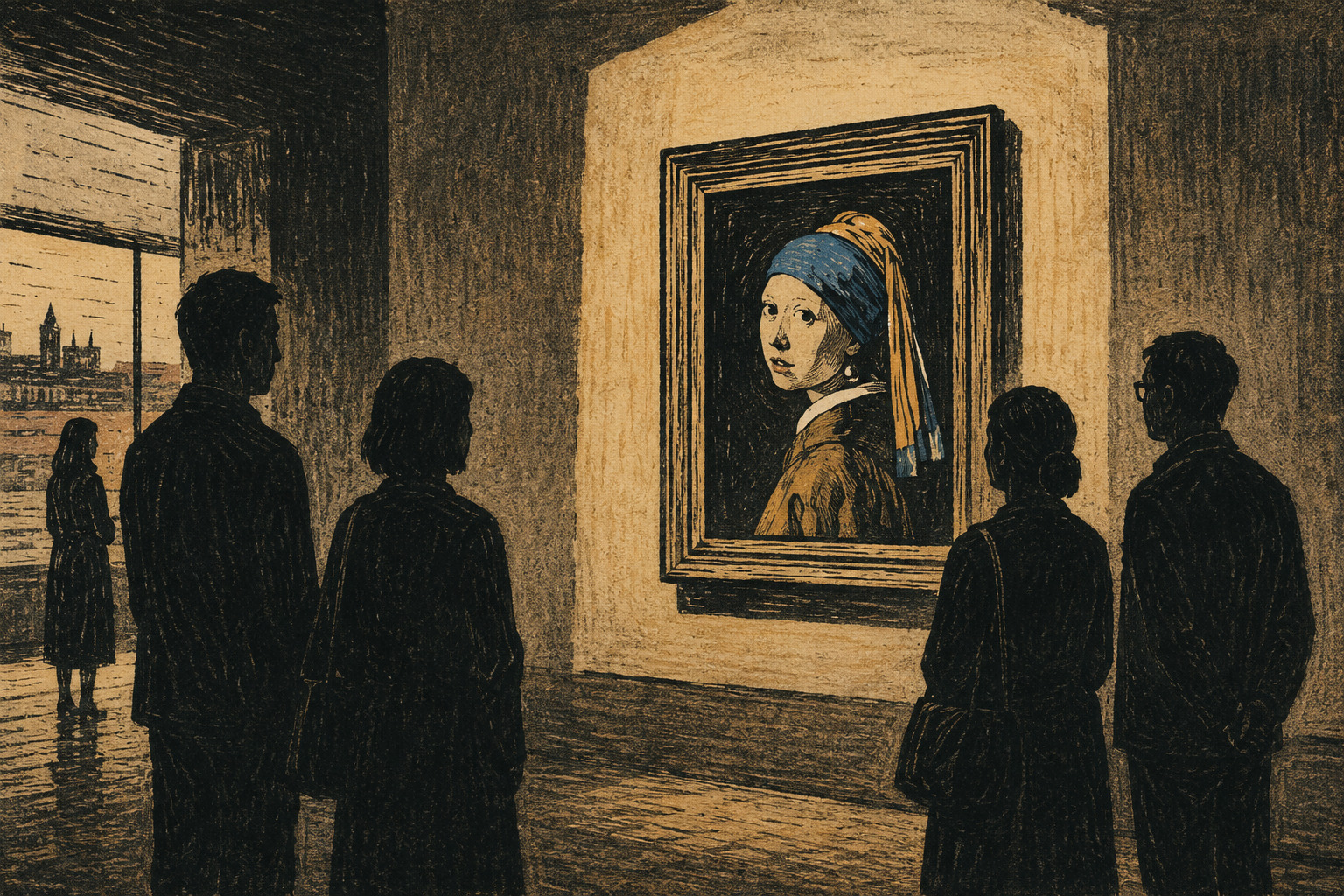
Is she looking at us, or has somebody just called her name? Is her mouth opening to speak, or merely to breathe? On August 21, inside a darkened room at the Nakanoshima Museum of Art, Osaka, a face without an answer began looking back at Japan for the first time in 14 years.
Johannes Vermeer's Girl with a Pearl Earring is on view in Osaka through September 27. Its home, the Mauritshuis in The Hague, is closing temporarily for alterations in August and September, creating the narrow window for an exceptional loan. The museum treats the painting as a central reason to visit and rarely lets it travel. This is its first appearance outside the Mauritshuis since the Rijksmuseum's Vermeer exhibition in 2023.
The Osaka exhibition brings 12 Mauritshuis paintings to Japan. Two are by Vermeer: the mature Girl and the early Diana and Her Nymphs. Works by Rembrandt, Jan Steen, Emanuel de Witte, Paulus Potter and Maria van Oosterwijck place them inside the competitive market of the Dutch Republic—history painting, portraiture and tronies, domestic comedy, church interiors, landscape and still life.
The renovation window that opened only in Osaka
A masterpiece does not travel simply because an audience wants it. Conservators must calculate temperature, humidity, vibration, light, packing, security and transport. Insurers and museums assess the risk to an irreplaceable object. The lender also loses one of its strongest reasons for visitors to walk through its own doors. Taking the Girl off the wall is therefore exceptional before the crate even moves.
The opening in 2026 was made by construction in The Hague. The Mauritshuis closes from August 24 through September 20; its visitor information says the Girl is absent from August 15 through October 4. A similar logic produced the painting's 2012–14 world tour during a major renovation. That tour—including Japan and the United States—drew a combined 2.2 million people and helped support the renewed museum.
This time there is no Japanese tour. The exhibition occupies the fifth floor of Nakanoshima Museum alone. Hours are 9:30 a.m. to 5 p.m., with closing extended to 8 p.m. on specified dates, and it is open every day. Admission is ¥3,000 for adults, ¥1,500 for university and high-school students and ¥500 for elementary and junior-high students. Entry is timed, and the museum does not sell same-day tickets at its counters.
Demand altered the system before opening. Heavy access destabilized the advance-sales site, so organizers replaced a first-come general sale with a lottery and introduced official resale. That is evidence of popularity, but it is also a question of public access: how should a scarce cultural experience be distributed? A lottery is an imperfect but meaningful correction to a race that rewards fast connections and flexible schedules.
Not a girl's portrait, but a “tronie”
The most persistent misunderstanding begins with the most natural question: Who is she? The Mauritshuis classifies the picture not as a commissioned likeness preserving a particular person's identity, but as a tronie. Popular in the 17th-century Netherlands, tronies were studies of faces, expressions, costumes or human types. A living model may have posed, but identifying that person was not the work's main purpose.
Girls in Delft did not ordinarily wear turbans like this. The blue and yellow cloth, exoticized dress and enormous earring gave Vermeer a stage on which to test color, skin, light and texture rather than record a sitter's status. Rembrandt helped popularize tronies by using his own face, unusual hats and armor. His roughly 1629–30 Laughing Man in Osaka lets viewers compare his muscular brushwork with Vermeer's suspended calm.
The absence of a fixed biography is precisely what keeps the Girl open. The turn of her head and parted lips leave the moments before and after outside the frame. The viewer supplies who called, what she might say, whether the emotion is surprise or recognition. The picture is not concealing an answer. It was constructed in a form that never required one.
We are not looking at the girl's identity. We are watching our own story enter the place where identity has disappeared.
Two periods in a career of only about 36 paintings
Vermeer was born in Delft in 1632 and died there in 1675 at 43. He worked as a painter, but also as an art dealer and an expert called upon to judge paintings. Only about 36 works are widely accepted as his. With so few pictures and limited documentation, his reputation did not remain as stable as Rembrandt's; his modern stature is partly the result of 19th-century rediscovery.
Putting two Vermeers together in Osaka is not merely doubling the celebrity count. Diana and Her Nymphs, painted around 1653–54, belongs to his early twenties and to the prestigious genre of history painting. Mythological figures fill a large, warm, weighty composition far removed from the hushed rooms of his maturity. During an 1885 treatment, a false signature naming Nicolaes Maes was removed and a “JVMeer” monogram uncovered. Conservation in 1999–2000 removed a later blue sky, restoring the darker evening atmosphere underneath.
About a decade later, the Girl removes narrative action, furniture and nearly all setting. What remains is face, cloth, collar, earring and darkness. The two canvases trace a startling compression: from a young painter pursuing the hierarchy of history painting to an artist capable of stopping time with a handful of forms.
The black void was once a green curtain
To the unaided eye, the background is almost black, lifting the head out of timeless space. In 2018, however, the Mauritshuis and an international team examined the picture in its “Girl in the Spotlight” project, combining non-invasive scanning, digital microscopy and analysis of tiny samples. They found a green curtain, complete with diagonal folds in the upper right.
The translucent green paint underwent physical and chemical change over centuries until the fabric effectively vanished. Vermeer did not originally place the figure against infinite blackness; time made the composition more abstract. The eyes also seemed to lack lashes, but microscopy and macro X-ray fluorescence imaging revealed fine eyelashes around both.
Infrared imaging exposed broad brown-and-black underlayers beneath the visible paint. Vermeer adjusted the ear, the top of the headscarf and the back of the neck while working. Researchers reconstructed an approximate sequence: background, skin, yellow jacket, white collar, headscarf and finally the pearl. Beneath the serene finish is a physical history of moving, reconsidering and layering.
He selected two forms of lead white to shape the face and used costly natural ultramarine, made from lapis lazuli originating in what is now Afghanistan, for the headscarf. Other materials point toward present-day Mexico or Central America, England, Asia and the West Indies. The quiet Dutch surface contains the long, unequal geography of early modern trade.
A pearl made with almost two strokes
The object that supplies the modern title may not be a pearl. It is implausibly large, and Vermeer painted no visible hook attaching it to the ear. The Mauritshuis has suggested a varnished glass imitation or an object of the artist's imagination.
More astonishing is how little paint forms it. A firm white highlight at upper left and a soft reflection of the collar below are enough. There is scarcely an outline. The viewer's visual system completes those marks as a round, heavy, luminous jewel. Less paint does not mean less information: darkness, placement and expectation make the unpainted portion active.
| What we seem to see | What research indicates | What remains uncertain |
|---|---|---|
| A black background | A folded green curtain before its paint changed | Its original color cannot be perfectly recovered by eye |
| Large eyes without lashes | Microscopy and X-rays reveal fine lashes | The model's identity |
| A gigantic pearl | About two white strokes; perhaps imitation glass if real | What, if anything, the model wore |
| An instantly settled composition | The ear, scarf and neck were moved during painting | Preparatory drawings and working time |
The global icon bought for 2.30 guilders
Today's fame makes the painting's modern emergence difficult to imagine. In 1881, the Dutch cultural official Victor de Stuers and collector Arnoldus Andries des Tombe noticed a small, badly neglected work at an auction viewing in The Hague. Accounts diverge: in one, De Stuers recognized Vermeer immediately; in another, the signature became apparent only after cleaning. The uncertainty matters because provenance stories often become neater as an object becomes famous.
The two men agreed not to bid against each other. Des Tombe acquired it for two guilders plus a 30-cent commission: 2.30 guilders. That price was not an occult “true value” missed by a foolish market. It was the price of an object whose maker, condition and place in art history were not secure.
Des Tombe opened his home to visitors and lent the picture to the Mauritshuis from 1881. Abraham Bredius, later the museum's director, praised its light and modelling in 1885. Des Tombe died in December 1902; a secret will left 12 paintings to the museum, and the bequest became formal in 1903. A private discovery became public patrimony.
c. 1665 — Vermeer paints the work in Delft.
1696? — A Dissius-family auction may include it; the chain is uncertain.
1881 — Des Tombe buys it in The Hague for 2.30 guilders.
1903 — The bequest enters the Mauritshuis collection.
2012 — Tokyo and Kobe attract about 1.2 million visitors.
2018 — Public scientific study reveals the curtain, lashes and revisions.
2023 — Loaned to the Rijksmuseum's major Vermeer exhibition.
2026 — Travels exceptionally to Osaka during alterations in The Hague.
Why Japan waited 14 years
The 2026 appearance is widely described as the painting's fourth visit to Japan: the National Museum of Western Art in 1984; Osaka Municipal Museum of Art in 2000; Tokyo Metropolitan Art Museum and Kobe City Museum in 2012; and now Nakanoshima. The 2012 exhibition drew about 1.2 million visitors in Tokyo and Kobe. The Mauritshuis says it achieved the highest daily attendance of the tour.
Renovation in The Hague also made the 2012 journey possible. The museum's relationship with The Asahi Shimbun deepened around that project and now extends to the 2026 exhibition and long-term support for an education center due to open in 2028. The exchange is therefore more than a one-way consumption of a borrowed masterpiece: part of the partnership supports the lender's conservation and educational infrastructure.
It is tempting to explain Vermeer's Japanese popularity through one national temperament—quiet, empty space, light, everyday life. But that risks forcing unlike traditions into a flattering resemblance. His restrained gestures may indeed feel intimate. Decades of exhibitions, translated books, television, advertising, reproductions, tourism and corporate sponsorship are equally important in producing familiarity.
Tracy Chevalier's 1999 novel and its film adaptation supplied a concrete life for the unknown model and spread the image beyond art history. The heroine, however, is fictional. No historical identity was discovered. The lack of evidence is exactly what allowed a storytelling industry to flourish.
Twelve works restore the star's world
Ending with the Girl alone turns Vermeer into an isolated genius. The other 11 paintings rebuild his market. In the Dutch Republic, urban citizens, merchants and professionals bought art, and painters specialized in portraits, domestic scenes, churches, landscapes, animals, flowers and other niches.
Rembrandt's Laughing Man catches expression in emphatic strokes, proving that a tronie can move at a different speed. Jan Steen's As the Old Sing, So Pipe the Young makes a household of drinking and music both comedy and warning. Maria van Oosterwijck's flowers recover the career of an internationally successful woman who wove religion and mortality into still life.
A digital presentation about 20 meters long shows Vermeer's surviving works at relative scale and magnifies details. It is a useful entry, but emitted screen light is not light reflected from paint. In 2024 the Mauritshuis publicized an EEG and eye-tracking study reporting a stronger emotional response to the original than to reproductions, and an attentional loop among the Girl's eyes, mouth and earring. That limited, museum-commissioned study is intriguing; it should not be inflated into a universal law that an original produces exactly ten times more feeling for everyone.
How many seconds at the end of the line?
Blockbuster exhibitions contain a contradiction. The more people admitted to the original, the less time each may have with it. Timed entry can regulate crowds, but bodies still accumulate at the star. Photographs, merchandise, giant projections and special trains can expand an experience while also turning it into proof of attendance.
No long lecture is required before looking. Begin with the small scale. Then find the background that was once green, the cheek without a hard outline, the point of white on the lips, the blue scarf and the two marks of the earring. Step back and locate the distance at which strokes become a person. The eye works hardest where Vermeer withheld information.
- Scale: Feel 44.5 by 39 centimeters rather than the poster-sized icon.
- Face: Let the eyes and parted lips remain emotionally unresolved.
- Materials: Compare the thick collar, dry cloth and gliding skin.
- Omission: Imagine the unoutlined pearl and darkened curtain.
- Context: Return to Rembrandt's tronie and the early Vermeer.
For those without tickets, the museum's high-resolution collection page and enlargements from the 2018 research remain publicly available. They do not replace the object, but they support study, teaching and return visits. Digital access is part of the exhibition's public value, keeping a rare loan from ending only as the private memory of those admitted.
The girl goes home; the questions remain
After September 27, the picture returns to The Hague. The director's “probably last” language is understandable given transport risk and the duty to show the work at home. International cultural exchange need not be measured by how often the same fragile icon flies. High-resolution records, conservation research, curator exchanges, education and loans of less vulnerable works can also build durable relationships.
Girl with a Pearl Earring became famous by resisting certainty. Who posed? What is she about to say? What hangs at her ear? Science restored a curtain and eyelashes and mapped the geography of pigments without closing the story. The more we learn about what is present, the more powerful the omissions become.
A painting bought for 2.30 guilders in 1881 now requires Osaka to allocate time by lottery. The girl did not change. The institutions, knowledge, stories and desires surrounding her did.
A 14-year reunion punctures the fantasy that a masterpiece is eternally unchanged. Backgrounds discolor, titles shift, reputations rise and travel becomes rarer. The physical painting ages while creating a new present for each viewer. During its 38 days in Osaka, the point is not to solve the girl's identity. It is to carry away the short silence in which we felt that she had recognized us.
- Official exhibition site — dates, admission and ticketing
- Official exhibition site — works and object data
- Nakanoshima Museum of Art, Osaka — exhibition structure
- Mauritshuis — closure and exceptional Osaka loan
- Mauritshuis collection record — technique, tronie and provenance
- Mauritshuis — 2018 “Girl in the Spotlight” research
- Mauritshuis — 2024 EEG and eye-tracking study
- Mauritshuis — Asahi partnership and 2012 attendance
- Tokyo Metropolitan Art Museum — 2012 exhibition
- Mauritshuis — Vermeer's life and accepted works
Editor's note: This report compares museum, organizer and conservation materials publicly available through August 21, 2026. Japan.co.jp has not reviewed the loan agreement, insurance value or transport specifications, and did not independently interview the curators. “Probably the last visit” is the director's expectation, not a permanent prohibition. The lead image is an editorial illustration—not a reproduction of Vermeer's painting or a photograph of the gallery.