A Heavy Message Wins Japan’s First Tsuchiya Bunmei Tanka Competition
Typing “I’m taking today off” should be easy. Sending it is not. Kōrin Yoshizawa, a second-year student at Takasaki High School, compressed the gulf between a few characters on a screen and their emotional weight into 31 sounds. His poem won the student division of the first national competition named for Tsuchiya Bunmei, the Gunma poet who insisted that tanka was life itself.
A finger pauses over a very short absence message. The poem never tells us whether its writer is ill, exhausted, unhappy or simply in need of a day. It says only that on a morning of school club practice, typing “I’m taking the day off” weighs far more than the sentence's length should allow.
The Tsuchiya Bunmei Memorial Museum announced on August 21 that Yoshizawa's tanka led 1,528 student entries. Together with 2,261 adult entries, the inaugural competition attracted 3,789 poems. The set word was bun or fumi—文, meaning writing, sentence, text or letter. Students had to use the prompt; adults could submit a set-topic poem or a free-topic poem.
The adult division's top honor, formally called the Tsuchiya Bunmei Prize, went to Gunma's Shizuko Shimizu. Looking at a blue teacup in a reconstruction of Bunmei's room, she wondered what kind his wife, Teruko, had used.
The two poems appear opposite. One contains a smartphone and school club; the other a museum object and a dead couple. Yet both make a small visible thing release a larger, unspoken relationship. The first competition became an experiment in how the “life” and close observation prized by Bunmei and the Araragi school persist across generations.
Why does “taking the day off” weigh so much?
The student poem gains power by refusing to overexplain. It opens in ordinary speech—yasumu tte, roughly “saying I'm taking off”—then moves to the contemporary action of typing a short text. The phrase “all I have to do” promises lightness. “This heavy” reverses it. Only at the end does “on a club-practice morning” disclose the social chamber in which that weight accumulates.
Japanese school clubs can contain obligation to teammates, guilt about missing practice, senior-junior hierarchy, a coach's judgment and pressure to justify absence. The poem neither condemns clubs nor permits us to diagnose the author. That restraint lets readers bring their own unsent absence notice, declined invitation or unanswered message.
The prompt 文 can become an old letter, literature, an English textbook sentence or a smartphone text. In other student awards, its sound opens into buntan, pomelo, or into classmates laughing at implausible textbook English. A set topic is not merely a puzzle requiring a character. It tests how many kinds of life one written sign can reach.
A few characters on the screen; kilograms in the body. Tanka places those incompatible units of weight inside one sentence.
A blue teacup opens a marriage
Shimizu begins with the blue cup in “Bunmei's room” at the museum. Her question—what kind did Teruko use?—turns toward an object that is not displayed. Faced with the great poet's relic, the poet looks sideways toward his wife's daily life.
Bunmei married Teruko Tsukagoshi, who came from the same region, in 1918. She died in 1982 at 93. Their marriage crossed Suwa, Matsumoto, Tokyo and wartime evacuation. A single preserved cup may be catalogued as Bunmei's, but it cannot preserve the complete arrangement of two people drinking tea. Tanka makes the missing second place visible.
The literary diction of tsukai shika—“what did she use?”—meets the clean ending, “there is one blue.” Museums exhibit what remains. The poem shows what did not. It does not indict the archive; it uses one object to ask after an entire household.
From the foot of Mount Haruna to Araragi
Tsuchiya Bunmei was born in 1890 in Hodota, now part of Takasaki. His family traded silk and cocoons and practiced small-scale agriculture. Rural work and the landscape beneath Mount Haruna formed his early world. At Takasaki Middle School—the predecessor of today's Takasaki High School—teacher Shigeyuki Murakami encouraged his literary interests.
In 1909, at 19, Bunmei moved to Tokyo and lodged with Itō Sachio, an inheritor of Masaoka Shiki's tanka reform. Sachio immediately took him to a poetry meeting and introduced him to writers including Saitō Mokichi. With financial support, Bunmei attended the First Higher School and Tokyo Imperial University. By 1917, he was an Araragi selector.
He also pursued education. In Nagano, he became principal of Suwa Higher Girls' School at 29, reportedly the youngest principal in Japan. He later refused a transfer order and resigned. His first collection, Fuyukusa, appeared in 1925. From 1930 he spent 22 years as editor and publisher of Araragi, placing him at the center of a nationwide network of writing, submission and rigorous selection.
1890 — Born in Hodota, Gunma.
1909 — Moves to Tokyo and joins Sachio's circle.
1917 — Becomes an Araragi selector.
1918 — Marries Teruko; moves to Suwa.
1925 — Publishes Fuyukusa.
1930 — Takes charge of Araragi.
1945 — Loses his home in an air raid and evacuates to Gunma.
1953 — Japan Art Academy Prize for his Man'yōshū commentary.
1986 — Order of Culture.
1990 — Dies at 100.
1996 — Memorial museum opens.
2026 — Museum turns 30; first national contest.
Shasei is not photographic copying
Masaoka Shiki stands at the hinge of modern tanka. As Western writing and a transformed society challenged conventional waka, Shiki advanced shasei—sketching from life—and recast waka as modern tanka. Araragi, shaped by Sachio, Nagatsuka Takashi, Mokichi, Bunmei and others, turned that proposition into an influential magazine and social system.
Shasei does not mean mechanically copying whatever is visible. It means looking hard, removing prefabricated sentiment and letting an object or action carry emotion. Bunmei never saw a smartphone, but the motion of typing a short sentence to reveal social pressure can be read as contemporary shasei.
The adult winner works similarly. It does not call the blue cup beautiful or sad. It places the fact that one cup is present beside a question about the absent one. The narrower the observation becomes, the more the invisible marriage expands.
After the war: “Tanka is life itself”
An air raid destroyed Bunmei's Tokyo home in 1945, and he evacuated to Agatsuma in Gunma. After defeat, traditional verse faced scrutiny for its associations with prewar authority and nationalism. The “second-rate art” debate associated with Takeo Kuwabara challenged whether short fixed forms could produce serious modern literature.
Bunmei defended tanka not as a miniature antique but as life itself. Poetry arising from concrete lived reality, he argued, remained valuable in a democratic age. He revived Araragi, traveled widely and encouraged writers. At the same time, his scholarship culminated in an extensive private commentary on the Man'yōshū, which earned the Japan Art Academy Prize in 1953.
That claim resonates in 2026. Life is not limited to farming and war. It includes notification screens, clubs, English textbooks and paperback bookmarks. A form may be ancient without requiring its subjects to pretend they are.
Eleven awards, many meanings of “writing”
One adult excellence award, by Teruo Onikata, places a mother's hand on the fevered forehead of a body still carrying the smell of silkworms—Gunma's sericulture history condensed into odor and touch. Chizu Kondō layers two photographs of parents smiling slightly apart: the first image of their meeting and their last together.
Selector awards range from a group that says Gunma “has nothing” while talking about nothing but Gunma, to a mother touching a father's famously generous earlobe just before cremation, to lips letting go of context. Student poems find 文 inside pomelo, unlikely textbook English, a small handprint saved in a grandfather's document box and a bookmark removed beside the jade-green Tone River.
| Division | Grand-prize focus | How time works |
|---|---|---|
| Adult | A blue museum teacup | One surviving object summons a missing domestic life |
| Student | A short club-absence text | Seconds before sending hold obligation and anxiety |
| Adult excellence | Silkworm scent; parents' photograph | Labor and family history enter touch and image |
| Student excellence | Pomelo; textbook English | Wordplay opens seasonal and classroom life |
The authority—and limitation—of choosing
The five judges are Kazuhiro Nagata, Yukari Kojima, Takahiro Ōtsuji, Naoko Higashi and Yoritsuna Sasaki, poets spanning distinct styles and generations. As of publication, their detailed deliberations and grand-prize commentary have not been released. Commentary is scheduled for the September 20 ceremony; Nagata will then lecture on elegy and love poetry.
A prize gives poems readers, but cannot permanently establish “the best.” Selecting 11 from 3,789 leaves thousands of lives outside the spotlight. The museum also selected 81 adult and 52 student poems for an anthology. If the event grows, access to that larger field will matter as much as celebrating two winners.
Adults paid ¥1,000 per pair of entries; students entered one poem free. Free student participation lowers one barrier. A genuinely national competition must continue considering unequal access to literary instruction, supportive schools and digital submission.
A centenarian poet meets a teenager's send button
Bunmei lived through Meiji, Taishō, Shōwa and Heisei. He wrote rural cocoons, women's education, the Tokyo air raids, evacuation, democracy and ancient poetry into one long career. We cannot know what he would have made of a smartphone. We can know that his insistence on lived reality offers a strong key to Yoshizawa's poem.
Thirty-one sounds are short, not light. By withholding the unsent explanation and positioning one exact action, the poem leaves space for readers' experience. The club-practice morning belongs to Japanese school life, but it also captures a broad modern paradox: communication has become effortless while saying no has not.
- 1 p.m.: Museum 30th-anniversary ceremony
- About 1:15 p.m.: Awards and judges' comments
- 2:20 p.m.: Kazuhiro Nagata, “Elegy and Love Poetry”
- Tsuchiya Bunmei Memorial Museum, second-floor seminar room
- The lecture lottery has closed; the museum is otherwise closed that day.
A form more than 1,300 years old does not break when it holds a teenager's finger above “send.” That adaptability is why it remains alive.
The first competition's central question is not whether tanka is old or new. It is whose life can be placed accurately inside it. A blue teacup and a smartphone seem far apart. Both, however, ask a small object to hold an absent person or unspeakable weight. Bunmei's century and a few seconds before club practice meet in the same 31-sound room.
- Gunma Prefecture — entries, winning poems and ceremony
- Tsuchiya Bunmei Memorial Museum — complete award list
- Museum — Bunmei chronology
- Museum — introductory Bunmei history
- Gunma Prefecture — competition rules and purpose
- Museum — Kazuhiro Nagata lecture
- Museum — Shiki and Araragi anniversary exhibition
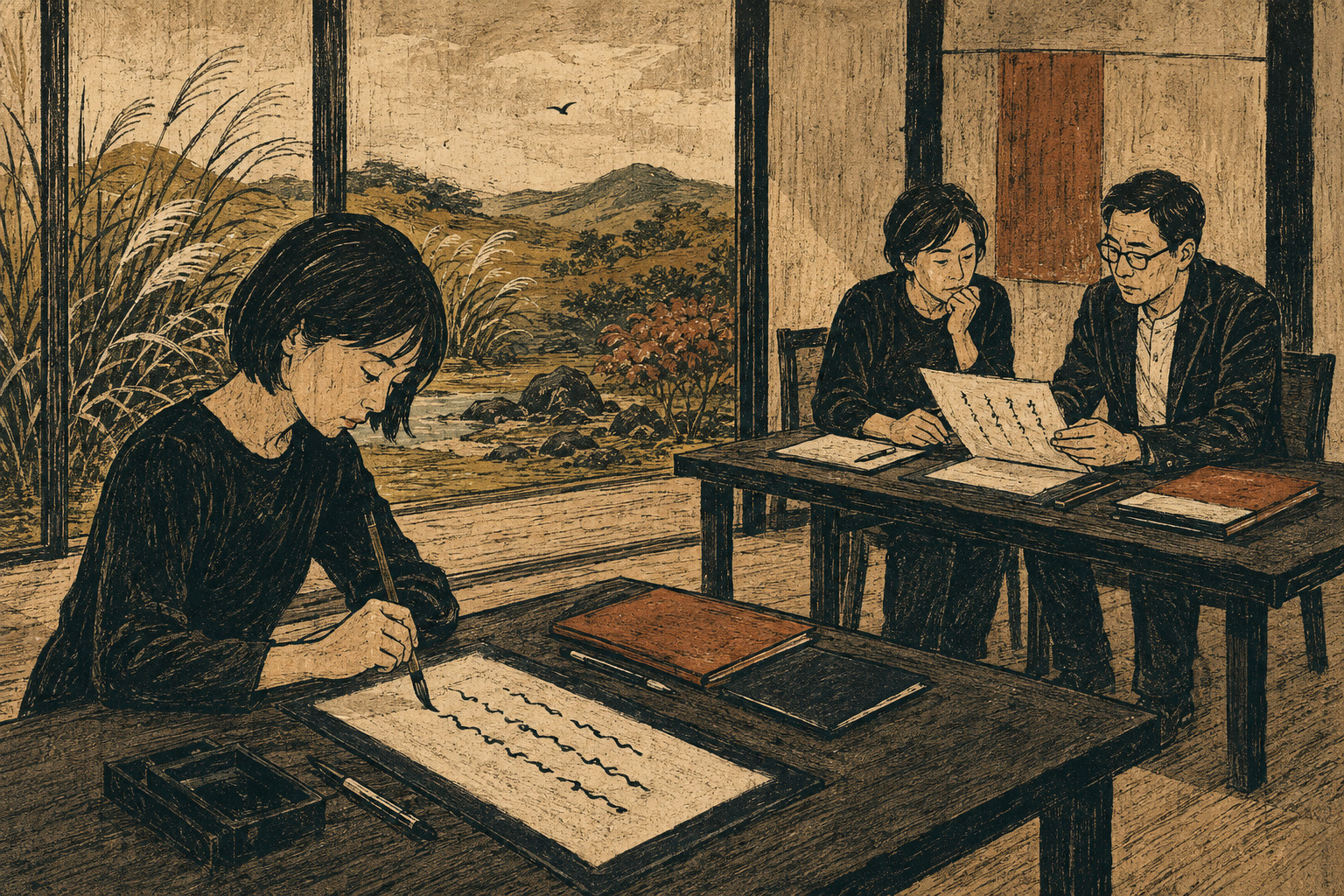
Editor's note: This report uses official information available through August 21, 2026. Detailed judges' comments are scheduled for September 20; readings here are Japan.co.jp's analysis. English renderings of the winning tanka are interpretive, not official translations. The Japanese poems are reproduced only as necessary for accurate reporting and criticism. The lead image is an editorial illustration, not a photograph of the winners or museum.