Seven Years After the Fire, Performers Prepare to Celebrate Shuri Castle’s Return
On October 31, 2019, Okinawa watched a symbol of its kingdom disappear into fire—again. In November 2026, the Seiden opens its doors once more. Two days earlier, classical music, folk song, dance, eisa and contemporary voices will gather in Osaka to celebrate a return that cannot be completed by architecture alone.
Osaka will begin celebrating Shuri Castle's return before Okinawa formally opens it. On November 21, sanshin, kokyū, song, Ryukyuan dance and creative eisa will fill the WW Hall at Cool Japan Park Osaka. Forty-eight hours later in Naha, an opening ceremony will mark public access to the reconstructed Seiden, or main hall.
The festival, titled Wind from Okinawa, brings together singer-songwriter Kazufumi Miyazawa; Hajime Nakasone; Haruka Oyakawa; Hiromi Maeda; Mion Kamei; Kyoka Hayashi; the Akamine Sisters; the Kyan-ryū Kikkō-no-kai dance group; Claudia Oshiro; and Ryukyu Koku Matsuri Daiko. Osaka-born writer and comedian Naoki Matayoshi, whose family roots are in Okinawa, appears as a guest. Yoshimoto Entertainment Okinawa is the organizer. The performance is scheduled from 1:30 to 3:30 p.m.; the lobby will also have a reconstruction exhibition, Okinawan food and goods.
This is not the Okinawa Prefecture opening ceremony at Shuri Castle on November 23. It is a related salute sent from Osaka. The distinction clarifies the idea. Kansai has long been home to Okinawan migrants and the communities they built. Here, Shuri is not merely a distant tourist site. It is a center of history carried across the sea by people who moved for work and survival.
A castle becomes a castle again when sound returns
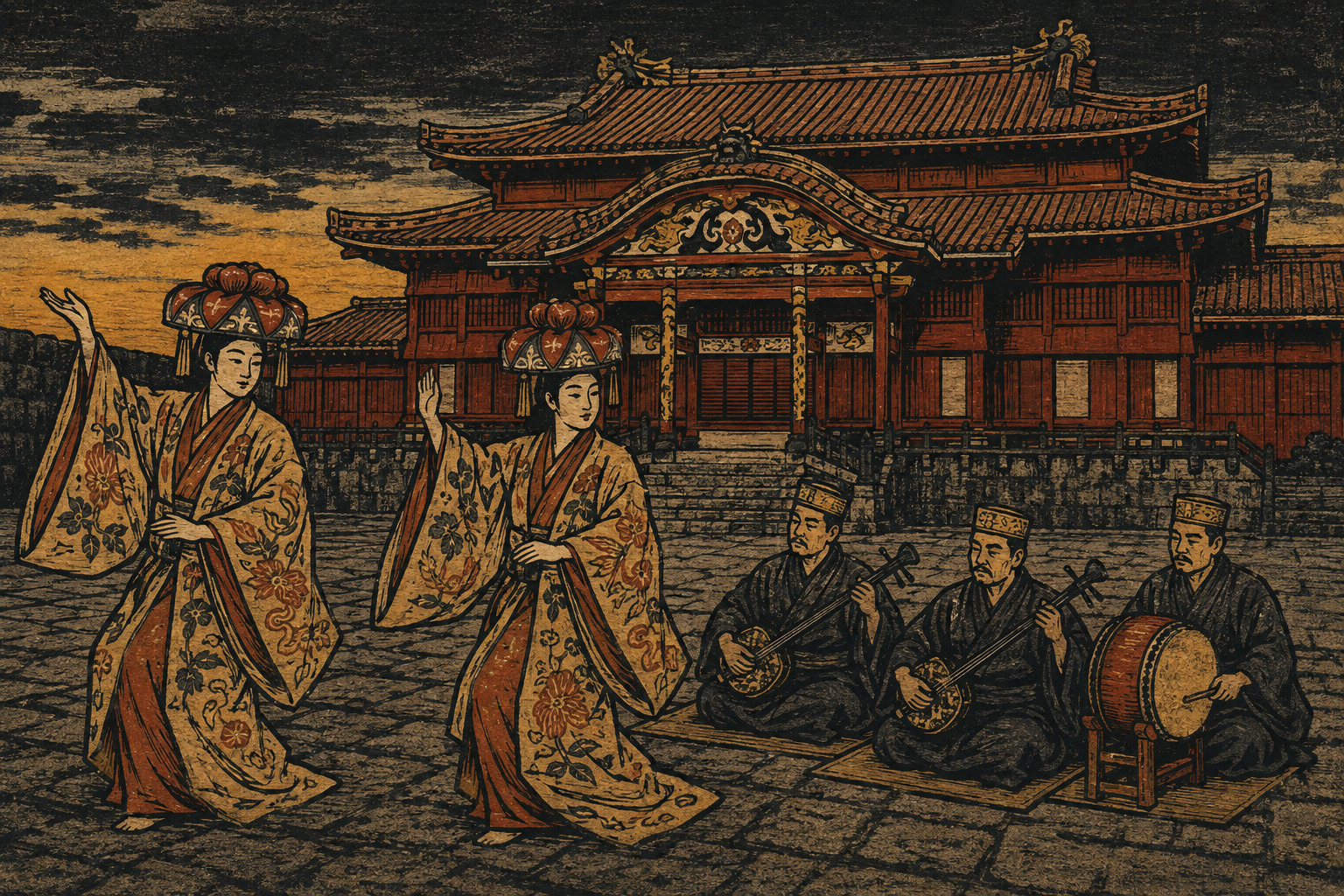
Seen only as architecture, Shuri Castle can be reduced to one red façade. But its forecourt was both a political space and a diplomatic stage activated by music and dance. When investiture envoys arrived from the Chinese emperor, the kingdom deployed costume, vessels, food, language, instruments and disciplined movement to demonstrate sophistication and sovereignty.
Classical Ryukyuan song-sanshin is not merely accompaniment. Text, the pauses between plucked notes and the dancer's pace inhabit one measure of time. Kokyū, flute, koto and drum add color; uzagaku preserves a memory of Chinese-derived court music. Rebuilding the walls without sustaining those practices would recover only the silhouette.
That is why the 2026 commemorative program does not treat performance as decoration after construction. Okinawa Prefectural University of Arts began a five-part “Courtyard Night Stage” series in August, linking younger artists, senior masters and women's kumiodori groups. Okinawan theater follows in October, the Seiden opens in November, and a December performance of the kumiodori Chūshin Migawari no Maki extends the sequence. A building milestone becomes an infrastructure for transmission.
Shuri was more than a royal residence. It was the state theater in which the Ryukyu Kingdom showed the world who it was.
A maritime kingdom built a political theater
Shuri Castle's precise origin remains uncertain, but it probably took form by the 14th century. In 1429, Shō Hashi unified the three competing polities on Okinawa Island, establishing the First Shō dynasty and Shuri as the royal capital. Under the Second Shō dynasty, the kingdom ruled islands from Amami to Yaeyama and prospered as a maritime intermediary linking China, Japan, Korea and Southeast Asia.
After Satsuma invaded in 1609, Ryukyu lived inside a double political structure: subordinate to Satsuma while maintaining tributary and investiture relations with China. The Japanese and Chinese elements in the castle are therefore more than decorative eclecticism. They are spatial evidence of a small kingdom speaking several diplomatic languages between larger powers.
In the Una forecourt, the central Ukimichi organized the king's passage, while striped red-and-white paving located officials by rank. Buildings, clothing colors, assigned positions and the sequence of sound turned government into visible order. Shuri was fortress, palace, administrative center and diplomatic theater at once.
In 1719, kumiodori emerged from diplomacy
Kumiodori combines dance, sung sanshin music and dialogue in an Okinawan dramatic form. In 1719, dance magistrate Tamagusuku Chōkun is said to have premiered Nidō Tekiuchi and Shūshin Kaneiri to entertain envoys investing King Shō Kei. He drew on Noh, kabuki, Chinese arts and Ryukyuan language and music without producing a copy of any one tradition.
Nidō Tekiuchi follows two brothers seeking vengeance for their father. Shūshin Kaneiri turns a woman's consuming attachment into demonic transformation. The plots are violent, but performance is restrained. A slow walk, the angle of a hand, the contours of recitation and the ensemble's breath concentrate emotion. The audience waits for time to thicken inside minimal movement.
When Japan abolished the kingdom in 1879, aristocratic actors and musicians lost court employment. Kumiodori moved into Naha theaters and village festivals, surviving as popular entertainment and ritual offering. It crossed further crises in the Battle of Okinawa and the age of cinema and television. Japan designated it Important Intangible Cultural Property in 1972; UNESCO inscribed it in 2010. Performance did not merely survive the loss of the castle. It carried the castle's memory.
Shuri has burned—and been politically remade—before
Known fires destroyed Shuri buildings in 1453, 1660 and 1709, and the royal government rebuilt. After the 1879 annexation, the king departed and the complex was repurposed for military and educational uses. By the 1920s, the deteriorated Seiden faced demolition. Preservation efforts associated with scholars including Yoshitarō Kamakura and Chūta Itō secured protection and repairs.
In 1945, the Japanese 32nd Army placed its command headquarters beneath the castle. U.S. bombardment during the Battle of Okinawa obliterated the Seiden and devastated Shuri. The University of the Ryukyus later occupied the site. Only after its relocation could excavation and reconstruction proceed.
Research using archaeology, old photographs, drawings and surviving fragments enabled the restored Seiden to open in 1992, the 20th anniversary of Okinawa's reversion to Japan. In 2000, the “Gusuku Sites and Related Properties of the Kingdom of Ryukyu” entered the World Heritage List. Crucially, the archaeological remains constitute the listed property; the reconstructed halls protect and interpret them.
14th century — Shuri Castle probably takes form.
1429 — Shō Hashi unifies the Three Kingdoms.
1609 — Satsuma invades.
1719 — Chōkun premieres kumiodori for investiture envoys.
1879 — Japan abolishes the kingdom.
1945 — The Battle of Okinawa destroys Shuri Castle.
1992 — Reconstructed Seiden opens.
2000 — The castle site becomes part of a World Heritage property.
2019 — Fire destroys the main reconstructed buildings.
2022 — Rebuilding of the new Seiden begins.
2026 — Public access begins November 23.
October 31, 2019: Okinawa watches the fire
The blaze began at about 2:40 a.m. in the Seiden and spread to the North Hall, South Hall/Bandokoro and adjacent structures. Firefighters battled it for hours. According to Japan's Fire and Disaster Management Agency, six buildings burned down and two more were damaged, along with art and craft objects stored or exhibited inside. Nobody died; one firefighter suffered a minor injury. Viewers watched a postwar symbol of Okinawan cultural recovery collapse on live television.
Investigators located the likely point of origin in the northeastern area of the Seiden but could not establish a cause. That uncertainty deserves precision. Electrical equipment was among the possibilities examined; investigators did not conclusively determine that electricity caused the fire, and they found no evidence proving arson. The unresolved cause supported a broad redesign of fire protection rather than a narrowly targeted correction.
Donations arrived from Japan and overseas. Yet reconstruction was not a matter of reusing one drawing. The lost 1992 building had itself embodied research into 18th-century plans, photographs, archaeology, remnants and craft practice. The Reiwa project is a restoration of a restoration, preserving the Heisei records while incorporating what was learned from their limitations and from newer evidence.
Making reconstruction visible also trains craftspeople
Work launched in November 2022 beneath an enormous protective shed, with a visitor route allowing the public to observe parts of the process. Timber selection, carving, roof construction, vermilion coatings, lacquer and tile work—activities ordinarily hidden behind barriers—became an exhibition of knowledge rather than merely a path to a finished product.
Sourcing suitable Okinawan timber, supplemented where necessary by wood from elsewhere, was one challenge. The celebrated red is not one simple color: pigments, tung oil, lacquer, sunlight and salt exposure require different materials and layers by location. Recreating dragon pillars and ornament means leaving people who still know how to hold the tools, not simply objects with the correct shape.
The new hall incorporates strengthened alarm, sprinkler, water-cannon, monitoring and compartmentation systems. Integrating them without overwhelming the historic appearance is a central problem in reconstructed wooden heritage. “As it was” cannot excuse a modern public institution from protecting visitors and the object entrusted to it.
The Okinawan voice that crossed to Osaka
Osaka is not an arbitrary venue. As migration from Okinawa to mainland Japan increased in the modern era, Kansai became an important destination. Amid discrimination and difficult labor, prefectural associations, sanshin circles, dance, festivals and restaurants sustained community. Okinawan culture in Osaka—especially around Taishō Ward—is not a copy of home. It is a living culture changed by relocation.
Miyazawa is widely known for The Boom's “Shima Uta” and has worked to transmit Okinawan folk repertoire. Matayoshi was born in Osaka into an Okinawan-rooted family. Classical musicians, folk singers, dancers, Brazil-born Claudia Oshiro and the contemporary eisa ensemble Ryukyu Koku Matsuri Daiko resist the idea that authenticity has only one form.
| Stage element | History it carries | Meaning in 2026 |
|---|---|---|
| Classical music and dance | Royal ritual and diplomatic reception | Reconnects the court arts to Shuri's space |
| Folk song | Island and village life | Adds Okinawa beyond the royal capital |
| Creative eisa | From Obon dance to modern stage form | Shows that transmission includes change |
| Pop music and literature | Postwar migration, media and border crossing | Connects younger and mainland audiences |
Celebration still requires care. Shuri symbolizes brilliant royal culture, but it also bears histories of hierarchy, Satsuma control, annexation, the Battle of Okinawa and unequal relations with mainland Japan. Reduced to a vermilion tourism image, restoration can decorate rather than confront history. The value of a mixed cast lies in refusing to seal the past inside one nostalgic scene.
On November 23, the work beyond “completion” begins
Public access to the Seiden begins November 23. Visitors seeking to enter the interior need a timed reservation. New admission is ¥1,000 for adults, ¥760 for high-school students, ¥370 for elementary and junior-high students, and free for children under six. The park attributes the increase partly to stronger fire protection and higher operating costs.
Completion is not the end of work. A long regime of safe access, paint maintenance, craft training, reconstruction of surrounding buildings, traffic and neighborhood management begins. More visitors can support Okinawa's economy while placing pressure on Shuri's roads, residents and heritage.
- September 5; October 3 and 11: Remaining Courtyard Night Stage programs, Okinawa Prefectural University of Arts
- October 17–18: Okinawan theater at National Theatre Okinawa
- November 21: Wind from Okinawa, Osaka
- November 23: Seiden opening ceremony and public access, Shuri
- December 19: Kumiodori Chūshin Migawari no Maki, National Theatre Okinawa
The 2019 images demonstrated the vulnerability of timber. The 2026 stages show a different strength. A song does not burn, and a dance is not trapped beneath rubble. Yet both can disappear without people and places that teach, rehearse and perform them. Intangible culture is not immortal. It is rebuilt from body to body every time.
The Seiden's vermilion will return. True recovery depends on who sings before it, who dances there and who teaches the next generation.
The sanshin heard in Osaka will not be a victory fanfare for a finished building. It will cross the distances between Okinawa and the mainland, court and commoner, classical and newly created, loss and reconstruction. Seven years ago, fire erased Shuri's outline from the night. In November, the outline returns. Performers and audiences will put time and meaning back inside it.
- Yoshimoto Entertainment Okinawa — Osaka program, cast and tickets
- Official Shuri Castle Seiden completion program — 2026 schedule
- Okinawa Prefectural University of Arts — Courtyard Night Stage
- Shurijo Castle Park — reconstruction, public access and safety
- Shurijo Castle Park — reservations and November 23 fees
- UNESCO World Heritage Centre — Gusuku Sites and Related Properties
- Agency for Cultural Affairs — kumiodori history and transmission
- Okinawa Prefecture — Shuri Castle Recovery Basic Plan
Editor's note: This report compares organizer, Okinawa Prefecture, Shurijo Castle Park, Agency for Cultural Affairs and UNESCO materials available through August 21, 2026. The Osaka festival and the Seiden opening ceremony are separate programs. Cast details and schedules may change. The lead image is an editorial illustration, not a photograph of the reconstruction or performance.