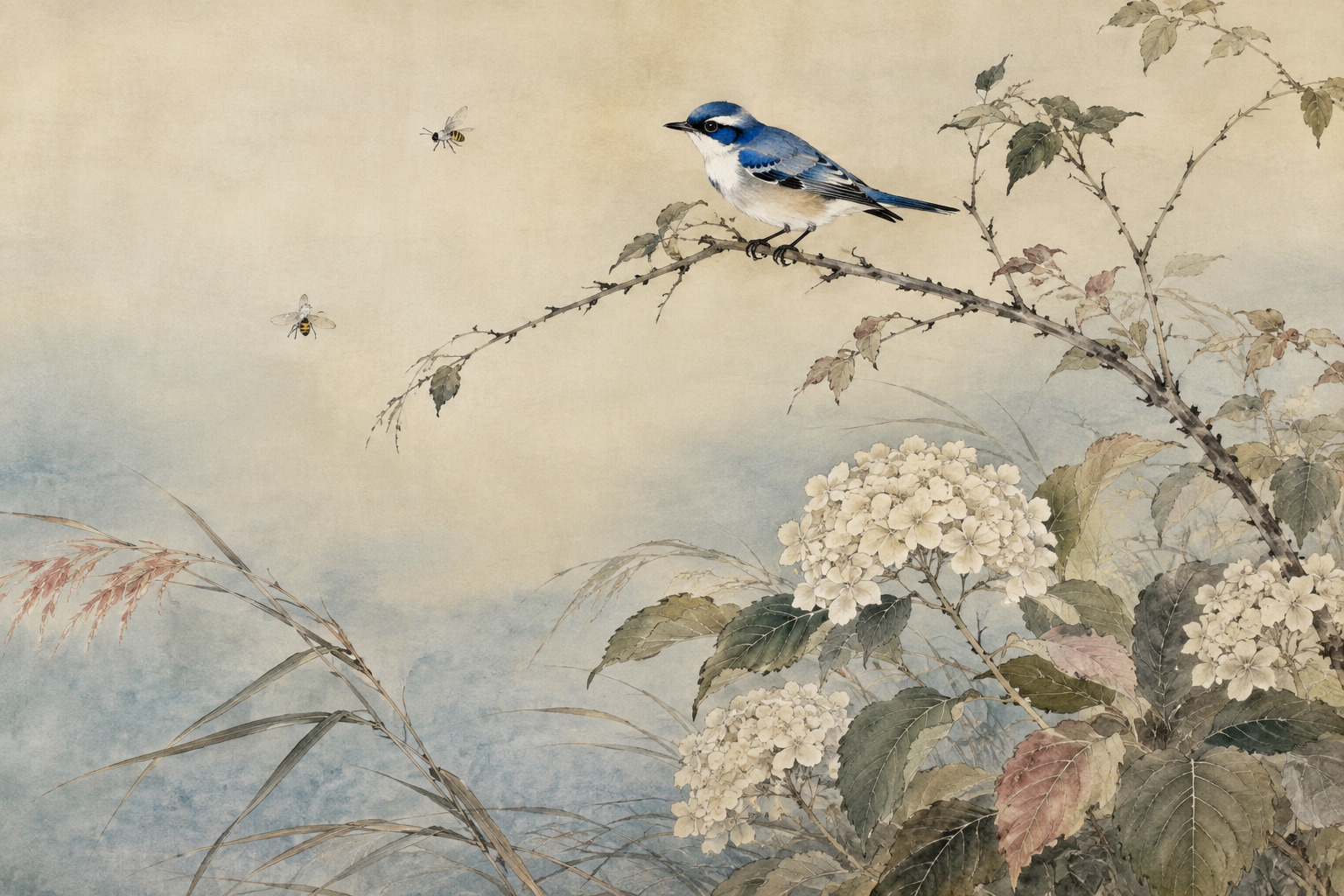
A bird occupies only a fraction of the surface. Its body is small enough to miss at thumbnail size. Yet once noticed, it controls the entire field: the direction of the branch, the weight of the blossoms, the empty area into which it could fly. Watanabe Seitei understood that stillness is most convincing when escape remains possible.
Today’s point of departure is the album leaf the Metropolitan Museum of Art titles Birds and Flowers, made around 1887. It is ink and color on silk, 36 by 27.6 centimeters—an intimate object, closer to the scale of reading than spectacle. The Met marks the image public domain. The museum does not provide an official Japanese title on the object page, so Japan.co.jp does not invent one.
The large image above is different. It is newly made editorial art that borrows general qualities associated with Seitei—an alert bird, finely weighted branches, quiet color and unpainted breathing room. It is neither the Met leaf nor any other historical picture. An Art Choice can use interpretation to invite attention, but it should not convert resemblance into attribution.
Do not begin by naming the species
Bird paintings often trigger an identification reflex. Is it a warbler, a tit, a finch? That can be useful, but it is a poor first question. Begin with the body. Does the foot grip or merely rest? Does the breast sit forward of the legs? Is the tail a counterweight or a flourish? Which part of the branch bends under weight?
Seitei’s naturalism is not just the accumulation of feather detail. It is an account of balance. A plausible bird belongs to gravity before it belongs to taxonomy. Even a viewer who cannot name it can feel when the body is prepared to turn, call or launch.
Then inspect the blank field. It does not describe a complete habitat. It withholds one. A Western landscape might place the animal within a receding sky, field or forest. Seitei can leave that spatial information unstated. The opening becomes directional: room in front of a beak, beneath a falling petal or beyond the last twig. What is absent acquires a verb.
Only after that should color enter the discussion. Seitei could be vivid, but he rarely made every passage compete at equal intensity. Silk shows through. Ink grows dense or watery. Pigment changes the sensation of feather, leaf, snow and damp air. Precision is surrounded by release.
The painter with two Western birth years
The National Diet Library verifies the name as Watanabe Seitei—渡辺省亭, read わたなべ・せいてい. It gives his birth as the 27th day of the 12th month of Kaei 4, converted to January 18, 1852, and his death as April 2, 1918. His original surname was Yoshikawa and his personal name was written 義復. Major English-language museums commonly print 1851–1918. The discrepancy appears to arise from mapping the Japanese era year Kaei 4 directly to 1851 without converting its late lunar-calendar date.
That discrepancy is not evidence of two competing men. It is a calendrical problem carried into modern metadata. This article uses the NDL’s exact Gregorian conversion when stating his life dates, while preserving museums’ own catalog wording when describing their records.
Seitei was born in Kanda, Edo, at the end of the Tokugawa period. At 16 he entered the studio of Kikuchi Yōsai, a painter renowned for historical subjects. The Tokyo Fuji Art Museum says that at 22 he entered the Watanabe family by adoption and took its surname. In 1875 he began designing export craftwork for Kiritsu Kōshō Kaisha, 起立工商会社.
That employment matters as much as a stylistic influence. It asked a painter to think about curved vessels, lacquer surfaces, metal, ceramics, buyers he would never meet and objects meant to cross oceans. Before Seitei became internationally known for paintings of birds and flowers, he had already learned that an image changes when it has a job.
Paris saw a worker making art in real time
Seitei went to Europe in connection with the 1878 Paris Exposition. The National Diet Library’s Japanese biography is unusually precise about his status: he was dispatched as a shokunin, a craftsman or artisan. It records that he made improvised pictures and hanging scrolls in Paris salons. The Tokyo University of the Arts Museum says he had contact with Edgar Degas and other Impressionist painters.
The episode is frequently inflated into a cinematic origin story: the first Japanese-style painter in Europe astonishes Degas, discovers realism and returns home transformed. Each clause requires caution. “First” depends on how painter, purpose and length of residence are defined. Surviving institutional summaries establish contact, demonstration and exposure, but not every line of dialogue later attached to the meeting.
The deeper point does not require legend. Seitei’s brush was itself an exhibit. European viewers were not only seeing a finished Japanese object; they were watching speed, water and pressure produce a form. A stroke could become a stem, a wing edge or a shadow before their eyes. The process complicated the period’s habit of treating Japanese art as anonymous ornament.
Paris added tools to Seitei’s seeing: modeling, light, volume and forms of pictorial depth. But he did not trade silk for canvas or abandon the loaded brush. He brought selected effects back into a visual system that continued to depend on line, wash, surface and omission.
Realism in Japan did not begin at the Paris city limits
The National Diet Library places Seitei’s work at the meeting of Maruyama–Shijō and Rinpa traditions with Western painting encountered in Paris. The statement resists a common hierarchy. Europe did not deliver observation to an otherwise decorative Japan.
Long before Seitei, Edo painters made close studies from life. The Kano workshops preserved drawing traditions; Maruyama Ōkyo and artists shaped by him pursued shasei, observation and sketching; natural history made precise records useful beyond art. The Kyoto National Museum describes the Maruyama–Shijō lineage of Ōkyo and Goshun as particularly skilled in observational depiction.
Rinpa supplied another kind of intelligence: cropping, repetition, seasonal association and the conversion of natural form into surface rhythm. Seitei inherited a world in which a flower could be accurately observed and radically arranged. His achievement was not to pour “West” into “Japan,” as if each were a sealed container. It was to decide, passage by passage, how much volume a breast required, how much contour a petal could lose and how much space a branch needed in order to feel alive.
| Medium | Documented example | What had to change |
|---|---|---|
| Painting on silk | Birds and Flowers, circa 1887; Chickens in Snow, 1893. | Water, pressure and the prepared silk ground could create subtle, unrepeatable gradations. |
| Color woodblock | The three-volume Seitei Kachō Gafu, 1890–91. | A painter’s marks had to be separated into blocks, colors and repeatable impressions. |
| Export design | Work for Kiritsu Kōshō Kaisha from 1875. | An image had to serve the material, curvature and market of a crafted object. |
| Cloisonné panel | Thirty works in Akasaka Palace’s Kachō no Ma. | Painted gradation became vitreous color fired by Namikawa Sōsuke. |
A picture book built for circulation
Seitei Kachō Gafu—省亭花鳥画譜—appeared in three volumes in 1890 and 1891. The Tokyo Museum Collection records an edition published by Ōkura Magobei, three books measuring 24.2 by 16.7 centimeters. The National Diet Library explains that the Ōkura publishing business produced such art books with two audiences in mind: a Europe excited by Japonisme and Japanese craftspeople seeking designs.
The books turned looking into infrastructure. A unique silk painting might be seen by one household or one salon. A printed album could travel to merchants, workshops, collectors and schools. A branch angle could be borrowed for metalwork; a flower pairing could become textile pattern; a bird could cross from book to ceramic without the original painting moving at all.
Reproduction was also collaboration. A carver had to translate wet brush into cut wood. A printer had to control registration, paper moisture, pressure and the density of color. The result is not adequately described as a mechanical copy. It is a negotiated performance in which several specialists preserve the impression of one quick hand.
That economy unsettles the modern division between fine art and design. Seitei was a painter, but also an editor of images for manufacture and circulation. His birds were collected as works of art and mined as working visual knowledge.
The chickens that went to Chicago
The Tokyo National Museum’s Setchū Gunkei, 雪中群鶏—rendered here by Japan.co.jp as Chickens in Snow—was painted in 1893. It is ink and color on silk, 152.1 by 73.3 centimeters. Japan’s Cultural Heritage Online says the vividly realistic birds form oval and triangular groupings within the tall composition and that the work was shown at the World’s Columbian Exposition in Chicago.
Snow does not require the whole surface to be painted white. It can be made perceptible through compressed bodies, dulled ground, cold air and the way feathers hold warmth. Seitei’s quiet is therefore physical. The birds do not become silent symbols; they remain creatures responding to weather.
A world exposition was never a neutral gallery. It joined national display, trade, industrial competition, collecting and imperial power. Japanese makers faced a foreign appetite for recognizable “Japan.” Seitei’s birds could satisfy that appetite through format and subject, yet observation kept them from collapsing into emblems. A chicken with believable weight resists becoming mere pattern.
In Akasaka Palace, the brush entered the kiln
Seitei’s most permanent public ensemble survives in the Kachō no Ma, 花鳥の間, at the State Guest House, Akasaka Palace. The Cabinet Office says 30 oval cloisonné panels depicting seasonal birds and flowers are mounted on walls paneled in Kiso-grown shioji wood. Seitei drew the designs; Namikawa Sōsuke—涛川惣助, read なみかわ・そうすけ by the official site—fired them. The room’s account emphasizes how the panels reproduce the tonal gradation and soft transitions associated with Japanese painting.
A frequent captioning error must be removed: these are not the ceiling paintings. The coffered ceiling contains 24 oils by French painters and 12 pictures on gold-leaf grounds. Seitei and Namikawa’s cloisonné works occupy the walls. The distinction makes the room more interesting, not less. French oil painting, Japanese wood, Nishijin tapestry, imported furnishings, enamel and Japanese pictorial design all coexist within one state interior.
The palace was built from 1899 to 1909 as the Crown Prince’s residence under the direction of architect Katayama Tōkuma. The Cabinet Office describes the project as a summation of Meiji Japan’s Western-style architectural technology. The Kachō no Ma reveals that “Western-style” did not mean materially uniform. The state’s modern room depended on craftsmen and media translating one another.
Seitei’s drawing could suggest a fading edge with a change in moisture. Cloisonné had to arrive at softness through prepared material and heat. Namikawa did not merely preserve the painter’s design; he rebuilt its optical behavior in glassy color. Authorship became a relay.
He was not forgotten everywhere
Seitei is now routinely introduced as a forgotten master. The phrase contains truth. The Tokyo University of the Arts Museum says that although his ability was recognized—among other things through the Akasaka Palace commissions—he gradually withdrew from the central art establishment after the 1890s and continued as an independent urban painter. As a result, his work appeared less often in exhibitions. The museum’s 2021 survey was the first exhibition designed to reveal the full range of his career in Japan.
But total disappearance is too dramatic. His images remained in a state guest house, museum storage, private collections, printed books and major collections abroad. The Metropolitan Museum of Art had received the Charles Stewart Smith album leaves by 1914. The National Diet Library preserved the printed albums. The problem was not that every object vanished. It was that the objects stopped lining up inside the dominant account of modern Japanese painting.
That account was increasingly organized through schools, juried exhibitions, official categories and institutional descent. Seitei’s career ran laterally: historical-painting apprenticeship, export company, international exposition, illustration, art publishing, private commission and collaboration with decorative-art makers. What had made him adaptable in life made him inconvenient to file after death.
Rediscovery is therefore not a magician’s reveal. It is archival repair. The 2021 exhibition at Tokyo University of the Arts brought privately held works and pictures returning from overseas into the same argument as the albums and palace designs. It restored connections among things that had never entirely ceased to exist.
January 18, 1852 Born in Kanda, Edo; Gregorian conversion by the National Diet Library.
Age 16 Enters the studio of Kikuchi Yōsai.
1875 Begins export-design work for Kiritsu Kōshō Kaisha.
1878 Travels in connection with the Paris Exposition and demonstrates painting there.
1890–91 The three-volume Seitei Kachō Gafu is published.
1893 Chickens in Snow goes to Chicago’s World’s Columbian Exposition.
1899–1909 The Crown Prince’s palace is built; Seitei’s designs enter its cloisonné interior.
April 2, 1918 Seitei dies in Tokyo.
2021 Tokyo University of the Arts Museum mounts a career-spanning exhibition.
A five-part way to look
- Find the center of weight. Trace breast, feet and tail before counting feathers.
- Read the opening. Ask toward which unpainted area the bird could move.
- Locate the flower in time. Bud, full bloom, damage and decline make different clocks.
- Separate edge from wash. Notice where line controls form and where water is allowed to dissolve it.
- Remember the surface. Silk, printed paper and fired enamel cannot hold the same kind of silence.
Symbolism may come later. Plum, wisteria, chrysanthemum, snow and particular birds carry seasonal and literary associations. They can deepen a reading. But knowledge need not police the entrance. Seitei’s primary invitation is bodily: feel the grip of the foot, the load on the branch and the interval before departure.
No sound leaves the picture. Yet a throat may open, an insect may close the distance to a flower, or a branch may spring upward when its passenger goes. Seitei’s nature is not preserved in permanent suspension. It continues just beyond the edge of the viewer’s attention.
That is why a small nineteenth-century album leaf survives enlargement on a twenty-first-century screen. Detail pulls the eye close; open space sends it back. Between those two motions, the viewer slows down. Living silence is not the absence of a bird’s call. It is the moment in which we finally become patient enough to wait for one.
- National Diet Library, Portraits of Modern Japanese Historical Figures — Watanabe Seitei
- National Diet Library Image Bank — Seitei’s bird-and-flower picture book
- NDL Search — Seitei Kachō Gafu, volume 3
- Tokyo Museum Collection — Seitei Kachō Gafu bibliographic record
- Tokyo University of the Arts Museum — Watanabe Seitei retrospective
- Cabinet Office, Akasaka Palace — Kachō no Ma
- Cabinet Office, Akasaka Palace — official history
- Cultural Heritage Online — Setchū Gunkei
- ColBase — 《赤坂離宮花鳥図画帖》
- Tokyo Fuji Art Museum — Watanabe Seitei artist record
- The Metropolitan Museum of Art — Birds and Flowers, circa 1887
- The Metropolitan Museum of Art — Pigeons in a Tree, circa 1887
- Philadelphia Museum of Art — Seitei’s Bird-and-Flower Picture Book, Vol. 2
- Kyoto National Museum — observational practice in the Maruyama–Shijō lineage
Names and attribution: The readings Seitei for 省亭 and Sōsuke Namikawa for 涛川惣助 follow Japanese government sources. The article uses January 18, 1852 because the NDL converts Seitei’s lunar birth date; collection databases that print 1851–1918 are identified as such rather than silently corrected. Birds and Flowers is the Met’s official English title; no Japanese title has been reconstructed. “Living silence,” the account of negative space and the analysis of why Seitei became less visible in institutional art history are Japan.co.jp interpretations, not claims attributed to the artist.