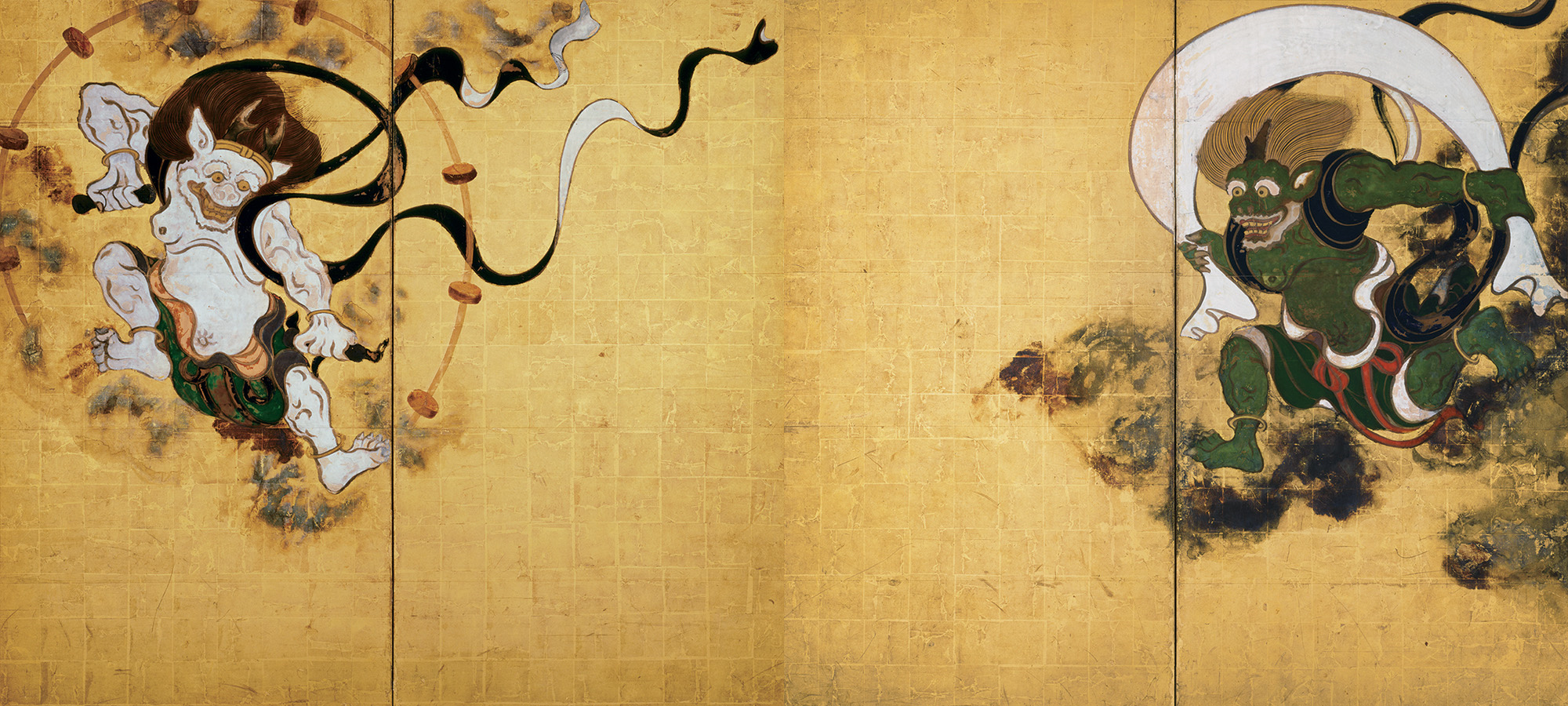
Before looking closely at either god, look between them. A broad expanse of gold separates the two bodies in Tawaraya Sōtatsu’s Wind and Thunder Gods. That interval is central to the picture’s force: the eye crosses it, anticipating an encounter that the still image never resolves.
Japan.co.jp’s art choice for September 11 is this seventeenth-century pair of folding screens, a National Treasure owned by Kenninji in Kyoto. The Wind God occupies the right screen and the Thunder God the left. Kenninji identifies the original as deposited at Kyoto National Museum and the work displayed at the temple as a high-resolution reproduction. [1][2]
| Artist and title | Tawaraya Sōtatsu, Wind and Thunder Gods |
|---|---|
| Date and status | Edo period, seventeenth century; National Treasure |
| Materials and format | Colour on gold-leaf paper; a pair of two-panel folding screens |
| Dimensions | Each screen: 154.5cm high × 169.8cm wide |
| Ownership and custody | Kenninji; deposited at Kyoto National Museum |
The Japanese format designation, nikyoku issō, means two screens, each with two panels. These object details follow Kenninji’s catalogue. [1]
The space that carries the movement
The following is Japan.co.jp’s reading of the composition. On the right, the green Wind God carries an enormous bag, his limbs pressing outward. On the left, the pale Thunder God twists beneath an arc of drums, with beaters in his hands. Dark clouds and curling lengths of cloth gather around their bodies.
Neither figure occupies the centre. Their forms approach the outer edges, leaving the viewer to connect them across the gold. Imagine bringing the gods together in the middle: their encounter might become easier to describe, but the distance that gives the present arrangement its tension would disappear.
The gold is therefore more than a luxurious backing. It offers no horizon fixing the gods in a measurable landscape. The eye can travel through it without finding a street, mountain or building that settles the scale of the scene.
The drums prompt the imagination to supply sound; the bag invites a thought of moving air. Nothing on the page actually moves. The action happens partly in the viewer’s response to what Sōtatsu has made visible.
Older deities, a concentrated image
Sōtatsu did not invent these figures. Canon’s Tsuzuri Project explains them as personifications of wind, thunder and rain, with a place in Japanese Buddhism as attendants of the Thousand-Armed Kannon. [2]
That context gives the image a history beyond its immediate graphic appeal. These are ways of representing natural powers that people cannot fully command. Bodies and attributes make those powers available to the eye.
This is not an account of atmospheric physics. The drums do not explain how thunder is produced, and the wind bag is not a meteorological instrument. The relevant artistic question is how an unseen force can acquire a memorable form.
A famous work by an elusive painter
Kenninji notes that the screens have neither signature nor seal, while accepting them as Sōtatsu’s work. The artist’s life remains incompletely documented. The temple describes him as probably heading the Tawaraya painting workshop in Kyoto, making decorated fans, screens and designs for writing paper. Exact birth and death dates should not be treated as settled. [1]
Thinking about that workshop broadens the picture of the artist. A fan, a folding screen and a sheet for calligraphy each demand different decisions. Shape, use and the circumstances of looking become part of the work.
The original commission is also uncertain. Canon records a tradition that a wealthy merchant commissioned the screens in connection with the revival of Myōkōji, and that they subsequently passed to Kenninji, but explicitly qualifies the account. It is a tradition, not a securely established commissioning history. [2]
Another Sōtatsu: cranes, calligraphy and time
One useful comparison is Kyoto National Museum’s Poems of the Thirty-Six Immortal Poets over a Painting of Cranes, 鶴下絵三十六歌仙和歌巻. Sōtatsu supplied the cranes and Hon’ami Kōetsu the poetry in a handscroll more than 13.5 metres long. [3]
In a museum essay, curator Yuya Fukushi explains how viewing the scroll gradually from the right makes the birds appear to rest, take flight and cross the sea. Repeated forms and the unfolding format create an experience of movement. [3]
The gods’ screens do not offer that sequence of episodes. The comparison nevertheless suggests a rewarding question: what does a work’s physical format ask the viewer to do? In the scroll, attention advances through a succession; in the screens, it travels between separated presences.
The collaboration with Kōetsu also gives a more expansive view of artistic invention. Painting and writing occupy the same object. Sōtatsu’s achievement can be approached through shared work as well as through the image of an individual master.
How Kōrin and Hōitsu carried the image forward
Sōtatsu became a central figure in what is called Rinpa. The Metropolitan Museum of Art cautions that this was not an organised hereditary school: the term groups artists connected through a style, and its name derives from Ogata Kōrin. [4]
The history of these gods makes the connection tangible. Kōrin copied Sōtatsu’s composition. Later, Sakai Hōitsu painted Summer and Autumn Grasses on the backs of Kōrin’s screens: rain-struck summer plants behind Thunder, windblown autumn plants behind Wind. The paintings were subsequently separated for preservation. [5]
Japan.co.jp sees a compelling shift in that response. Hōitsu turns attention from the personified powers to the vegetation that feels their effects. Reference to an earlier work becomes a way to choose a different subject.
Even Kōrin’s closely related composition changes the encounter. The ColBase commentary reproduced by Canon identifies a difference in the Thunder God’s gaze: downward in Sōtatsu’s image, toward the Wind God in Kōrin’s. Following the eyes is a practical first step when comparing the versions. [5]
Original, facsimile and digital reproduction
A visit to Kenninji should not be planned on the assumption that its National Treasure is always there on view. The temple distinguishes its displayed reproduction from the original deposited at Kyoto National Museum. Deposit at a museum, in turn, is not a promise of continuous exhibition. Check current notices before travelling. [1]
The image accompanying this article comes from a Wikimedia Commons file labelled public domain, rather than Canon’s restricted project imagery. The complete supplied composition retains Thunder on the left, Wind on the right and the open gold between them. [7]
A screen reduced to a rectangle on a phone cannot reproduce the encounter with a folded physical object. It can still support careful looking. Begin with the pair as a whole, then inspect the hands, cloth, drums and clouds. Returning to the whole reveals what a crop of a single god leaves out.
Japan.co.jp analysis: why these gods belong in this edition
The strongest editorial connection is with ENERGY EMBODIMENT THEORY, scheduled at SUPER DOMMUNE on Shibuya PARCO’s ninth floor on September 22, from 7:30 to 9:30 p.m. JST. Its official programme names Ryo Fujimoto, Itti and Takuma Nakata, describing bodily expression, spatial approaches to sound and Nakata’s sound-and-image work auve. [6]
Wind takes bodily form in Sōtatsu’s picture; thunder acquires the equipment of percussion. Setting that image beside the performance offers a way to think about sound becoming a physical experience. This is Japan.co.jp’s interpretation, not a verified claim that the performers drew inspiration from Sōtatsu. Our event introduction provides the practical details.
The gods’ bent limbs and turning torsos also resonate with the edition’s sports coverage. Its electricity stories raise another question: how do we represent a process we cannot simply see? Such comparisons can connect reading across the edition without treating an early Edo-period painting as a prediction of modern technology.
Return, finally, to the gold between the figures. The picture gives us a bag, drums and two bodies, then leaves room for the senses to complete the encounter. Its continuing appeal lies partly in that invitation: to see a shape, imagine a sound and feel a movement.
- Kenninji: cultural properties, Wind and Thunder Gods
- Canon Tsuzuri Project: Sōtatsu’s Wind and Thunder Gods
- Yuya Fukushi, Kyoto National Museum: animation 400 years ago, November 6, 2015
- The Metropolitan Museum of Art, Department of Asian Art: Rinpa Painting Style, October 2003
- Canon Tsuzuri Project: Kōrin’s Wind and Thunder Gods and Hōitsu’s Summer and Autumn Grasses; commentary from ColBase
- DOMMUNE: September 22 ENERGY EMBODIMENT THEORY programme
- Wikimedia Commons: reproduction file and public-domain designation
