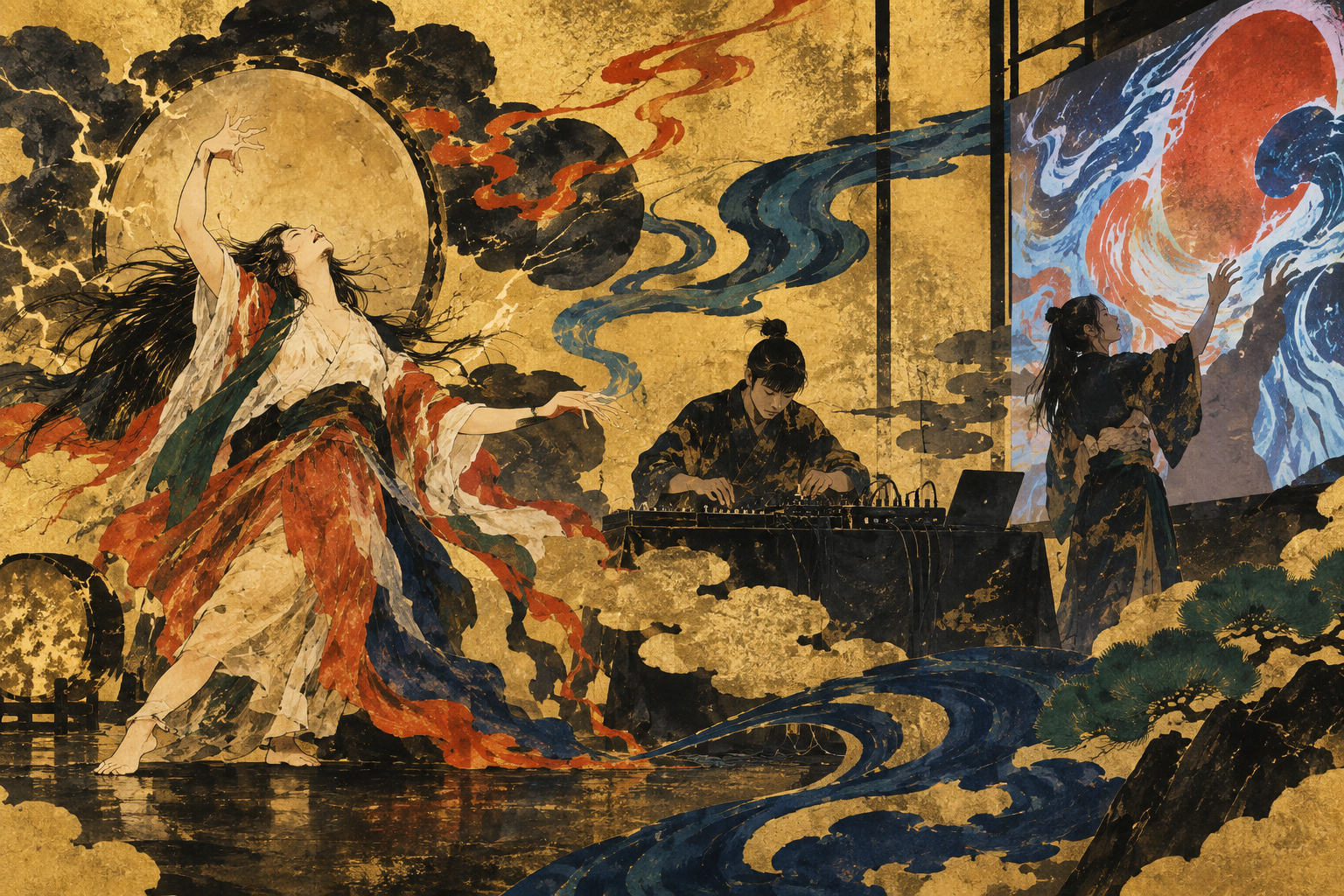
A voice has a visible source: a person moving, breathing and making an effort. An electronic sound can conceal its origins. An image can become the material from which a sound is made. ENERGY EMBODIMENT THEORY brings those relationships into focus for an evening at SUPER DOMMUNE, the broadcasting studio on the ninth floor of Shibuya PARCO.
Ryo Fujimoto, Itti and Takuma Nakata are the announced artists for September 22. The Japanese title is エネルギー体現論. For visitors curious about experimental performance, the programme offers a manageable starting question: how do bodies, sounds and images affect the way we perceive one another? [1]
The evening at a glance
| When | Tuesday, September 22, 2026, 7:30–9:30 p.m. JST |
|---|---|
| Where | SUPER DOMMUNE, Shibuya PARCO, ninth floor |
| Address | 15-1 Udagawacho, Shibuya-ku, Tokyo |
| Admission | ¥3,000 |
| Studio audience | Limited to 50, according to the listing |
| Booking | Official Peatix booking page |
The official listing also announces a livestream and advises that audience members may appear on camera. [1]
Fujimoto: listening to the body that makes the sound
Fujimoto’s official biography traces a background in beatboxing and Humanelectro, a project combining voice with live electronics. His account of his current practice moves among vocal sounds, beats, song and electronics, placing the body at the centre of their relationship. These are the artist’s descriptions of his own work. [2]
His separately published statement develops that idea through bodily signals such as shouts, breath and reflex, extended into electrical processes and vibration. It describes a reciprocal process: the body acts on its surroundings and is affected by them in return. [3]
That suggests a useful way to watch. Alongside asking what kind of sound you hear, notice the movement associated with its production. Does seeing the effort change how you attend to a brief sound? Does your attention move between the performer and the sound’s apparent presence in the room?
These are Japan.co.jp’s viewing suggestions, rather than a description of a performance we have already witnessed. They make the title approachable without treating “energy” as a scientific quantity. Fujimoto’s use of ritual language belongs to his artistic framework; it should not automatically be read as the recreation of an established religious ceremony. [2][3]
Itti: attention to space and structure
The programme introduces Itti as a Tokyo-based producer whose appearances include MUTEK.AR in Buenos Aires, emphasising an interest in space and structure. That account comes from the event’s own artist introduction. [1]
Placed beside a body-centred practice, this offers another route into listening: the arrangement of sound over time. A listener can follow the interval between events, the persistence of a repeated pattern or the point at which an expected continuation changes.
No specialist vocabulary is required to notice anticipation. You can recognise that you are waiting for something before knowing how a producer created that expectation. Learning the terminology can come later, if the experience leaves you curious.
Nakata’s auve: when images produce sound
The clearest technical foothold is Takuma Nakata’s auve. Japanese documentation from Flying Tokyo 2024 identifies the artist as 中田拓馬 and explains a work that analyses images and converts information from them into sound. Pixel analysis becomes a way to investigate rhythm and tempo within changing visuals. [4]
For a spectator, that changes the question asked of a screen. Instead of considering only how well an image fits accompanying music, it becomes possible to consider the image as part of the music-making process. Watching and listening can become two approaches to the same unfolding activity.
The work has a documented development history. Flying Tokyo 2024, a creator-support programme organised by Rhizomatiks, included auve in its January 2025 final presentation as both an installation and a performance. Nakata’s own biography describes developing a custom system for simultaneous sound and image generation through the programme. [4][7]
Those records establish a background for the forthcoming appearance. They do not establish that September’s presentation will reproduce every detail of an earlier version. Their value is in explaining a method that the short phrase “audiovisual performance” can otherwise leave obscure.
A studio with a history of making performance public
DOMMUNE began on March 1, 2010, founded by artist Naohiro Ukawa as a livestreaming studio and channel. Its institutional account describes filming, broadcasting and recording as part of Ukawa’s artistic practice. [5]
This history matters to the coming event because it makes the camera part of the cultural setting. The broadcast is shaped by decisions about framing and timing. A viewer elsewhere encounters a particular visual account of what is happening, while someone in the room can direct their own gaze.
Shibuya PARCO’s current venue page identifies the ninth-floor SUPER DOMMUNE as a development of that platform. A building visited for shopping and food also accommodates a studio producing sound-and-image culture for an audience beyond its walls. [6]
For a visitor, that is a reminder to look vertically as well as along the street. A cultural destination can sit within an otherwise familiar commercial building. The address becomes interesting because of what people are making there, rather than because the exterior announces a particular genre.
Two positions from which to experience the event
Being present and watching a livestream offer different control over attention. In the studio, you choose where to look within the available space. Online, a camera can bring a particular detail forward. Neither position needs to be dismissed for the difference to matter.
An event concerned with the relationship between body, sound and image makes that distinction especially relevant. The audience’s own position becomes part of how the work is encountered, even when the programme is shared at the same time.
The current event notice says there are no studio lockers or cloakroom, and asks visitors not to bring drinks inside. Online viewing is announced through DOMMUNE’s website or YouTube channel. [1]
In information supplied to Japan.co.jp, Fujimoto says English assistance is available at reception. That does not amount to an announcement of an entirely English-language programme. Visitors with particular requirements should confirm them before booking.
Japan.co.jp analysis: curiosity is a useful starting point
One evening should not be asked to represent the whole of Tokyo’s experimental scene. The more compelling prospect is specific: three practices, a small studio audience and a broadcast connecting that room with people elsewhere.
You can arrive with questions rather than conclusions. When does a voice become something you hear primarily as texture? What changes when the image participates in generating the sound? How does seeing a body alter your listening?
The point is not to arrive knowing what the performance means. It is to give attention to what happens, notice what holds that attention, and leave with a more precise curiosity than the one you brought upstairs.
- DOMMUNE, September 22 programme; introductory text by Ryo Fujimoto
- Ryo Fujimoto, official profile
- Ryo Fujimoto, artist statement
- Flying Tokyo 2024, January 24–25, 2025 final presentation and auve description
- DOMMUNE, institutional history; historical page, not current visitor instructions
- Shibuya PARCO, official SUPER DOMMUNE venue listing
- Takuma Nakata, official biography and project history