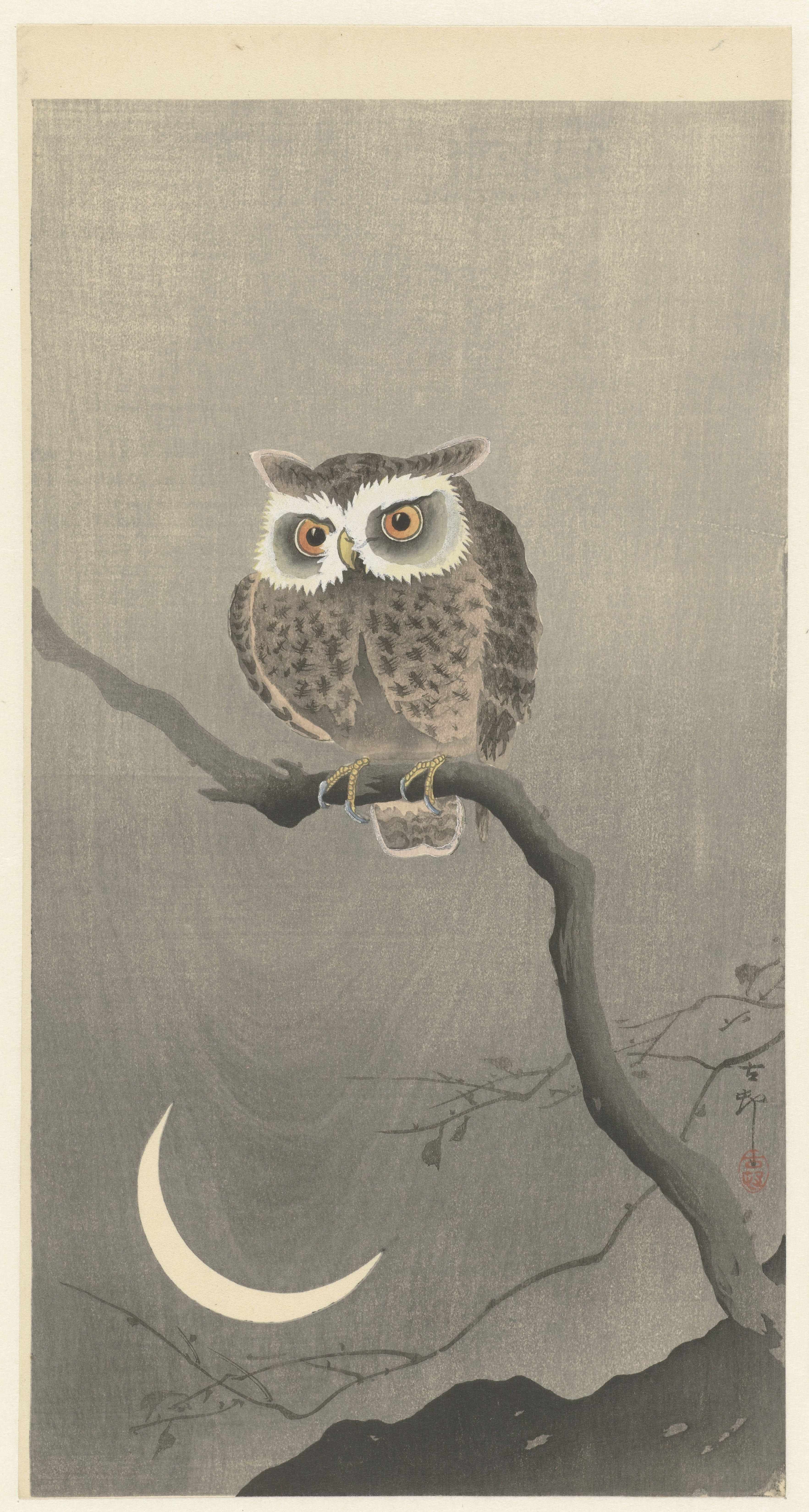
The first surprise is factual. The owl is not beneath the crescent moon. It sits well above it, gripping a branch that enters from the left and turns into a dark trunk on the right. The moon hangs low in the opposite corner, nearer the ground than the bird. That correction matters because the print’s atmosphere does not come from a familiar emblem—owl under moon—but from the extraordinary distance Koson leaves between two small forms.
The Rijksmuseum identifies the sheet in Dutch as Ransuil op kale boomtak, catalogues the subject as a long-eared owl and a crescent, and dates the work broadly to 1900–1930. It records Ohara Koson as printmaker and Matsuki Heikichi as publisher. The physical description is unusually useful: a color woodcut made with a black line block and color blocks. The image measures 347 by 187 millimeters, a tall ratio of roughly 1.86 to 1.
That museum title is the safest identifier for this particular impression, especially when paired with object number RP-P-2005-456. Yet it is not the only title in circulation. In 2025, the Ōta Memorial Museum of Art listed four Koson designs as 《月に木菟》, Horned Owl and Moon. The public checklist does not provide enough visual or catalogue detail to map one of those four entries conclusively onto the Rijksmuseum sheet. The Japanese edition of this article uses 《月に木菟》 as the established Japanese subject title while preserving the Rijksmuseum’s own Dutch record for the specific object.
The night is printed, not empty
At thumbnail size, most of the sheet appears vacant. Up close, it becomes material. The gray is neither pure black nor untouched paper. Subtle changes in density reveal the pressure of printing, the behavior of pigment and the texture of the sheet. The pale face, orange eyes, yellow feet and white crescent do not merely sit on a neutral background; they emerge from a worked field.
Koson’s owl is nearly frontal but refuses perfect symmetry. The eyes do not align like manufactured circles. The ear-like tufts rise at different angles. Short, repeating marks across the breast suggest plumage without turning every feather into an inventory. The wings close around the body as dark masses, giving the animal both softness and weight.
Then the branch complicates what first seemed like a simple silhouette. It enters from the left, thickens beneath the talons, bends into a trunk at right and drops toward the lower edge. A dark bank or rock occupies the bottom right. Together, branch, trunk and ground form a heavy structure. The crescent is the only large pale shape capable of answering that weight.
A “bare” branch that still has leaves
The Dutch title describes a bare branch, but the image contains thin twigs and a handful of leaves. Museum titles are identifiers, not exhaustive transcriptions. “Nearly bare” is a fair visual description; “completely leafless” is not. The discrepancy is small, but it is a useful warning against allowing metadata to replace looking.
The bird name requires similar care. The Rijksmuseum’s subject taxonomy says long-eared owl. The Ōta checklist uses the broader Japanese term 木菟 and translates it as horned owl. The painted bird clearly has prominent tufts, but a designed woodblock image is not automatically a diagnostic ornithological specimen. Koson makes the animal convincing through posture, gaze and mass while also simplifying it for the block and the composition.
Multiple names can coexist because they perform different jobs. A museum needs a stable collection title. An exhibition checklist groups related designs. A zoological taxonomy seeks a species. A writer needs language that lets readers find the object without overstating what is known. Keeping the Dutch title, object number and Japanese subject title visible is more accurate than pretending one English phrase is the original, universal name.
| Record | Wording | What it establishes |
|---|---|---|
| Rijksmuseum | Ransuil op kale boomtak RP-P-2005-456 | The primary catalogue identifier for this particular museum object. |
| Ōta Memorial Museum, 2025 | 《月に木菟》 Horned Owl and Moon | A Japanese and English title used for four related Koson works; the checklist alone does not identify a specific match. |
| Descriptive English | Long-eared owl on a bare branch | A translation of the Dutch record, not a separately documented artist-given title. |
| Rights field | Public domain | The museum’s reuse status for the work—not permission to erase attribution, provenance or the fact of alteration. |
Before Koson was a print legend, he was Ohara Matao
The Chigasaki City Museum of Art gives the clearest concise Japanese biography. Ohara Koson was born Ohara Matao in Kanazawa in 1877. He studied with Suzuki Kason, a Nihonga painter known for birds and flowers, exhibited Japanese paintings under the name Koson and received commendations. The National Diet Library confirms the reading Ohara Koson and the dates 1877–1945.
Calling him simply a “shin-hanga artist” obscures the object in front of us. Japanese museum records distinguish the Koson-signature bird-and-flower prints issued in the late Meiji and Taishō years by Matsuki Heikichi and Akiyama Buemon from the later Shōson-signature prints published by Watanabe Shōzaburō in the early Shōwa period.
This sheet bears the characters 古邨 at lower right with a red seal, and the Rijksmuseum names Matsuki as publisher. That combination places it within the Koson-name, Matsuki publishing corpus, not the later Watanabe–Shōson group. But the museum’s 1900–1930 range should remain intact unless firmer edition evidence appears. A plausible period is not a confirmed year.
Matsuki Heikichi: the publisher inside the picture
Matsuki Heikichi, associated with the publishing house Daikokuya, connected Koson to a longer commercial history of Japanese prints. The Ōta Memorial Museum identifies Matsuki as the Meiji publisher who worked with Kobayashi Kiyochika to bring the luminous “light pictures” known as kōsen-ga to market. In its 2025 history of publishers, the museum placed Matsuki alongside the entrepreneurial figures who turned an artist’s design into a circulating work.
A published woodblock is not a solitary painting multiplied by machinery. A publisher chose and financed a design; a carver translated it into blocks; a printer managed moisture, pressure and pigment; paper supplied its own resistance and absorbency. The Rijksmuseum’s phrase “black line block with color blocks” invites us to separate these jobs while looking. The eyes, talons, breast marks and branch contours depend on line. The gray night, feather masses, white face and crescent depend on carefully coordinated areas of color and reserve.
Digital display tends to collapse those decisions into “the Koson style.” The signature matters, but so do the people whose names were less often placed on the sheet. Even impressions from the same blocks can differ through ink, paper, pressure, wear and later condition. What looks like atmospheric personality is partly a history of production.
Kachō-ga traveled as both art and commodity
Koson did not invent the union of bird, plant, weather and season. The Ōta Memorial Museum situated his work alongside bird-and-flower prints and books by Utagawa Hiroshige, Katsushika Hokusai, Kawanabe Kyōsai, Watanabe Seitei and Kōno Bairei. The spare encounter between a living creature and a seasonal sign belongs to a deep visual tradition extending through painting, illustrated books and ukiyo-e.
His modernity lay in the way that inheritance was edited for a changing market. A narrow vertical sheet suited domestic display abroad. The animal offers immediate psychological contact. Restrained color reads from a distance; observed posture rewards proximity. Open space makes the image decorative without turning the owl into an ornamental repeat.
Chigasaki’s museum notes that Koson’s late-Meiji designs for Daikokuya were made with export in mind and became particularly popular overseas. That history helps explain why so many works survived in foreign collections and why international collectors were central to his later reputation. It does not, however, establish the first buyer or export route of RP-P-2005-456. The public Rijksmuseum provenance confirms only that J. Perrée donated it in 2005. General market history should not be mistaken for an individual object’s biography.
Three art names, several publishing worlds
Koson’s career continued under other names. According to Chigasaki, he worked as Shōson for the Watanabe Print Shop and used the art name written 豊邨 for joint publications by Sakai Kōkodō and Kawaguchi. The Ōta Memorial Museum likewise separates the late-Meiji and Taishō prints signed Koson from the early-Shōwa shin-hanga signed Shōson and published by Watanabe Shōzaburō.
These names are not trivia. They help map changes in publisher, period and market. They also expose the limits of searching by image alone. A database may group similar owls under Koson even when signature, publisher and printing history point to different phases. Conversely, a search for Shōson can hide continuity in the artist’s observation of birds.
Nor does the career fit a clean story in which old ukiyo-e becomes modern shin-hanga. Collaborative production already belonged to Edo print culture. Shin-hanga reorganized that collaboration under twentieth-century publishers and international demand. Koson’s practice is better imagined as a network of studios, names and markets than as a straight bridge from tradition to modernity.
1877 Ohara Matao is born in Kanazawa; he later studies with Suzuki Kason.
Meiji period He exhibits Japanese painting under the art name Koson and develops a career in bird-and-flower prints.
Late Meiji–Taishō Matsuki Heikichi and Akiyama Buemon publish works bearing the Koson signature.
1900–1930 The Rijksmuseum’s date range for the owl and crescent sheet.
Early Shōwa He uses Shōson for Watanabe publications and the art name written 豊邨 in the Sakai–Kawaguchi publishing context.
1945 Koson dies.
2005 J. Perrée gives the present impression to the Rijksmuseum.
2018 Chigasaki exhibits 230 works from the former Hara Yasuzaburō collection for the first time.
2019 and 2025 Ōta holds major Koson exhibitions; the latter marks 80 years since his death.
What “forgotten in Japan” leaves out
The phrase “forgotten artist” is useful publicity and incomplete history. The Ōta Memorial Museum says Koson was little known in Japan for a long period even as overseas collectors valued him. Chigasaki’s 2018 exhibition became a turning point, presenting 230 of roughly 260 exceptionally preserved works from the former Hara Yasuzaburō collection. Ōta followed with a broad Tokyo exhibition in 2019 and returned in 2025 with about 130 Koson-signature prints across two rotations.
Yet a painter cannot be entirely forgotten when the works remain cared for. Foreign collectors held them; Hara assembled them in Japan; the National Diet Library preserved volumes of Shōson Kachō Gashū and now displays them through its Image Bank. What faded was not the physical object but Koson’s place in dominant accounts of modern Japanese art.
Recovery therefore requires more than renewed popularity. It requires distinguishing designs, impressions, signatures, publishers and provenance. The fact that a Japanese checklist can contain four works called Horned Owl and Moon while a Dutch collection record supplies a different title is not an embarrassment. It is evidence of the cataloguing work still needed after images become famous online.
Public domain does not mean history-free
The Rijksmuseum marks the print public domain and makes a large image available. That openness invites scholarship, teaching, publication and new art. The design also appears unusually “AI-ready”: owl, branch, moon, limited palette, large field, vertical poster. Its nouns are easy to put into a prompt.
Its relationships are much harder to reproduce. Generic image generation tends to center the owl, place the moon above its head and apply a uniform paper texture as a style effect. Koson does nearly the opposite. The moon is very low. The bird is weighted toward the upper right. The ground is a dark interruption rather than a scenic landscape. The gray is not a retro filter; it is the physical surface of a print.
A responsible AI interpretation should therefore remain visibly separate from the museum reproduction. It should be labeled as a contemporary derivative, should not transplant Koson’s signature or seal and should identify the source work that prompted it. Public domain status answers an important reuse question. It does not make a generated picture an original Koson, and it does not erase the publisher, object number, donor or museum.
A three-minute way to look
- Begin at the bottom left. Let the crescent establish the sheet’s lightest mass before looking at the bird.
- Test the owl’s symmetry. Compare eyes, tufts and wing edges; its alertness depends on their small disagreements.
- Find the weight. Follow the yellow toes into the branch and ask where the body’s mass lands.
- Inspect the gray. Move close enough to see variation in the supposedly empty night.
- Read the dark structure. Trace branch, trunk and ground as one counter-form to the moon.
- End with the record. Read the Koson signature, then add Matsuki Heikichi, RP-P-2005-456, the 2005 gift and the public-domain field.
Now reduce the image until the orange eyes and feather marks disappear. Owl, branch, crescent and ground remain, and the design still holds. Enlarge it again and the material history returns: uneven gray, paper, printing, wear. Moving between those scales is the best defense against treating a woodblock as a frictionless screen image.
There is no need to decide immediately that the owl symbolizes wisdom, loneliness, luck or threat. Such associations can be interesting, but they too easily displace the animal Koson built from posture and pressure. Start with the uneven eyes, the gripping feet, the compressed chest, the bending branch and the long fall to the moon. Meaning can arrive after seeing.
The print feels simple because every explanatory device has been reduced. That simplicity is not haste. It is the endpoint of decisions about what to carve, what to print, how low to set the moon and how directly the owl should face us. Koson removes almost everything except life, gravity and interval. The night is quiet because the structure is exact.
- Rijksmuseum — Ransuil op kale boomtak, RP-P-2005-456 (maker, publisher, date, technique, dimensions, acquisition and rights)
- Rijksmuseum — persistent object identifier 200473960
- Ōta Memorial Museum of Art — “Ohara Koson: Birds in Paradise,” 2025
- Ōta Memorial Museum of Art — exhibition checklist listing four works as 《月に木菟》 / Horned Owl and Moon
- Ōta Memorial Museum of Art — “Ohara Koson,” 2019 (signatures, publishers and rediscovery)
- Chigasaki City Museum of Art — Hara Yasuzaburō Collection: Ohara Koson (birth name, birthplace, teacher, art names and export production)
- National Diet Library Image Bank — “Ohara Koson’s Bird-and-Flower Pictures”
- National Diet Library Search — The World of Ohara Koson: Bird-and-Flower Pictures Loved in the West (authority form and reading)
- Ōta Memorial Museum of Art — publisher history including Matsuki Heikichi
Title and attribution note: The English headline “Long-Eared Owl on a Bare Branch” translates the Rijksmuseum’s Dutch catalogue title; it is not presented as a separately documented title assigned by Koson. The Ōta checklist uses 《月に木菟》 and Horned Owl and Moon for four works, so this article does not claim a conclusive one-to-one match from the checklist alone. The transliterations Ohara Koson, Suzuki Kason and Shōson follow Japanese museum and National Diet Library records; the less securely verified reading of 豊邨 is not romanized. The compositional account of the crescent as counterweight and the discussion of common AI-image defaults are Japan.co.jp’s analysis.