Three ships, three meanings of “public”
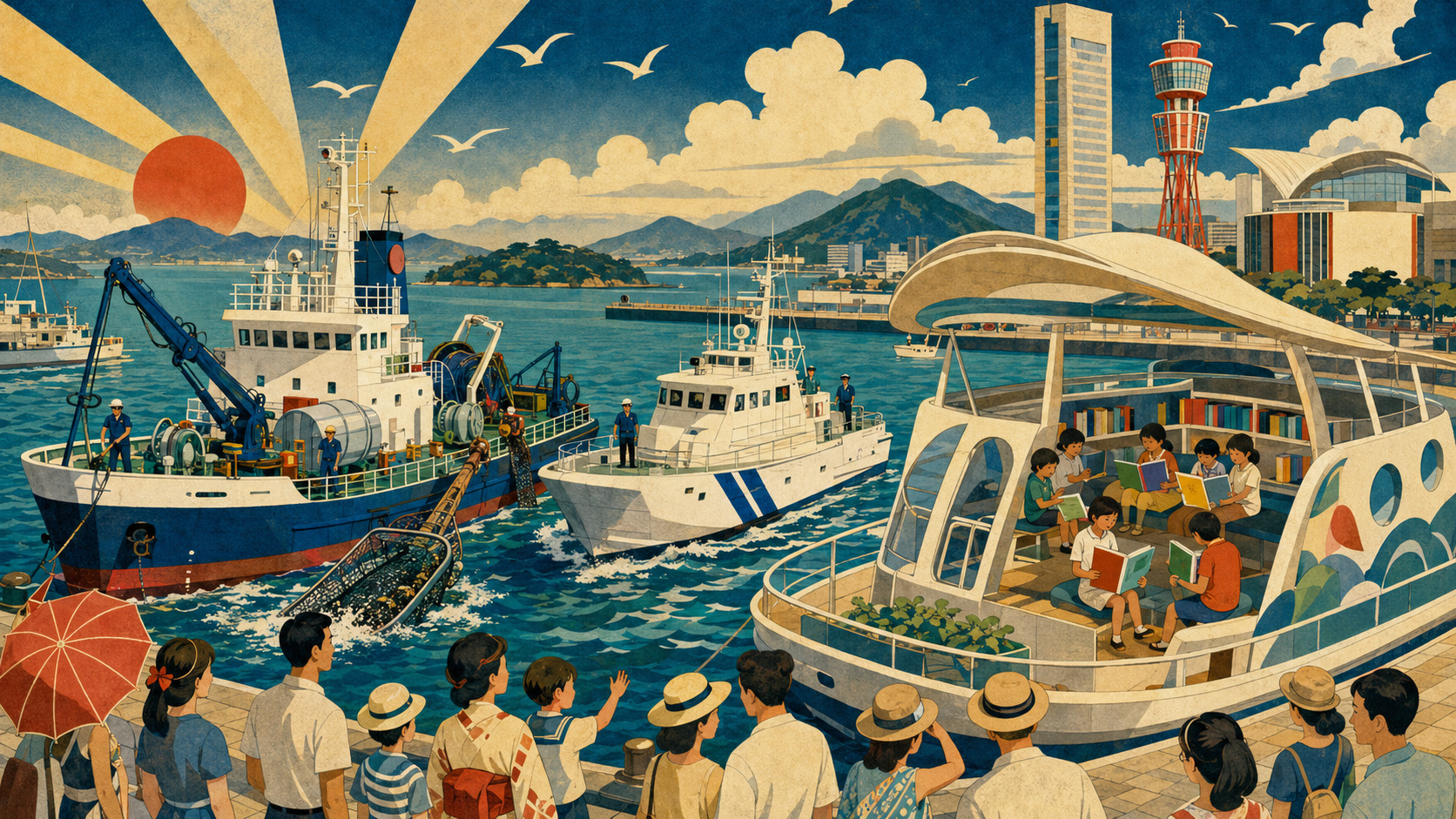
At one berth, a catamaran lowers a collection container into the water and turns a tide line of bottles, timber and weeds into cargo to be removed. At another, a white Coast Guard craft represents patrol, rescue and law enforcement in one of Japan’s busiest inland seas. Nearby, a 19-ton former passenger vessel carries shelves, picture books and children on a twenty-minute circuit of the harbor.
That is the unusually coherent idea behind Takamatsu’s Marine Day waterfront on Monday, July 20. National port officials are staging the 2026 Takamatsu Port Festa from 10:00 a.m. to 2:30 p.m. Kagawa Prefecture is simultaneously running Setouchi Island Festa from 10:00 a.m. to 3:00 p.m. And the Children’s Library Ship Executive Committee has scheduled ten cruises by Hon-no-Mori from the Second Floating Pier.
The events are adjacent, not identical. Boarding Bisan and Kurinami is free and requires no advance application. The library cruises were free but required an application by July 6; the lottery result date was July 13. By this edition’s July 18 deadline, that reservation window had closed. Families without a library-cruise place can still visit the Port Festa and Island Festa, and festival survey respondents can receive a Hon-no-Mori novelty item while supplies last.
First, a correction about “launches”
The headline’s “launches” describes the launch of ten harbor cruises, not the commissioning of a new vessel. Hon-no-Mori began service in April 2025 after a former Setouchi passenger ship was converted into a mobile children’s library. It came to the first Setouchi Island Festa at Takamatsu in July 2025, when the project reports that more than 160 people viewed the ship and the wider festival drew about 3,000 visitors.
That distinction matters because the ship’s history is the point. The project did not order a floating building that happened to resemble a boat. It reused a vessel that had carried passengers around the Seto Inland Sea for roughly twenty years and gave it a second public life. In 2026, the new element is motion: ten short cruises make the harbor itself part of the reading room.
| Program | Place and time | Admission or booking |
|---|---|---|
| Takamatsu Port Festa Bisan, Kurinami, liquefaction model and water-tank experiment | Sunport Takamatsu waterfront 10:00–14:30 | Free; no advance application for the two public ship openings. Program may change with weather. |
| Setouchi Island Festa 14 municipal and workshop booths | Sunport Takamatsu Exhibition Hall and Decks Galleria, Sunport 2-1 10:00–15:00 | Free; most floor activities are walk-up. This is a land-based festival, not a trip to the islands. |
| Hon-no-Mori cruises | Second Floating Pier at Takamatsu Port Ten slots, 10:00–15:00 | Free but advance lottery required; application closed July 6. Meet ten minutes before the assigned slot. |
Bisan: the ship that cleans the road
The most revealing thing about Bisan is that environmental work and navigation safety are the same job. A refrigerator, length of timber or mat of storm debris is pollution, but it is also a collision hazard. Oil from an accident is an ecological emergency and a threat to ports, fishing grounds and shipping. The vessel’s day-to-day territory covers Bisan Seto and portions of Bingo Nada, Hiuchi Nada and Harima Nada—about 2,500 square kilometers of confined, heavily used water.
Bisan is a 196-gross-ton twin-hull vessel, 33.5 meters long and 11.6 meters wide, with a maximum speed of about 14 knots. As the catamaran advances toward floating debris, the gap between its hulls guides material into a central container collection system. Articulated cranes on the sides can lift large driftwood. At the stern, oil-recovery machinery separates oil and water and is designed to handle viscosities ranging from light diesel to heavy fuel oil. Water-quality instruments allow the crew to monitor the environment rather than wait for visible waste.
The ship was completed on December 22, 2011 and entered service from Sakaide in January 2012. It replaced Washū, a 1982-built cleaning vessel retiring after about three decades. The public chose the new name: 407 proposals were submitted, and Bisan combined the character for beauty, 美, with 讃 from Bisan Seto. The result is a name that is both place and assignment—make the Bisan waters beautiful.
Routine service can become disaster response overnight. After the July 2018 torrential rains sent huge quantities of drift material into the Inland Sea, an official Takamatsu office account says Bisan collected 880 cubic meters in the following month, the equivalent used in that report of about 147 ten-ton dump-truck loads. Across Shikoku’s three-vessel environmental fleet, the wider cleanup reached 3,197 cubic meters. The ship on public display is therefore not a ceremonial port asset. It has already worked a regional emergency at scale.
Kurinami: 31 years on Takamatsu’s watch
The Japan Coast Guard classifies Kurinami as a 35-meter patrol craft, hull number PC15. The Sixth Regional Coast Guard Headquarters lists it at 35.0 meters overall and 110 gross tons. Takamatsu Coast Guard’s own chronology records the craft entering service at the office on January 23, 1995. Marine Day 2026 therefore finds the same named craft in its thirty-second calendar year on the local roster.
A patrol craft’s work is broader than the word “police” suggests. Coast Guard units enforce maritime law, watch traffic, respond to distress, search for missing people, assist disabled vessels, address pollution and support marine-disaster response. In the narrow channels and island-dotted approaches of the Seto Inland Sea, those duties overlap: a grounding may be a rescue case, a navigation obstruction, an oil-spill risk and an investigation at the same time.
The public-opening notice intentionally gives only the broad program, not a promise that every compartment or piece of equipment will be accessible. Visitors should treat the craft as an operating workplace. Crew directions, weather and readiness take priority over the published attraction. The value of stepping aboard is not access to a theatrical set; it is seeing how much function must fit inside 35 meters.
| Vessel | Official type and scale | Primary public purpose | What July 20 offers |
|---|---|---|---|
| Bisan | Surface-cleaning/oil-recovery catamaran; 196 GT; 33.5 m × 11.6 m | Floating-waste collection, oil response, water-quality monitoring and safe navigation | Free public opening; no advance application |
| Kurinami | 35-meter Coast Guard patrol craft PC15; 110 GT; in Takamatsu service since 1995 | Law enforcement, search and rescue, traffic safety, pollution and disaster response | Free public opening; no advance application |
| Hon-no-Mori | Converted passenger vessel; 19 GT; about 20 m × 4 m; cabin capacity 12 | Bring books, reading and island encounters to children around Kagawa | Ten free, advance-lottery cruises of about 20 minutes |
Hon-no-Mori: a library designed by listening
The library ship began as an idea from architect Tadao Ando in May 2023. Island residents were interviewed that November, and a public questionnaire early in 2024 drew around one hundred responses. After Ando offered the vessel to Kagawa Prefecture, an executive committee was established in April 2024. A working group that included island residents met five times through December. The ship was acquired and conversion began in November; it was completed and donated to the prefecture in March 2025, then began operating in April.
Ando’s architectural practice participated in the conversion, but the process was not simply an architect placing a signature object in the harbor. Hearings, questionnaires, working-group sessions, donations and donated books shaped what the vessel would do. A public vote selected a logo that combines books, the calm Setouchi landscape and the expanding ripples of a story.
The result is compact: 19 gross tons, approximately 20 meters long and 4 meters wide, a cabin capacity of 12 and roughly 2,000 books. There is an aft deck and a second-level observation deck. On ordinary visiting days children have priority, use is free, life jackets are worn aboard and deck access is supervised. Readers may take up to five books ashore and return them through collection boxes, allowing the “library” to continue moving after the ship leaves.
Its collection is organized around five Setouchi-centered ideas: life in the islands; links between Setouchi and the wider world; the region’s past and future; courage; and play. That taxonomy turns a small shelf count into a large geography. A book about ships can be read while ferries cross the window. A story about island life can leave the gangway in a child’s bag. The catalog is mobile, but it is also rooted in the water outside.
Ten small voyages, not one open house
The July 20 cruise plan divides the day into ten half-hour appointment windows: 10:00, 10:30, 11:00 and 11:30; noon and 12:30; then 1:00, 1:30, 2:00 and 2:30 p.m. Actual sailing time is about twenty minutes. Participants meet at the Second Floating Pier ten minutes before their assigned departure. Pier conditions can shift the timetable.
Applicants had to be high-school age or younger and travel with a guardian; the application allowed one guardian. Each cruise was listed at roughly twelve people. The operator’s capacity note counts children under twelve as half a person for the calculation, a technical passenger-capacity convention rather than a statement about the child’s place in the program.
The ship’s berth is separate from the Island Festa’s main indoor venue. That is easy to miss in a quick reading of the publicity: the Exhibition Hall and Decks Galleria hold the booths, while library-cruise passengers report to the Second Floating Pier. Families should allow walking time and should not expect the festival desk to function as a walk-up cruise ticket counter.
| Cruise | Assigned window | Meeting time |
|---|---|---|
| 1 / 2 | 10:00–10:30 / 10:30–11:00 | 9:50 / 10:20 |
| 3 / 4 | 11:00–11:30 / 11:30–12:00 | 10:50 / 11:20 |
| 5 / 6 | 12:00–12:30 / 12:30–13:00 | 11:50 / 12:20 |
| 7 / 8 | 13:00–13:30 / 13:30–14:00 | 12:50 / 13:20 |
| 9 / 10 | 14:00–14:30 / 14:30–15:00 | 13:50 / 14:20 |
The islands come to the city
Setouchi Island Festa is careful about what it is and is not. It is not an excursion to an island. It brings island municipalities, crafts, stories and foodways to a land-side hall in Takamatsu. Kagawa Prefecture lists nine participating local governments—Takamatsu, Marugame, Sakaide, Kanonji, Mitoyo, Tonoshō, Shōdoshima, Naoshima and Tadotsu—and fourteen booths across the program.
Examples show how specific the island lens can be. Naoshima offers illustration-based can badges. Marugame’s Hiroshima island introduces local stone through a treasure-hunt activity and an Aji-stone coffee grinder. Ibukijima turns its anchovy identity into key rings. Shōdoshima brings bamboo craft. Ōshima is approached through mapping. Other workshops use island sand, indigo-dyed book covers, book-band collage and library bags.
These activities keep Hon-no-Mori from becoming an isolated attraction. The ship carries books to islands; the festival carries island knowledge back to the city. The movement is two-way, and the participating municipalities are not decorative “themes.” They are communities for which ports and ferries remain ordinary infrastructure.
From a castle harbor to Sunport
Takamatsu’s relationship with the sea predates the modern port. Kagawa’s official port history begins in 1588, when Ikoma Chikamasa built Takamatsu Castle—one of Japan’s celebrated sea castles—and developed Uchimachi harbor. Modern construction began in earnest in 1897. The first two improvement campaigns created inner and outer harbor works; a major national expansion from 1922 to 1928 enlarged the water area, added quays and formed the basis of the present port.
In 1910 the Uno–Takamatsu railway ferry made the port a hinge between Honshu and Shikoku. Trains, passengers and freight converged at the water. When the Seto Ohashi bridge opened in 1988, the railway ferries stopped and the old geography of transfer lost its central role. The response was Sunport Takamatsu: a combined harbor and urban redevelopment using the former JR freight yard and new reclamation, with the passenger-port district opening in 2001 and the broader civic complex developing around it.
The irony is productive. Sunport was built partly because the bridge reduced dependence on the ferry, yet it remains a place where the city explains itself through ships. Ferries still lead to Megijima, Ogijima, Shōdoshima and other islands. On Marine Day, a cleaning ship, patrol craft and library boat make that continuing maritime identity visible without pretending the port is only a historic backdrop.
Port Festa as a recurring public lesson
The lineup changes, but the educational method has continuity. In 2024 Takamatsu Port Festa paired Bisan and Kurinami with a liquefaction experiment and a visit to the red lighthouse known as Setoshirube. In 2025 Bisan appeared with the larger patrol vessel Ibuki, alongside a port cruise and technical programming. In 2026 Kurinami returns, and the liquefaction model and water-tank experiment remain.
That soil experiment may look unrelated to ships, but ports depend on ground that survives earthquakes. Much of a modern waterfront is reclaimed or engineered land; liquefaction can damage quays, roads, utilities and the connection between relief vessels and the city. The demonstration places the ship visit inside a wider lesson: maritime resilience begins below the visitor’s feet.
A practical plan for July 20
- Separate the three schedules. Port Festa ends at 2:30 p.m.; Island Festa and the last library-cruise window continue to 3:00 p.m.
- Do not queue for a library cruise without a confirmed lottery place. Applications closed July 6. The public ship openings for Bisan and Kurinami are the no-booking alternatives.
- Use the correct venue. Island booths are in the Exhibition Hall and Decks Galleria at Sunport 2-1; library-cruise participants meet at the Second Floating Pier.
- Expect operating ships. Access can change for safety or readiness. Follow staff instructions, supervise children at the quay and ask organizers in advance about mobility needs.
- Prepare for midsummer waterfront conditions. Bring water, sun protection and time for breaks. Covered festival space does not remove the heat on an exposed pier.
- Check weather notices. The Port Festa organizer plans to announce a cancellation by 1:00 p.m. July 19 on the Takamatsu Port and Airport Office’s X account. The library-ship site sets the same deadline for its weather notice.
The port-office notice gives 087-851-5524 as the principal event contact. Last-minute operational questions should go to the named organizers rather than to a general tourism desk.
What a child can learn from three decks
The best sequence may be Bisan, then Kurinami, then the library. The first reveals the waste and oil a working sea must absorb. The second shows the people and machinery that respond when traffic, weather or human decisions go wrong. The third asks what knowledge a maritime community chooses to pass to its children.
None of the vessels is large by ocean-going standards. Together, however, they make a complete civic portrait. Clean water is public infrastructure. Safety is public infrastructure. Reading is public infrastructure. Takamatsu’s Marine Day program puts all three on the same horizon—and lets children cross the gangway to see who keeps them moving.
Principal sources and official event links
- MLIT Shikoku Regional Development Bureau, Takamatsu Port Festa 2026 official notice: July 20 hours, Bisan and Kurinami openings, free/no-booking rule, experiment, organizers, weather policy and contact.
- Kagawa Prefecture, Setouchi Island Festa 2026 official program: venue, 14 booths, nine local governments, activities and the distinction between the hall festival and an island trip.
- Children’s Library Ship Hon-no-Mori, July 20 cruise notice: ten slots, meeting times, Second Floating Pier, eligibility, capacity, lottery deadline and weather policy.
- Official Hon-no-Mori project history and vessel profile: 2023–25 development, former passenger ship, Tadao Ando, dimensions, capacity and collection size.
- Official library-ship user guide: children’s priority, free use, book loans, life jackets, deck supervision and onboard rules.
- Official book-selection policy: five Setouchi-centered collection themes.
- Official report on the 2025 Setouchi Island Festa: first-year Takamatsu attendance and ship-viewing figures.
- MLIT, Bisan enters service: replacement of Washū, naming process, completion and environmental role.
- MLIT, Bisan equipment, service area and 2018 flood cleanup: container, cranes, oil separation, monitoring, 2,500-square-kilometer territory and 880-cubic-meter response.
- Takamatsu Port Office newsletter, Bisan specifications: dimensions, tonnage, speed and completion date.
- Takamatsu Coast Guard, current vessel roster: Kurinami as a 35-meter patrol craft.
- Sixth Regional Coast Guard Headquarters, vessel data: PC15, 110 gross tons and 35.0-meter length.
- Takamatsu Coast Guard chronology: Kurinami entered local service January 23, 1995.
- Kagawa Prefecture, official Takamatsu Port profile: 1588 origin, modern construction and the port’s transport role.
- Shikoku Infrastructure Heritage, Takamatsu Port and Sunport history: harbor expansions, railway-ferry transition and reuse of the former JR freight yard.
- Official 2024 Takamatsu Port Festa notice and official 2025 notice: recent program history.
Editor’s note: Event information was checked on July 18, 2026, Japan time. This is a pre-event guide and does not report that a scheduled opening, cruise or activity has already occurred. The Hon-no-Mori lottery has closed. Weather, sea conditions and operational requirements may change or cancel programs; consult the linked official notices before traveling. The hero is an editorial illustration, not a photograph.