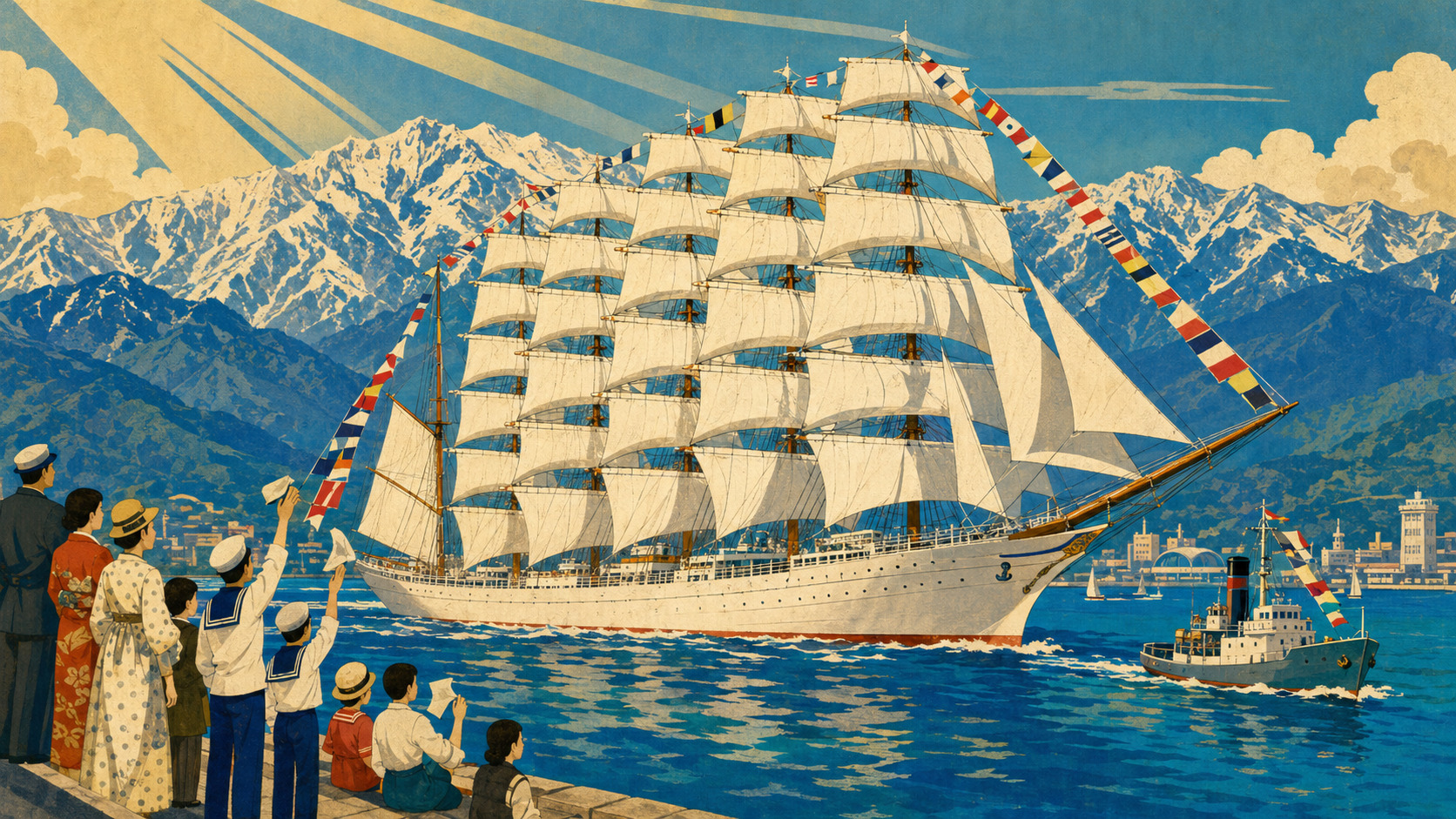
At 10 a.m., people climb instead of sails
The first great vertical movement of Marine Day comes at 10 a.m. Crew members and trained participants climb the rig and take their positions along the horizontal yards. The tōshōrei, or yard-arm salute, is the sailing ship’s highest ceremonial greeting: people aloft face the waterfront and render honor to those ashore. Kaiwo Maru Park normally performs it only once a year. In 2026, the foundation deliberately assigned that annual moment to Marine Day rather than to one of its ordinary full-sail dates.
The official festival flyer allows roughly 30 minutes for the ceremony. Below, the ship is dressed from bow to stern in international signal flags. This is mansenshoku, usually rendered “full-dress ship” or “full-dress flags.” A foundation explanation describes 61 signal flags, with the four at the bowsprit spelling the ship’s call sign, JFPC. The celebratory arrangement is chosen so it does not accidentally form distress combinations such as SOS or NC.
Neither display should be confused with sōhan tenpan, full-sail display. That operation sends trained volunteers and crew through a long sequence of hauling, easing and belaying until 29 sails—2,050 square meters of canvas—are set. It normally takes about 90 minutes to spread them and another 90 minutes to take them in. Marine Day 2026 offers a salute and hands-on sail work, but not that complete evolution.
What is scheduled, and when
Kaiwo Maru Park Festival runs from 10 a.m. to 4 p.m. on Sunday, July 19, and Marine Day, Monday, July 20. Admission to the festival grounds is free; several rides, games, cruises and entry aboard Kaiwo Maru carry charges. Activities can be changed or canceled for weather, heat, operational or safety reasons.
| Date and time | Program | What visitors need to know |
|---|---|---|
| July 19 10:00–11:30 13:30–15:00 | Small boat Nago circles Kaiwo Maru | For elementary-school age and older; children require an adult. First-come registration from 9:45 and 13:15. This is a close harbor circuit, not a voyage aboard the sailing ship. |
| Both days 9:00–16:00 | Kaiwo Maru–Uchikawa sightseeing cruise | Paid Shinminato sightseeing-boat service. Same-day tickets are sold by the operator; Kaiwo Maru ticket holders receive the advertised discount. |
| July 20 10:00–about 10:30 | Kaiwo Maru yard-arm salute | Watch from shore. Shipboard admission begins after the aloft ceremony and safety reset. |
| July 20 | Full-dress signal flags | Decorative international flags run from bow through the masts to the stern. This is not a full-sail display. |
| July 20 about 11:00–18:00 | Kaiwo Maru shipboard visit | Event flyer shows boarding after the salute, with final admission at 17:30. Elementary pupils are offered free admission for Marine Day; normal adult admission is ¥500. |
| July 20 10:00–12:00 13:00–15:00 | Patrol vessel Yahiko scheduled public opening | Kaiō Quay; final boarding 14:30. The Coast Guard labels the opening “planned,” and an emergency call can cancel it. |
| July 20 13:30–14:00 14:30–15:00 | Parent-child sail-handling | Two first-come sessions, 15 people each. Registration from 13:00 and 14:00 near the Kaiwo Maru entrance; elementary-age children must be with an adult. Wear clothes suitable for active deck work. |
The correction: three kinds of display, one misleading line
The 38-page national Marine Day and Sea Month guide, dated June 23, places the two-day festival at Kaiwo Maru Park and says its attractions include a full-sail display, a Nago cruise, parent-child sail handling, the yard-arm salute, full-dress flags and the planned opening of Yahiko. That summary is the source of the early “every sail” billing.
The more specific records point another way. The foundation’s 2026 full-sail calendar lists ten dates: April 19 and 26; May 5 and 24; June 7 and 21; September 13 and 20; and October 4 and 18. July 19 and 20 are absent. The same notice says explicitly that the annual yard-arm salute will be held on Marine Day. The dedicated festival notice, the two-page event flyer and Toyama Prefecture’s July visitor bulletin all list the salute, full-dress flags and parent-child sail handling—but not full sail.
The likely explanation is a category error in the national summary: “parent-child sail handling” became conflated with “full-sail display.” That is an inference, not an official explanation. Unless Kaiwo Maru Park issues a same-day change, visitors should expect selected hands-on sail work, not all 29 sails in the wind.
| Japanese term | What it means | July 20, 2026 |
|---|---|---|
| 総帆展帆 Sōhan tenpan | All 29 sails spread by trained volunteers and crew. | Not listed in the detailed program. |
| 親子展帆体験 Oyako tenpan taiken | Short, supervised family experience opening a sail. | Scheduled at 13:30 and 14:30. |
| 登檣礼 Tōshōrei | People take positions aloft on the yards for the highest sailing-ship salute. | Scheduled from 10:00. |
| 満船飾 Mansenshoku | International signal flags dress the ship from bow to stern. | Scheduled for Marine Day. |
A ship designed to turn students into seafarers
Kaiwo Maru was not built as a floating museum. Construction began at Kawasaki Dockyard in Kobe on April 25, 1929. The four-masted barque was launched on February 14, 1930, one month after her sister ship Nippon Maru. The name carried an instruction and an ambition: become a king of the sea, in service of Japan’s merchant-marine education.
Her first distant training voyage went to Truk—now Chuuk—in late 1930. Over 59 years, the ship sailed 1.06 million nautical miles, a distance the foundation equates to about 50 circuits of Earth, and trained 11,190 young mariners. Those figures explain why a preserved sail is more than spectacle. Every line, block and yard formed part of a working classroom in judgment, coordination, maintenance and command.
Life under sail was deliberately collective. A square-rigger cannot be handled by isolated effort: one team’s timing changes the load another team feels. The modern volunteer evolutions preserve that social technology. They do not reproduce a voyage, but they keep alive the language of orders, the sequence of labor and the knowledge that large beauty is assembled by many small correct actions.
Gray hull, coal cargo and 27,000 journeys home
The ship’s history contains a severe break. In 1943, wartime conversion stripped away the sailing rig, repainted the white hull gray and sent Kaiwo Maru into emergency transport, including coal carriage. After the war she undertook repatriation work, carrying about 27,000 people back to Japan. The foundation records release from repatriation and special transport in 1951; full rig restoration and a return to the white-hulled form were completed at Uraga in December 1955.
In 1956, Kaiwo Maru made the first postwar long-distance voyage, calling at Los Angeles and Port Allen. Later training voyages tied seamanship to public diplomacy: the centennial of Japan–United States relations in 1960, a Los Angeles–Honolulu yacht race in 1961, Canada’s centennial in 1967 and the Captain Cook bicentennial in 1978. Her final long voyage, to Hawaii, came in 1989. She retired from active service on September 16 that year.
This arc—training ship, wartime transport, repatriation carrier, restored sailing classroom—makes full-dress flags on Marine Day more than decoration. The flags rest on a hull that has performed radically different national duties without losing its identity as a school.
How Toyama won the “Lady of the Sea”
Retirement triggered competition among communities that wanted to preserve the first Kaiwo Maru. Toyama’s campaign was unusually broad. A prefectural review records that 46 organizations from the former Shinminato City, economic groups and tourism bodies formed a citizens’ association in 1983 to bring the ship to Toyama. The prefecture made the project official in 1987, and in 1989 the ship was selected for preservation at Toyama New Port.
Public opening began at the port’s north wharf on April 28, 1990. Kaiwo Maru Park and the Japan Sea Exchange Center were completed in 1992. The original plan called for Toyama Prefecture and Osaka City to alternate custody every five years. Osaka withdrew from that arrangement in 1993, and permanent mooring in Toyama was decided in 1994.
The ship’s arrival changed the civic meaning of an industrial waterfront. Toyama New Port had opened in 1968 as a dug harbor serving the surrounding coastal industrial zone. Today it is the core Shinminato district of Fushiki-Toyama Port, handling containers, bulk cargo and large vessels while also supporting a passenger berth, marina and public park. Kaiwo Maru turns those commercial systems into something visitors can read at human scale.
From preserved object to Ship Heritage No. 11
In 2018, the Japan Society of Naval Architects and Ocean Engineers designated Kaiwo Maru Ship Heritage No. 11. The cited reasons are exacting: with Nippon Maru, she is among the oldest surviving Japanese-built training sailing ships; her 59 years in maritime education were exceptionally long; and she remains active in ocean education rather than being sealed as a static artifact.
That last point is the center of the Toyama model. The foundation opens cabins and working spaces, conducts youth marine programs, trains sail-handling volunteers and repeatedly moves the rig. Preservation here means controlled use. Canvas, cordage, spars, steel, wood and fittings must be inspected precisely because people continue to learn from them.
On ordinary full-sail days, spreading begins around 10 a.m., the complete rig is normally visible from about 11:30 to 2, and taking in sails runs until about 3:30. Rain, strong wind and extreme heat can reduce the sail set or cancel work; the foundation posts decisions by 8 a.m. Marine Day’s smaller family sessions obey the same principle: heritage has no value if its demonstration outruns safe conditions.
Why Yahiko belongs beside the training ship
At Kaiō Quay, the Coast Guard schedules patrol vessel Yahiko for free public opening from 10 a.m. to noon and 1 to 3 p.m., with final boarding at 2:30. The foundation’s flyer warns that a marine emergency can call the ship away. The Coast Guard’s own national event page also retains the word “planned.” It is therefore accurate to name the ship and hours, but not to treat its presence as unconditional.
The pairing is unusually coherent. Kaiwo Maru represents the disciplined education behind merchant navigation. Yahiko represents the public service that keeps navigation safe and responds when the sea defeats plans. The nearby Fushiki Customs branch adds another layer: borders, cargo and law. A child can move in a few hundred meters from rope handling, to a preserved training ship, to a working patrol vessel, to the agencies that govern a modern port.
There is also a name that needs care. The 1930 vessel moored in the park is the first Kaiwo Maru. Her successor, the second Kaiwo Maru, grounded near Fushiki-Toyama Port during Typhoon Tokage in October 2004. The Coast Guard mounted a major rescue and all 167 people aboard were brought off. That accident did not happen to the museum ship, but it remains a powerful local lesson in weather, anchoring, rescue and the limits of maritime confidence.
Marine Day returns to its original date
In 2026, the calendar gives this festival an extra historical symmetry: the third Monday of July falls on July 20. Japan’s Marine Day originated in the July 20 arrival of the lighthouse vessel Meiji Maru at Yokohama in 1876 after an imperial northern tour. The holiday was legislated in 1995 and first observed in 1996 on July 20; from 2003 it moved to the third Monday in July.
The statutory purpose is to give thanks for the sea’s benefits and pray for the prosperity of maritime Japan. At Kaiwo Maru Park, that abstract phrase divides into visible actions. Give thanks: dress the old ship. Understand prosperity: look across to the container cranes and working quay. Prepare the next generation: put a line in a child’s hands. Respect risk: let the patrol vessel leave if duty calls.
A practical plan for families
Visitors arriving only for the Marine Day program should aim to be on the waterfront before 10 a.m. The yard-arm salute is brief, visually legible from shore and cannot simply be repeated for late arrivals. The Yahiko opening begins at the same hour, so watch the salute first and use the patrol vessel’s later window if lines permit.
Parent-child sail handling is first come, with sign-ups at 1 and 2 p.m. for sessions beginning 30 minutes later. Capacity is 15 people per session, including accompanying adults. The foundation asks participants to wear clothes suitable for movement. Standard shipboard cautions also matter: steep ladders, high thresholds and working-deck geometry reward closed footwear and free hands.
Kaiwo Maru Station on the Manyō Line is about a ten-minute walk from the park. The festival flyer says trams run from Takaoka Station at approximately 15-minute intervals and advertises a one-day pass bundled with ship admission. The official tourism guide also gives about 20 minutes by car from the Hokuriku Expressway’s Kosugi Interchange. Crowds, heat and waterfront exposure favor public transport, water, sun protection and a flexible sequence.
| Question | Answer for July 20, 2026 |
|---|---|
| Will all 29 sails be spread? | No full-sail display appears in the foundation’s calendar, festival notice or flyer. The national 38-page guide conflicts with those detailed sources. |
| What is the main morning ceremony? | Yard-arm salute from 10 a.m., followed by shipboard visiting after operations permit. |
| Are the colored flags sails? | No. Full-dress ship uses international signal flags; the sails remain a separate rig. |
| Can children handle a sail? | Yes, in two limited parent-child sessions, subject to capacity and weather. |
| Is Yahiko definitely open? | It is scheduled, with published hours, but remains subject to emergency deployment or cancellation. |
| Is the festival free? | Ground admission and the patrol-vessel opening are free. Kaiwo Maru entry and several attractions are normally paid; the flyer offers free Kaiwo Maru admission to elementary pupils. |
The better image is the honest one
A four-masted ship under every sail is irresistible newspaper art. It is also exactly the kind of image that can overtake a program’s fine print. Marine Day 2026 offers a useful correction. A ship does not become less historic when its canvas stays furled. Its meaning may be clearer when visitors see the components separately: bodies spaced along the yards, signal flags carrying a coded identity, one sail handled by a family, a patrol vessel waiting under operational orders.
Kaiwo Maru’s full rig will return on scheduled dates if weather and maintenance allow. Today, Toyama presents something else: not the illusion of a 1930 departure, but the machinery of keeping 1930 knowledge alive in 2026.
Ninety-six years in one timeline
| Year | Kaiwo Maru | Why it matters today |
|---|---|---|
| 1929 | Construction begins at Kawasaki Dockyard, Kobe. | Japanese-built merchant-marine training capacity takes physical form. |
| 1930 | Launched February 14; first distant voyage to Truk later that year. | The four-masted school begins a 59-year career. |
| 1943–1955 | Rig removed for wartime transport; postwar repatriation; white hull and sails restored. | The ship survives radically different national duties. |
| 1956–1978 | Postwar international training voyages resume. | Seamanship becomes exchange and maritime diplomacy. |
| 1989 | Final Hawaii voyage and retirement. | Toyama’s preservation chapter begins. |
| 1990–1994 | Public opening in Toyama, park completion and permanent-mooring decision. | An industrial port gains a civic maritime classroom. |
| 2018 | Designated Ship Heritage No. 11. | Technical, educational and cultural value receive formal recognition. |
| 2026 | Marine Day yard-arm salute, full-dress flags and family sail handling. | Active practice keeps the preserved ship legible. |
Principal sources and further reading
- Kaiwo Maru Park, official 2026 festival notice: two-day program and the separation of July 19 and July 20 activities.
- Kaiwo Maru Park, official two-page festival flyer: exact cruise, salute, sail-handling and Yahiko times, capacity, costs and cancellation cautions.
- Kaiwo Maru Park, 2026 full-sail schedule: ten full-sail dates, operating pattern, weather rules and the separate Marine Day yard-arm salute.
- Toyama Prefecture visitor bulletin: 10 a.m. salute, two parent-child sessions and full-dress flags.
- Japan Coast Guard event calendar: planned July 20 opening of Yahiko at Kaiō Quay and Fushiki Coast Guard contact.
- Japan Maritime Public Relations Center, 38-page 2026 national guide: the broader festival listing, including the conflicting full-sail reference.
- Kaiwo Maru Park, ship profile and chronology: dimensions, sail plan, training record, wartime service, voyages, retirement and Toyama opening.
- Kaiwo Maru Park, publication history: wartime conversion, repatriation, Toyama–Osaka preservation plan and permanent mooring.
- Kaiwo Maru Park, Ship Heritage designation: 2018 No. 11 recognition and continued educational use.
- Toyama Prefecture program review: the 46-organization citizens’ campaign and public preservation rationale.
- Toyama Prefecture, Shinminato district profile: the 1968 dug harbor, logistics capacity and public-waterfront role.
- Japan Coast Guard Report 2005: response to the second Kaiwo Maru grounding; this was not the preserved 1930 ship.
- Japan Coast Guard, history of Marine Day: Meiji Maru, the 1995 legislation and the 2003 calendar change.
Editor’s note: Research was reviewed on July 18, 2026, Japan time. The headline supplied during early planning said Kaiwo Maru would “spread every sail.” Japan.co.jp changed it after comparing the national summary with the foundation’s detailed calendar, notice and flyer. As of publication, the full-sail display is not scheduled; the yard-arm salute, full-dress flags, parent-child sail handling and Yahiko opening remain subject to weather, heat, safety and operational requirements. The hero is an editorial illustration of Kaiwo Maru’s historic full-sail appearance, not a record of the 2026 event.