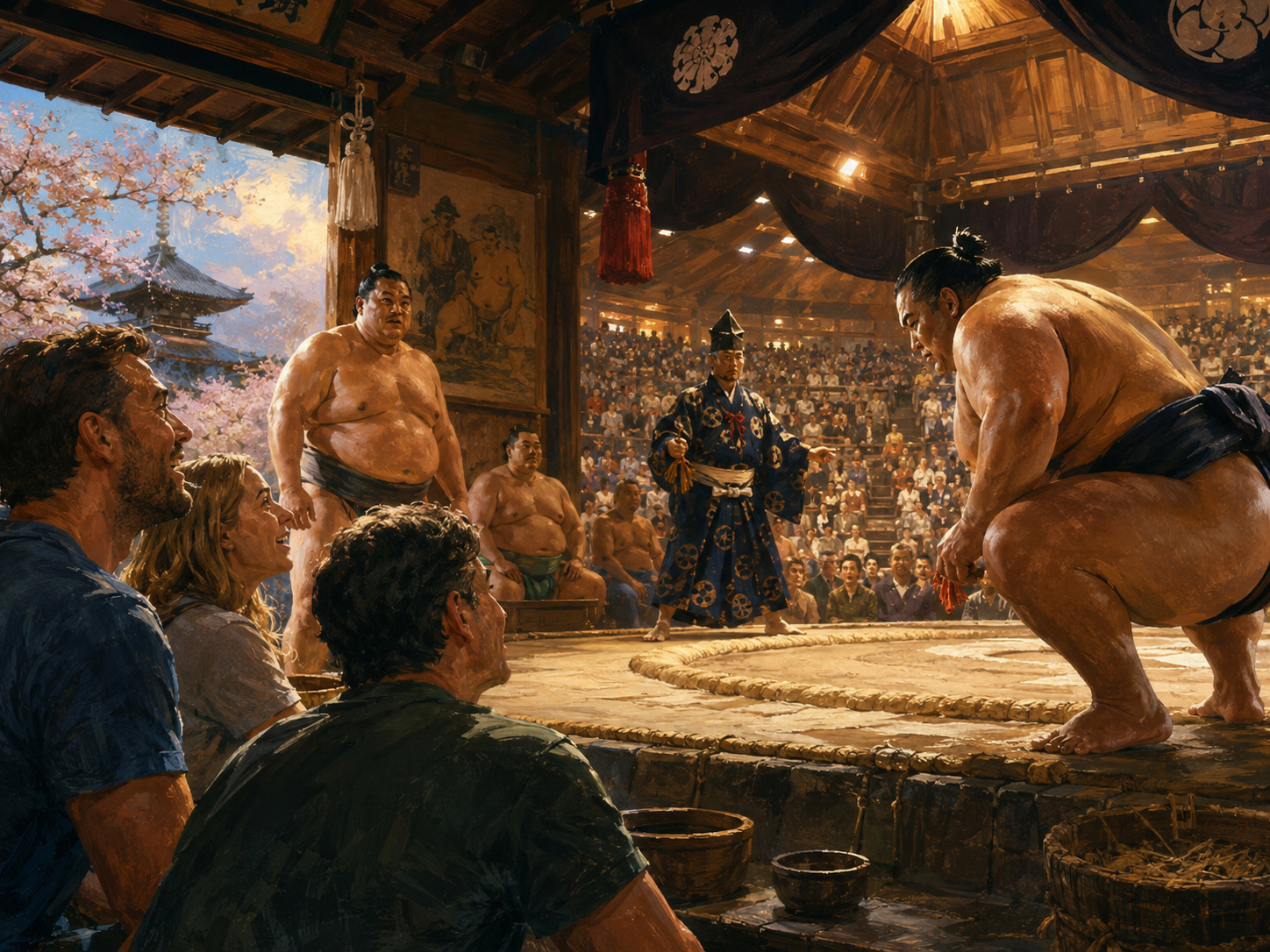
Ryogoku in the morning does not behave like a tourist district. It is quieter than Asakusa, less polished than Ginza, less obvious than Shibuya. But walk from the station toward the Kokugikan and the air changes. Chanko signs, stable names, young wrestlers on bicycles, older fans with folded schedules, small plaques on ordinary buildings: the neighborhood tells you that sumo is not simply an event. It is a working culture.
That is why sumo is becoming one of Japan’s most compelling travel experiences. Visitors are not only coming to see large men collide. They are coming to witness a world in which sport, ritual, hierarchy, food, neighborhood memory and bodily discipline are still tied together. In an age when many attractions feel designed for the camera, sumo still asks the visitor to sit still and pay attention.
JNTO describes sumo as a tradition rooted in Shinto ritual, with purifying salt, bows, formal gestures and the sacred clay ring surrounding the brief combat. The rules of victory are simple: force the opponent out of the ring or make him touch the ground with anything other than the soles of his feet. But the simplicity is deceptive. Around those few seconds of contest lies a dense ceremonial world.
To watch sumo well is to lower your volume. The best visitor does not dominate the room. The best visitor learns how to be present.
The era of hard-to-get tickets
Sumo’s status in inbound tourism has changed. It used to be something visitors did if their dates happened to match a tournament. Now, for some travelers, it is a reason to come to Japan in the first place. Japan Forward reported in January 2026 that foreign visitors are increasingly joining guided tournament tours and morning-practice viewings. The report also noted that all 90 days of the six annual grand tournaments had sold out for two consecutive years through 2025, and cited a Japan Sumo Association estimate that about 2,000 foreign visitors attend each day at the 11,000-seat Ryogoku Kokugikan.
That demand has created a new travel layer around sumo. A first-time visitor may not understand the banzuke rankings, the order of bouts, the meaning of the ring-entering ceremony, the rhythm of applause or why a match that lasts five seconds may have taken a lifetime to prepare. Guided viewing turns the afternoon into a readable text. Suddenly, the hand placement at the start matters. The stare-down matters. The balance at the straw bales matters.
The official 2026 tournament calendar makes sumo a national travel itinerary: January in Tokyo, March in Osaka, May in Tokyo, July in Nagoya, September in Tokyo and November in Fukuoka. As of mid-June, the next major destination is Nagoya, where the July tournament is scheduled from July 12 to July 26. A sumo trip can therefore become a seasonal map of Japan: New Year Tokyo, spring Osaka, summer Nagoya, autumn Tokyo, late-year Fukuoka.
Morning practice and the discipline of silence
The most revealing sumo experience may not be the tournament at all. It may be morning practice. Unlike a performance designed for visitors, morning practice is work. Wrestlers stretch, sweat, fall, rise, repeat, collide and repeat again. The stable master watches. Senior wrestlers correct. Younger wrestlers learn the body language of obedience and ambition.
JNTO cautions that spontaneous visits to sumo stables are not encouraged, though some agencies arrange small-group tours. That distinction matters. A stable is not a museum. It is a home, a workplace and a training ground. The visitor’s job is not to interrupt the ritual but to understand the privilege of proximity.
In a practice room, the sound changes everything. Feet scrape clay. Palms strike flesh. Breathing becomes audible. A short instruction from the stable master can cut through the room. Foreign visitors sometimes arrive expecting a dramatic show and discover something more powerful: repetition. The same movement, refined again and again, until a few seconds in the ring can be trusted.
Chanko and the neighborhood around the ring
Sumo travel expands naturally beyond the ring. In Ryogoku, visitors can move from the Kokugikan to chanko restaurants, the Sumo Museum, the Sumida River and old Tokyo neighborhoods. Chanko nabe is often explained as the food of wrestlers, but it is also the food of shared labor. It belongs to stable life, where eating together is part of the system that produces the sport.
For travelers, food makes sumo legible. You may not understand every technique, but you can understand the pot, the rice, the broth, the appetite and the community. A full day might begin with morning practice, continue with a walk through Ryogoku, move into an afternoon tournament and end with chanko. That rhythm is what turns a ticket into a travel experience.
Between authenticity and entertainment
As sumo becomes more popular with overseas visitors, the industry faces a delicate question: how much should be translated, packaged and performed? There are official tournaments, stable tours, provincial exhibitions, public ceremonies and entertainment-style sumo shows led by former wrestlers. Each has value. But they are not the same thing.
The danger is not that tourists enjoy sumo. The danger is that Japan sells the feeling of authenticity without explaining the boundaries that protect the real thing. A tournament is competition. Morning practice is training. A show is education and entertainment. A shrine ceremony is ritual. A good travel culture tells visitors which world they are entering, and how to behave when they get there.
How to visit sumo well
- Check official ticket channels early; popular dates sell quickly.
- Do not attempt spontaneous stable visits; use approved arrangements.
- At practice, remain quiet, avoid flash photography, and do not move around unnecessarily.
- Remember that the dohyo is treated as a sacred space, not just a sports surface.
- Give Ryogoku time: chanko, the museum, the river and the neighborhood complete the story.
Japan.co.jp reads sumo travel as a symbol of deeper tourism. As Japan receives more repeat visitors, the strongest experiences are no longer only the famous places. They are the places where visitors are asked to adjust themselves to Japan, not the other way around.
Sumo’s power lies in proximity. But proximity requires manners. The closer a traveler gets to the ring, the more the traveler must understand that watching is also a form of respect.
Sources and references
This Japan.co.jp Sunday Report draws on the Japan Sumo Association’s 2026 tournament schedule, JNTO’s sumo travel guide, official ticket information, and Japan Forward’s reporting on the rise of overseas visitors at tournaments and morning-practice viewings.