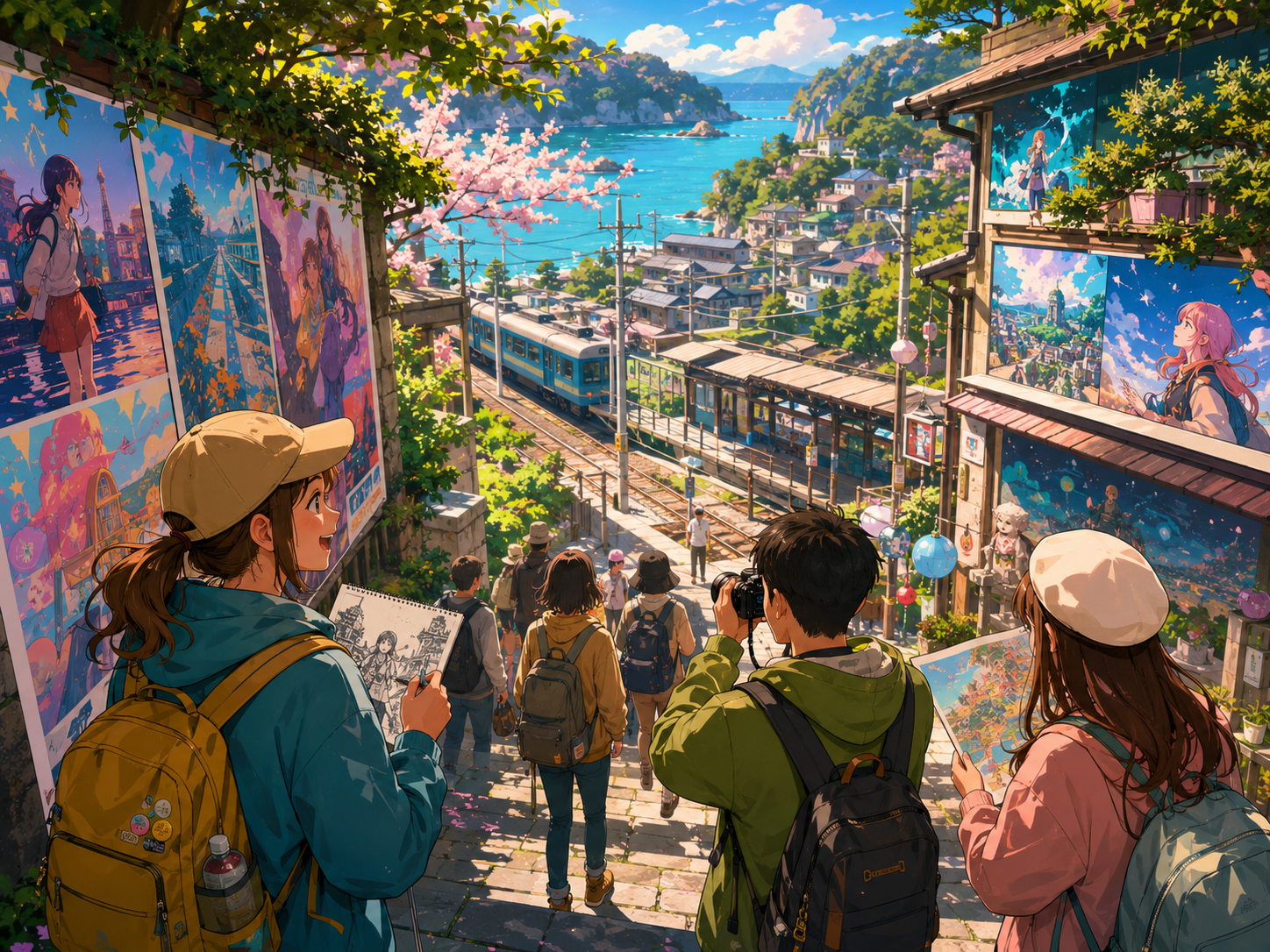
Anime pilgrimage often begins in a place that did not think of itself as a destination. A ticket gate. A hill road. A riverbank bench. A convenience store corner. A railway crossing at sunset. These are not always famous sights. They become important because an animated story framed them, colored them, and gave fans a reason to search for them in the real world.
Japan National Tourism Organization now presents anime and manga as Japanese cultural gifts that have captured hearts around the world, encouraging fans to visit the “sacred sights” of beloved works. That official language matters. Anime tourism is no longer a side habit of fandom. It is now part of how Japan explains itself to international travelers.
The shift is especially powerful for regional Japan. Conventional tourism often flows toward Tokyo, Kyoto, Osaka, major temples, castles, hot springs and Mount Fuji. Anime settings are much more granular. They can be residential streets, school routes, rural stations, harbor towns, old theaters, local shopping arcades and shrines that never expected a global audience. Fans are not always looking for “famous Japan.” They are looking for the Japan where their story lives.
The heart of anime pilgrimage is not sightseeing. It is the search for proof that a time loved on screen still exists in real air.
From fan ritual to regional system
Anime pilgrimage began as a fan practice. Viewers watched a show, identified a background, compared screenshots with maps, and traveled to the real location. KADOKAWA describes anime pilgrimage as visits by fans to places where anime works take place or that inspired those works, and argues that the cycle among fans, works, regions and businesses must be cultivated so visits do not end as a short-lived fad.
This point is crucial: regions cannot simply wait for fans and expect the boom to sustain itself. If there is no guidance, no welcome, no connection to shops, no respect for residents, no official goods, no food, no event, no way to explain photography rules, the energy cools. But if local stores, transport operators, tourism desks, municipalities and rights holders coordinate, pilgrimage can become a durable form of cultural tourism.
Tokyo’s official travel site explains that the Anime Tourism Association has selected “88 Animation Spots in Japan Recommended for Visits” since 2018 and promotes certification plaques and scarlet-seal stamps at selected locations. That turns spontaneous fan discovery into a walkable network. Japan is moving from an age of fans finding sacred sites to an age of regions preparing to receive them.
The borrowed power of “88”
The number 88 is not accidental. It echoes the Shikoku 88-temple pilgrimage. Anime pilgrimage is not religious pilgrimage, of course, but the travel structure overlaps in intriguing ways. People follow a map, visit places in sequence, collect stamps, record memory, meet others who share the same route, and return home with stories that encourage the next traveler.
Academic work also treats anime pilgrimage as a form of visual media-induced tourism. A 2026 study distinguishes anime pilgrimage from live-action location tourism: anime is drawn, not filmed, so travelers must actively merge the real place with an imagined visual world. They rewatch, compare, locate the camera angle, and wait for similar light. The journey is partly geographic and partly interpretive.
That is what gives anime pilgrimage its emotional depth. A fan does not only stand on a road. The fan stands inside a remembered frame. A stairway becomes a scene. A station platform becomes a threshold. A town becomes a medium between fiction and personal memory.
Anime as regional revitalization
For regional Japan, the appeal is that anime pilgrimage does not always require giant infrastructure. A town does not need to build a theme park. Its existing station, arcade, bridge, shrine approach, café, school-view street or coastal road may already be part of a work’s emotional map. The challenge is not construction; it is reception.
KADOKAWA’s explanation of anime tourism stresses the need to connect anime spots, local companies and content holders to products and services that can welcome fans. This is a practical regional-development lesson. Fans are not merely consumers. They are visitors with attachment. Because they care about the work, they may become unusually loyal to the place.
Tourism research has begun to examine that attachment. The 2026 MDPI study discusses place attachment in anime pilgrimage and its possible relationship to destination loyalty, revisit intention and word-of-mouth. A place that ordinary tourists might see once can become a repeated destination when linked to a story. Fans return by season, by event, by anniversary, or simply to feel the place again.
The key success factor: translating manners
But anime pilgrimage is delicate. Many locations are not conventional tourist sites. They may be residential streets, narrow roads, school-adjacent spaces, shrine stairs, local crossings, storefronts or ordinary neighborhoods. That means manners are not a side issue. They are the core infrastructure.
Where may visitors photograph? Where should they not stop? What is private property? Which spaces are schools, homes or working shops? What happens at night? Are costumes appropriate? Are drones prohibited? How should social media posts avoid exposing residents? These rules must be multilingual, clear and kind.
A list of prohibitions is not enough. Fans are attached to the work. A better message is: protecting the everyday life of this place protects the world of the story. Respect for residents can be framed as part of respect for the work itself. That translation — from rule to emotional logic — is what successful anime destinations learn to do.
Copyright, coordination and trust
The other challenge is copyright. A municipality cannot simply use characters however it wishes. A shopping street cannot freely print posters. A station cannot necessarily create a stamp, a café cannot automatically sell a collaboration menu, and a tourism office cannot always use titles and images without permission. Rights holders matter.
When coordination works, pilgrimage becomes stronger: certified spots, stamps, exhibitions, official merchandise, event maps, local foods, commemorative tickets and guided walks. Fans participate with confidence. Communities benefit through legitimate channels. When coordination is not possible, regions can still design landscape-based walking routes and general cultural guides without leaning too heavily on protected characters.
The point is simple: anime should not be treated as free decoration. The creators, rights holders, residents, local businesses and visiting fans all need trust. Without that, the pilgrimage may produce attention but not sustainable value.
When the story begins at the airport
The Anime Tourism Association’s English site notes the opening of an information point for Japan’s 88-site anime pilgrimage at Narita Airport. That is symbolic. Anime pilgrimage is no longer only domestic fan travel. For many visitors, Japan begins with a fictional map already loaded into the phone.
Tokyo offers obvious entry points: anime-linked locations in Akihabara, Suginami, the Tokyo Metropolitan Government area and other walkable spots. But the deeper potential is outside Tokyo: seaside towns, snow-country stations, local shrines, hot-spring streets, regional railways and ordinary neighborhoods that become extraordinary through story.
This matters for dispersing tourism. Instead of concentrating foreign visitors only in Kyoto, Shibuya, Asakusa or around Mount Fuji, anime can move travelers into smaller cities and towns. For regional Japan, that creates a new doorway. For travelers, it creates a more personal Japan.
Five ways to read anime pilgrimage
- It began as fan-led travel: viewers identifying and visiting real places behind animated scenes.
- Long-term success requires local guidance, resident protection, transport links, shops and rights-holder coordination.
- The “88” framework turns scattered fan destinations into a walkable and stampable pilgrimage map.
- Good destinations do not only attract visitors; they teach visitors how to respect local life.
- Anime pilgrimage can move inbound tourism beyond Tokyo and Kyoto into regional Japan.
Entering the story without breaking it
The beauty of anime pilgrimage lies between reality and fiction. Fans find a place, and the work changes how they see it. A region sees outsiders looking closely at something locals had stopped noticing. A stairway becomes a destination. A quiet shopping arcade becomes someone’s dream.
But that power is fragile. Too many visitors can damage daily life. Ignoring copyright can weaken the bond with creators. Poor manners can turn residents against fans. The moment a place becomes a sacred site, it also becomes something to protect.
As a Sunday journey, anime pilgrimage feels deeply Japan.co.jp: food, railways, shopping streets, regions, culture, youth, inbound travel, social media, copyright and local revival all meet on one ordinary road. To know Japan is not only to see the famous sights. It is also to walk into the place where someone’s story took root.
Japan.co.jp reads anime pilgrimage not as a subculture footnote, but as story-led rediscovery of regional Japan.
The task now is to keep fan energy from becoming disposable consumption. If works, regions, residents and travelers can respect one another, anime pilgrimage can become a slower, deeper form of cultural travel.
Sources and references
This Japan.co.jp Sunday Long Read draws on Japan National Tourism Organization guidance, the Anime Tourism Association, Tokyo’s official travel site, KADOKAWA’s explanation of anime pilgrimage and regional development, and 2026 scholarship on anime pilgrimage and place attachment. Titles, events and facility information may change, so visitors should check official information before traveling.