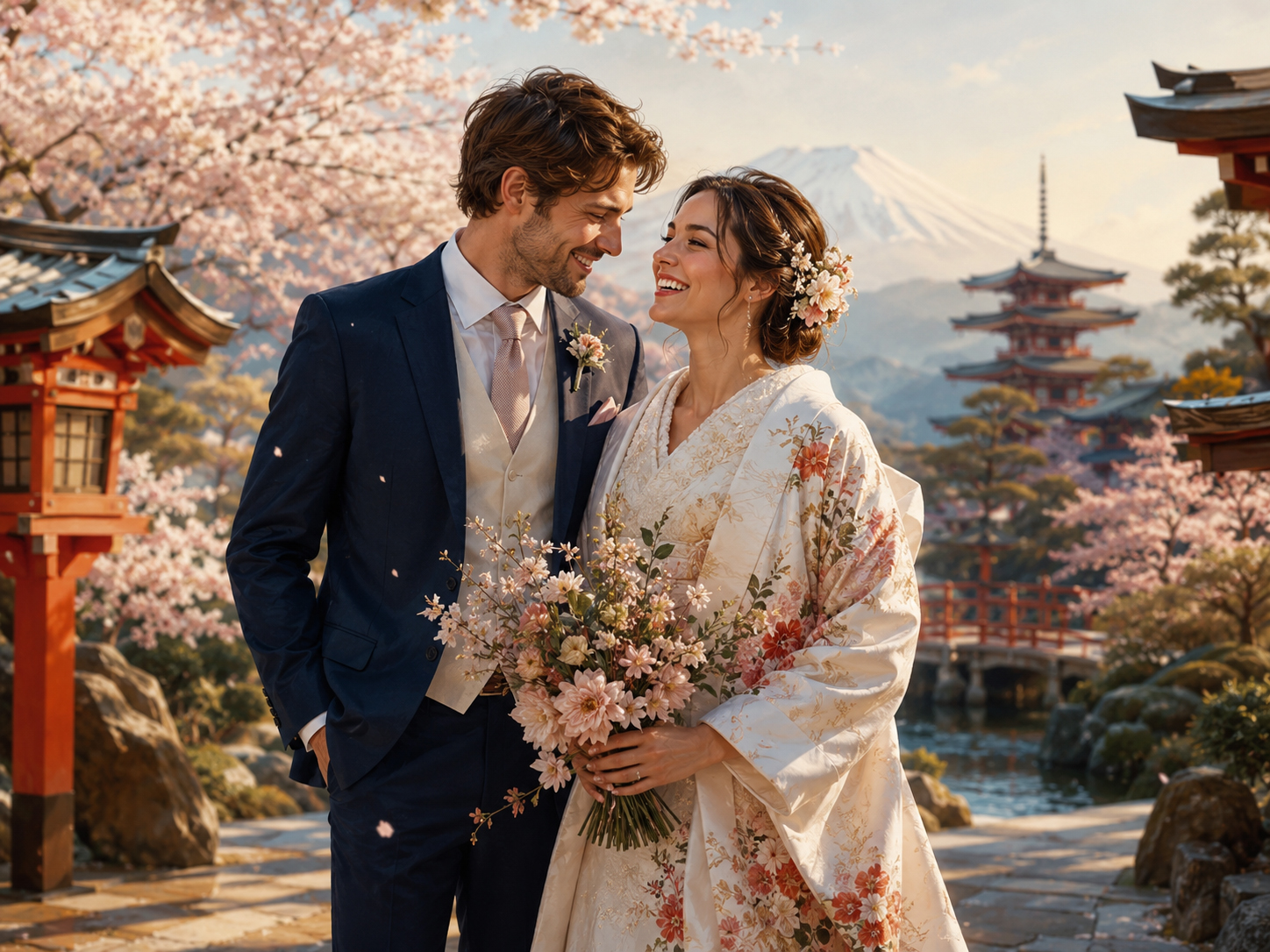
A wedding changes when the location changes. The vows may be familiar. The dress, flowers and music may feel universal. But the air around the vows — the light, the silence, the family faces, the walk after the ceremony — belongs to one place. Increasingly, that place is Japan.
Japan’s tourism boom is entering a deeper phase. Visitors still come for food, temples, shopping, anime, skiing, hot springs and cherry blossoms. But some travelers now want Japan to hold something more permanent: a life milestone. The destination wedding is one of the clearest signs of that shift. Some foreign couples complete legal marriage paperwork in Japan. Many others legally marry at home and hold a symbolic ceremony, photo session or family gathering in Japan. Either way, they are not merely renting a venue. They are choosing the Japanese landscape as part of their personal history.
The Japan Times reported in June that foreign couples are increasingly turning Japan into a wedding destination. The weak yen is part of the story. But the deeper reason is not price alone. Couples are drawn by personal ties, cultural fascination, Mount Fuji, Kyoto, gardens, ryokan, food, design, seasonal beauty and the desire to show relatives a country that already means something to them.
This is not simply “Japan because it is cheaper.” It is “Japan because this is where we want our memory to live.”
The weak yen opens the door, but meaning keeps couples there
The currency matters. Flights, hotels, photographers, venues, transport, meals and multi-day guest activities all sit inside a wedding budget. For couples coming from the United States, Europe, Australia or parts of Asia, a weak yen can make a Japan ceremony feel more possible. It can extend the trip, upgrade the meal, add a photographer, bring more relatives, or turn a one-day event into a three-day gathering.
But if price were the only factor, couples could choose many other places. Japan’s advantage is the combination of value and meaning. A vow by Lake Kawaguchi, a photo walk through Kyoto, a reception in a renovated townhouse, a coastal ceremony in Izu, a family dinner in a ryokan, a snowy Hokkaido portrait session, or a garden ceremony in Kanazawa all carry instant storytelling power. When families see the images, the setting explains itself.
A destination wedding is also a different kind of tourism spending. Guests stay in hotels, ride trains, eat in restaurants, buy gifts, book guides, rent formalwear, hire interpreters, visit museums, and travel before and after the ceremony. The event becomes a small tour. The wedding party is not just a group of guests. It is a temporary travel economy.
When the wedding and the Japan trip become one thing
A traditional wedding asks guests to arrive, attend and leave. A destination wedding changes the rhythm. The trip begins at the airport. It includes the first train ride, the convenience-store breakfast, the awkward luggage transfer, the family meal, the hot-spring stay, the morning walk through a shrine, and the sightseeing day after the ceremony. All of it becomes part of the wedding memory.
For Japan, that changes the tourism opportunity. Wedding guests have a reason to linger. They are likely to value hospitality, translation, food, photography, transport and local culture. That gives business to hotels, wedding planners, kimono stylists, florists, restaurants, sake breweries, craftspeople, guides, drivers, interpreters and small venues beyond the most famous tourist zones.
The opportunity is not risk-free. International weddings require language support, dietary sensitivity, religious flexibility, backup plans for rain, accessibility for older guests, photography permissions, transport planning and clear explanations of local customs. A beautiful garden or shrine-style setting is not enough. Foreign guests need to know what is allowed, what is expected, where to stand, when to remove shoes, and how to move through the day without embarrassment.
Legal marriage or symbolic ceremony?
For foreign couples, the first planning question is practical: are they legally marrying in Japan, or are they holding a symbolic ceremony in Japan after completing legal marriage at home? Legal marriage in Japan can involve embassy-issued documents, proof of capacity to marry, Japanese translations, witnesses and municipal filing. Requirements vary by nationality. The process can be manageable, but it is not casual.
That is why many international couples separate the two tracks. They handle legal marriage in their home country and use Japan for the ceremony, photographs, family gathering and travel experience. This approach gives more freedom. A couple can incorporate religious rituals, cultural fusion, private vows, kimono photography, a small dinner, or a multi-day itinerary without turning every detail into paperwork.
Japan needs translation, not just production
The important translation is not only linguistic. Japan must translate its invisible rules. Which parts of a shrine or garden allow photography? How should guests behave in a traditional venue? What happens if rain changes the plan? How much walking is required for older relatives? Can meals be vegetarian, halal, kosher, gluten-free or allergy-aware? How should tipping expectations be explained? How are payments, taxis, trains and luggage handled?
Regions that win in this market will be the places that bridge tourism and weddings. A hotel alone is not enough. A planner alone is not enough. A photographer alone is not enough. Destination weddings require an ecosystem: transport, interpretation, food, styling, emergency contacts, local etiquette, family comfort and cultural explanation.
That also means smaller regions can compete. Not every couple wants a crowded Kyoto street or the busiest Fuji viewpoint. Some want quiet: a village, a seaside villa, a bamboo grove, a restored kominka, a ryokan courtyard, a mountain inn, an island garden. Japan’s less famous places may be especially suited to the intimacy that destination weddings require.
Five ways to read this trend
- Japan is expanding from tourist destination to life-event destination.
- The weak yen helps, but scenery, culture, photography and family memory drive the choice.
- Legal marriage and symbolic ceremonies must be clearly distinguished.
- Regional Japan can compete through quiet, seasonality, architecture, food and hospitality.
- The key is not louder production. It is clearer explanation and deeper guest care.
Why this belongs in the Sunday edition
This is not a hard economic headline. But it reveals a serious change in Japan’s economy. Inbound tourism is no longer just a count of arrivals. It is a market of moments: anniversaries, honeymoons, proposals, family reunions and weddings. These are high-emotion, high-memory forms of travel, and they can support local businesses in ways that quick sightseeing cannot.
Japan’s challenge is quality, not just quantity. Crowding more people into the same places will not be enough. The higher-value future is slower, more personal, more respectful and more regional. A wedding lasts one day, but the photographs may last a lifetime. If Japan appears in those images, it continues to speak long after the trip ends.
Japan.co.jp reads this as a story of inbound tourism maturing. Japan is moving from a country people come to see into a country where people choose to place a milestone.
For a Sunday edition, the news is not only the number of visitors. It is the memory they decide to make here.
Sources and references
This Japan.co.jp Sunday Long Read is based on reporting and reference material about foreign couples choosing Japan for weddings, Japan’s inbound tourism boom, legal marriage logistics, and Japan destination-wedding services.