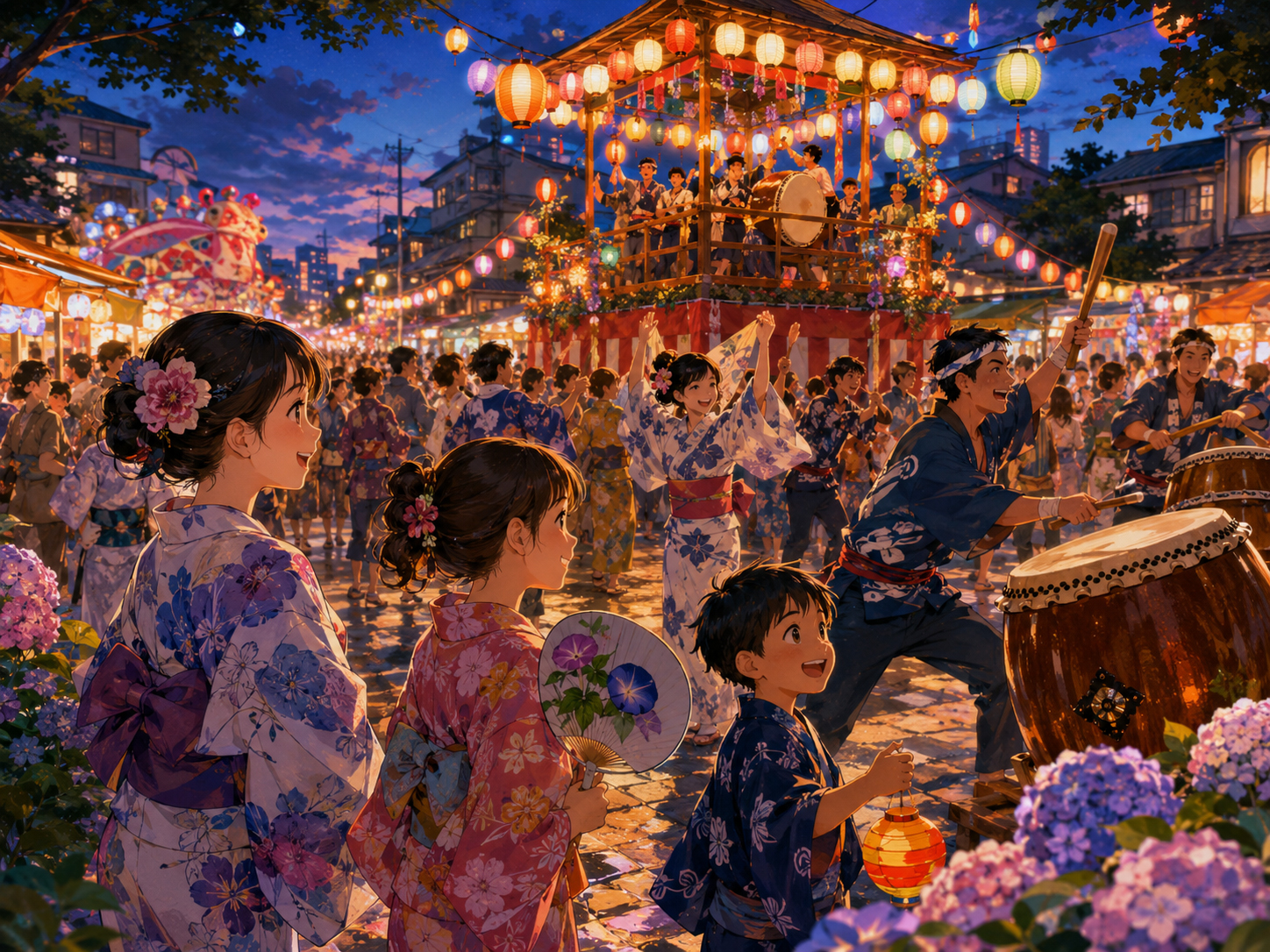
Visitors often describe June in Japan as the rainy season. But in the Japanese calendar, rain is not an interruption. It is a medium. It deepens the blue of hydrangeas, shines on moss, turns rice paddies into mirrors and makes fireflies visible in the dark. Before the great summer festivals become loud, Japan has already entered festival season in the quiet of the rains.
July and August are famous for fireworks, bon odori, Kyoto’s Gion Matsuri, Aomori’s Nebuta and Tokushima’s Awa Odori. June is less obvious. It is smaller, wetter and closer to the ground. There is Tokyo’s Sanno Matsuri, but also shrine rice-planting rites, hydrangea temples, firefly evenings, riverbank kite battles, rain-soaked food stalls, lanterns, local preservation groups and dances that belong first to neighborhoods, not to tourism brochures.
The Japan National Tourism Organization describes Sanno Matsuri as a festival that heralds the beginning of Japan’s summer festival season. Centered on Hie Shrine in Tokyo, it runs from June 7 to 17 in even-numbered years, when the larger procession receives attention. It is counted among the three great Edo festivals and carries the memory of an era when portable shrines and floats were paraded for Tokugawa shoguns. In modern Tokyo, that old time walks between office towers, government ministries, hotels and subway exits.
June festivals do not avoid the rain. They use rain to make a place’s memory visible.
Sanno Matsuri: old time walking through central Tokyo
The fascination of Sanno Matsuri begins with its location. When people imagine Tokyo festivals, they often think of Asakusa or old downtown streets. Sanno Matsuri moves through another Tokyo: Nagatacho, Akasaka, Hibiya, Marunouchi and the Imperial Palace area — the districts of politics, business and national ceremony. The procession turns glass buildings, suits, traffic control, foreign cameras and shrine ritual into a single urban image.
A festival is not merely an event. Sanno Matsuri holds the memory of Tokyo as a political city. Its history as a procession once shown to the shoguns reminds us that festivals were tied to the structure of urban power. There are no shoguns now. But the act of moving a shrine procession through the center of Tokyo still summons the deeper layers of the city.
For travelers, this is a chance to see an unexpected Tokyo. It is not only futuristic, efficient and vertical. It is also ritual, memory and choreography. The festival reveals that modern Tokyo is built over older routes of prayer.
Hydrangeas: turning rain into color
In June, the most photographed flowers in Japan are not cherry blossoms. They are hydrangeas. From Kamakura’s Meigetsuin and Hasedera to Takahata Fudoson in Tokyo, Kyoto and Nara temples, Shimoda on the Izu Peninsula and shrines across the country, hydrangea sites open in blue, purple and pink. The wetter the stones, moss and leaves become, the richer the flowers appear.
A hydrangea festival changes the pace of travel. People stop. They wait for a photograph. They welcome clouds. It is a different form of sightseeing from bright-sky tourism. Rain may look like a negative on a travel forecast, but for hydrangeas it is the staging. To sell June travel in Japan well, one must not apologize for rain; one must explain what rain reveals.
Shimoda Park’s hydrangeas, for example, spread across hills above the harbor. The trip does not end with flowers. It connects to hot springs, seaside walks, local food and history. This is the strength of June regional travel: a seasonal plant becomes the doorway to a place.
Fireflies: tiny lights that gather a community
Firefly festivals may be the quietest night events in June. They do not split the sky like fireworks. They do not push a crowd toward a stage. People gather near a dark waterway, lower their voices and wait for a small light. Fireflies require water quality, fields, forest edges, darkness and local stewardship. A firefly event is therefore also an environmental event.
For city dwellers, fireflies are a memory of water that has almost disappeared. For children, they are proof that nature still has a hidden life. For communities, they reward years of keeping streams and darkness alive. For travelers, they are not a thing to consume quickly. They require patience, silence and eyes adjusted to night.
That slowness belongs in a Sunday long read. June festivals do not rush. Rain, firefly light, rice planting, hydrangea color — each returns travel to a slower human tempo.
Rice planting and prayer: festivals at the beginning of food
No account of June festivals is complete without rice planting. The roots of Japanese festival culture are deeply connected to rice agriculture: flooding the paddies, planting seedlings, praying for a good harvest. For urban life this may seem distant. Yet rice remains the ground of Japanese food culture, ritual and community time.
A rice-planting festival is a communal act before it is a show. Lines of seedlings, songs, drums, costume, shrine prayer and muddy water place food before the supermarket shelf. For international visitors, it can be an entry point into Japanese cuisine. Sushi, donburi, bento, sake and mochi all begin with the season of the field.
To see June festivals only as entertainment is to miss half the story. They are also food news, environmental news and local education. A community grows rice, gives thanks, teaches children and opens the landscape to visitors.
Niigata’s giant kites: memory colliding in the sky
June is not only quiet. It can be wild. Niigata’s Shirone Giant Kite Battle is one of the clearest examples. From both banks of the Nakanokuchi River, teams launch huge kites into the air, tangle them, let them fall to the river and pull the ropes in a contest of wind, timing and strength. Regional materials describe kites around 5 meters by 7 meters and roughly 300 huge kites taking part. Sky, wind, river, paper, bamboo, rope and local pride become one.
The attraction is not just victory. It is the painted faces and characters on the kites, the shouts of the crews, the riverbank crowd, the experience of reading the wind, and the astonishment of children looking up. It feels a little like sport, but its tools are paper and bamboo. That contradiction is part of its power.
For overseas travelers, the battle may first look like an unusual festival. For the region, it is a system for passing down skills. Who paints? Who builds the frame? Who reads the wind? Who pulls the line? The festival confirms local roles each year.
Five ways to read June festivals
- Rainy season is not a bad travel month; it is what makes flowers, fireflies, paddies and moss visible.
- Sanno Matsuri joins Tokyo’s modern cityscape to Edo-period memory.
- Hydrangea festivals teach the value of rainy-day tourism.
- Fireflies and rice planting show nature and food culture as festival forms.
- Regional events such as the Shirone kite battle lift craft, rivalry and community memory into the sky.
Tourism needs interpretation, not just crowds
Japanese festivals are attractive to international travelers, but popularity brings problems: crowds, photography etiquette, residents’ daily life, trash, traffic control and respect for religious practice. A festival may be a public spectacle, but it is also a local act of faith and community.
What is needed is not merely English signage. Visitors need interpretation: where to stand, when to photograph, when not to cross a procession, why one should not touch certain ritual objects, what happens if it rains, how crowded the station will be, and why a firefly riverbank should stay dark and quiet. The better the explanation, the better the guest.
For regions, June is an opportunity. Travel demand does not have to be trapped between cherry blossoms and autumn leaves. Hydrangeas, fireflies, rice planting, kites and shrine rites can make June a month for deeper Japan travel rather than a month to avoid.
Japan.co.jp reads June festivals as the overture to summer. Before high-volume festival season begins, local Japan uses rain, water, rice, flowers, light and wind to tune the year.
The important question is not only which festival is famous. It is why people gather there, why the practice continues, and why the rainy season can be one of Japan’s most revealing travel seasons.
Sources and references
This Japan.co.jp Sunday Long Read draws on tourism and event information for Sanno Matsuri, June hydrangea and firefly events, rice-planting rites and the Shirone Giant Kite Battle.