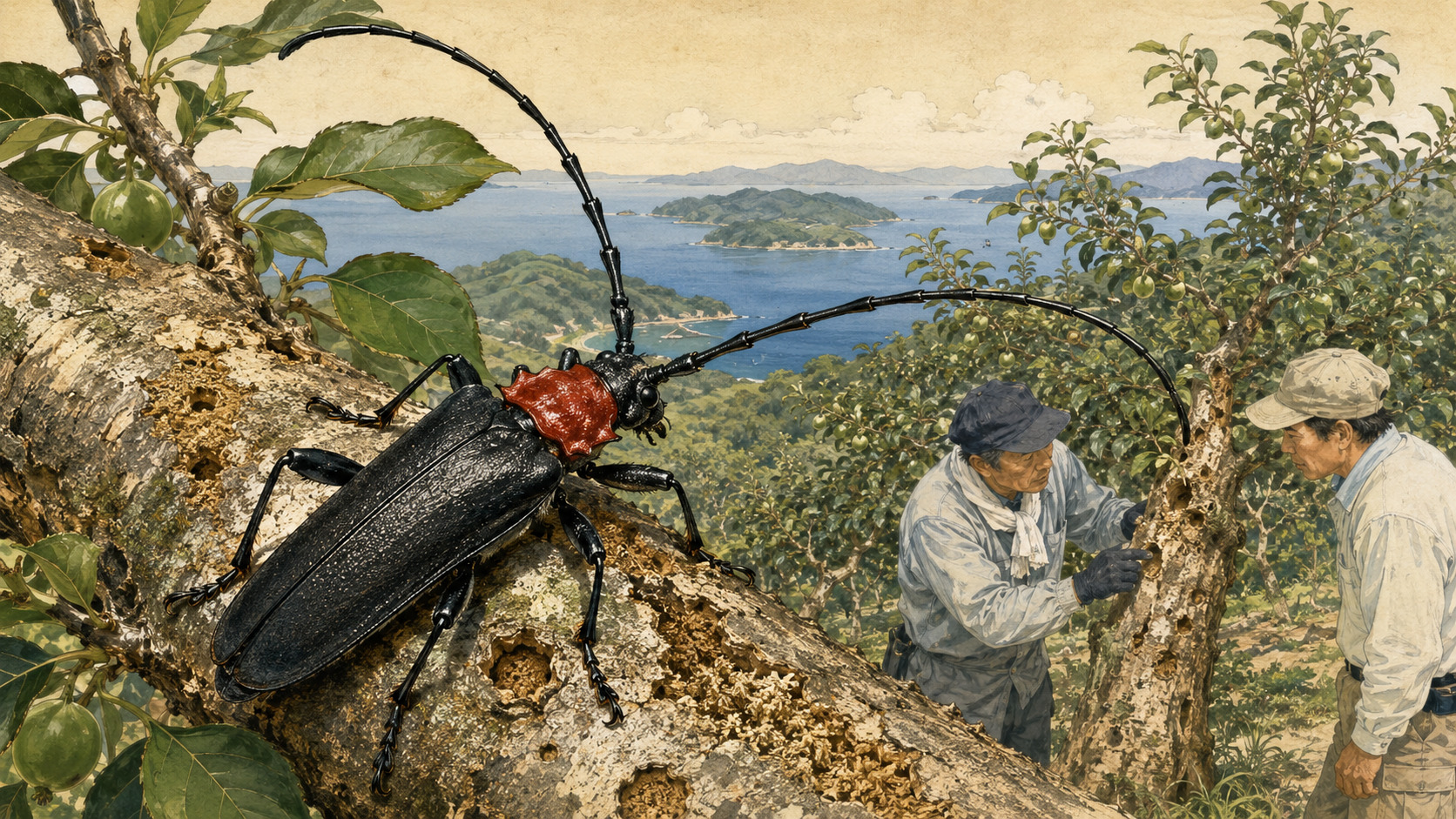
At the base of a cherry trunk lies something that resembles a narrow strand of udon. It is orange-brown, linked and extruded. Not soil, not sap: it is frass, the mixture of wood particles and feces that a larva feeding beneath the bark has pushed out of its tunnel.
On June 17, 2026, an arborist inspecting cherry trees at the request of the National Lodge Shodoshima found suspicious frass on two cherries and an adjacent plum in Ikeda, Shodoshima Town. On July 7, the Kagawa Prefectural Research Institute for Environmental Sciences and Public Health detected DNA specific to the red-necked longhorn beetle, Aromia bungii, in the material. The next day, environmental and agricultural officials captured an adult at the site. It was Kagawa’s first official confirmation.
The story may begin with one beetle, but the problem does not. Before an adult appears, a larva ordinarily spends about two years inside a tree. Did the captured adult emerge there or fly in from somewhere else? How many larvae occupy nearby trunks? How many eggs had already been placed in bark cracks? The visible beetle is only the brief final scene of a much longer period concealed beneath the bark.
June frass, a July adult, an August orchard
The initial site lay along the cherry avenue between National Lodge Shodoshima and Shiroyama Park, with a plum beside it. On July 12, a dead adult was also found in a roadside drain in Sanbonmatsu, Higashikagawa City, across the water in eastern Kagawa. Officials urgently inspected parks within roughly one kilometer. Frass that looked suspicious tested negative for the beetle’s DNA. Two records alone do not reveal whether the sites are connected.
On August 4, a Shodoshima grower who had seen an alert leaflet reported abnormal frass in a plum orchard to the Shozu Agricultural Extension Center. According to regional broadcaster KSB, officials examined 13 trees, found suspected red-necked longhorn beetle damage on six and applied insecticide. At that point, no damage had been reported by the island’s other plum growers. A threat first framed around a public cherry landscape had moved closer to agricultural production.
June 17 An arborist reports suspicious frass on two cherry trees and one plum in Ikeda.
July 7 A prefectural laboratory detects species-specific DNA in the frass.
July 8 Officials capture an adult at the site, Kagawa’s first confirmation.
July 12–13 A dead adult is found and reported in Higashikagawa; suspicious material found in the surrounding survey tests negative.
August 4 A grower reports frass in a Shodoshima plum orchard; suspected damage is found on six of 13 trees.
August 5–6 Kagawa holds field-control training and an initial-response seminar for arborists, officials and property managers.
August 22 Residents, arborists, community groups, town and prefecture plan a coordinated search and control exercise.
The red collar is obvious. The dangerous years are not
An adult measures about 2.5 to 4 centimeters excluding the antennae. The body is glossy black and the pronotum—the section that looks like a neck—is brilliant red. A male’s antennae may approach twice its body length; a female’s are roughly as long as her body. Adults are active by day and can be seen on trunks and major branches in early and midsummer. Their appearance is distinctive enough for a nonspecialist to remember.
But adulthood is short. The beetles can mate and lay eggs soon after emerging, and females producing more than 1,000 eggs have been recorded. Eggs are placed in bark crevices and hatch after roughly two weeks. Tiny larvae immediately enter beneath the bark and consume inner bark, including tissue involved in carrying nutrients. They pause activity in winter. During the second summer they cut a pupal chamber farther into the wood, pupate in the third early summer and emerge through a narrow exit hole.
One larva can create more than one frass opening as it extends a long gallery. Early material may be around two millimeters thick; late material can reach about eight millimeters, with two to five millimeters common. In the early stage of infestation, holes and frass usually appear between ground level and eye height. A useful survey therefore does not admire the crown from a distance. It walks once around the lower trunk.
Looking for adults is a job for one summer. Looking for frass is the work of reading two hidden years inside a tree.
How feeding turns into decline
Inner bark contains phloem that carries sugars and other products of photosynthesis. When many larvae expand galleries around a trunk, transport to branches and roots is disrupted. Vigor declines, limbs die back, and a heavily attacked tree can die within one to several years. Cavities and decay also raise the risk of branch or whole-tree failure in typhoons and strong winds.
Confirmed Japanese hosts include peach and flowering peach, Japanese apricot, plum, prune, apricot and cherries such as Somei Yoshino, Oshima cherry and wild mountain cherry. The Forestry and Forest Products Research Institute says Somei Yoshino accounts for the largest number of damaged trees in Japan, while peaches appear particularly susceptible. Apple, pear and loquat belong to the rose family too, but outdoor damage has not been confirmed in Japan. “All Rosaceae are equally threatened” would be inaccurate.
The Shodoshima discovery matters because unlike owners and purposes meet within a compact landscape: public cherries, tourist facilities, garden trees and productive plum orchards. A cherry avenue supports scenery and spring gatherings; an orchard supports annual income. Deciding whether to remove one tree means balancing safety, cultural value, treatment cost and its potential to seed the next generation.
Japan’s invasion did not arrive as one wave
The beetle is native to continental East Asia, including China, the Korean Peninsula and northern Vietnam. Japanese authorities believe it entered with cargo or materials such as wood packaging. Tree damage was first confirmed in Aichi Prefecture in 2012. Records then appeared in disconnected places: Saitama in 2013; Gunma, Tokyo, Osaka and Tokushima in 2015; Tochigi in 2016; and Wakayama in 2017.
That spotted map does not resemble a simple front produced by adults flying outward from one origin. Researchers sampled 120 beetles from six Japanese regions and compared mitochondrial DNA. Most regions contained different genetic types. The result supports separate introductions into multiple parts of Japan. A shared type in parts of Kanto also leaves room for movement after establishment. Border entry and human-assisted movement within Japan both matter.
The Environment Ministry began regulating the beetle as a Designated Invasive Alien Species on January 15, 2018. The ministry counted its distribution across 17 prefectures at the end of March 2026. Kagawa, Okayama and other new records followed; regional reporting counted 20 prefectures by late July. In October 2025 it was first found at Mount Yoshino, one of Japan’s most historically important cherry landscapes, bringing the issue into the national environmental white paper as a threat to community memory as well as fruit production.
| Year | Turning point in Japan | Meaning |
|---|---|---|
| 2012 | First tree damage confirmed in Aichi | The invasion becomes visible in Japan |
| 2013–17 | Records appear in separated parts of Kanto, Kansai and Tokushima | Expansion is difficult to explain as natural spread alone |
| 2018 | National invasive-species restrictions begin | Keeping, storing, transporting, selling, transferring or releasing live beetles is generally prohibited |
| 2022 | Genetic study of 120 beetles from six regions is published | Evidence favors multiple introductions |
| 2025 | First detection at Mount Yoshino | A pest of fruit and street trees becomes a threat to historic cherry scenery |
| 2026 | First confirmations in Kagawa and around Okayama Korakuen | The early-containment front expands through the Seto Inland Sea region |
How did it reach an island? The sea-crossing story is unproven
An adult on an island invites a dramatic explanation: it flew across the Seto Inland Sea. There is currently no evidence establishing that route. An adult could have flown in, or a larva could have arrived inside firewood, a living tree, wood packing or another moved material. Genetic analysis of the local population, a better map of damage and evidence about material movement would be needed to distinguish those possibilities.
Sea separation can be a barrier before an introduction occurs. On a modern island linked daily by ferries and freight, it is not a complete quarantine line. Yet an island can offer an advantage if the invaded area remains small: ports, roads and host-tree corridors provide a finite structure for targeted surveillance. Geography is not a guarantee of safety. It is a condition around which containment can be designed.
Moving cut wood casually is itself dangerous. Larvae can survive inside felled material and later emerge. The Environment Ministry advises that infested wood be promptly chipped, treated or destroyed at an appropriate facility, and that stumps be removed or sealed. Firewood hauled away during an attempted cleanup can create a new focus of infestation.
Frass is evidence—but not every frass pile is this beetle
Native insects also push material from cherry and peach trees. Frass from the clearwing moth Synanthedon hector tends to contain darker, pellet-like droppings and occurs in smaller amounts. Citrus longhorn beetle frass may resemble that of Aromia bungii in color and form, but its wood particles are more often long and fibrous. Red-necked longhorn beetle chips tend to resemble tiny spooned-out fragments joined like minced material.
Field identification can still be wrong. During Kagawa’s Higashikagawa survey, material that looked suspicious was negative in the DNA test. The original Shodoshima frass was positive, and an adult followed the next day. A resident’s task is not to pronounce a final diagnosis. It is to notice the sign, record it and deliver the observation to people who can verify it.
- Inspect the tree: Circle the lower trunk of cherry, peach, Japanese apricot or plum trees and look for linked frass, expulsion holes, exit holes and dieback.
- Record it: Note the time, precise location, tree species and circumstances. If possible, photograph the insect or frass and the full tree.
- Report it: Contact Kagawa Prefecture’s Green Conservation Division at 087-832-3227 or the relevant municipal invasive-species office.
- Kill an adult on site: Kagawa instructs residents to use household insecticide or crush the adult where found.
- Do not carry it alive: Taking a live specimen home, keeping it, giving it away or releasing it elsewhere is prohibited under invasive-species law.
Residents should not improvise work on high branches, beside traffic, on structurally compromised trunks or with agricultural chemicals. The owner or manager, arborists, agricultural advisers and public authorities should assess safety and infestation severity. A suspicious tree should not be felled and moved without a disposal plan.
Saving one tree and protecting a district are different problems
When infestation is light and only a few larvae are present, specialists may expose and kill an individual larva or inject a currently registered insecticide into a frass opening. The forestry institute’s guide reports that individual injection succeeds only about half the time. Fresh frass must be checked again three days to a week later. Treatment is an action; stopped frass is the evidence that it worked.
For cherry trees, systemic trunk injection can distribute insecticide through a larger portion of the tree. Decayed areas may not receive enough material, however, and individuals resting in pupal chambers may remain. Managers may combine treatment with netting the following summer. Pesticide registrations, allowable crops, timing and preharvest intervals differ by product and can change. An older manual is not a current prescription; the label and professional guidance control.
Netting is a containment device, not a decoration. If pressed tightly against the bark, adults can chew through it. It must leave space, use fine strong mesh and be closed toward the ground. During emergence, someone must inspect it frequently and kill trapped adults. An abandoned net can allow mating and egg laying inside, concentrating the next generation in the same tree.
Heavily damaged trees may require felling, stump treatment and destruction of the wood by chipping, controlled incineration or other approved methods. This is no longer a decision about saving that individual tree. It is a decision not to preserve a breeding source at the expense of the surrounding landscape. Once infestation becomes dense, the labor and money needed to treat every tree are overwhelming. Early detection matters because it buys a period in which more choices remain.
| Stage | Typical response | Essential limit |
|---|---|---|
| Suspected | Record photos, location and host; obtain expert identification | Native insects can produce similar frass |
| Light | Remove individual larvae or inject a registered product into galleries | One treatment can fail; follow-up inspection is mandatory |
| Moderate | Cherry trunk injection, netting and continued monitoring | Dormant insects or areas unreached by treatment may remain |
| Severe | Felling, stump treatment and chipping or approved destruction | Loss of landscape value and cost; mishandled wood can spread the pest |
| District-wide | Number and map trees, repeat surveys, connect resident reports | Requires coordination across owners and agencies |
On August 22, residents become the island’s eyes
Kagawa Prefecture and Shodoshima Town plan a coordinated control activity beginning at 8:30 a.m. on August 22 at the Muro Community Hall. The Muro and Hamajo neighborhood associations, Shodoshima Furusato Village Foundation, Kagawa Arborist Association and the nonprofit Minna de Tsukuru Natural History Museum Kagawa are cooperating. A 30-minute lesson on the life cycle will be followed by one hour in the field with arborists.
This is not merely a cleanup. Specialists cannot inspect every private garden, roadside, park and orchard each week. Once residents learn what the frass looks like, which trees to check and where on the trunk to look, ordinary routes through the island become a surveillance network. But if everyone injects chemicals or cuts trees independently, false diagnoses, injury and dispersal of infested wood become more likely. Citizen science does not replace expert judgment. It shortens the time before experts are called.
The forestry institute recommends concentrating early-stage searches on the lower trunk and, if a site can be surveyed only once annually, looking after Obon when more active frass is likely to be visible. The August 22 timing is consistent with that guidance. A single event is still insufficient. The island needs numbered trees and a shared map recording location, frass openings, treatment and recurrence from one year to the next.
Success is not “we saw no beetles this autumn”
If larvae pass two winters inside wood, silence after the 2026 adult season is not an all-clear. Eggs laid this summer may produce more visible frass in 2027 and adults around 2028. Managers must ask whether frass stopped on treated trees, whether new material appeared nearby and whether later adult emergence declined.
Nor does one damaged tree justify removing every cherry on the island. Unknowns include the island-wide range, population size, number and timing of introductions, route of entry, condition of each tree and survival after treatment. DNA established the species at the original site; it did not measure the size of the outbreak. Six suspected trees among 13 were in one orchard, not a prevalence estimate for Shodoshima.
Protecting cherry scenery does not mean freezing it forever
Somei Yoshino—the cherry most often damaged in Japan—was spread nationwide through clonal grafting, producing avenues that bloom with remarkable uniformity. Those landscapes are spectacular in spring, but a long sequence of favorable hosts can also become a corridor for a specialist pest. In areas with severe infestation, forestry researchers recommend considering non-Rosaceae replacements as part of long-term diversification.
Shodoshima’s early stage is not an argument for immediately replacing its cherry trees. It is a reminder that defining protection as “never changing a single tree” can delay removal of a heavy breeding source and endanger an entire avenue. Cutting too quickly can destroy trees that could have been saved. Decisions must consider both the condition of each tree and its role in the local beetle population.
The first signal was found not by a machine but by an arborist asked to look closely. The next orchard report came from a grower who read an alert. DNA confirmation by a public laboratory, expert diagnosis, farmers’ daily observation and residents looking down at the base of trees are beginning to form one control network.
Shodoshima’s outcome will not be decided in the moment one adult is captured. It will be decided by who notices a small line of frass, who receives the report, how each tree is recorded and whether someone returns next year. The island’s first summer with Aromia bungii is not principally a chase after a conspicuous beetle with a red collar. It is a race to make two invisible years visible.
Detection and response at a glance
| Species | Red-necked longhorn beetle, Aromia bungii, native to continental East Asia including China, the Korean Peninsula and northern Vietnam |
|---|---|
| First Shodoshima site | Ikeda, along the cherry avenue between National Lodge Shodoshima and Shiroyama Park, with an adjacent plum |
| Confirmation | An arborist found frass, a prefectural laboratory detected species-specific DNA, and officials captured an adult the following day |
| Principal hosts | Cherry, peach and flowering peach, Japanese apricot, plum, prune and apricot |
| Primary signs | Orange-brown linked frass from the lower trunk, expulsion holes, narrow adult exit holes and branch dieback |
| Legal status | Designated Invasive Alien Species since January 15, 2018; keeping, storing, transporting, selling, transferring and releasing live individuals are generally prohibited |
| Resident response | Record location, time, host and photographs; report to prefecture or town; kill adults on site and do not carry them alive |
| Community event | August 22, 2026, 8:30–10:00 a.m., meeting at Muro Community Hall for a life-history lesson and arborist-led field search |
| Unknowns | Island distribution, abundance, time and route of introduction, genetic relationship to other regions, and multi-year control outcome |
- Kagawa Prefecture, “First prefectural confirmation of the red-necked longhorn beetle”
- Kagawa Prefecture, “Confirmation of the red-necked longhorn beetle”
- Kagawa Prefecture, expert field-control course and initial-response seminar
- Kagawa Prefecture, “Coordinated red-necked longhorn beetle control activity”
- Shodoshima Town, “Red-necked longhorn beetle”
- KSB Setonaikai Broadcasting, report on suspected agricultural damage in a Shodoshima plum orchard
- Environment Ministry, red-necked longhorn beetle public guide, revised July 2025
- Environment Ministry, 2026 Annual Report on the Environment, invasive-species section
- Forestry and Forest Products Research Institute, Control Methods for the Red-Necked Longhorn Beetle
- Forestry and Forest Products Research Institute, “Invasive red-necked longhorn beetles differ genetically among invaded regions”
- Tamura S. et al., “Genetic Differences among Established Populations of Aromia bungii in Japan,” Insects
- NARO, Integrated Management Manual for Invasive Longhorn Beetles Threatening Japanese Fruit and Trees
- Okayama Prefecture, “Red-necked longhorn beetle occurrence confirmed in the prefecture”
Editor’s note: The six of 13 orchard trees are from KSB’s August 10 report and are described as suspected damage, not treated as final species identification for every tree. The article time-stamps the Environment Ministry’s count of 17 prefectures at March 31, 2026 and regional reporting of 20 by late July. The route into Shodoshima and links to Higashikagawa, Okayama or other outbreaks remain unknown; no sea flight or movement of materials is asserted as fact. Because pesticide registrations change, this report does not prescribe product names and directs readers to current labels and professional advice. The exchange-rate display is an editorially supplied value.