Thursday, August 20, 2026 · Morning Edition日本語 · Send a tip
Japan.co.jp
Japan, clearly explained
Thursday, August 20, 2026Japan Standard Time · Morning Edition
US Dollar = 159.49 Japanese YenLast updated · August 19 at 10:18 AM JST
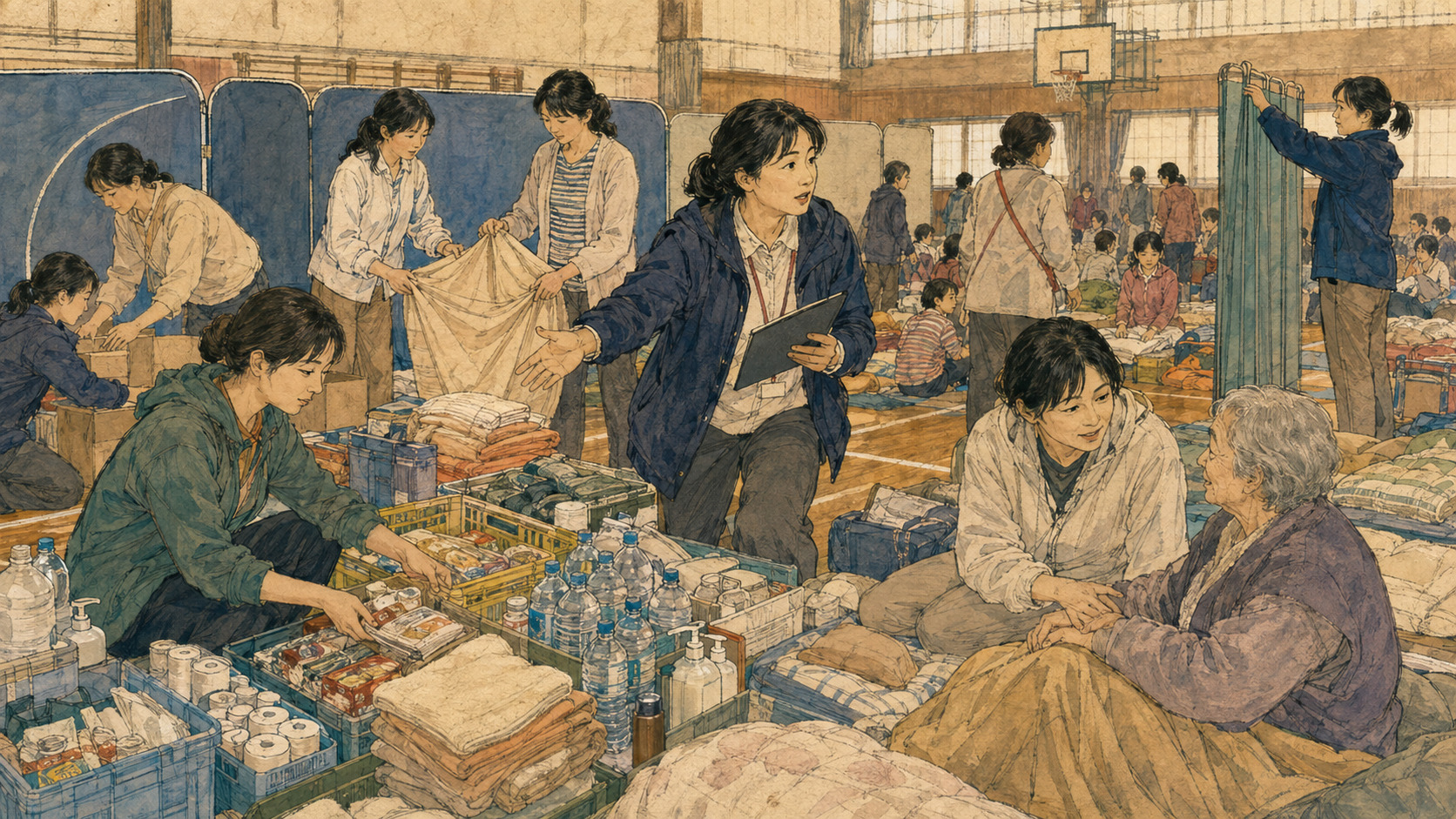
Illustration of women leaders organizing supplies, checking family needs and guiding residents in a Kagawa evacuation shelter
Women arrange supplies, ask about family circumstances and mark living zones. Shelter leadership is less about giving orders than carrying needs that are easy to miss into decisions that everyone can see. Illustration: Japan.co.jp, inspired by the dramatic Meiji-era art of Kobayashi Eitaku.
8 — LIFE & SOCIETY
LIFE & SOCIETY · DISASTER READINESS, SHELTERS & GENDER

From Helping in the Shelter to Deciding How It Runs: Kagawa Trains 20 Women for Disaster Leadership

Kagawa Prefecture’s first Women’s Regional Disaster Leader course is preparing 20 residents to make decisions in shelters, not simply help carry them out. Its August 20 session connects registration, floor plans, supplies, hygiene, consultation and safety. The deeper test is whether lessons from Kobe, Tohoku and Noto can be built into authority, relationships and routines before the next emergency.

The doors to a school gymnasium open. The first evacuees enter, and someone decides where the blankets will go. How many aisles must remain clear? Should a person in poor health stay near the entrance or in a quieter room? Where are the changing and nursing areas, the safe route to women’s toilets, the pet zone and the charging station? How will supplies reach people sheltering in cars or at home? Decisions begin before an official management committee exists. The first lines on the floor shape the next day of life.

On August 20, 2026, 20 women living in Kagawa Prefecture are studying “knowledge and skills for evacuation-shelter management” at Flatopia Kagawa, the prefectural gender-equality center in Takamatsu. The instructors are from Kagawa University’s Center for Education and Research in Crisis Management. It is the third meeting in a seven-part course that began in June—and the first time Kagawa has offered this particular Women’s Regional Disaster Leader certification.

The word “women” is not there because shelter work should be handed to women alone. Past Japanese disasters repeatedly produced a contradiction. Women cooked, cleaned, cared for children and older people, and learned intimate details about what residents needed. Yet the meetings that allocated space, ordered supplies and set rules could remain overwhelmingly male. Labor was visible; the information produced by that labor did not reliably reach authority. Kagawa’s course is an attempt to repair that broken connection before disaster.

An essential distinction: A “women’s perspective” does not mean that all women share one experience or opinion. Needs differ among pregnant people, parents of infants, women living alone, older and disabled residents, foreign nationals, sexual and gender minorities, and people providing care. Increasing women’s representation is a starting point. It becomes operational capacity only when a shelter can safely collect diverse experiences and translate them into decisions.

Seven meetings teach a method for judgment, not a set of perfect answers

The first session, held June 16, covered preparation for and response to disasters with Kagawa’s disaster-prevention training supervisor. The second, on July 23, brought participants to the Japan Ground Self-Defense Force’s Zentsuji Camp to observe the Nankai Rescue command-post exercise and speak with female SDF personnel. The third moves inside shelter operations. Later meetings address gender, the responsibilities and limits of support workers, decisions that do not divide neatly into right and wrong, health during shelter life, and final reflection.

SessionSubjectLeadership capacity
1 · June 16Preparing for and responding to disasterUnderstand hazards and set initial priorities
2 · July 23Nankai Trough response exercise; discussion with female SDF membersObserve command, information flow and cooperation across organizations
3 · August 20Knowledge and skills for shelter managementConnect registration, zoning, hygiene, supplies and consultation as one system
4 · October 7Disaster readiness through a gender lens; developing people and the mindset of a supporterRecognize hidden needs and the limits of support workers themselves
5 · November 28The Crossroad disaster decision gameExplain assumptions and hear dissent where no option is cost-free
6 · December 12Public lecture on health during shelter lifeTreat living conditions as prevention of secondary illness and death
7 · January 29, 2027Reflection and certificationTurn lessons into action in a participant’s own community

Participants who complete all sessions are to receive a Women’s Regional Disaster Leader certificate from the governor. Recruitment was directed at women who live in the prefecture, could attend the full sequence, and already held a disaster-related qualification or had experience in disaster readiness or response. This is therefore not a basic public lecture starting at zero. It is designed to connect knowledge and motivation already present in communities to leadership in actual shelter operations.

Kagawa has also begun a separate six-part course for 23 female prefectural and municipal employees. That “shelter and evacuee support personnel” track covers basic disaster knowledge, living conditions and field visits, and will produce a compact disaster handbook. The two groups meet together in the fourth session. Training 20 community members and 23 public employees in the same year matters because neither administrators nor residents can operate a shelter alone.

20 womenParticipants in the first community-leader cohort
7 sessionsFrom June 2026 through January 2027
23 employeesWomen in the parallel prefectural and municipal course
About 276,000Immediate evacuees in Kagawa’s maximum-class Nankai Trough scenario

A shelter becomes a small municipality, not just a place to sleep

Until the day before an earthquake, a school gym is an educational facility. The next day it may be asked to serve simultaneously as housing, dining hall, clinic, information center, warehouse, consultation office and security base. Kagawa’s shelter-management guidance, revised in March 2026, treats a shelter not only as a building for people sleeping inside but as a support hub for those staying in damaged homes or vehicles too.

The prefecture divides operations into opening, life-protection, living-stabilization and closure phases. Structural safety and head counts dominate at first. Over time, priorities shift toward chronic disease, infection, inactivity, mental health, bathing, employment and housing recovery. A leader cannot read one checklist with the same emphasis from beginning to end. The clock changes the order of work.

Management itself is divided into functions such as general coordination, information, food, goods, health and sanitation, public communication and security. The leader’s task is not to do all of them. It is to establish who decides, what is recorded and how the next shift receives both the formal log and the small observations that have not yet become an incident. Kagawa’s guidance calls for participation by both women and men in shelter committees because more people at the table create more routes through which essential information can enter.

A shelter leader is not the person with the loudest voice. It is the person who can translate a quiet concern into the allocation of space, goods, staff and time.

From 1995 to 2011: how ordinary life moved to the center of disaster policy

The 1995 Great Hanshin-Awaji Earthquake forced Japan to confront rescue, fire, displacement and the power of volunteers after an urban earthquake. It also exposed what happens to privacy, toilets, care and gender roles during long periods of collective living. Experience from Kobe and later disasters, including the Niigata Chuetsu Earthquake, helped move women’s representation in disaster decision-making and differences in need into Japan’s second Basic Plan for Gender Equality in 2005.

The Great East Japan Earthquake in 2011 made the gap impossible to treat as a peripheral issue. The Reconstruction Agency’s lessons portal notes that roughly 97% of neighborhood-association heads in the three hardest-hit prefectures were men. Those heads often played central roles in shelters. Some sites therefore lacked awareness of the needs of women and families with children. In a Miyagi shelter where women actively joined management, however, women-only toilets, a children’s play area and a protected place for women to dry laundry were created. At Big Palette Fukushima, the prefecture’s largest shelter, a women-only space was staffed with help from the prefectural gender-equality center and local women’s organizations.

The lesson is not that the presence of any woman automatically creates a good shelter. A difference appears when residents have someone they can approach, when that person has authority to change an order or floor plan, and when a committee accepts the information. In 2013 the government produced guidance on disaster and reconstruction through a gender lens. Its ideas entered the national shelter-management guidance of 2016 and local manuals. A more operational set of gender and disaster guidelines, with checklists, followed in 2020.

1995 The Great Hanshin-Awaji Earthquake exposes problems of collective living, privacy, care and gender roles in an urban disaster.

2005 The second Basic Plan for Gender Equality treats women’s participation and different needs in disasters as policy concerns.

2011 The Great East Japan Earthquake documents both deficits in male-dominated management and concrete improvements where women participate.

2013–20 Government guidelines, the shelter-management framework and the 2020 gender-and-disaster guidance codify those lessons.

2015 The Sendai Framework places women’s participation and leadership within the global principles of disaster-risk reduction.

2024 The Noto Peninsula Earthquake shows productive coordination among diverse actors, but also a renewed increase in women’s burden.

2026 Kagawa begins parallel leadership tracks for women in communities and in local government.

Representation can reach all the way into a warehouse inventory

Representation should be tested in material outcomes, not only in principle. A Cabinet Office follow-up covering local governments in 2023 found that jurisdictions with higher proportions of women in disaster-management departments and disaster councils also tended to stock higher shares of women’s and infant goods. The result is an association, not proof that adding one female member automatically fills a warehouse. It does, however, show that who is in a position to ask a question and which items enter the inventory are not unrelated.

Kagawa’s own 2024 fiscal-year report put women at 21% of the prefectural disaster council. That was up from 15% in fiscal 2020, but below the prefecture’s 30% target for fiscal 2025. The number of women certified as bōsaishi, or disaster-prevention specialists, had reached 1,024—well above a target of 860. Kagawa has a growing pool of trained women. The next barrier is whether those women enter disaster headquarters and shelter committees in positions where their information can change a decision.

Municipal representation varies. A Cabinet Office visualization based generally on the end of 2024 put women at 41.4% of Marugame’s disaster council and 31.3% of Mitoyo’s, compared with 13.7% in Takamatsu and 4.2% in Zentsuji. The denominators and institutional structures differ, so this is not a league table of total preparedness. It does show that routes into disaster decision-making are very different within one small prefecture. Where the 20 new certificate holders are placed may matter more than the existence of the certificate itself.

A toilet is health and safety infrastructure, not an amenity

If a shelter toilet is far away, dark, dirty or surrounded by a long queue, some residents drink less to avoid using it. An older or disabled person may reduce movement and food. Dehydration, constipation, urinary problems and physical decline can follow. The number of women’s toilets, lighting at night, lines of sight, separate and accessible routes, multipurpose facilities, cleaning and waste disposal are therefore part of disease and crime prevention.

Menstrual supplies illustrate why “in stock” is not enough. A shelter needs different absorbencies, underwear, disposal bags and washing arrangements. If a resident must ask a male attendant for each item at a public desk, supplies may remain untouched. Female staff, discreet self-access, opaque bags and a working replenishment record together make an item usable. Infants require safe choices among liquid and powdered formula, clean feeding utensils, baby food and several diaper sizes. Assuming that every mother can breastfeed is unsafe; distributing formula without regard to hygiene or individual feeding is unsafe too.

DecisionNeeds easily missedManagement mechanism
Living zonesPregnancy, infants, night workers, infection, dementia and sensory sensitivityAsk at entry and keep quiet, family and special-care zones adjustable
Toilets and bathingWomen, older and disabled people, attendants, sexual and gender minoritiesLighted routes, women’s/men’s and multipurpose options, locks, cleaning and user inspection
DistributionMenstruation, infant feeding, care, allergy, religious diets and people sheltering elsewhereA discreet request channel, itemized inventory, quantities and recipient records
ProtectionPeople escaping domestic violence or stalking, children and those living aloneConfidential registration, team patrols, consultation routes and police or specialist links
WorkCooking, cleaning and care fixed to one gender or a few reliable peoplePublic rotations, rest, and assignment based on skills, condition and consent

Protection requires more than a night patrol. Kagawa’s current guidance warns that public registration can expose the location of a person fleeing domestic violence, stalking or child abuse. It advises staff not to answer an identity inquiry immediately and to use a system in which the resident chooses whether to make contact. The same guidance anticipates sexual crime, calls for patrols by more than one person and recommends police visits. Registration, lighting, locks, consultation and security may look like separate tasks. They form one protective chain.

Fixing women to the kitchen loses both people and information

Cooking and cleaning are necessary in a shared shelter. The problem is the assumption that women will do them, while men attend meetings, move goods and patrol. Women can become trapped in long hours of care and miss the meetings where their observations matter. Men can lose direct contact with changing conditions among children, older people and sanitation. A gendered work chart becomes an information barrier.

The solution is not to remove women from cooking. It is to make all work visible, assign it by skill, health, preference and time rather than gender, and build rotation and rest. A food-team member’s discovery of an allergy, a cleaning team’s observation of diarrhea and a child-space volunteer’s report of fear need a scheduled route into the management meeting. If operational work and decision-making can exchange people and information, “support role” no longer becomes a dead end.

Five conditions that keep female leadership from existing only on paper
  • Assign roles before disaster: Name primary and alternate shelter leaders and team leads, with more than one woman in the structure.
  • Provide access: Let those leaders use facility plans, inventories, contact networks, radios and registration forms during drills.
  • Plan for nights and weekends: Create alternates because employment, injury or family duties may keep any one person away.
  • Support care responsibilities: Child care, substitute elder care and transport keep the private cost of training from falling on one participant.
  • Build legitimacy: Tell neighborhood groups, schools, fire services, welfare providers and police who the trained leaders are and what authority they hold.

Crossroad: distribute 2,000 meals among 3,000 people?

The fifth session uses Crossroad, a disaster-decision game developed from interviews with Kobe City employees who responded to the 1995 earthquake. Its first Kobe and general editions were completed in 2004. A participant must answer yes or no to a dilemma such as whether to distribute 2,000 emergency meals in a shelter holding 3,000 people. The game does not reveal a correct answer. Participants explain their assumptions, values and acceptable losses.

Real disaster decisions rarely arrive with every condition supplied. Will another truck come in two hours or two days? Are infants or people with diabetes present? Can portions be divided safely? Have people outside the building been counted? The value of the exercise is not becoming good at choosing one side. It is learning to name missing information, hear a reason different from one’s own, explain why a temporary decision was taken and specify when it will be reviewed.

A women-only cohort is not a room of one opinion. Age, occupation, health, income and family structure produce different judgments among women too. That is why the sequence—joint work with female public employees in session four, then structured disagreement in session five—has practical logic. A leader is not someone who makes everyone agree. A leader lays out the conditions, states what will happen now and identifies the point at which the decision can change.

A scenario of 276,000 evacuees gives Kagawa the scale of the problem

Kagawa’s 2025 damage estimates say a maximum-class Nankai Trough earthquake could produce about 276,000 evacuees immediately after the event, roughly 7,800 deaths and about 39,000 destroyed or burned buildings under the most severe combinations of assumptions. This is a planning scenario, not a prophecy. The prefecture released it alongside estimates showing that seismic upgrades and immediate evacuation could sharply reduce losses.

If a large share of the prefecture’s population is displaced, 20 trained women cannot directly manage every shelter. Their value cannot be a story about 20 heroes. It must be multiplication: each person joins a local operating team, teaches others, connects to administrators, and spreads common forms and decision habits. The objective is to distribute a method of judgment, not concentrate prestige.

Earthquakes are not the only use. Typhoons, heavy rain, storm surge, prolonged outages, fires and other emergencies also open shelters. The number of residents and length of stay may differ, but health screening at entry, confidential registration, toilet management, information and the danger of fixing care work by gender remain. Every small shelter opening can be documented as a real operation and a rehearsal for the next one.

Noto showed that a rule on paper does not always reach the gym floor

For the 2024 Noto Peninsula Earthquake, the Cabinet Office’s Gender Equality Bureau surveyed four affected prefectures and 47 municipalities, supporting local governments, 357 gender-equality centers and roughly 200 private organizations. The investigation found early use of broad evacuation and partnerships among local governments, specialists, civil groups and women disaster leaders. It also found familiar problems, including increased burden on women in shelters.

That gap explains why guidelines alone are insufficient. Partitions in a warehouse are useless if no one knows where the key is. A confidential box on a form is dangerous if registration staff do not understand it. A certified female leader cannot enter a meeting if the facility manager and neighborhood chair have never heard of her role. Relationships and drills cover the final meters between a policy, a stockpile and a resident.

The reverse is also true: a network built in ordinary time does not have to be invented during an emergency. The Noto research recorded cases in which women’s disaster-leadership groups and private organizations worked with government. Kagawa’s course brings together residents, female officials, a university, the Red Cross, the SDF and women’s organizations. Knowing who can be asked to do what is itself a kind of stockpile.

What should be measured after the certificate?

The number who finish all seven sessions cannot by itself establish success. The meaningful questions are whether certificate holders joined local shelter committees; whether they drilled as primary or alternate leaders; whether inventories of women’s, infant and care supplies changed; whether staff practiced protecting a domestic-violence survivor’s registration; and whether someone walked the nighttime route to every toilet.

WhenEvidence to examineHow to correct failure
Course completionSeven sessions, decision exercises and a local action planOffer follow-up learning and create a network among certificate holders
Routine drillWomen among primary and alternate leaders, work rotation, facility and inventory accessWrite authority, keys, contacts and alternates into the local manual
Shelter operationComposition of meetings; speed of fixing consultation, toilet, safety and supply problemsConduct short daily listening rounds and revise layouts at management meetings
After closureIllness, accidents, violence, shortages, staff exhaustion and support beyond the buildingReview with affected residents and carry findings into the next budget

One more safeguard is essential: do not consume the 20 people being trained. A disaster supporter is often a disaster survivor too. She may be searching for family, have lost a home or be unable to sleep. Without shifts, rest, psychological support and the right to step down, an old expectation of the endlessly self-sacrificing woman can be reproduced under the new title of leader. Developing people does not mean teaching them to tolerate unlimited strain.

The course’s current limit: Kagawa’s announcements do not yet establish which shelters the graduates will serve, what formal authority they will hold, or how their activity will be tracked after certification. Recognition is an important entrance. It becomes command capacity only when connected to local disaster plans, shelter committees, drills, budgets, keys, communications and registration systems.

Do not build a shelter only around the needs that are easy to see

Requests from people comfortable speaking in public are easy to collect. Circumstances remain hidden among those who cannot speak, those for whom disclosure increases danger, and those who never reach the gym because they are in a car or damaged home. Broadcasting “please tell us if you have a problem” will systematically miss some of the most important information.

A better shelter asks at registration, makes two-person listening rounds, offers an anonymous request channel, connects residents with female advisers and health or welfare professionals, posts in multiple languages and plain Japanese, and gives children a different way to communicate. Outreach to people sheltering elsewhere may require neighborhood groups, welfare commissioners, visiting nurses and care providers. Multiple routes for information are how gender equality becomes an operational practice.

Over more than half a year, Kagawa’s 20 participants are not learning to be fearless. They are learning to ask whose disadvantage is still invisible, explain a provisional decision under scarcity, and change it when new facts arrive. When someone marks an aisle on a gym floor, the line is not only a route. It determines who can reach a toilet, who can be found by the health team and whose sleep will be interrupted all night.

A helper performs the work assigned. A decision-maker can redesign the work, carry another voice into the meeting and change the allocation of resources. The success of Kagawa’s course will not be visible in the certificates handed out in January 2027. It will be visible when the next shelter opens: who draws the first line, and who has the authority to redraw it.

Course and preparedness at a glance

ProgramFiscal 2026 Women’s Regional Disaster Leader Training Course, Kagawa’s first edition
Participants20 women living in Kagawa with disaster knowledge, qualifications or relevant experience and motivation
ScheduleSeven sessions from June 16, 2026 through January 29, 2027
August 20Session three, “Knowledge and skills for evacuation-shelter management,” taught by Kagawa University’s crisis-management center
Later sessionsGender, supporter development and mindset, Crossroad, shelter health and reflection
CompletionA governor-issued Women’s Regional Disaster Leader certificate for participants who complete the sequence
Parallel programSix sessions for 23 female prefectural and municipal employees; the fourth session is joint training
Current indicatorsWomen were 21% of Kagawa’s prefectural disaster council in fiscal 2024; the prefecture counted 1,024 female disaster-prevention specialists
Maximum scenarioAbout 276,000 immediate evacuees in the maximum-class Nankai Trough estimate; a severe planning scenario, not a prediction
Next testPlacement, authority, drills, sustained support and evaluation in each community
Reporting materials and sources

Editor’s note: Course enrollment, dates, subjects, instructors and certification are drawn from Kagawa announcements published from June through August 2026. As of August 20, the final four sessions are scheduled, not completed. The 21% disaster-council share and 1,024 female disaster-prevention specialists are fiscal 2024 results. Municipal percentages generally describe December 31, 2024 and are not a ranking of total disaster readiness. The roughly 276,000 evacuees come from Kagawa’s maximum-class Nankai Trough damage scenario, not an event forecast. The national finding on representation and stockpiles is reported as an association, not a simple causal claim. The exchange-rate display is an editorially supplied value.

From Helping in the Shelter to Deciding How It Runs: Kagawa Trains 20 Women for Disaster Leadership | Japan.co.jp
Thursday, August 20, 2026 · Morning Edition日本語 · Send a tip
Japan.co.jp
Japan, clearly explained
Thursday, August 20, 2026Japan Standard Time · Morning Edition
US Dollar = 159.49 Japanese YenLast updated · August 19 at 10:18 AM JST
Illustration of women leaders organizing supplies, checking family needs and guiding residents in a Kagawa evacuation shelter
Women arrange supplies, ask about family circumstances and mark living zones. Shelter leadership is less about giving orders than carrying needs that are easy to miss into decisions that everyone can see. Illustration: Japan.co.jp, inspired by the dramatic Meiji-era art of Kobayashi Eitaku.
8 — LIFE & SOCIETY
LIFE & SOCIETY · DISASTER READINESS, SHELTERS & GENDER

From Helping in the Shelter to Deciding How It Runs: Kagawa Trains 20 Women for Disaster Leadership

Kagawa Prefecture’s first Women’s Regional Disaster Leader course is preparing 20 residents to make decisions in shelters, not simply help carry them out. Its August 20 session connects registration, floor plans, supplies, hygiene, consultation and safety. The deeper test is whether lessons from Kobe, Tohoku and Noto can be built into authority, relationships and routines before the next emergency.

The doors to a school gymnasium open. The first evacuees enter, and someone decides where the blankets will go. How many aisles must remain clear? Should a person in poor health stay near the entrance or in a quieter room? Where are the changing and nursing areas, the safe route to women’s toilets, the pet zone and the charging station? How will supplies reach people sheltering in cars or at home? Decisions begin before an official management committee exists. The first lines on the floor shape the next day of life.

On August 20, 2026, 20 women living in Kagawa Prefecture are studying “knowledge and skills for evacuation-shelter management” at Flatopia Kagawa, the prefectural gender-equality center in Takamatsu. The instructors are from Kagawa University’s Center for Education and Research in Crisis Management. It is the third meeting in a seven-part course that began in June—and the first time Kagawa has offered this particular Women’s Regional Disaster Leader certification.

The word “women” is not there because shelter work should be handed to women alone. Past Japanese disasters repeatedly produced a contradiction. Women cooked, cleaned, cared for children and older people, and learned intimate details about what residents needed. Yet the meetings that allocated space, ordered supplies and set rules could remain overwhelmingly male. Labor was visible; the information produced by that labor did not reliably reach authority. Kagawa’s course is an attempt to repair that broken connection before disaster.

An essential distinction: A “women’s perspective” does not mean that all women share one experience or opinion. Needs differ among pregnant people, parents of infants, women living alone, older and disabled residents, foreign nationals, sexual and gender minorities, and people providing care. Increasing women’s representation is a starting point. It becomes operational capacity only when a shelter can safely collect diverse experiences and translate them into decisions.

Seven meetings teach a method for judgment, not a set of perfect answers

The first session, held June 16, covered preparation for and response to disasters with Kagawa’s disaster-prevention training supervisor. The second, on July 23, brought participants to the Japan Ground Self-Defense Force’s Zentsuji Camp to observe the Nankai Rescue command-post exercise and speak with female SDF personnel. The third moves inside shelter operations. Later meetings address gender, the responsibilities and limits of support workers, decisions that do not divide neatly into right and wrong, health during shelter life, and final reflection.

SessionSubjectLeadership capacity
1 · June 16Preparing for and responding to disasterUnderstand hazards and set initial priorities
2 · July 23Nankai Trough response exercise; discussion with female SDF membersObserve command, information flow and cooperation across organizations
3 · August 20Knowledge and skills for shelter managementConnect registration, zoning, hygiene, supplies and consultation as one system
4 · October 7Disaster readiness through a gender lens; developing people and the mindset of a supporterRecognize hidden needs and the limits of support workers themselves
5 · November 28The Crossroad disaster decision gameExplain assumptions and hear dissent where no option is cost-free
6 · December 12Public lecture on health during shelter lifeTreat living conditions as prevention of secondary illness and death
7 · January 29, 2027Reflection and certificationTurn lessons into action in a participant’s own community

Participants who complete all sessions are to receive a Women’s Regional Disaster Leader certificate from the governor. Recruitment was directed at women who live in the prefecture, could attend the full sequence, and already held a disaster-related qualification or had experience in disaster readiness or response. This is therefore not a basic public lecture starting at zero. It is designed to connect knowledge and motivation already present in communities to leadership in actual shelter operations.

Kagawa has also begun a separate six-part course for 23 female prefectural and municipal employees. That “shelter and evacuee support personnel” track covers basic disaster knowledge, living conditions and field visits, and will produce a compact disaster handbook. The two groups meet together in the fourth session. Training 20 community members and 23 public employees in the same year matters because neither administrators nor residents can operate a shelter alone.

20 womenParticipants in the first community-leader cohort
7 sessionsFrom June 2026 through January 2027
23 employeesWomen in the parallel prefectural and municipal course
About 276,000Immediate evacuees in Kagawa’s maximum-class Nankai Trough scenario

A shelter becomes a small municipality, not just a place to sleep

Until the day before an earthquake, a school gym is an educational facility. The next day it may be asked to serve simultaneously as housing, dining hall, clinic, information center, warehouse, consultation office and security base. Kagawa’s shelter-management guidance, revised in March 2026, treats a shelter not only as a building for people sleeping inside but as a support hub for those staying in damaged homes or vehicles too.

The prefecture divides operations into opening, life-protection, living-stabilization and closure phases. Structural safety and head counts dominate at first. Over time, priorities shift toward chronic disease, infection, inactivity, mental health, bathing, employment and housing recovery. A leader cannot read one checklist with the same emphasis from beginning to end. The clock changes the order of work.

Management itself is divided into functions such as general coordination, information, food, goods, health and sanitation, public communication and security. The leader’s task is not to do all of them. It is to establish who decides, what is recorded and how the next shift receives both the formal log and the small observations that have not yet become an incident. Kagawa’s guidance calls for participation by both women and men in shelter committees because more people at the table create more routes through which essential information can enter.

A shelter leader is not the person with the loudest voice. It is the person who can translate a quiet concern into the allocation of space, goods, staff and time.

From 1995 to 2011: how ordinary life moved to the center of disaster policy

The 1995 Great Hanshin-Awaji Earthquake forced Japan to confront rescue, fire, displacement and the power of volunteers after an urban earthquake. It also exposed what happens to privacy, toilets, care and gender roles during long periods of collective living. Experience from Kobe and later disasters, including the Niigata Chuetsu Earthquake, helped move women’s representation in disaster decision-making and differences in need into Japan’s second Basic Plan for Gender Equality in 2005.

The Great East Japan Earthquake in 2011 made the gap impossible to treat as a peripheral issue. The Reconstruction Agency’s lessons portal notes that roughly 97% of neighborhood-association heads in the three hardest-hit prefectures were men. Those heads often played central roles in shelters. Some sites therefore lacked awareness of the needs of women and families with children. In a Miyagi shelter where women actively joined management, however, women-only toilets, a children’s play area and a protected place for women to dry laundry were created. At Big Palette Fukushima, the prefecture’s largest shelter, a women-only space was staffed with help from the prefectural gender-equality center and local women’s organizations.

The lesson is not that the presence of any woman automatically creates a good shelter. A difference appears when residents have someone they can approach, when that person has authority to change an order or floor plan, and when a committee accepts the information. In 2013 the government produced guidance on disaster and reconstruction through a gender lens. Its ideas entered the national shelter-management guidance of 2016 and local manuals. A more operational set of gender and disaster guidelines, with checklists, followed in 2020.

1995 The Great Hanshin-Awaji Earthquake exposes problems of collective living, privacy, care and gender roles in an urban disaster.

2005 The second Basic Plan for Gender Equality treats women’s participation and different needs in disasters as policy concerns.

2011 The Great East Japan Earthquake documents both deficits in male-dominated management and concrete improvements where women participate.

2013–20 Government guidelines, the shelter-management framework and the 2020 gender-and-disaster guidance codify those lessons.

2015 The Sendai Framework places women’s participation and leadership within the global principles of disaster-risk reduction.

2024 The Noto Peninsula Earthquake shows productive coordination among diverse actors, but also a renewed increase in women’s burden.

2026 Kagawa begins parallel leadership tracks for women in communities and in local government.

Representation can reach all the way into a warehouse inventory

Representation should be tested in material outcomes, not only in principle. A Cabinet Office follow-up covering local governments in 2023 found that jurisdictions with higher proportions of women in disaster-management departments and disaster councils also tended to stock higher shares of women’s and infant goods. The result is an association, not proof that adding one female member automatically fills a warehouse. It does, however, show that who is in a position to ask a question and which items enter the inventory are not unrelated.

Kagawa’s own 2024 fiscal-year report put women at 21% of the prefectural disaster council. That was up from 15% in fiscal 2020, but below the prefecture’s 30% target for fiscal 2025. The number of women certified as bōsaishi, or disaster-prevention specialists, had reached 1,024—well above a target of 860. Kagawa has a growing pool of trained women. The next barrier is whether those women enter disaster headquarters and shelter committees in positions where their information can change a decision.

Municipal representation varies. A Cabinet Office visualization based generally on the end of 2024 put women at 41.4% of Marugame’s disaster council and 31.3% of Mitoyo’s, compared with 13.7% in Takamatsu and 4.2% in Zentsuji. The denominators and institutional structures differ, so this is not a league table of total preparedness. It does show that routes into disaster decision-making are very different within one small prefecture. Where the 20 new certificate holders are placed may matter more than the existence of the certificate itself.

A toilet is health and safety infrastructure, not an amenity

If a shelter toilet is far away, dark, dirty or surrounded by a long queue, some residents drink less to avoid using it. An older or disabled person may reduce movement and food. Dehydration, constipation, urinary problems and physical decline can follow. The number of women’s toilets, lighting at night, lines of sight, separate and accessible routes, multipurpose facilities, cleaning and waste disposal are therefore part of disease and crime prevention.

Menstrual supplies illustrate why “in stock” is not enough. A shelter needs different absorbencies, underwear, disposal bags and washing arrangements. If a resident must ask a male attendant for each item at a public desk, supplies may remain untouched. Female staff, discreet self-access, opaque bags and a working replenishment record together make an item usable. Infants require safe choices among liquid and powdered formula, clean feeding utensils, baby food and several diaper sizes. Assuming that every mother can breastfeed is unsafe; distributing formula without regard to hygiene or individual feeding is unsafe too.

DecisionNeeds easily missedManagement mechanism
Living zonesPregnancy, infants, night workers, infection, dementia and sensory sensitivityAsk at entry and keep quiet, family and special-care zones adjustable
Toilets and bathingWomen, older and disabled people, attendants, sexual and gender minoritiesLighted routes, women’s/men’s and multipurpose options, locks, cleaning and user inspection
DistributionMenstruation, infant feeding, care, allergy, religious diets and people sheltering elsewhereA discreet request channel, itemized inventory, quantities and recipient records
ProtectionPeople escaping domestic violence or stalking, children and those living aloneConfidential registration, team patrols, consultation routes and police or specialist links
WorkCooking, cleaning and care fixed to one gender or a few reliable peoplePublic rotations, rest, and assignment based on skills, condition and consent

Protection requires more than a night patrol. Kagawa’s current guidance warns that public registration can expose the location of a person fleeing domestic violence, stalking or child abuse. It advises staff not to answer an identity inquiry immediately and to use a system in which the resident chooses whether to make contact. The same guidance anticipates sexual crime, calls for patrols by more than one person and recommends police visits. Registration, lighting, locks, consultation and security may look like separate tasks. They form one protective chain.

Fixing women to the kitchen loses both people and information

Cooking and cleaning are necessary in a shared shelter. The problem is the assumption that women will do them, while men attend meetings, move goods and patrol. Women can become trapped in long hours of care and miss the meetings where their observations matter. Men can lose direct contact with changing conditions among children, older people and sanitation. A gendered work chart becomes an information barrier.

The solution is not to remove women from cooking. It is to make all work visible, assign it by skill, health, preference and time rather than gender, and build rotation and rest. A food-team member’s discovery of an allergy, a cleaning team’s observation of diarrhea and a child-space volunteer’s report of fear need a scheduled route into the management meeting. If operational work and decision-making can exchange people and information, “support role” no longer becomes a dead end.

Five conditions that keep female leadership from existing only on paper
  • Assign roles before disaster: Name primary and alternate shelter leaders and team leads, with more than one woman in the structure.
  • Provide access: Let those leaders use facility plans, inventories, contact networks, radios and registration forms during drills.
  • Plan for nights and weekends: Create alternates because employment, injury or family duties may keep any one person away.
  • Support care responsibilities: Child care, substitute elder care and transport keep the private cost of training from falling on one participant.
  • Build legitimacy: Tell neighborhood groups, schools, fire services, welfare providers and police who the trained leaders are and what authority they hold.

Crossroad: distribute 2,000 meals among 3,000 people?

The fifth session uses Crossroad, a disaster-decision game developed from interviews with Kobe City employees who responded to the 1995 earthquake. Its first Kobe and general editions were completed in 2004. A participant must answer yes or no to a dilemma such as whether to distribute 2,000 emergency meals in a shelter holding 3,000 people. The game does not reveal a correct answer. Participants explain their assumptions, values and acceptable losses.

Real disaster decisions rarely arrive with every condition supplied. Will another truck come in two hours or two days? Are infants or people with diabetes present? Can portions be divided safely? Have people outside the building been counted? The value of the exercise is not becoming good at choosing one side. It is learning to name missing information, hear a reason different from one’s own, explain why a temporary decision was taken and specify when it will be reviewed.

A women-only cohort is not a room of one opinion. Age, occupation, health, income and family structure produce different judgments among women too. That is why the sequence—joint work with female public employees in session four, then structured disagreement in session five—has practical logic. A leader is not someone who makes everyone agree. A leader lays out the conditions, states what will happen now and identifies the point at which the decision can change.

A scenario of 276,000 evacuees gives Kagawa the scale of the problem

Kagawa’s 2025 damage estimates say a maximum-class Nankai Trough earthquake could produce about 276,000 evacuees immediately after the event, roughly 7,800 deaths and about 39,000 destroyed or burned buildings under the most severe combinations of assumptions. This is a planning scenario, not a prophecy. The prefecture released it alongside estimates showing that seismic upgrades and immediate evacuation could sharply reduce losses.

If a large share of the prefecture’s population is displaced, 20 trained women cannot directly manage every shelter. Their value cannot be a story about 20 heroes. It must be multiplication: each person joins a local operating team, teaches others, connects to administrators, and spreads common forms and decision habits. The objective is to distribute a method of judgment, not concentrate prestige.

Earthquakes are not the only use. Typhoons, heavy rain, storm surge, prolonged outages, fires and other emergencies also open shelters. The number of residents and length of stay may differ, but health screening at entry, confidential registration, toilet management, information and the danger of fixing care work by gender remain. Every small shelter opening can be documented as a real operation and a rehearsal for the next one.

Noto showed that a rule on paper does not always reach the gym floor

For the 2024 Noto Peninsula Earthquake, the Cabinet Office’s Gender Equality Bureau surveyed four affected prefectures and 47 municipalities, supporting local governments, 357 gender-equality centers and roughly 200 private organizations. The investigation found early use of broad evacuation and partnerships among local governments, specialists, civil groups and women disaster leaders. It also found familiar problems, including increased burden on women in shelters.

That gap explains why guidelines alone are insufficient. Partitions in a warehouse are useless if no one knows where the key is. A confidential box on a form is dangerous if registration staff do not understand it. A certified female leader cannot enter a meeting if the facility manager and neighborhood chair have never heard of her role. Relationships and drills cover the final meters between a policy, a stockpile and a resident.

The reverse is also true: a network built in ordinary time does not have to be invented during an emergency. The Noto research recorded cases in which women’s disaster-leadership groups and private organizations worked with government. Kagawa’s course brings together residents, female officials, a university, the Red Cross, the SDF and women’s organizations. Knowing who can be asked to do what is itself a kind of stockpile.

What should be measured after the certificate?

The number who finish all seven sessions cannot by itself establish success. The meaningful questions are whether certificate holders joined local shelter committees; whether they drilled as primary or alternate leaders; whether inventories of women’s, infant and care supplies changed; whether staff practiced protecting a domestic-violence survivor’s registration; and whether someone walked the nighttime route to every toilet.

WhenEvidence to examineHow to correct failure
Course completionSeven sessions, decision exercises and a local action planOffer follow-up learning and create a network among certificate holders
Routine drillWomen among primary and alternate leaders, work rotation, facility and inventory accessWrite authority, keys, contacts and alternates into the local manual
Shelter operationComposition of meetings; speed of fixing consultation, toilet, safety and supply problemsConduct short daily listening rounds and revise layouts at management meetings
After closureIllness, accidents, violence, shortages, staff exhaustion and support beyond the buildingReview with affected residents and carry findings into the next budget

One more safeguard is essential: do not consume the 20 people being trained. A disaster supporter is often a disaster survivor too. She may be searching for family, have lost a home or be unable to sleep. Without shifts, rest, psychological support and the right to step down, an old expectation of the endlessly self-sacrificing woman can be reproduced under the new title of leader. Developing people does not mean teaching them to tolerate unlimited strain.

The course’s current limit: Kagawa’s announcements do not yet establish which shelters the graduates will serve, what formal authority they will hold, or how their activity will be tracked after certification. Recognition is an important entrance. It becomes command capacity only when connected to local disaster plans, shelter committees, drills, budgets, keys, communications and registration systems.

Do not build a shelter only around the needs that are easy to see

Requests from people comfortable speaking in public are easy to collect. Circumstances remain hidden among those who cannot speak, those for whom disclosure increases danger, and those who never reach the gym because they are in a car or damaged home. Broadcasting “please tell us if you have a problem” will systematically miss some of the most important information.

A better shelter asks at registration, makes two-person listening rounds, offers an anonymous request channel, connects residents with female advisers and health or welfare professionals, posts in multiple languages and plain Japanese, and gives children a different way to communicate. Outreach to people sheltering elsewhere may require neighborhood groups, welfare commissioners, visiting nurses and care providers. Multiple routes for information are how gender equality becomes an operational practice.

Over more than half a year, Kagawa’s 20 participants are not learning to be fearless. They are learning to ask whose disadvantage is still invisible, explain a provisional decision under scarcity, and change it when new facts arrive. When someone marks an aisle on a gym floor, the line is not only a route. It determines who can reach a toilet, who can be found by the health team and whose sleep will be interrupted all night.

A helper performs the work assigned. A decision-maker can redesign the work, carry another voice into the meeting and change the allocation of resources. The success of Kagawa’s course will not be visible in the certificates handed out in January 2027. It will be visible when the next shelter opens: who draws the first line, and who has the authority to redraw it.

Course and preparedness at a glance

ProgramFiscal 2026 Women’s Regional Disaster Leader Training Course, Kagawa’s first edition
Participants20 women living in Kagawa with disaster knowledge, qualifications or relevant experience and motivation
ScheduleSeven sessions from June 16, 2026 through January 29, 2027
August 20Session three, “Knowledge and skills for evacuation-shelter management,” taught by Kagawa University’s crisis-management center
Later sessionsGender, supporter development and mindset, Crossroad, shelter health and reflection
CompletionA governor-issued Women’s Regional Disaster Leader certificate for participants who complete the sequence
Parallel programSix sessions for 23 female prefectural and municipal employees; the fourth session is joint training
Current indicatorsWomen were 21% of Kagawa’s prefectural disaster council in fiscal 2024; the prefecture counted 1,024 female disaster-prevention specialists
Maximum scenarioAbout 276,000 immediate evacuees in the maximum-class Nankai Trough estimate; a severe planning scenario, not a prediction
Next testPlacement, authority, drills, sustained support and evaluation in each community
Reporting materials and sources

Editor’s note: Course enrollment, dates, subjects, instructors and certification are drawn from Kagawa announcements published from June through August 2026. As of August 20, the final four sessions are scheduled, not completed. The 21% disaster-council share and 1,024 female disaster-prevention specialists are fiscal 2024 results. Municipal percentages generally describe December 31, 2024 and are not a ranking of total disaster readiness. The roughly 276,000 evacuees come from Kagawa’s maximum-class Nankai Trough damage scenario, not an event forecast. The national finding on representation and stockpiles is reported as an association, not a simple causal claim. The exchange-rate display is an editorially supplied value.