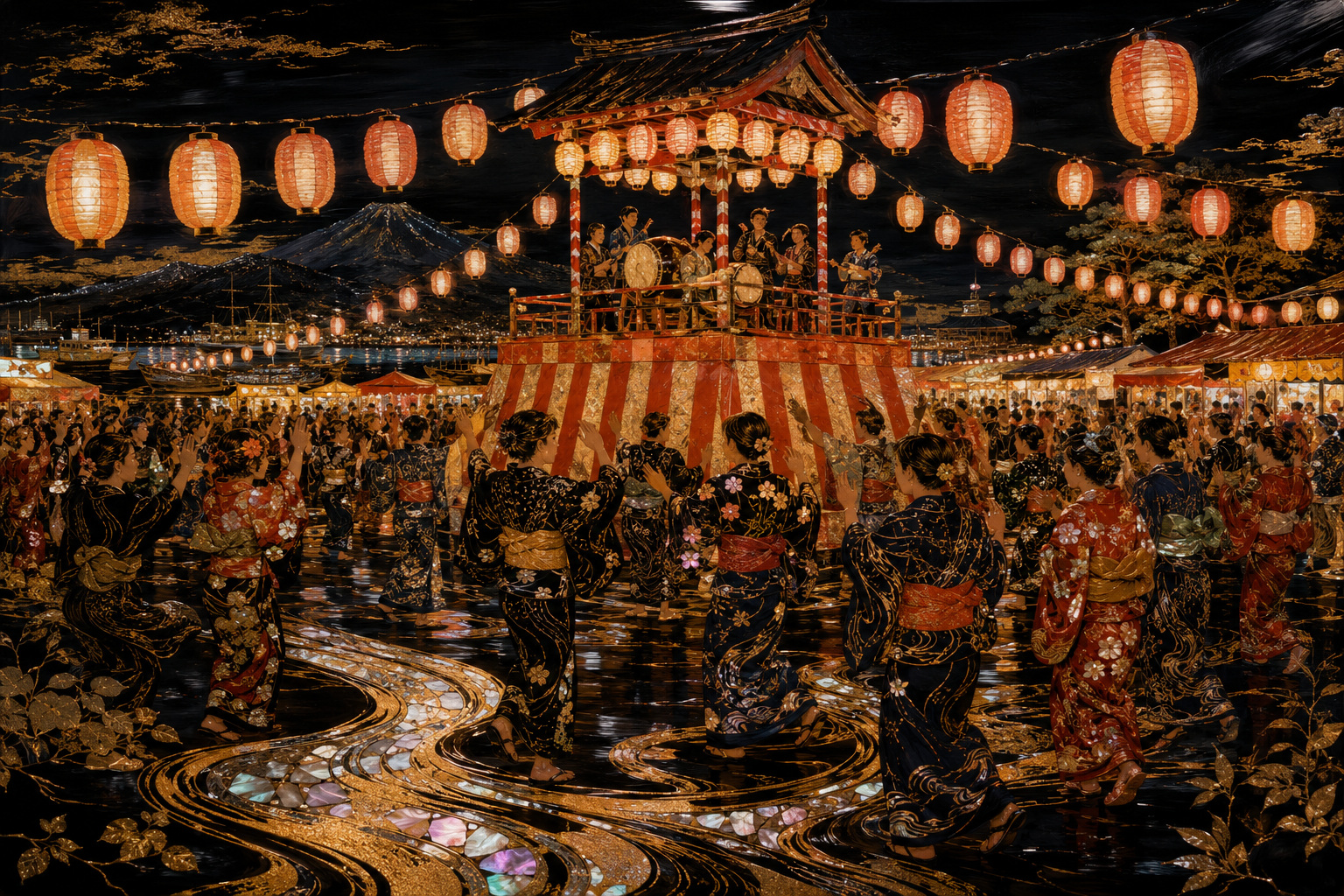
A Bon-dance circle has no front. It needs no privileged seat and no stage reserved for technically perfect dancers. A child from the neighborhood, a young person home for summer and a traveler who knows nobody can watch the hands beside them, join one beat late, and still be accepted by the ring.
A young Shizuoka company wants to restart that old social machine with the sound of 2026. On Saturday and Sunday, August 22 and 23, nonii Inc. plans to hold the first BON BON BON 2026 in Kiyomida Park, Yaizu. From 4 to 9 p.m., it will combine a DJ booth integrated into a yagura tower, live music, comedy, festival games, food and drink, lanterns and a final-night production called “OKURIBI.” The company contracts “music festival and Bon-dance party” into a new word: bonpa.
The bill includes Minyo Crusaders, known for rebuilding Japanese folk song through cumbia and other global dance music; pop band D.W. Nichols; reggae artist PAPA U-Gee; Blue Vintage; and comedy duo Bambino. Shamisen, minyo, reggae, pop and jokes will occupy the same evening, with K-MIX broadcaster Masazumi Takahashi as master of ceremonies.
This is not an inherited neighborhood Bon dance
A distinction matters. BON BON BON is not a Yaizu-specific dance handed down intact by generations of a preservation society. Nor is it the small, free summer gathering financed by a residents’ association. It is a ticketed event produced by a private company, with the structure of a music and food festival. Standard early admission is ¥1,500 and same-day admission ¥2,500.
That is precisely why the experiment deserves attention. Across Japan, local events contend with aging organizers, weak finances, worn sound equipment, volunteer fatigue and noise concerns. nonii is applying the methods of a commercial event producer to find a new audience and revenue. The tension should remain visible: a community ritual open to the passerby versus a cultural product behind a ticket. The festival’s real test is whether a paid gate can still create a public circle.
The announcement promises Yaizu-resident and student discounts, free-admission conditions and package tickets. Kiyomida Park is about a 20-minute walk from Yaizu Station, and a shuttle bus is planned. Once admission is charged, accessibility for first-timers, families, older people, disabled visitors and people without cars matters as much as the stage design.
From a night for returning ancestors to a place for the living
Bon has no single, tidy origin. Japan’s government describes it as a fusion of older beliefs in ancestral spirits with the Buddhist Urabon-e observance. The dead return to the world for a set period; families welcome, feed and remember them, then send them away again. Chanting, song, dance and shared food accumulated around that sacred interval.
The dancing nembutsu associated with the Heian-period monk Kuya and the Kamakura-period itinerant preacher Ippen is often presented as a distant source. The name of the Buddha was given melody and physical rhythm; groups chanted, stamped and danced. But today’s many Bon dances do not descend in a straight line from one religious performance. Local spirit-sending, prayers for harvest or rain, courtship gatherings and entertainment intermingled over centuries.
The Agency for Cultural Affairs defines furyu-odori as folk performing arts in which people dance to song, flute, drum and gong, often with eye-catching costume and objects. They carry wishes for protection from disaster, rest for the dead, harvest, rain and peaceful life. In 2022, UNESCO inscribed a group of 41 Japanese furyu-odori on its Representative List of the Intangible Cultural Heritage of Humanity, including traditions in which participation and transmission remain essential to local vitality.
Religious purpose gradually overlapped with social purpose. On summer nights, people who worked separately gathered; young adults met; children learned adult movement; and returnees checked that they still belonged. Bon dance sent the dead away while fastening the living back to the town.
The circle is one of Japan’s oldest participatory media
The form succeeds because it values imperfect participation over expert spectatorship. Movements repeat; there is no first or last dancer. The yagura is a broadcasting tower, carrying sound across the grounds, while the circle is an interface that converts audience into performer. No manual is necessary: learning happens by looking sideways.
That architecture differs from a conventional music festival. On a festival stage, performers face one direction under bright lights and the crowd looks toward them. In Bon dance, people move while seeing one another. Integrating the DJ booth with the yagura should not merely elevate a new star; it can return the source of sound to the community’s center.
BON BON BON’s five advertised components offer different ways in. BONDANCE remixes familiar dance numbers. STAGE runs from folk music to reggae, pop and comedy. ENNICHI offers paper balloons, stilts, spinning tops, kendama and beanbags. FOOD & DRINK gathers vendors. LANTERN NIGHT uses lanterns and closes the second night with okuribi imagery. A visitor can watch, dance, play, eat or carry light before gaining confidence to do more.
| Component | Traditional connection | Modern translation |
|---|---|---|
| BONDANCE | Yagura, repetition, circle | DJ remixes lower the entry barrier |
| STAGE | Minyo, shamisen, festival music | Reggae, pop and comedy share the bill |
| ENNICHI | Festival play and learning across ages | Hands-on journey from Showa to Reiwa |
| FOOD | Stalls and communal eating | Curated food-festival model |
| LANTERN | Welcome and departure fires | Nighttime finale built for a contemporary audience |
New music is not new to Bon dance
To treat the DJ as a foreign object dropped into an unchanged tradition is to flatten history. Bon dance has absorbed local songs and instruments, urbanization, recorded music, broadcasting, corporate ondo and anime themes. A record played from a Showa-period tower was once new technology, too.
Tradition is not the freezing of the earliest version. Each repetition involved someone changing the order, standardizing costume, adding loudspeakers or inserting a children’s song. The important question is not whether change occurs, but whether local people can make the change their own.
Minyo Crusaders fit that question. Their method does not simply dilute folk song into pop. It retains the song’s outline while placing it against cumbia and other dance forms that traveled across oceans. Yaizu, a fishing and distribution port, has always faced outward toward moving people and goods. Traveling sound may suit its history better than sealed preservation.
Why Yaizu matters
Yaizu is one of Japan’s major fishing cities. Its municipal government points to three ports—Yaizu, Kogawa and Oigawa—landing southern bluefin tuna, bonito, mackerel, horse mackerel, sakura shrimp and whitebait. It sits almost between the country’s two largest urban regions, about 193 kilometers west of Tokyo and 173 kilometers east of Nagoya.
It is also a city of ritual performance. Fujimori no Ta-asobi, said to date to the Heian period and designated an Important Intangible Folk Cultural Property, dances the cycle from opening fields to harvest. The Yaizu Shrine Grand Festival carries mikoshi through town with Shishi Kiyari song. In the city’s 75th-anniversary year, BON BON BON joins an already crowded calendar rather than filling a cultural vacuum.
Kiyomida Park stands beside the cultural center and near the Yaizu Koizumi Yakumo Memorial Museum. The museum remembers Lafcadio Hearn’s attachment to Yaizu and his warm exchanges with its residents. Nearby, a new company is proposing another form of encounter. The site is more than an empty lawn.
From sweet potatoes to Bon dance
Organizer nonii is not a major entertainment conglomerate. It was incorporated in March 2022, has ¥1 million in capital and is unlisted. It reported 32 employees as of March 2026. The business began with oimo&coco., a roasted-sweet-potato and dessert brand that grew from a food truck into directly managed shops, franchising, wholesale and e-commerce.
Food sales then expanded into places where people gather. The company says its 2024 Oimo Festival and Shizuoka Expo drew roughly 12,000 people. It also runs Cocotto, a Type-B continuous-employment-support facility, and offers digital marketing and design. Led by former occupational therapist Yusuke Katayose, nonii describes food, events, welfare and design as work arising “between people.”
Sweet potatoes and a DJ Bon dance look far apart. In the story of a small company, they are continuous. Sell a potato. A customer queues. Connect farmer and shop. Gather several vendors. Extend the visit with play and music. Eventually, the product is no longer food; it is the reason to assemble.
Ancient–medieval Ancestral belief, Urabon-e, nembutsu and local performance overlap
Early modern Bon dance develops as memorial, entertainment, courtship and social order
Modern–postwar Records, loudspeakers, new ondo and popular songs join the circle
2022 nonii is established; 41 furyu-odori are inscribed by UNESCO
August 2026 First BON BON BON planned for Yaizu
The responsibility of turning festival into business
When a private small company handles community culture, creativity brings accountability. Ticket income supports security, sound, performers, temporary structures, cleaning, transport and insurance. Yet price can weaken the Bon-dance promise that even the passerby may join. The resident discounts and free conditions should be judged by how much they widen actual participation, not by their value as copy.
Okuribi and lanterns need meaning as well as spectacle. Can the event explain why the light sends ancestors home, instead of reducing it to a photogenic finale? Fire rules, wind, waste, falling objects, neighborhood noise, child safety, extreme heat and sudden thunderstorms are operational questions that precede cultural theory.
Nor will national acts and popular food stalls alone make this a Yaizu festival. Local dancers, shops, fishing businesses, schools, welfare groups and residents need some ownership in preparation. After the event, do knowledge, income and relationships remain in town? The more important outcome than first-year attendance is whether local people call it “our festival” next summer.
- Dates: Saturday–Sunday, August 22–23, 2026, 4–9 p.m. daily.
- Venue: Kiyomida Park, 1626 Sangamyo, Yaizu, Shizuoka.
- Base admission: ¥1,500 early; ¥2,500 same day. Check resident, student and free-entry conditions.
- Access: about 20 minutes on foot from Yaizu Station; shuttle planned. The announcement conflicts between 400 and 500 parking spaces.
- Confirm the final lineup, timetable, heat/rain policy and lantern method on the official site.
Open the circle again in order to preserve it
Bon dance survived not simply because it was old, but because each generation reopened the old ring. Shamisen joined drums; loudspeakers joined voices; recorded ondo joined local song. In Yaizu in 2026, a DJ moves into the middle.
Success should not be measured mainly by volume or social-media views. It will be visible when strangers copy one another’s hands, a child plays, an older visitor recognizes a song, a young person brings a new sound, and the final light retains some meaning of farewell. In other words, festival customers become, for one night, participants in a town.
A company with ¥1 million in capital and 32 employees is reaching into more than a millennium of cultural history. That may sound audacious. Yet local tradition only continues through somebody’s small act of execution. What BON BON BON is really trying to reinvent is not the sound of Bon dance. It is the reason to enter the circle.
Reporting notes and principal sources
This story reflects public information checked through August 5, 2026 at 9:41 a.m. Japan Standard Time. It treats the organizer’s pre-event statements as plans, not proven results. Admission, transport, performers and staging may change.
- nonii: BON BON BON dates, bill, admission and program, August 2, 2026
- BON BON BON 2026 official site
- nonii: company profile, employees and businesses
- nonii: Oimo Festival and welfare-business history
- Yaizu City: official geography, ports and traditional culture
- Government of Japan: Bon as a fusion of ancestral belief and Urabon-e
- Agency for Cultural Affairs: explanation of furyu-odori
- UNESCO: Furyu-odori, inscribed in 2022
- Agency for Cultural Affairs: the 41 furyu-odori traditions
- Japan Bon Dance Association: preservation and promotion work