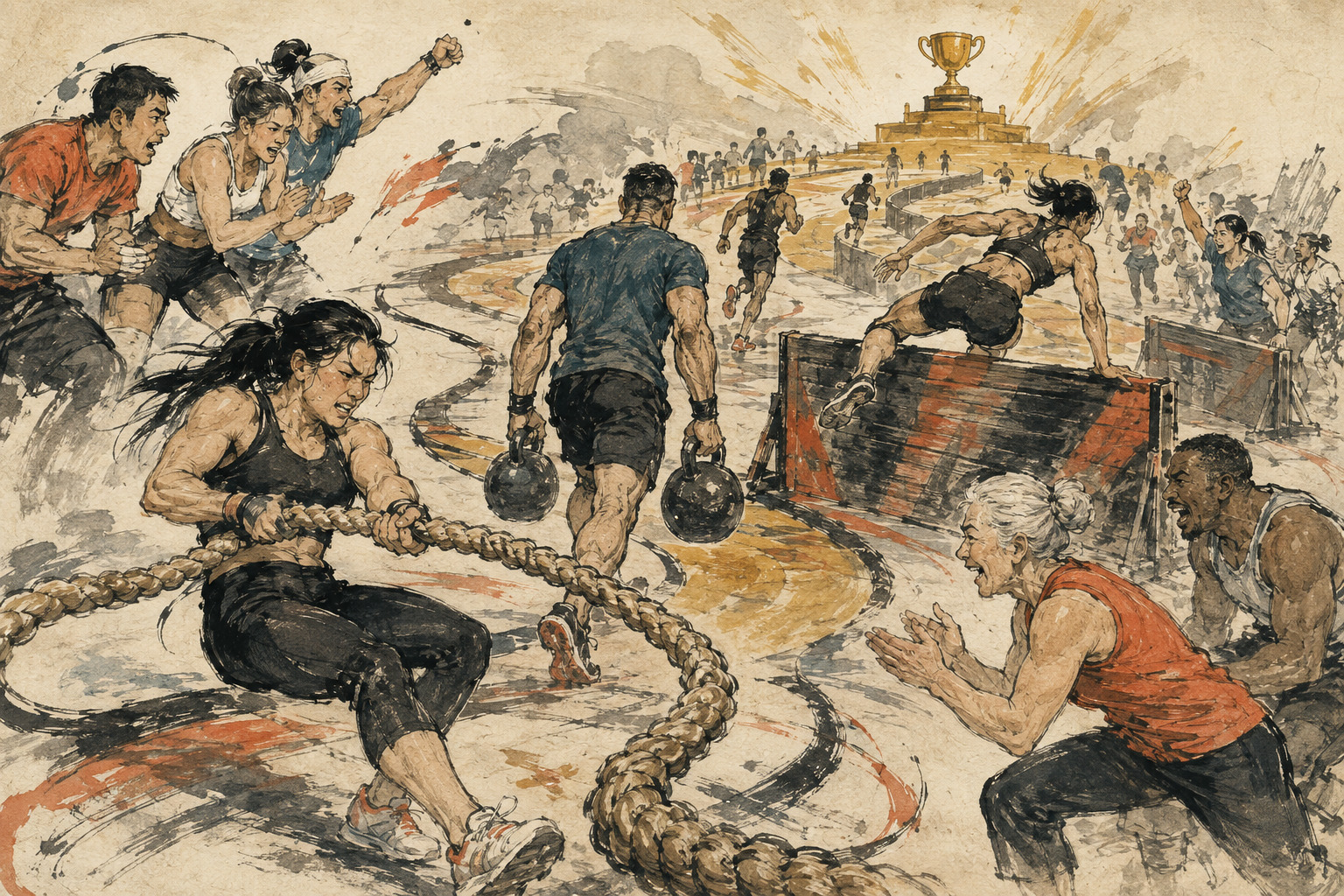
There is no academy badge to present, no federation ranking to defend and no entry fee to recover. A challenger needs to be at least 18, hold Japanese nationality, be healthy enough to compete and want to test a limit. If one qualifying attempt goes badly, the official site says the challenger may enter another. The proposition is disarmingly simple: walk in from ordinary life and try to become Japan’s “physical fitness king.”
That simplicity has already narrowed into a serious field. Eleven qualifying rounds in Tokyo, Osaka, Fukuoka and Nagoya have advanced three people each. Thirty-three names now occupy the official finalist gallery. Three heats remain—Fukuoka on August 29, Osaka on September 13 and Tokyo on September 27—before the final on October 12 at the main arena of BumB Tokyo Sports Culture Center in Shinkiba.
The winner receives ¥10 million. The public prize schedule continues through eighth place: ¥3 million for second, ¥1 million for third, then ¥500,000, ¥300,000, ¥200,000, ¥100,000 and ¥50,000. Together that is a ¥15.15 million announced purse. For a new event with free entry and no qualifying résumé, it is enough money to transform a fitness test into a consequential sporting opportunity.
The 33 who are already through
The official finalist cards give names and photographs but not ages, occupations, training histories or complete performance data. That restraint prevents easy character sketches, but it also keeps the focus where the competition has placed it: finishing position. Listed below are the three qualifiers from each completed round, in the order published by the organizer.
| Qualifier | 1st | 2nd | 3rd |
|---|---|---|---|
| 1 · Tokyo | Naoki Takahashi 高橋直希 | Yuko Sakuyama 作山悠子 | Takuma Kyosu 京須卓雅 |
| 2 · Tokyo | Takuya Terada 寺田拓矢 | Taisei Maegata 前潟大成 | Ryuji Takahashi 高橋龍二 |
| 3 · Osaka | Kazuya Nishikawa 西川一哉 | Yasuhito Imoto 井本恭人 | Tetsuya Matsuyama 松山哲也 |
| 4 · Osaka | Ken Sato 佐東拳 | Ryosuke Maeya 前家涼佑 | Ryosuke Nakajima 中島良介 |
| 5 · Fukuoka | Hiroki Nakata 中田大樹 | Ryuto Sakurai 櫻井隆人 | Ryosuke Oba 大庭良介 |
| 6 · Tokyo | Shun Kanari 嘉成駿 | Shota Yamamoto 山本翔太 | O Rostislav オロスティスラブ |
| 7 · Nagoya | Tsubasa Ito 伊藤翼 | Yuta Numazaki 沼崎雄汰 | Tohei Watanabe 渡邊桐平 |
| 8 · Osaka | Kazuki Miyakawa 宮川知樹 | Yohei Akao 赤尾洋平 | Tatsuya Osawa 大澤達也 |
| 9 · Tokyo | Yuichi Okada 岡田祐一 | Takayuki Yamanaka 山中貴之 | Kohei Sorimachi 反町康平 |
| 10 · Nagoya | Takuma Murayama 村山拓真 | Koki Omasa 大政光輝 | KENTARO KENTARO |
| 11 · Tokyo | Shota Kusakabe 日下部翔大 | Atsushi Atsuiotoko 熱い男 あつし | Shota Suzuki 鈴木祥太 |
The names make the contest tangible; the missing numbers leave its competitive geometry hazy. How many people entered each heat? How close was fourth? Which movement separated first from third? Did repeat entrants improve, and if so by how much? A developing event need not publish the data infrastructure of an Olympic federation, but leaderboards are more than decoration. They allow athletes to understand the standard, audiences to recognize excellence and future entrants to decide whether the door is genuinely within reach.
A door can be open and still have a frame
SAMURAI’s most persuasive idea is not the giant cheque. It is the removal of the usual gatekeepers. The organizer asks for no professional record or coaching certificate. Entry is free. Multiple attempts are permitted. The February announcement said participants ranged from everyday training enthusiasts to instructors. SUMI Group chairman Takahiko Sumi traced the idea to an 87-year-old acquaintance who still runs 10 kilometers every day: he wanted accumulated daily effort, rather than an elite résumé, to become visible.
That is a meaningful correction to the way fitness is usually marketed. Transformation advertising sells a before and an after. Professional sport sells rare talent. Social media sells the most dramatic few seconds. SAMURAI can instead reward repetition: the unnoticed push-up, the early run, the pull-up practiced after work. Its format says routine may someday meet a public test.
But “anyone” is an invitation, not a literal description. The live eligibility rules exclude people under 18 and people without Japanese nationality. The site requires competitors to be healthy enough to participate. It does not advertise age, sex or adaptive divisions. A February release said one woman was among the first 15 finalists and presented that as evidence that the competition crossed sex lines. The current finalist gallery does not publish demographic profiles, so no broader conclusion should be manufactured from names or photographs.
The distinction matters because access and competitive equivalence are different achievements. Removing the entry fee makes the starting line more accessible. It does not make every body equally likely to excel under the same raw movements. Pull-ups reward one combination of relative strength and body mass; standing long jump emphasizes explosive power; burpees and push-ups impose their own mixture of pace, range of motion and fatigue. Change the movement, time window, required depth or scoring weight and the person crowned “fittest” may change with it.
A fitness champion does not emerge from neutral exercises. The event creates the champion by deciding which capacities count, how they are measured and what happens when they conflict.
The rules have evolved in public
The event’s own announcements preserve a useful record of adjustment. At launch in September 2025, LAVA International proposed 30 qualifying rounds between October 2025 and September 2026. Each heat’s top three would advance, joined by the ten best records across all qualifiers. Example events were sit-ups, push-ups, pull-ups and shuttle running.
By February 2026, the schedule had become 15 qualifiers. The final pathway was described as the top three from each heat plus an unspecified group of leaders from a time trial. The promoter emphasized changing, functional-training-based challenges whose details could remain concealed until competition day.
The live site in August is different again: 14 rounds, the top three from each qualifier, and four challenge demonstrations—push-ups, burpees, pull-ups and standing long jump. Yet the FAQ on the same page still says events may include push-ups, pull-ups, sit-ups and shuttle runs, with details undisclosed until the day. Eleven completed rounds plus the three posted future dates reconcile to 14. If the present rule is exactly three per heat, the maximum final field would be 42.
September 2025 — Launch plan: 30 heats; top three from each plus ten season-long record leaders.
February 2026 — Revised plan: 15 heats; top three plus time-trial leaders; final fixed for October 12.
August 2026 — Live site: 14 heats; top three per heat; 33 finalists from 11 completed rounds.
October 12, 2026 — Final at BumB Tokyo Sports Culture Center, on Sports Day.
Revision is not evidence of impropriety. Venues disappear, demand becomes clearer and new organizers discover how much a national series costs. But a seven-figure prize magnifies the obligation to preserve versions of the rules. A competitor who trained for shuttle running, or planned around 30 chances to qualify, deserves a dated explanation when the pathway changes. The clean solution is an archive: rule version, effective date, qualified athletes protected under it and the precise final-field formula.
Japan has been measuring fitness since 1964
SAMURAI feels contemporary—short videos, functional training, a prize large enough to become a thumbnail—but its central impulse is old. Japan’s Ministry of Education began the national Survey of Physical Fitness and Athletic Ability in 1964, the year of the first Tokyo Olympics. Measurement linked the national festival of sport to classrooms, public administration and lifelong health. Fitness was not merely admired; it was recorded.
In fiscal 1999, the ministry introduced the New Physical Fitness Test after a comprehensive review accounting for changes in physique, advances in sports science and population aging. For adults aged 20 to 64, its standard menu includes grip strength, sit-ups, sit-and-reach, side steps, a fast walk or 20-meter shuttle run, and standing long jump. The point is not to discover a single supreme citizen. It is to create repeatable evidence about different capacities across a population.
SAMURAI borrows the language of that culture while reversing its purpose. A public test asks: how is the country doing? A commercial final asks: who is number one? The first values comparability over spectacle. The second needs drama, elimination and a person standing alone. Both depend on protocols. Without fixed depth, locked elbows, accepted grip, foot-fault rules, calibrated distance and consistent judges, a familiar movement stops being a measurement and becomes an impression.
The national context gives the contest a broader claim to relevance. The Sports Agency’s latest survey, conducted in November 2025, found that 51.7% of adults exercised or played sport at least once a week—well below the government’s roughly 70% goal. The median adult reported 69 minutes a week. Women reported 59.8 minutes against 90 minutes for men, and the gap was especially large from the student years through the 40s. An event that makes ordinary training aspirational can help the culture. One that equates health with victory, however, would narrow it.
Health is not the same as winning a maximal test. The Health Ministry’s most recent published healthy-life-expectancy figures, for 2022, were 72.57 years for men and 75.45 for women, compared with life expectancy of 81.05 and 87.09. Closing those roughly nine- and twelve-year gaps requires movement people can sustain, not a nation of finalists. Sumi’s 87-year-old runner is therefore the event’s most valuable origin story precisely because the acquaintance was not described as chasing a podium. The achievement was continuity.
From SASUKE to the sport of fitness
Japan also knows how to turn physical tests into character drama. TBS first broadcast SASUKE on September 27, 1997. Its archive remembers four finalists and no total victor in that first edition. Carpenters, fishermen, firefighters, entertainers and elite athletes would come to be introduced not only by their bodies, but by their jobs, families, failures and returns. The obstacle course gave biography a stopwatch.
The format traveled as Ninja Warrior, while competitive fitness developed another global grammar. The first CrossFit Games gathered about 70 athletes at a California ranch in 2007. The worldwide Open began in 2011 with more than 26,000 participants submitting results over six weeks. CrossFit deliberately withholds or changes tests to ask whether athletes can handle the unknown; it also separates major sex, age and adaptive divisions.
SAMURAI is not a branch of either enterprise, and its four listed movements are far plainer than a giant obstacle course or a multi-day international fitness championship. Yet it draws from the same dramatic reservoir: open entry, hidden details, repeated failure, measurable work and the promise that someone without a conventional sports career can become the central figure.
Its opportunity is to make smallness a strength. A push-up is legible from the back row. A pull-up produces an undeniable pause at exhaustion. A standing jump compresses training into one airborne instant. The movements need no mythology. What they need are camera angles that show standards, judges willing to reject bad repetitions and a scoreboard that lets viewers understand why one ordinary-looking effort is extraordinary.
The prize is also a business proposition
SAMURAI is produced by SUMI Group, whose businesses include LAVA International, FEEL CONNECTION and VB NEXT. The group said in February that eight companies operated across 16 industries and 45 businesses, centered on fitness, health, beauty and well-being. LAVA, founded as a hot-yoga brand in 2004, says its wider studio network has grown into one of Japan’s largest. The competition is therefore not detached philanthropy. It extends a fitness company’s core story: daily physical practice can change a life.
That alignment is not disqualifying; it is why the event can exist. A purse of ¥15.15 million, venues, judges, video and staff require commercial resources. Free entry shifts the immediate cost away from competitors. Official footage gives the group a library of determined bodies and emotional finishes. The responsible bargain is clarity: label sponsorship, explain data and image use, distinguish health messaging from competitive selection and avoid implying that the winner represents every kind of fitness.
The nationality rule deserves the same candor. A title marketed as “Japan’s No. 1” can reasonably be framed as a domestic championship, but residence, community or federation membership are other possible definitions of belonging. The February eligibility list did not state a nationality requirement; the live site now does. The organizer should explain when and why it was added, especially in a country where non-Japanese residents train, coach, work and pay gym fees alongside Japanese citizens.
What the October final must make visible
Mystery can be part of the test without turning governance into a mystery. Athletes may learn the workout late while still knowing the scoring system, movement standards, equipment, tie-breaks, appeal process and judge qualifications well in advance. Surprise should test preparation, not a competitor’s ability to guess what a referee will count.
Safety deserves equal visibility. The live site requires competitors to be healthy, but its public page does not detail medical screening, emergency staffing or withdrawal protocols. That does not prove such plans are absent. It means spectators and entrants cannot evaluate them from the published information. In January, the Sports Agency issued a trial safety guideline specifically divided for participants, coaches, event organizers, operators and facility managers. A high-intensity open event has a ready-made public benchmark against which to explain its own plan.
| Before the final | Why it matters |
|---|---|
| Publish the complete qualification and final-field formula | Confirms whether 42 is the final maximum and whether any time-trial or discretionary places remain. |
| Issue movement standards and scoring weights | Shows what counts as a repetition, how different capacities combine and how ties are broken. |
| Release heat results and performance data | Lets finalists compare preparation and allows audiences to understand the level of achievement. |
| Explain divisions—or the decision to have none | Makes the title’s age, sex and adaptive philosophy explicit rather than leaving “open” to do all the work. |
| Identify judging, appeals, anti-doping and safety procedures | Protects athletes and gives a ¥10 million outcome institutional credibility. |
| Archive each rule revision | Respects entrants who planned around the original 30-heat structure and later versions. |
This is not bureaucracy imposed on fun. It is how effort becomes sport. A rejected repetition hurts more when it may be worth millions; a tie-break matters more when the people involved rearranged work and travel to enter; an emergency plan matters more when “test your limit” is the event’s emotional command.
A final on the right day
October 12 is not merely an available Monday. It is Sports Day, Japan’s national holiday on the second Monday of October. The holiday began in 1966 as Health and Sports Day, originally fixed to October 10 in memory of the 1964 Tokyo Olympics opening ceremony. It moved to Monday in 2000 and was renamed Sports Day in 2020. Its legal purpose now speaks of enjoying sport, cultivating respect for others and wishing for a healthy, energetic society.
A single-winner contest naturally emphasizes the first of those ideas less than the podium. Yet the open qualifiers can serve the larger purpose. Every entrant who trains for a first pull-up, attempts again after missing the top three or brings a friend to watch expands the event beyond the cheque. Every transparent standard demonstrates respect: the same movement, judged the same way, with the result explained.
Thirty-three finalists have already supplied the one thing no organizer can manufacture—effort under pressure. Nine more direct places remain if the live three-per-heat rule holds. Their task is physical and wonderfully plain. The organizer’s task is harder to photograph. It must turn changing plans into stable rules, a slogan into a defensible test and a large prize into a trusted result.
At the end, one competitor may stand beneath the title “Japan’s physical fitness king.” That person will deserve applause for whatever the final demands. The deeper success will be whether everyone else can say exactly what was tested, why the winner won and how the next challenger can begin. Four familiar movements can open a door. Credibility is what keeps it open.
- SAMURAI 2026 official site — live schedule, eligibility, 14-heat format, challenges, FAQ and finalist gallery
- LAVA International, Feb. 2, 2026 — final announcement, prize ladder, organizer background and first 15 finalists
- LAVA International, Sept. 4, 2025 — original 30-qualifier launch plan and example events
- LAVA International — brand origin in 2004 and network description
- Ministry of Education / Sports Agency — New Physical Fitness Test history and guidelines
- Sports Agency, 2025 participation survey — weekly participation and exercise-time findings
- Sports Agency — national weekly sports-participation target
- Ministry of Health — life expectancy and healthy life expectancy, 2022
- Cabinet Office — origin and legal purpose of Sports Day
- Sports Agency, Jan. 27, 2026 — trial guideline for safety in exercise and sports
- TBS — official SASUKE archive, beginning with the Sept. 27, 1997 first tournament
- TBS — SASUKE’s development beyond television
- CrossFit Games — official history of the 2007 Games and 2011 Open
Editorial note: This report is based on the cited public materials and contains no independent interviews. The organizer’s live page is treated as controlling where it conflicts with earlier press releases. Finalist names and order were transcribed from the organizer’s image cards; its page does not publish full biographies or heat performance tables. We found no public final rulebook, scoring weights, judge protocol, appeal system, anti-doping policy or detailed medical plan on the live event page as of publication; absence from that page is not evidence that internal procedures do not exist. “¥15.15 million” is the sum of the eight prizes announced in February. The foreign-exchange strip is an editorial reference unrelated to the competition.