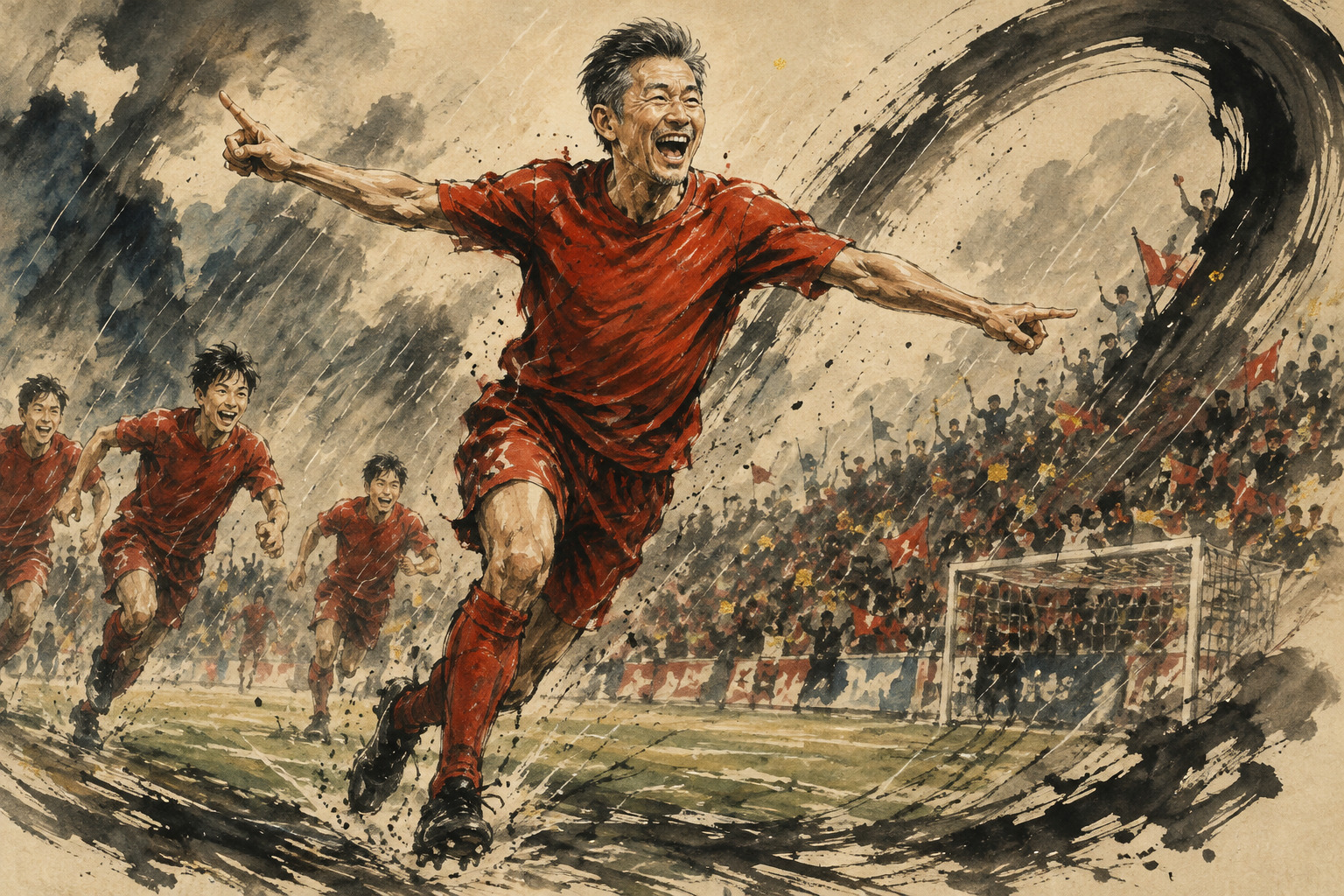
The first kick changed the record. The second made the record harder to imagine. Twelve minutes into Wednesday night’s first-round Emperor’s Cup tie in Fukushima, captain No. 11 Kazuyoshi Miura stood over a penalty and scored with his right foot. At 59 years and 174 days, he had become the oldest goalscorer in the competition’s history. In the 55th minute, he did it again.
Three minutes later, Kazumasa Shimizu replaced him. Rain had arrived at Toho Minnano Stadium; the temperature was 26.5 degrees Celsius and humidity 83%. The crowd numbered 566. Fukushima United, the professional J3 club representing the prefecture, finished with seven goals. Oyama Soccer Club, Yamagata’s amateur representative, finished with none.
The images invite myth. The official sheet provides useful resistance. Miura started at forward, wore the armband, played 58 minutes, took six of Fukushima’s 31 shots and converted two penalties. Fukushima led 3–0 at halftime and 5–0 when he left. Oyama managed four shots. This was neither a token appearance nor evidence that a 59-year-old had conquered the physical demands of a level contest. It was something more exact: a veteran entrusted with a start and captaincy in a competitive cup tie, completing the two chances given to him while a much stronger team imposed itself.
Two penalties, neither less nor more
Penalties produce an odd argument in football. Because the ball is stationary and the distance fixed, they are sometimes dismissed as cheap goals. Because a single player must act while everyone waits, they are also treated as a pure test of nerve. Both descriptions are incomplete. A penalty is a high-probability chance earned by the team and resolved by one player. It rewards repeatable technique, information, disguise and emotional control; it does not require the scorer to outrun a defender or create the chance alone.
The JFA record tells us only what can be stated safely about Miura’s finishes: both were penalties and both were struck with his right foot. It does not record the corner, the goalkeeper’s movement or the celebration. There is no need to invent them. The drama lies in the chronology. The first kick came with the score 0–0. It opened the tie. The second came after Toraji Chiba had made it 4–0, and turned the evening from comfortable progress into a personal double.
Six shots matter because they describe participation beyond two touches from 11 meters. They do not reveal shot quality, pressing work or whether younger teammates carried his running. But for 58 minutes Miura was present in Fukushima’s attacking volume, not waiting solely for a ceremonial farewell. The armband matters too. It signaled that the club was asking him to carry authority as well as attention.
Still, responsible praise begins with the opponent. Oyama is a regional side, not a J.League peer. The Yamagata representative was appearing for a third consecutive year and fifth time overall, a legitimate participant in the national cup. Its players had earned the stage through their prefectural competition. The 7–0 score and the 31–4 shot count show the sporting hierarchy held brutally firm. Miura’s record is real; so is the imbalance that made the night easier for every Fukushima attacker.
Longevity becomes sentimental when context disappears. It becomes history when the record, the limits and the work required to remain selectable are all held in the same frame.
A cup older than the professional game
The setting could hardly be more appropriate. The Emperor’s Cup is not merely another date on the domestic calendar. Its origin is intertwined with the creation of Japan’s national football association. In 1919, the English Football Association donated a silver cup. The gift helped build momentum for the establishment of the Greater Japan Football Association in September 1921. Two months later, four teams contested the first All-Japan Championship—then called the “Association Football National Championship Competition”—on a ground in Tokyo’s Hibiya Park. Tokyo Shukyu-dan became the first champion.
War interrupted editions 21 through 25. The national championship returned in May 1946 under the name “First Reconstruction All-Japan Football Championship.” An Emperor’s Cup was bestowed in 1948 and, beginning with the 31st competition in 1951, awarded to the national champion. The tournament opened more broadly in 1972. From the 76th edition in 1996, the old nine-region representative system gave way to representatives from all 47 prefectures, widening the path for university, youth and local clubs.
The 2026 format is the institutional descendant of that history: 88 teams, including 20 from J1, 20 from J2, amateur seed Tsukuba University and 47 prefectural representatives. First-round teams play for the right to meet the top two professional divisions when they enter in round two. The final returns to New Year’s Day for the first time in six editions, at MUFG Stadium in Tokyo.
That openness gives the competition its democratic romance. A club from a regional league can stand on the same bracket as a national champion. A university can eliminate professionals. A J3 side can be favorite one week and underdog the next. “Open,” however, does not mean “equal.” Fukushima’s victory over Oyama showed exactly why giant-killings are treasured: the giant normally wins.
Miura’s own timeline crossed the cup’s. His appearance Wednesday was his first in the main tournament since the 99th edition, seven years ago, when he belonged to Yokohama FC. He returned not as a retrospective guest but on an active registration, captaining a prefectural representative into round two.
Before Japan had a J.League
When Miura left Shizuoka for Brazil in 1982 at age 15, Japanese professional football did not exist. Domestic clubs belonged to a company-centered system. The men’s national team had not reached a World Cup. A teenage striker who wanted a professional education had to imagine a route outside his own country.
Brazil supplied that route, though not quickly or romantically. Miura passed through youth and senior environments, learning Portuguese and the daily competition of a football culture that did not owe him a place. He made his professional debut with Santos in 1986. His club list then wound through Palmeiras, Matsubara, CRB, XV de Jaú, Coritiba and Santos again before he returned to Japan in 1990 to join Yomiuri Club, later Verdy Kawasaki.
The date matters. Miura came home before the J.League’s 1993 launch, then became one of the faces that made the new league feel glamorous, urgent and national. He wore bright suits, danced after goals and attacked with a showman’s appetite. In an era when Japanese football was trying to become mass entertainment without losing competitive seriousness, “King Kazu” offered both spectacle and proof.
He was named the J.League’s inaugural most valuable player in 1993. Verdy dominated the league’s early years, and Miura’s fame spilled beyond sport into advertising, television and the new merchandise culture—down to the player cards in packets of J.League chips. The league now counts 60 clubs across three divisions; its official history still reaches for Miura’s 1993 award scene when it wants to recover the electricity of the beginning.
In 1994 he joined Genoa. The move was brief and difficult, including a facial injury in his Serie A debut, but symbolically immense: a leading Japanese player had entered one of Europe’s strongest leagues when such transfers were still exceptional. Later came Croatia Zagreb, Kyoto Purple Sanga, Vissel Kobe, Yokohama FC, Sydney FC, Suzuka, Oliveirense in Portugal and Fukushima. The club map spans five decades and multiple football cultures. The essential continuity is not geography but appetite: training, selection, minutes, another contract.
1982 — Leaves Japan for Brazil at 15.
1986 — Makes his professional debut with Santos.
1990 — Returns to Japan with Yomiuri Club and debuts for the national team.
1992 — Helps Japan win the Asian Cup on home soil.
1993 — Becomes the inaugural J.League MVP.
1994 — Joins Genoa in Italy’s Serie A.
1998 — Is omitted from Japan’s final squad for the country’s first World Cup.
2000 — Ends his international career with 55 goals in 89 appearances.
2005 — Joins Yokohama FC, still his parent club in 2026.
2017 — Scores a J2 winner at 50 years, 14 days.
2023–24 — Plays on loan for Oliveirense in Portugal.
2026 — Captains Fukushima and scores twice in the Emperor’s Cup at 59.
The absence inside the legend
A career this long can be flattened into uninterrupted triumph. Miura’s public story contains a defining absence. He scored 55 goals in 89 appearances for Japan between 1990 and 2000 and helped the country win the 1992 Asian Cup. He was central to the painful 1993 qualifying campaign that ended in the final seconds in Doha. He then helped drive Japan toward its first World Cup qualification.
But he did not go to France in 1998. Coach Takeshi Okada omitted him from the final squad before Japan’s World Cup debut. For the player most associated with the rise of Japanese football, the sport’s arrival on its biggest stage happened without him. The omission remains inseparable from his mythology because it resists the easy moral that commitment guarantees reward.
That wound changes the meaning of his longevity. It is tempting to read every extra season as an attempt to defeat 1998, but that would claim access to motives only Miura can define. What can be observed is a career that did not seek a perfect ending. He kept playing after the greatest available narrative closure had been denied. There would be promotions, relegations, substitute appearances, loans far below the spotlight and long periods without a goal.
His international numbers stayed fixed. Japanese football did not. The national team that once struggled to qualify now prepares for its eighth consecutive World Cup. Japanese players populate major European leagues. The domestic pyramid has spread professional clubs across the country. Miura has gone from symbolizing the future to playing among athletes born after his most famous disappointments—and, in some cases, after his 2005 move to Yokohama FC.
The career endures not because every chapter is glorious, but because Miura accepted that the next chapter might be smaller and still worth doing.
The hard arithmetic of staying
Age stories can become evasive. “Age is just a number” is an inspirational slogan, not physiology or squad analysis. Speed, recovery and robustness change. Clubs have finite roster places. Every appearance given to an icon is an appearance unavailable to someone else. Miura’s visibility also has commercial value: he sells tickets, brings cameras and gives a regional club international recognition.
Those facts make selection a legitimate sporting question. His late-career minutes have often been limited. He went scoreless in seven appearances totaling 69 minutes for fourth-tier Atletico Suzuka in 2025. After joining Fukushima on loan from Yokohama FC, he made six appearances in the shortened early-2026 competition. His deal was extended through June 2027, meaning he can turn 60 while registered with the club.
Neither marketing value nor limited minutes proves bad faith. Professional clubs choose squads for sporting, financial and cultural reasons all the time; Miura simply makes the mixture unusually visible. The fair test is not whether his name attracts attention. It is whether coaches can define a football role, teammates recognize the standards attached to it, and the club remains honest about the level of contribution.
Wednesday offered evidence for both sides of the debate. Skeptics can point to an amateur opponent, two penalties and a seven-goal rout. Admirers can point to a start, the captaincy, six shots, 58 minutes and two conversions under match pressure. Neither side should erase July 25, when he scored from open play in the prefectural final by arriving at the near space to meet Takatora Einaga’s low delivery. That goal, his first in a competitive match since November 2022, was not part of the Emperor’s Cup main bracket—but it showed the movement a penalty cannot.
| Claim | What the evidence supports | What it does not prove |
|---|---|---|
| “The record is historic.” | A 59-year-old scored twice in the national cup proper; Miura’s birth date and the JFA match sheet establish an extraordinary age mark. | That every late-career appearance is automatically merited. |
| “They were only penalties.” | Both finishes came from the spot in a 7–0 mismatch. | That conversion under competitive pressure has no value, or that Miura did nothing else in six shots and 58 minutes. |
| “His presence is commercial.” | Miura’s fame plainly creates attention and economic value. | That coaches cannot also assign him a genuine football role. |
| “He proves age does not matter.” | Preparation and craft can preserve useful abilities much longer than convention expects. | That aging has vanished, or that this performance translates unchanged to J3 league intensity. |
Miura’s most durable late-career skill may be willingness to inhabit this uncomfortable middle. He is no longer the league’s dominant star, yet he refuses to recast himself as a mascot. He trains to be selected while knowing every selection will be interrogated. A ceremonial figure can live on applause. A registered player must live with the next team sheet.
Records that are similar, but not the same
Football’s longevity records are easy to scramble because competitions and definitions differ. In March 2017, Miura scored Yokohama FC’s winner over Thespakusatsu Gunma in J2 at 50 years and 14 days. Guinness World Records recognizes that as the oldest age for a professional player to score in a competitive league match. It remains a league category, not an all-competition claim.
His July 2026 finish for Fukushima came at 59 years and 149 days in a prefectural qualifying competition. News reports often shortened the setting to “the Emperor’s Cup,” but the JFA’s structure is clear: the match decided Fukushima’s representative; it was not round one of the national tournament. The Aug. 19 goals are different. They appear on the official record for match No. 14 of the Emperor’s Cup proper.
The distinction is not pedantry. The cup is built from local qualification into a national bracket. Both stages are competitive and both mattered. One got Fukushima into the tournament; the other advanced it to face a J1 club. Precise labels make the achievement more, not less, meaningful.
- March 12, 2017: J2 league goal for Yokohama FC at 50 years, 14 days—the Guinness competitive-league record.
- July 25, 2026: open-play goal for Fukushima at 59 years, 149 days in the Fukushima prefectural representative final.
- Aug. 19, 2026, 12th minute: right-footed penalty in Emperor’s Cup round one at 59 years, 174 days—the national tournament’s oldest goalscorer mark.
- Aug. 19, 2026, 55th minute: a second right-footed penalty extends the new Emperor’s Cup mark before Miura leaves in the 58th minute.
The other team in the picture
Hero stories often turn opponents into scenery. The Emperor’s Cup is diminished when that happens. Oyama Soccer Club arrived as Yamagata’s representative, having secured a third straight and fifth overall appearance. Its players entered the same 106-edition lineage and stood through the same humid rain. The final score was severe, but participation was not a favor.
For regional clubs, the cup offers measurement as much as romance. The distances exposed by a professional opponent—speed of circulation, penalty-area defending, depth from the bench, concentration after the score grows—can be painful and useful. Fukushima’s sixth and seventh goals came from substitutes Shimizu and Yuki Okada. That is what a deeper squad does: it keeps increasing the burden after the first selection has tired the opponent.
The same bracket now reverses Fukushima’s perspective. On Aug. 26, it is scheduled to visit Yokohama F. Marinos at Nissan Stadium. J1 and J2 clubs enter in this round. The stadium will be larger, the opponent stronger and the hierarchy pointed in the other direction. There is no guarantee Miura will play. If he does, a record set against an amateur side will immediately meet a much harsher test.
The Yokohama setting adds resonance without needing invented destiny. Miura’s parent club is Yokohama FC, the city rival of Marinos. He has belonged to Yokohama FC since 2005 even as recent loans took him to Suzuka, Portugal and Fukushima. A second-round appearance would place the oldest scorer inside a stadium and a professional culture radically different from those he encountered when he left for Brazil in 1982.
What remains after the rain
The easiest version of this story says a 59-year-old beat time. He did not. Time is visible in his reduced minutes, the careful choice of matches, the debate around selection and the likelihood that recovery takes more management than it once did. The extraordinary fact is not immunity. It is negotiation.
Miura has negotiated with changing leagues, countries, coaches, bodies and status. He accepted movement from national icon to senior specialist, from automatic starter to substitute, from top division to lower tiers, from the center of Japanese football to clubs where his fame can be both asset and burden. He kept one demand unchanged: he wanted to be evaluated as a player.
That demand should be honored rigorously. Do not pretend two penalties in a 7–0 win settle his competitive value for a J3 season. Do not pretend they mean nothing because they were penalties. The official sheet gives a sturdier conclusion. He was selected. He captained. He took six shots. He scored the first and fifth goals. He left after 58 minutes. Fukushima advanced.
The cup supplies the longer conclusion. Its first edition arrived 65 years before Miura’s professional debut; Miura’s debut arrived seven years before the J.League. Now the 106th competition contains all three eras at once: the 1921 national championship, the star who embodied professional football’s 1993 birth, and teammates young enough to regard both as history.
When Miura walked to the spot in the rain, the field did not stop to admire that chronology. The referee waited, the goalkeeper prepared and the score remained 0–0. The ball still had to be struck. That may be the clearest explanation for why he continues. History is awarded afterward. A player first has to take the kick.
- Japan Football Association, Fukushima United 7–0 Oyama Soccer Club, official match page
- Japan Football Association, match No. 14 official record—lineups, shots, penalties, weather and attendance
- Japan Football Association, 106th Emperor’s Cup regulations and 88-team format
- Japan Football Association, origins of the competition and the Emperor’s Cup
- Japan Football Association, Emperor’s Cup historical timeline
- Japan Football Association, Aug. 10 tournament preview and Miura’s seven-year return
- Japan Football Association, Fukushima and Yamagata representative results
- Japan Football Association, second-round fixture at Yokohama F. Marinos
- Fukushima United FC, Miura loan announcement and career record
- Fukushima United FC, Kazuyoshi Miura player profile
- J.League, Miura’s 1993 MVP and the league’s inaugural-era legacy
- J.League, Miura’s 2017 J2 oldest-scorer record
- Japan Football Association, Miura’s 89 international appearances and 55 goals
- Guinness World Records, oldest professional competitive-league goalscorer
- Guinness World Records, five decades in professional football
- Reuters, Miura’s Fukushima extension through June 2027 and career background
- Reuters, Miura’s return to the J.League with Fukushima
- KFB Fukushima Broadcasting, July 25 open-play goal in the prefectural final
Editor’s note: This article is based on the cited public records and reporting and includes no original interview. The JFA official match sheet establishes Miura’s two right-footed penalties, six shots, 58 minutes, captaincy, weather, attendance and the 31–4 team shot count. Miura’s age of 59 years and 174 days is calculated from the Feb. 26, 1967 birth date in his official club profile. The characterization as the Emperor’s Cup’s oldest goalscorer follows that official record and the established tournament history; as of publication, the JFA had not posted a separate record announcement. The July 25 prefectural final is distinguished throughout from the Aug. 19 national tournament proper. The exchange-rate strip is an editorial market reference unrelated to the match.