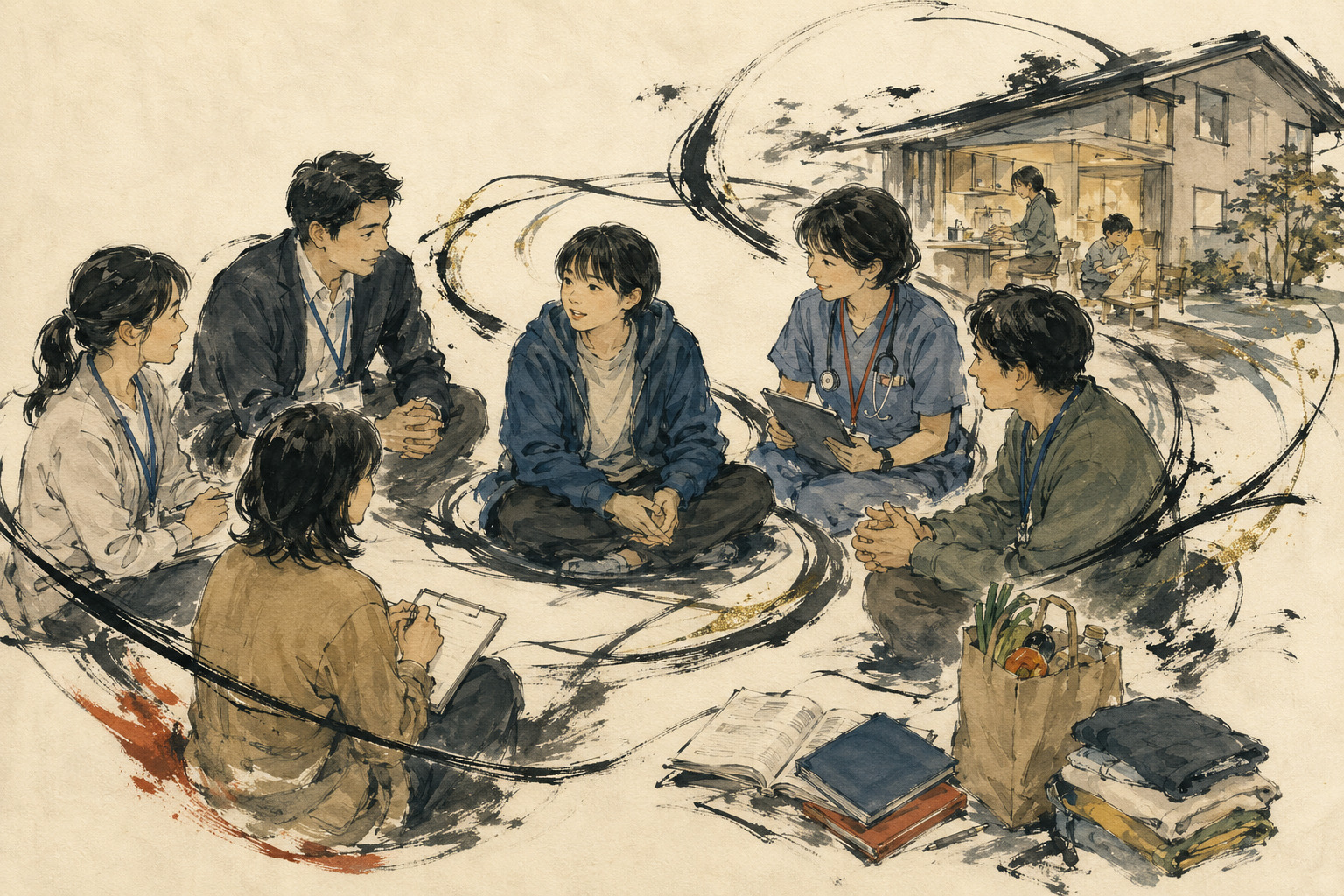
Imagine a composite morning assembled from patterns in the evidence, not the story of an identified child. A 14-year-old wakes before the alarm because a younger sibling is crying. Breakfast comes first, then medicine for a parent, then a message to an adult service the parent finds difficult to call. The student reaches school late, without homework, and sleeps during second period.
A teacher can read the scene as disengagement. A nurse may see exhaustion. A school counselor may hear anxiety. A hospital social worker sees the parent’s diagnosis; an elder-care manager sees the grandparent; a municipal officer sees benefit eligibility. Every observation may be accurate and still fail the family if it remains inside one institution.
This is the practical problem behind Toyama Prefecture’s first young-carer staff training session of fiscal 2026, scheduled for Friday afternoon at Toyama Kenminkaikan. The free session has a listed capacity of 70. Its audience crosses the usual administrative borders: education, welfare, long-term care, medicine, groups that operate places for children and young people, and government.
The program is deliberately layered. Mao Saito, a Ritsumeikan University professor of family sociology, is to lecture on the current state of young carers and the problems support systems face. Rie Takaoka, an author and former young carer who says she became the principal caregiver after her mother developed a rare disease when Takaoka was nine, is to speak about the experience and its long aftermath. Participants will then work through “whole-family support through multi-agency collaboration.” A second prefectural session, planned for Nov. 16, is expected to use case review to test what Toyama’s actual social resources can do.
Why the mixed room matters
Young-carer policy is often described as a problem of “early discovery.” That phrase can make the task sound like spotting a hidden category of child. In practice, it is closer to joining a set of disconnected records. The child may be visible everywhere: late at school, present at a parent’s appointment, collecting prescriptions, translating a benefits letter, watching a sibling while an adult works, or answering a care manager’s questions with startling competence. What is hidden is the sum of the work.
That sum is why Toyama invited adult-service professionals as well as teachers. A school is close to the child but may know little about the person receiving care. A psychiatric clinic can understand a parent’s illness yet never ask who makes dinner. A long-term-care planner can build a package around an older adult while quietly treating a grandchild as available “family capacity.” A welfare office may address income without hearing about night-time supervision. A community meal program may be the one place where a young person relaxes enough to speak.
| Frontline contact | The fragment it may see | A harmful shortcut | The better question |
|---|---|---|---|
| Teacher or school nurse | Lateness, absence, fatigue, missing work, hunger, sudden withdrawal or unusual maturity. | “The student lacks motivation” or “the parent is irresponsible.” | “What has to happen at home before you can get here?” |
| Hospital, clinic or visiting nurse | A patient depends on a child for communication, medication, mobility or emotional stability. | Counting the child as a reliable part of the treatment plan. | “Who does this when the child is at school, sick or away?” |
| Elder-care or disability service | A care plan works only because unpaid family help fills every gap. | Calling a minor “family support” without assessing age, hours or impact. | “Would this plan still be safe if the young person were unavailable?” |
| Child welfare or income support | Debt, food insecurity, unstable housing, parental illness or sibling care. | Opening separate cases for separate problems and making the family repeat everything. | “Who will coordinate one plan, and what burden can be removed first?” |
| Community youth space | A child seeks food, quiet, company or a predictable adult without using service language. | Forcing disclosure before offering belonging. | “What would make this week a little easier?” |
Toyama has been rehearsing this architecture. Its August 2025 session combined a 70-minute lecture with a video and 40 minutes of group work on how to listen to a child’s voice. A January 2026 session brought Osaka Metropolitan University professor Yoshie Hamashima together with a board member of the local organization Ponte Toyama. It linked testimony and British practice to what a small community “place” can see. The prefecture’s network meeting, held in February, stated the institutional objective plainly: identify young carers early, connect them to suitable support and build cooperation among agencies.
Training cannot itself deliver a home helper, shorten a service waiting list or guarantee that a family trusts officials. It can, however, change the moment before referral. It can teach a professional that noticing is not proving, that disclosure is not consent to broadcast, and that a referral is not complete merely because an email was sent.
A name for work families had long kept private
Children have always contributed to family life. They cook, clean, translate, comfort and look after siblings. Much of that participation can build skill, reciprocity, pride and belonging. The modern young-carer concept did not appear to declare all family help harmful. It emerged to name a different condition: substantial or inappropriate responsibility, carried without adequate choice or support, that begins to displace childhood, education, health or the transition to adult life.
British researchers began documenting children who provided primary care for ill or disabled adults in the early 1990s. Later research moved beyond the simple question “carer or not?” to ask what the child does, for whom, how often, with what support and with what effect. That shift matters. A 2022 realist synthesis of 44 studies concluded that outcomes vary with responsibilities, social support and whether the young person can form a positive rather than stigmatized caring identity. A 2025 systematic review in The Lancet Public Health found a small-to-moderate risk of poorer mental health overall, with stronger effects among high-intensity carers, while noting gaps and inconsistencies in the longitudinal evidence.
Japan’s policy recognition arrived much later and then moved quickly. National ministries formed a welfare, care, medical and education project team in 2021; its report organized action around early identification, support measures and public awareness. National funding from fiscal 2022 helped local governments run surveys, staff training and support-system projects. The Children and Families Agency began work in 2023. In June 2024, an amendment to the Child and Youth Development Support Promotion Act explicitly placed young carers among the children and young people whom national and local institutions should endeavor to support.
Early 1990s — British research begins making children’s substantial unpaid family care visible as a distinct social-policy issue.
2020–21 — Japan conducts national school-based studies covering junior-high and high-school students, followed by elementary and university cohorts.
May 2021 — A national cross-ministry project team sets early identification, support and public recognition as priorities.
Fiscal 2022 — National support for local surveys, professional training and system-building begins; Toyama surveys students in September and October.
Fiscal 2023 — Toyama convenes an expert network and develops a prefectural support guideline.
June 2024 — Amended national law takes effect, giving young carers an explicit statutory position as a group to be supported.
July 2026 — A new national three-year plan adds employment to welfare, care, medicine and education and elevates “whole-household support.”
Aug. 21, 2026 — Toyama’s current training turns that principle into cross-professional case work.
The 2024 law defines a young carer as a child or young person recognized as excessively providing family care or other daily-life assistance. The implementing guidance gives “excessive” a functional meaning: care has taken time needed for play, study, growth, job preparation or other social life, or has imposed a heavy physical or emotional load. Covered activities can include personal care, housework, looking after siblings, monitoring a person who cannot be left alone, emotional vigilance, paid work undertaken for the family and interpretation.
It also breaks an important age cliff. Support centers mainly on people under 30, while those under 40 can be included according to circumstances. That recognizes that care does not end on a person’s 18th birthday. A student may choose a nearby university, refuse a job that requires relocation, or enter unstable work because home cannot function without them. The 2026 national plan therefore added employment to the former four-sector coordination structure and set priorities for roughly fiscal 2026 through 2028.
What Toyama’s numbers say—and do not say
Toyama surveyed 1,227 second-year junior-high students and 1,974 second-year high-school students in September and October 2022, with a separate small sample from part-time high school. Among the two main cohorts, 5.5% and 4.2% respectively said they had a family member they cared for. The prefecture compared those results with national figures of 5.7% and 4.1%.
The questionnaire then moved from presence to pattern. Among the 68 junior-high and 82 high-school respondents in Toyama who reported care and answered the follow-up set, “almost every day” was the largest frequency category: 32.4% and 39.0%. Asked about the longest weekday in the previous month, 14.7% of the junior-high group and 19.5% of the high-school group reported three to under seven hours; 2.9% and 4.9% reported seven hours or more. Nonresponse was substantial, especially among the high-school group, so those percentages should be read as survey results, not precise population estimates.
The most sobering result concerns silence. Of Toyama respondents doing care, 72.1% of the junior-high group and 52.4% of the high-school group said they had never consulted anyone about it. Common reasons were that the situation did not feel like something to discuss, that talking would not change it, or that a family matter should remain inside the family. When asked what help they wanted, “nothing in particular” was the most common answer. The prefectural guideline reads this not simply as absence of need but as low expectation that adults can help.
| Survey finding | What it supports | What it cannot establish |
|---|---|---|
| 5.5% of junior-high year two; 4.2% of high-school year two reported a family member they cared for. | Family care is common enough that every school and local service should know how to respond. | That every respondent meets the legal “excessive” test or requires the same intervention. |
| Almost-daily care was the largest category among follow-up respondents. | For some students, care is a recurring structure of the week, not an occasional chore. | The intensity, meaning or harm of any individual case without an assessment. |
| Some reported three to seven hours, or seven hours and more, on their longest weekday. | High-burden cases exist and need priority attention. | A typical daily average; the question asked for the longest day in the previous month. |
| Majorities in both school groups had never consulted anyone. | Waiting for self-referral will miss many children. | That silence means a child rejects all help or has no trusted person. |
A separate Japanese study, using a translated and validated international screening tool with 5,000 adolescents in metropolitan Tokyo, estimated 7.4% met its operational young-carer criteria. It also found higher prosocial-behavior and emotional-symptom scores among young carers. The difference from Toyama’s survey is not a contradiction: sampling, questions and thresholds differ. It is a warning against pretending that one percentage can carry the entire policy.
A survey can reveal the size of the door. It cannot tell a professional what is happening in the room. That requires trust, a conversation and a plan specific to one family.
Notice without turning a clue into a verdict
Toyama’s 2024 guideline lists possible school signals: repeated lateness or early departure, sleeping in class, missed homework, sudden changes in achievement, frequent use of the health room, dropping out of overnight activities, visible fatigue, hunger, excessive worry about others, and a child who seems “too responsible.” None is proof of family care. Each has many possible explanations. The skill is to remain curious long enough to ask safely.
A direct opening—“Are you a young carer?”—may fail. A child may not know the term, may not identify with it, may fear that a parent will be blamed, or may believe that revealing the truth could split the family. Better questions start with daily life: Who is at home? What happens before school and after dinner? What do you worry will happen if you are not there? What would you like more time for? Who feels easiest to talk to?
Listening also means tolerating ambivalence. A young person can love a parent, value the skills acquired through care and still need the night shift to stop. They may want help with bathing but not with cooking; respite for two evenings but not removal from the family; a deadline extension but not a public identity. Toyama’s guideline cautions professionals not to deny the care itself, because a child may hear “you should not do this” as “what you have done for the person you love was wrong.”
- You are not in trouble. Difficulty at school is information about a burden, not evidence of bad character.
- Your family is not being judged. Illness, disability, poverty, isolation and service gaps can create impossible arrangements without a villain.
- You control the pace where safety allows. Explain what will be shared, with whom and why; do not promise secrecy that child-protection duties cannot permit.
- Support can change practical work. Listening matters, but trust grows when one concrete burden—transport, meals, medication support, sibling care or paperwork—actually becomes lighter.
Consent and confidentiality are not decorations on coordination. Information should be limited to what each partner needs, shared through an agreed route and revisited as circumstances change. Where there is immediate danger, abuse or neglect, safeguarding duties can override ordinary consent; the professional should still explain what is happening as honestly as possible. In non-emergency cases, surprising a family with a multi-agency meeting can destroy the relationship the system needs.
The child should not be the family’s case manager
“Whole-family support” is easy to applaud and easy to misunderstand. It does not mean treating the household as a single client whose wishes erase the child’s rights. It means solving the conditions that generate the child’s work while hearing each family member separately and together. The cared-for adult may need services; the child needs time, health, learning and a future; a sibling may need safe supervision; the adult caregiver may need income, treatment or rest.
The national implementation guidance is explicit on a point that can transform care planning: adult-care and disability systems should not assume that a child is part of the household’s available “care capacity.” If a care package is safe only because a 14-year-old fills its gaps, it is not a safe package. External support can include long-term-care insurance, disability services, home visiting, child-care help, interpretation, meal delivery, transport, housework, respite and peer support.
Toyama’s guideline offers a model case. A mother is hospitalized; a child is caring for a grandfather who has not used long-term-care insurance. The older-person service explains and starts care benefits, the medical institution helps the mother understand support and financial procedures, the child-and-family service talks with the young person and coordinates agencies, and the school supports emotional wellbeing and future choices. No single worker “fixes” the family. Each removes a different piece of the child’s load.
Another model involves a mother with a psychiatric disability and a younger sibling with a developmental disability. Disability support, visiting nursing, after-school services and home help stabilize the household, while a child-and-family hub holds the overall picture. The decisive move is not extracting a confession from the child. It is redesigning a service environment that had made the child indispensable.
| Stage | Good practice | Failure to avoid | Evidence of completion |
|---|---|---|---|
| Notice | Record an observable pattern and ask about ordinary routines. | Diagnosing from one late arrival or waiting for a crisis. | A named adult has a safe, private conversation. |
| Listen | Ask what the young person does, how it feels and what they want changed. | Imposing the young-carer label or criticizing family loyalty. | The child’s own priorities appear in the record. |
| Assess safety | Check immediate danger, health, sleep, school impact, hours, sole-care responsibility and contingency plans. | Confusing a checklist score with professional judgment. | Urgency and protective action are explicit. |
| Coordinate | Name one lead, obtain appropriate consent, define roles and share only necessary information. | Multiple referrals with no owner—or the child carrying messages between adults. | Each task has a person and date. |
| Change the load | Support the person receiving care and the child at the same time. | Offering counseling while leaving the child’s practical shift untouched. | At least one recurring task or risk is reduced. |
| Review | Ask the child and family what changed; revise after illness, discharge, exams, graduation or service transitions. | Closing the case when a referral is accepted. | Follow-up measures burden, time, safety and the young person’s goals. |
What a training day cannot solve
Professional awareness can expose needs faster than a local system can meet them. That is both success and risk. If teachers learn to notice but home-help hours are unavailable, if a psychiatric service cannot accept a parent, if rural transport makes appointments impossible, or if school social workers cover too many campuses, the child may disclose and see no change. Trust can fall below where it began.
There is also a danger of surveillance. A broad checklist can pull ordinary family reciprocity—especially in multigenerational, low-income, disabled or immigrant households—under suspicion. Translation deserves particular care: interpreting for a routine shop visit is not equivalent to carrying responsibility for diagnoses, benefits or emergencies. Culture can shape what family members expect, but it should never be used either to romanticize a burden or to presume harm.
The 2026 national plan acknowledges persistent structural gaps. More than 400 local governments conducted young-carer surveys in fiscal 2024, but only about 40% used a voluntary named or otherwise identifiable method capable of connecting an individual to support. The plan calls for clearer routes between schools, medical and welfare providers, community organizations and local young-carer teams, including appropriate handling of personal information. It also recognizes foreign-rooted young people who may not be able to understand conventional survey forms.
Nor should schools become universal care coordinators. Teachers are well placed to notice change and maintain a dependable relationship, but they cannot assess every adult service or manage a household alone. The Ministry of Education’s 2025 guidance followed the national young-carer support guideline by clarifying the school’s role and its connection to municipal teams. The right design protects the child without turning the homeroom teacher into another overburdened single point of failure.
The measure of coordination is not how many professionals attend the meeting. It is whether the family has fewer doors to knock on—and whether the child has fewer hours of adult work.
A scorecard that begins with time returned
Toyama can count attendance at Friday’s session, distribute questionnaires and hold the November case review. Those are useful implementation measures, not outcomes. The stronger test is whether a trained network changes real trajectories without making young people surrender privacy or family connection as the price of help.
- Reach: professions, municipalities and schools represented in training—not only total headcount.
- Confidence: before-and-after case tests on safe conversation, consent, urgent risk and the correct referral route.
- Response: time from first concern to conversation, named coordinator, family contact and practical service.
- Completion: referrals accepted and used, not merely sent; reasons families decline or services fail to begin.
- Burden: changes in hours of care, night-time responsibility, sole-care tasks and emergency contingency.
- Child-defined outcomes: sleep, attendance, study, friendships, club activity, privacy and freedom to make education or work choices.
- Family outcomes: stability and wellbeing of the person receiving care, household income and adult support.
- Equity: whether rural families, disabled young people, foreign-rooted households and those outside school can access support.
- Voice and safety: anonymous feedback on whether young people felt heard, informed and respected—and whether any contact made matters worse.
Qualitative evidence belongs beside the dashboard. A fall in weekly care hours may be decisive for one young person. Another may choose to keep cooking with a grandparent but gain a backup plan, uninterrupted sleep and permission to leave for university. Success is not a standardized family. It is a safe household in which care no longer confiscates a young person’s development or future.
Frontline staff also need a feedback loop. If the same referral repeatedly stalls, training should not teach workers to refer harder. It should expose a service-design failure to the prefectural network. Case review can turn individual frustration into evidence about shortages, eligibility cliffs, unclear leadership and transitions at hospital discharge, school graduation or age 18.
After the circle closes
The circle in Toyama’s training room will include adults with different statutes, vocabularies and professional loyalties. That diversity is the point. A teacher protects learning. A nurse protects health. A care manager supports the person who needs care. A welfare worker addresses income or family stability. A community organizer builds a place where a child may arrive without an appointment. Coordination asks none of them to abandon that expertise. It asks them to see how their plan changes everyone else’s.
The young person must be more than the subject in the center of the diagram. They are a participant whose knowledge of the household may be profound but whose responsibility for running it must not be assumed. Adults should carry the meeting, the phone calls, the eligibility arguments and the contingency plan. The child should not have to become fluent in five systems to earn an evening off.
Return to the composite student arriving after the bell. A weak response asks for an excuse. A better response asks what happened. A coordinated response makes sure the answer does not become another assignment for the child: tell the nurse, tell the counselor, tell the municipal office, explain the parent, arrange the meeting, remember the forms.
The deepest promise of Toyama’s training is therefore simple. Every professional may hold only one piece, but the child should not be the person required to assemble them. When the adults finally do that work together, the second shift before school can become smaller—and a morning can begin like a morning again.
- Toyama Prefecture, young-carer policy hub, survey results, guideline and FY2026 training materials
- Toyama Prefecture, flyer for the Aug. 21, 2026 young-carer staff training session
- Toyama Prefecture, first FY2025 young-carer staff training, Aug. 5, 2025
- Toyama Prefecture, second FY2025 young-carer staff training, Jan. 26, 2026
- Toyama Prefecture, FY2025 Young Carer Support Network Meeting
- Toyama Prefecture, FY2022 Young Carer Survey full report
- Toyama Prefecture, Young Carer Support Guideline, March 2024
- Children and Families Agency, national young-carer policy and legal materials
- Children and Families Agency, background and implementation of the June 2024 legal amendment
- Children and Families Agency, second cross-ministry project-team meeting, July 23, 2026
- Children and Families Agency, Young Carer Support Plan, July 23, 2026 version
- Ministry of Education, Culture, Sports, Science and Technology, school–young-carer support coordination notice, July 28, 2025
- Kanehara et al., Japanese Young Carers Scale validation and prevalence study, Psychiatry and Clinical Neurosciences Reports
- Health outcomes and psychosocial determinants in young carers: a 2025 systematic review, The Lancet Public Health
- Janes et al., young carers, mental health and psychosocial wellbeing: a realist synthesis
Editor’s note: This article is based on public prefectural and national documents and the cited scholarship; it does not include original interviews. The opening student is an explicitly fictional composite used to show how separate professional observations can fail to reveal the total care burden. Program details describe the official schedule available before the Aug. 21 session and do not claim that the session had occurred by this article’s 7:55 a.m. publication time. Survey percentages have been kept within their stated samples and question wording. Caring for a family member is not itself evidence of harm or a legal young-carer determination. The exchange-rate strip is an editorial market reference unrelated to the program.