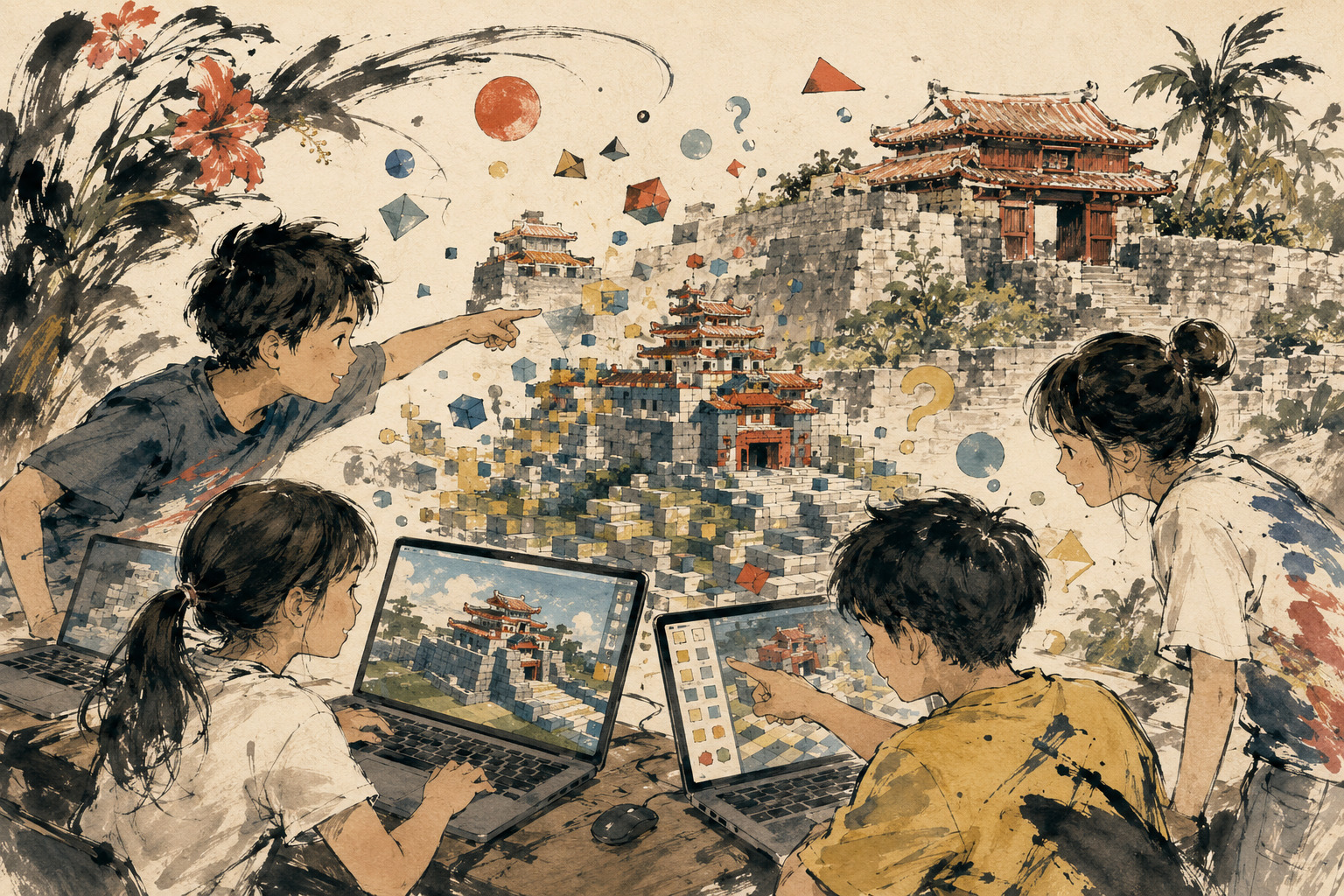
On a limestone hill in central Okinawa, a child can look at a park, houses and ordinary streets and ask an extraordinary question: where did the castle go? The answer is not waiting intact behind a gate. Much of the hill itself was altered. The walls and arched entrance once remembered there are largely gone. A monument and places of prayer remain, while the shape of the old gusuku survives in excavated traces, historical texts, photographs, songs and community memory.
That absence is now the raw material for a game. The Goeku White Camellia Association, or Goeku Shirotsubaki-kai, is leading a project in which local children build Goeku Gusuku in Teravit, a free-to-play Japanese sandbox game. CyberStep, the game’s developer, prepared a work area based on the site’s terrain. Children can place blocks and parts, modify a world and make playable experiences without beginning with conventional code.
The initiative did not begin with a software company arriving to invent a local cause. It grew from decades of community work. Families at Goeku Elementary made two handmade picture books about the site 31 years ago. In February 2026, the White Camellia Association completed a new 250-copy manga, Goeku Gusuku: The Great People of Goeku, after more than a year and a half of work supported by donations from 57 individuals and 16 businesses. The game is the next medium in that chain.
From community café to virtual hill
CyberStep announced its participation after a May 28 briefing at Goeku Community Center for residents, children and project members. The company donated devices and said that continuing workshops would be held alongside Goeku Café, a children’s meal and community program run by the neighborhood association. Students from the IT Systems Department at Mirai Technical High School were expected to help younger participants.
At a June 24 hands-on session, children and parents worked with Teravit producer Tokuya Saitō. Former SPEED member Takako Uehara, serving as a Teravit ambassador, and members of Mirai Technical High School’s game-production club joined the support team. One five-year-old participant told the Ryukyu Shimpo that building a bridge was fun. The small remark captures the method: a child does not have to begin by reciting dynasties. A bridge creates a practical question—what did it cross, where did it lead, and do we know that it existed?
A later company notice listed another two-hour session on July 31 for 20 children who use the community center. Organizers said work would continue toward a presentation at the Okinawa City Welfare Festival in November. At the time of publication, public materials did not provide a final map, a completed-game release date or evidence that the world had been historically validated. “In progress” is therefore the accurate description.
| Project step | What a child does | Digital skill | Historical discipline |
|---|---|---|---|
| Ask | Starts with a local puzzle: why is this place called Castle-front when so little castle is visible? | Frames a problem and breaks it into answerable parts. | Distinguishes a question from an answer inherited by repetition. |
| Collect | Uses the manga, site map, museum pages, old images, objects and elders’ accounts. | Searches, organizes and credits information. | Compares sources made at different times for different purposes. |
| Model | Places terrain, paths, walls, buildings and objects in the game world. | Practices scale, coordinates, spatial reasoning and iteration. | Marks what is excavated, documented, remembered or imagined. |
| Make rules | Turns a question into a quest, choice, trigger or puzzle. | Uses sequence, condition, cause and feedback—the grammar of computational thinking. | Avoids making a dramatic but uncertain story the only possible outcome. |
| Test | Lets another child play and watches where the experience fails. | Debugs both the system and the instructions. | Checks whether a player can separate fact from interpretation. |
| Publish | Presents the world to families and the city. | Explains design decisions and works collaboratively. | Provides sources, uncertainty labels and a route back to the real site. |
Why “gusuku” means more than “castle”
English often renders gusuku as “castle,” and the shorthand is useful. It can also make an Okinawan site look like a smaller version of a Japanese keep. Gusuku developed through Ryukyuan history as fortified settlements and elite strongholds, but many also contained or remained associated with sacred places. Their high ground, curving limestone walls, courts and worship sites joined political power, defense, exchange and ritual rather than separating them into modern categories.
Okinawa Prefectural Museum notes that gusuku origins can be traced to around the 13th century. From the late 14th to early 15th centuries, they became more fully developed fortifications as Shō Hashi consolidated royal power. UNESCO’s World Heritage account describes more than 300 gusuku and related sites across Ryukyu, while only five castle sites—Nakijin, Zakimi, Katsuren, Nakagusuku and Shuri—are components of the inscribed property.
Goeku is not one of those World Heritage components. Its national protection comes through a different designation. On Oct. 16, 2019, Goeku Gusuku was added to Amamikunomui, a nationally designated Place of Scenic Beauty linking sacred sites associated with the Ryukyuan creation deity Amamikyu. That status matters because the site is not only a vanished piece of military architecture. The worship places in today’s park continue a sacred and communal history.
A digital wall is easy to build. The harder design problem is showing that a gusuku was at once a stronghold, a residence, a landmark, a sacred place and a node in an island world.
The hill called Giiku Gusuku
Okinawa City’s heritage account gives the local name as Giiku Gusuku. It stood on a limestone ridge around 80 meters above sea level. Elders recalled a summit higher than the ground visible today and a view toward the eastern sea. That vantage point helps explain the site’s regional importance without requiring a child’s model to invent towers.
Excavation supplies a firmer layer. The city reports remains of buildings and hearths from the 14th and 15th centuries, tombs, imported ceramics, fragments of bronze mirrors and stone magatama beads. A 2012 city report on the third excavation also recorded pottery and ceramics from the 12th through 15th centuries, shells, animal bones and human remains; seven individuals had been found in the prior year’s work. These objects place Goeku inside networks of eating, building, burial, ritual and overseas exchange.
The written and remembered layer is different. Goeku appears in Omoro Sōshi, the Ryukyu Kingdom’s old anthology of sacred songs, where it is praised as a gusuku made by Amamikyu. Historical tradition connects the place to two future kings: Shō Taikyū of the First Shō dynasty and Shō Sen’i of the Second. Okinawa City uses careful wording—each ruled the Goeku territory as a prince, and each may have lived at the gusuku. A game should keep that verb.
| Layer of knowledge | What it can support in the game | What remains uncertain |
|---|---|---|
| Archaeology | Occupied zones, dates, hearths, burials and the presence of particular object types. | The full height and appearance of buildings, daily conversations and exact uses of every room. |
| Topography | A limestone hill, approximate elevation, sightlines and relationships to surrounding ground. | The ridge’s pre-development profile in every period. |
| Texts and songs | Names, praise language, political associations and a sacred genealogy. | Whether poetic or later historical narratives describe events literally. |
| Photographs and maps | Features visible before major postwar alteration, routes and later change. | Parts outside the frame and structures already altered before the image was made. |
| Community memory | Place-names, practices, routes, stories and how residents value the site. | Precise dating; memories can compress several generations or versions. |
| Creative design | Quests, guides, dialogue, bridges and alternative ways to explore. | It is not evidence unless tied to a cited source. |
A royal age made of conflict and exchange
Goeku’s most vivid political associations lie in the volatile 15th century. Shō Hashi defeated Hokuzan in 1416 and Nanzan in 1429, forming a unified Chūzan-centered kingdom. Unification did not end conflict. Okinawa Prefectural Museum describes the First Shō dynasty as an era of expeditions, powerful regional lords and short reigns. A succession struggle in 1453 reportedly burned much of Shuri Castle. In 1458 came the conflict remembered through the intertwined stories of Gosamaru and Amawari.
Shō Taikyū became the sixth king of the First Shō dynasty after the 1453 crisis. Goeku’s community manga makes him a guide for present-day children and introduces figures including his daughter Momoto Fumiagari and the warrior Uni-Ufugushiku. Those are compelling narrative anchors, but sources about the period do not all carry equal weight. Contemporary Chinese or Korean diplomatic records, later royal genealogies, chronicles, sacred songs and oral traditions answer different questions. The manga’s creators worked with specialists and revised the book repeatedly—exactly the editorial habit a game project needs.
Shō Sen’i belonged to the dynasty that followed. He was the younger brother of Shō En, received Goeku as a territory and succeeded to the throne in 1477, but reigned only about six months before yielding to Shō Shin. The city preserves a tomb associated with him in the Goeku area. Two dynasties thus touch the same local name, but the stories should not be blended into one household or one moment.
13th century — Gusuku emerge across the Ryukyus; their functions develop with farming communities and regional lords.
14th–15th centuries — Archaeology at Goeku records buildings, hearths, burials and imported goods.
1416 / 1429 — Shō Hashi defeats Hokuzan and Nanzan, consolidating a unified royal state.
1453 — A royal succession struggle burns Shuri and opens the way to Shō Taikyū’s accession.
1458 — The Gosamaru–Amawari conflict becomes a defining and later much-retold episode of Shō Taikyū’s reign.
1469–70 — The First Shō line falls; Shō En establishes the Second Shō dynasty.
1477 — Shō Sen’i briefly reigns and then returns to Goeku, according to the city’s heritage account.
Post-1945 — Roads, military development and other construction substantially alter the hill and dismantle remaining stonework.
1985, 2010–11 — Major archaeological investigations document surviving evidence.
2019 — Goeku Gusuku joins the nationally designated scenic place Amamikunomui.
2026 — A community manga and children’s Teravit project carry the site into two new storytelling forms.
The second disappearance came after the war
Goeku’s loss is easy to oversimplify. Regional headlines have called it a castle destroyed in the Battle of Okinawa. Community and municipal accounts describe a more extended process: walls and an arched gate survived into the prewar period, while postwar U.S. military-road and base-related work and other development cut down stonework and changed the hill. Houses and a park now occupy land that was once part of the site.
The distinction matters. If the game says “the castle vanished in one battle,” it turns a layered history of war, occupation and postwar construction into a single explosion. If it simply builds the hill as if nothing happened after 1450, it erases the people who lived around, prayed at and remembered the changed place. A strong version could let players switch time layers: archaeological period, photographed prewar landscape, postwar transformation and the present park.
The surviving absence also explains the project’s emotional force. Nakagusuku or Katsuren can teach through massive walls underfoot. Goeku asks residents to defend a place whose material evidence is harder to see. The game gives volume to memory, but it should also bring attention back to the actual monument, worship sites and altered terrain rather than replacing them with a cleaner virtual copy.
When building a game becomes historical thinking
Playing an educational game can reward recall. Making one demands something else. A designer must decide what a player can do, what causes an event, which objects matter, how space guides attention and what counts as success. Every rule is an argument. A locked gate says access was controlled; a trade quest says imported ceramics belong to exchange; a sacred-site mechanic says the hill cannot be treated only as a battlefield.
This is close to the educational idea of constructionism: people build knowledge while making a public object that can be tested, discussed and revised. Japan’s education ministry treats information literacy—including computational thinking and using ICT—as a foundation across subjects. Its elementary programming guidance says programming experiences should sit meaningfully inside inquiry rather than become isolated exercises. The Goeku project is a community program, not a formal curriculum trial, but it fits that logic unusually well.
Research supports possibility, not automatic success. A 2023 meta-analysis of 24 studies and 2,134 participants found an overall positive association between game-based learning and computational thinking, with substantial variation. A study of 29 young people designing place-based mobile games found that making stories about local environmental and civic issues elicited computational practices. Neither proves that this specific Okinawa workshop improves scores. They explain what to measure.
The learning is not hidden inside the blocks. It happens when a child asks for evidence, turns an idea into a rule, watches it fail for another player and revises both the code and the claim.
Four labels that protect the past
The London Charter, an international set of principles for computer-based cultural-heritage visualization, offers a practical rule: identify and evaluate sources, document the method, and tell users whether they are seeing an existing state, evidence-based restoration or hypothetical reconstruction. That standard can be made child-friendly.
| In-game label | Meaning | Example at Goeku | How it could appear |
|---|---|---|---|
| Found | Supported directly by excavation or a surviving feature. | Hearth traces, imported ceramic types, burials or a present worship place. | Solid marker with a link to the museum or excavation record. |
| Recorded | Visible in a historical image, map or reliable written source. | A prewar wall line or arch shown in documentation. | Striped marker naming the date and source. |
| Remembered | Preserved in oral history, sacred song or local tradition. | The higher summit, eastern view or association with Amamikyu. | Voice or song icon identifying the type of tradition. |
| Imagined | Added to make the world playable where evidence is absent. | Exact room interiors, dialogue, invented bridge or fantasy quest. | Bright creative marker and an invitation to propose alternatives. |
These labels do not drain fun from a game. They create a second game: evidence detective. Children can earn recognition for improving a source note, finding a contradiction or building two plausible versions. Uncertainty becomes a feature rather than an embarrassment.
The same discipline protects living culture. Sacred places should be modeled only with guidance from their custodians; restricted knowledge should not be opened merely because a platform makes publishing easy. Children’s names, faces, chat and location data need adult oversight. Project files should be exported or documented so the work survives a device failure, account closure or future platform shutdown.
How to know whether the project worked
A crowded workshop and a colorful world are outputs, not proof of learning or heritage preservation. The November presentation can be a checkpoint if organizers ask better questions. Can participants explain one object from excavation? Can they distinguish Shō Taikyū from Shō Sen’i? Can they point to one part of the world that is hypothetical? Did younger children make consequential design choices, or merely place decorative blocks selected by adults?
- Historical literacy: Before-and-after prompts test whether children can separate artifact, text, memory and invention.
- Digital making: Portfolios show planning, rules, testing, debugging and revision—not only a final screenshot.
- Authorship: Credits identify children’s design decisions, high-school mentoring, historians’ review and community sources.
- Access: Sessions include children without home devices, with suitable controls and alternatives for different ages and abilities.
- Heritage return: The game leads players to the real site, museum material and manga, while respecting worship places.
- Durability: Source lists, maps, screenshots and playable files have an archive plan independent of one commercial account.
There is also a governance question. CyberStep supplies useful software, expertise and devices, but Teravit is a commercial service with in-game item sales and publicly shareable worlds. Organizers should make clear who owns the children’s work, whether a world will be public, what accounts are used, how moderation works and whether participation creates any pressure to spend. Community stewardship is strongest when it can accept corporate help without surrendering editorial control of local history.
A castle made of questions
Goeku has already moved through several forms of memory: sacred song, genealogy, oral account, archaeological report, handmade school picture book, manga, monument and commemorative castle seal. The game does not replace those forms. It can connect them. An imported ceramic fragment can become a trade puzzle; an old photograph can constrain a wall; a grandparent’s account can open a remembered route; an excavator’s uncertainty can produce two alternative worlds.
The most interesting result may not be a finished castle at all. It may be a child who learns to look at an ordinary park and see several times at once: the limestone ridge, a prince’s possible residence, a sacred landscape, a dismantled postwar site and a present neighborhood still deciding how to remember.
A vanished wall cannot be restored by stacking digital blocks. But the habit required to care for it can be built: ask what stood here, find who knows, check the evidence, show the uncertainty, make something others can enter—and leave them a better question.
- CyberStep Holdings, announcement of the Teravit–Goeku Gusuku history-transmission project, June 8, 2026
- Ryukyu Shimpo, report on the June 24 game-making workshop, July 2, 2026
- CyberStep Holdings, summer workshop schedule and Smile Step program, Aug. 5, 2026
- Okinawa City, designated cultural property record for Amamikunomui (Goeku Gusuku)
- Okinawa City, Goeku Gusuku and Surrounding Cultural Properties Map
- Okinawa City newsletter, report on the 2011–12 excavation and finds
- Okinawa City, history and continuing traditions of the Goeku neighborhood association
- Ryukyu Shimpo, the community manga and its 31-year picture-book background, April 2, 2026
- Okinawa Prefectural Museum & Art Museum, curator’s history of the First Shō dynasty
- Okinawa Prefectural Museum & Art Museum, overview of gusuku development in the 13th–15th centuries
- UNESCO World Heritage Centre, Gusuku Sites and Related Properties of the Kingdom of Ryukyu
- Ministry of Education, Culture, Sports, Science and Technology, information literacy as a cross-curricular foundation
- MEXT, third edition of the elementary programming-education guide
- The London Charter for the Computer-based Visualisation of Cultural Heritage
- Lu et al., meta-analysis of game-based learning and computational thinking, 2023
- Dahya et al., place-based mobile-game design and youth computational thinking, 2020
Editor’s note: This article is based on public releases, local reporting, municipal heritage records and the cited scholarship; it does not include original interviews. “Rebuilding” refers to a creative digital world, not physical reconstruction or a validated archaeological model. Public sources confirm the May briefing, June workshop, later listed July session and planned November presentation, but did not provide a final game or outcome evaluation by publication time. Historical claims are worded to preserve the difference among excavation, written record, oral tradition and inference. The exchange-rate strip is an editorial market reference unrelated to the project.