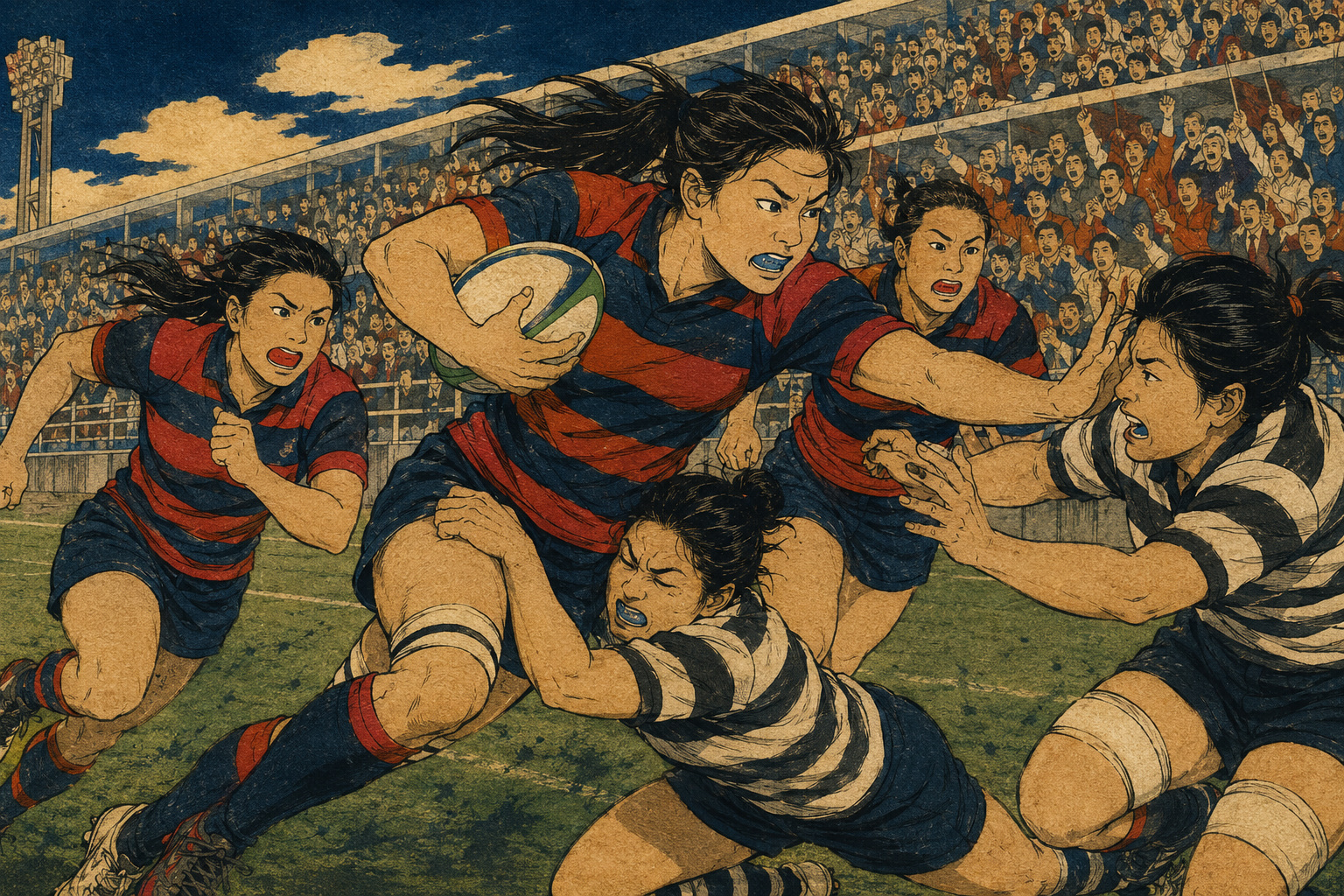
Most of the machinery of a tournament exists to avoid ambiguity. Pools produce rankings. Rankings create brackets. Scoreboards count points. Yet at the Kyushu women’s rugby sevens qualifier, the last national place came down to a rule reserved for the final and a score that would not survive its own announcement.
Fukuoka and Kagoshima finished regulation tied 17–17 on Aug. 23 at the officially styled Niterra日特スパークテックWKS公園 かぐや姫グラウンド in Satsuma, Kagoshima Prefecture. Under the event regulations, a final still level after the prescribed countbacks enters extra time. A new toss is held, play resumes one minute later, and the first score—a drop goal, penalty goal or try—ends the contest.
Fukuoka scored a try. The Kyushu Rugby Football Union’s published result records 22–17 and a final try count of four to three. It does not identify the scorer, the origin of the possession or the sequence that opened the space. The absence of a play-by-play leaves no responsible way to manufacture a heroic break. The official record gives something more austere: one try, then qualification.
The destination is the 80th National Sports Festival, branded in English by the Japan Sport Association as the Japan Games. The women’s seven-a-side competition at the Aono Kirameki Aomori Games is scheduled for Oct. 16–19 at Prifoods Stadium in Hachinohe.
How four games became one place in Aomori
The format made the first day matter without allowing it to settle the outcome. Eight prefectures were divided into two linked pools. Each team played twice on Aug. 21, receiving three table points for a win, two for a draw and one for a loss. Those standings seeded two knockout sections two days later.
Fukuoka opened by beating host-prefecture Kagoshima 26–7, then shut out Okinawa 38–0. Saga also went 2–0 in Pool A, but Fukuoka’s 64 points scored, seven conceded and plus-57 differential placed it first, ahead of Saga’s plus-43.
In the Part A semifinal, Fukuoka overwhelmed Kumamoto 47–0. Kagoshima reached the other side of the final after drawing Nagasaki 17–17 and advancing by lottery, as shown on the official bracket. The final returned Fukuoka to the opponent it had beaten two days earlier. This time Kagoshima held the score level through 14 regulation minutes.
The rematch is a useful warning about sevens. A 19-point pool victory is not a deposit that can be withdrawn in the knockout stage. Possession changes fast, the field punishes one late decision, and a short match offers little time to absorb an early mistake. Kagoshima moved from a 26–7 defeat to within the next score of the national event. Fukuoka supplied that score.
| Stage | Opponent | Score | Consequence |
|---|---|---|---|
| Pool, Aug. 21 | Kagoshima | 26–7 | Three table points |
| Pool, Aug. 21 | Okinawa | 38–0 | First in Pool A on points differential |
| Part A semifinal, Aug. 23 | Kumamoto | 47–0 | Advanced to the qualifying final |
| Part A final, Aug. 23 | Kagoshima | 22–17 | Extra-time try secured national berth |
The peculiar justice of a final
The qualifier’s tie procedure makes the last match different from every knockout match before it. Ordinarily, a tied game is decided first by tries scored, then penalty tries, then conversions after tries. If those measures remain equal, a lottery determines which team advances. That is how two drawn semifinals on the women’s bracket were resolved: Kagoshima over Nagasaki in Part A, and Saga over Oita in Part B.
Only a part final keeps the decision on the field beyond those countbacks. The teams toss again, begin after a one-minute interval, and play up to two three-minute periods without halftime. The first score wins. If neither side scores across all six minutes, the regulations return to a lottery.
At 17–17, Fukuoka and Kagoshima were level not only in points but, before extra time, in tries. Fukuoka’s extra score made the published try count 4–3. It was worth five scoreboard points and an entire season’s next destination.
Ten selected, seven at once
Each prefecture could enter ten players and one coach. Seven normally take the field; the event allowed a match to begin with no fewer than five, including three players in the scrum and two backs. Halves lasted seven minutes, halftime no more than two. A team had at most five substitution or replacement events, extra time included.
The women’s category was not an “adult women” division. Eligibility extended to anyone born on or before April 1, 2011, including first-year high school students subject to the required institutional approval. Mouthguards were compulsory for all women, while players under 19 also had to wear World Rugby-marked headgear.
The late-August setting shaped the schedule as well. The organizers left 1–3 p.m. free of matches, inserted water breaks and retained authority to add heat precautions. Pool play began at 3 p.m. These are not decorative provisions: sevens repeatedly asks players to accelerate into contact while defending far more space per person than in the 15-a-side game.
The official program names coach 平野 勉 and ten Fukuoka players: 吉本 芽以, 高崎 真那, 西郷 侑菜, 神谷 桃子, 中山 花のん, 藤田 野愛, 川島 朱莉, 田中 芽衣, 中園 真優佳 and 江島 美優. The program supplies neither readings nor club affiliations, so this article preserves the official Japanese orthography rather than inventing romanizations. It also does not publish a starting seven or attribute tries: the public record does not provide that information.
- Four wins and 133 points establish sustained scoring across two days.
- Two shutouts establish that opponents were denied points in half the matches.
- The 17–17 regulation final shows the early margin over Kagoshima did not carry over automatically.
- No public breakdown supports claims about tackles, turnovers, restart retention, possession or an individual leading scorer.
Before there was a national pathway
The Japan Rugby Football Union dates the serious organized beginning of women’s rugby in the country to 1983, when teams emerged at roughly the same time in Tokyo, Nagoya and Matsusaka. The first matches between women’s teams followed in 1984, involving Setagaya Ladies, Brother Industries Ladies—later Nagoya Ladies—and Matsusaka Ladies.
Those pioneers were not stepping into an inherited women’s competition. They were creating opponents, administration and reasons for institutions to recognize them. In April 1988, the Japan Women’s Rugby Football Federation was founded. On Nov. 3 that year, the first Women’s Rugby Exchange Tournament took place at an auxiliary ground in Tokyo’s Komazawa Olympic Park. Players helped run the event as well as compete in it.
The geography recorded in the JRFU history gives Fukuoka’s 2026 trip unusual resonance. Participants came to that first exchange from Fukuoka and from Hachinohe and Towada in Aomori, among other places. Thirty-eight years later, a Fukuoka prefectural team will travel to Hachinohe not in search of a first network, but as a formally qualified entrant in a national multisport competition.
Institutional recognition arrived in stages. The JRFU recognized the women’s federation as an affiliated body in 1997 and admitted it formally in 2002. In December 2014, the Japan Sport Association approved women’s rugby sevens as an official event beginning with the 2016 National Sports Festival in Iwate. The decision formed part of a program to strengthen women’s and junior events ahead of the Tokyo Olympics.
1983 Organized women’s teams emerge in Tokyo, Nagoya and Matsusaka.
1984 The first women-against-women matches are played.
1988 A national federation forms and stages the first exchange tournament.
1997 / 2002 The JRFU recognizes the federation, then accepts it formally.
2016 Women’s sevens becomes an official National Sports Festival event.
2024 The event adopts its new Japanese name, Kokumin Sports Taikai, and the English brand “JAPAN GAMES.”
2026 Fukuoka qualifies for the 80th edition in Aomori.
A recent national champion, not an automatic qualifier
Fukuoka arrives in the 2026 field with recent national weight. Its women won the SAGA2024 Japan Games. In 2025, they finished second as Yamaguchi took the women’s title at the Watashiga Kagayaku Games in Shiga. Fukuoka’s junior boys also placed second that year, helping the prefecture finish first in rugby’s combined competition standings and receive the Emperor’s Cup.
That sequence—champion, runner-up, qualifier again—suggests continuity without making the 2026 side identical to its predecessors. The available 2026 program gives names but no club affiliations or comparison with earlier national rosters. A prefectural entry can change from year to year; success belongs to the selected team in that competition, not to an immutable lineup.
There are signs of activity below senior representative level. The Fukuoka Rugby Football Union records Fukuoka Ladies Rugby Football Club winning the ninth Kyushu junior-high-school girls’ tournament in July 2026. That result does not prove a pipeline into this ten-player prefectural squad. It does show that girls in the prefecture have a regional competitive structure from which longer careers can be built.
The distinction matters in coverage of women’s sport. A headline result can make a program appear suddenly successful; a roster without affiliations can make the people and institutions behind it disappear. Publishing youth results, club pathways and accurate player biographies is not secondary to the result. It is how a public understands whether an ecosystem exists beyond one weekend.
Why “National Sports Festival” and “Japan Games” both appear
Japan’s long-running prefecture-versus-prefecture event changed its Japanese name in 2024, from Kokumin Taiiku Taikai to Kokumin Sports Taikai. Both are commonly rendered as National Sports Festival, while the Japan Sport Association adopted “JAPAN GAMES” as the official English styling and Kokuspo as the new Japanese abbreviation.
The revised label did not remove the competition’s defining structure. Prefectures still select teams, regional blocks still allocate places, and the host rotates. At the Kyushu rugby qualifier, uniforms were required to identify the prefecture on the chest. The shirt makes visible what the bracket is measuring: not merely club against club, but one prefectural selection against another.
That is also why the phrase “Fukuoka won Kyushu” needs qualification. The women’s event was designed to produce two representatives, not one overall winner. Fukuoka’s Part A victory and Saga’s 17–0 Part B final win over Miyazaki are equal routes into the national tournament.
What waits in Hachinohe
The Hachinohe organizing committee lists women’s and adult men’s rugby sevens for Oct. 16–19 at Prifoods Stadium. As of Aug. 25, the national draw, Fukuoka’s final event roster and its first opponent had not been published. Qualification is settled; the competitive map is not.
Fukuoka’s Kyushu record offers strengths for opponents to respect: scoring across four matches, defensive shutouts and the ability to win after a tied regulation final. It does not answer how those numbers will translate against champions from other regional blocks. National sevens compresses preparation into short, high-consequence matches, and the margins can be a restart, a penalty or one unsupported carry.
In 1988, women from Fukuoka and Aomori had to converge on Tokyo to make a national gathering real. In 2026, the competition travels to Aomori with a legal identity, a numbered edition, a qualification system and a stadium schedule. The institutions are larger now. The decisive act remains elemental: secure the ball, find the space, cross the line.
Fukuoka earned the opportunity to do that in Hachinohe because its final in Kagoshima did not end at 17–17. The score after the score was the one that opened October.
- Kyushu Rugby Football Union — 2026 National Sports Festival Kyushu Block Tournament results
- 46th Kyushu Block Tournament Kagoshima Organizing Committee — official rugby program and regulations
- Fukuoka Rugby Football Union — 2026 qualification, 2025 national and local competition records
- Aono Kirameki Aomori Hachinohe Organizing Committee — rugby sevens schedule and venue
- Aono Kirameki Aomori Organizing Committee — 80th National Sports Festival overview
- Japan Sport Association — National Sports Festival overview and 2024 name change
- Japan Sport Association — 2014 decision to add Olympic women’s events in 2016
- Japan Rugby Football Union — the beginnings of Japanese women’s rugby, 1983–88
- Japan Rugby Football Union — first Women’s Rugby Exchange Tournament, 1988
- Japan Rugby Football Union — institutional history of women’s federation recognition
- Japan Rugby Football Union — SAGA2024 Japan Games rugby results
- Japan Rugby Football Union — 2025 Watashiga Kagayaku Japan Games rugby results
Editorial note: Tournament title, venue, scores, format, qualifying allocation, entry list, eligibility and safety rules were checked against the organizer’s results and official program. Japanese personal names are retained in the official script because the program provides no readings; no romanization has been inferred. The public record does not identify try scorers, match-day selections or play statistics. “Winner” is qualified as Part A winner because the women’s event awarded two equal Kyushu berths. The illustration is conceptual. The supplied exchange-rate update of Aug. 25 at 7:48 p.m. UTC converts to Aug. 26 at 4:48 a.m. JST.