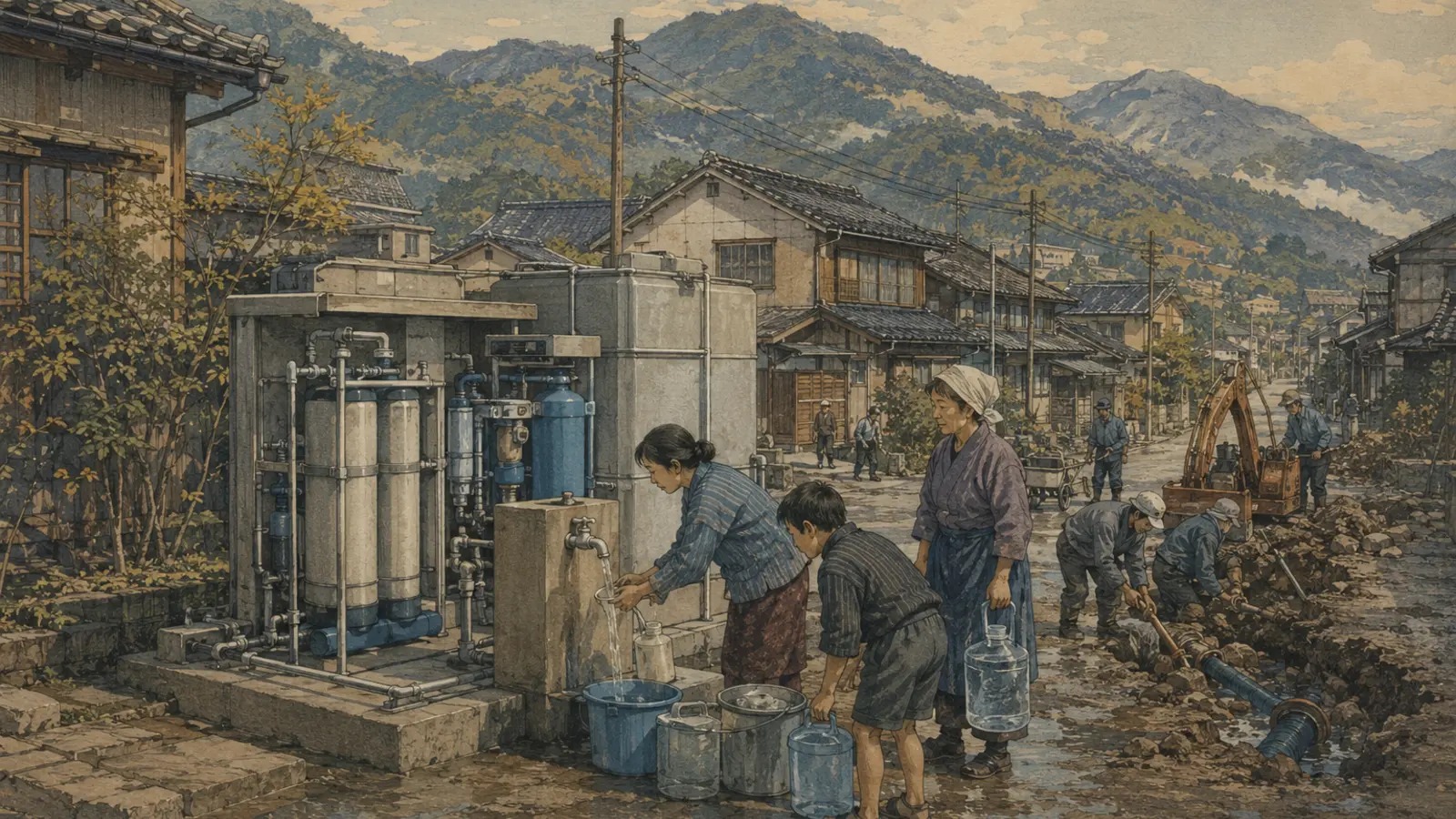
In an evacuation shelter without running water, the first person steps into a shower. The water does not disappear down a sewer after one use. It returns to a machine, passes through treatment and monitoring, and emerges for the next shower. Roughly 100 liters can support about 100 showers, according to WOTA. A conventional arrangement would consume approximately 5,000 liters.
That calculation changes the logistics of disaster relief. It does not make water from nothing. Soap, skin oils and hair still have to go somewhere. The unit uses electricity. An operator must clean drains, inspect and replace filters, disinfect the equipment and follow a storage procedure after the last shower. A decentralized water system is not the absence of infrastructure. It relocates treatment, monitoring and maintenance from the distant utility to the place where the water is used.
That distinction sits at the center of WOTA’s larger ambition. The Tokyo company, founded in 2014, built its public record with portable showers and handwashing stations after earthquakes and floods. It now wants to apply the same basic principle—circulating a small amount of water many times—to permanent homes and communities where population decline makes long pipelines increasingly difficult to renew.
Japan’s Ministry of Land, Infrastructure, Transport and Tourism is also promoting a “best mix” of centralized and decentralized water services. The question is no longer whether the country’s great postwar water network was a success. It was. The question is how much of that system can be rebuilt in the same form for the next 50 years when the network covers almost the same territory but has fewer customers and less fee revenue.
The triumph of water everywhere
Modern waterworks changed Japanese cities that had been vulnerable to infectious disease and fire. During the postwar growth decades, dams, treatment works, reservoirs, pumping stations and underground pipes expanded at extraordinary speed. The network eventually delivered pressurized, treated water around the clock to nearly every household. By the end of fiscal 2023, water-supply coverage stood at 98.2 percent.
Centralization has enduring strengths. A large plant can treat a great volume of raw water under professional supervision. Operators can monitor quality continuously. Costs and risks are shared among many users. In a dense city, one pipe may serve apartment towers, hospitals, factories and fire hydrants. The scale is usually more efficient than installing a separate treatment device in every home, and the utility provides a recognizable line of public responsibility.
But much of the system was designed during an era when planners expected demand and population to rise. Pipes do not automatically become shorter when residents leave. A pump that pushes water uphill, a main that crosses a valley and a reservoir serving a few scattered households remain physical obligations. Revenue falls; the geography does not.
The timing problem extends to wastewater. Japan had about 500,000 kilometers of sewer pipe at the end of fiscal 2023, according to the infrastructure ministry. Approximately 40,000 kilometers had passed the standard 50-year service life. The ministry projects the total will rise to about 100,000 kilometers in 10 years and 210,000 kilometers in 20. Around 2,000 of the country’s roughly 2,200 sewage-treatment plants already have mechanical or electrical equipment beyond the standard 15-year service life.
When the arithmetic changes at the edge
The national government’s 2026 planning guide describes the geography of the problem in three numbers. It tells utilities to give priority to evaluating decentralization in areas with a present or projected service population of 100 or fewer, 30 meters or more of pipe per resident, and at least half of pipes beyond their legal service life or of unknown age.
Those are screening indicators, not an order to abandon any community that falls below 100 people. A mountain water source, elevation, snow, the spacing of houses, elderly residents, firefighting needs, seasonal tourism and population forecasts all shape the decision. The guide asks utilities to compare cost, maintenance, water quality, disaster resilience, community effects and environmental impact. Its current options include small local treatment works and water delivered to shared storage tanks.
The exclusion of household recycling from that guide is just as important as the government’s interest in decentralization. A public drinking-water service must work not only on a clear day during a demonstration but after a freeze, power failure, erroneous chemical discharge, long absence, sensor fault and supply-chain disruption. If the device has a shorter life than a buried main, somebody must be responsible for replacing it—again and again—over the life of the community.
| Model | Primary strength | Condition that cannot be ignored |
|---|---|---|
| Large centralized water and sewer network | Professional control, high capacity and economies of scale in cities | Renewing long pipes, seismic upgrades and rising cost per customer |
| Small local plant or communal tank | Can reduce long-distance mains and fit a compact settlement | Delivery logistics, daily tests, chlorine control and local staffing |
| On-site water recycling | Reuses a small supply and can remain useful during a network outage | Power, filters, cleaning, monitoring, residual waste and liability |
| Centralized-decentralized “best mix” | Keeps the network where density supports it and adds alternatives at the edge | More complex governance, fair pricing and clear boundaries of responsibility |
Turning 100 liters into 100 showers
WOTA’s technology is easier to understand when its portable and permanent systems are separated. WOTA BOX is a transportable shower-water recycling system intended for evacuation centers, work sites and events. WOTA says it can recover up to 98 percent of water, allowing approximately 100 showers from about 100 liters. The company says two adults can set it up in roughly 15 minutes without specialist plumbing.
That portability matters when roads and utility lines are damaged. Water is heavy. The approximately 5,000 liters ordinarily associated with 100 showers weighs five metric tons. In a disaster zone, that load competes for trucks, fuel and road space with drinking water, medicine and food. Circulation can dramatically reduce the daily delivery burden.
WOTA Unit is the company’s permanent concept for houses and small facilities. It treats graywater from activities such as showering, cooking and laundry, then supplies treated water for bathing, dishwashing and clothes washing. WOTA claims a recovery rate of up to 97 percent and says sensors measure water and operating conditions while software adjusts treatment automatically. A listed domestic-water module runs on 100-volt electricity, averages 105 watts and combines a 150-liter base tank with an optional 500-liter tank.
There is an essential boundary. Toilet waste is separated from the domestic-water loop; in proposed configurations, its treated output is used for toilet flushing. A self-sufficient home that includes drinking water requires a separate system to turn rainwater or another source into potable water. WOTA describes that part of the system as under development and demonstration. “Up to 97 percent” does not mean zero replenishment, zero waste, or that every liter from the household loop is automatically drinking water.
- Makeup water: Rainwater or another source to replace evaporation, carryout, cleaning and process losses.
- Electricity: For pumps, sensors, controls, disinfection and communications—with backup power for outages.
- People: To remove hair and debris, replace filters, clean the machine and respond to failures.
- Monitoring: A system that detects unsafe conditions, stops operation, alerts users and verifies recovery.
- An outlet: Safe disposal for concentrated contaminants, used filters and separated toilet wastewater.
Disasters were the first proving ground
WOTA was established in 2014. Its portable shower equipment was deployed after the 2016 Kumamoto earthquake, the 2018 Western Japan floods and the 2018 Hokkaido Eastern Iburi earthquake. A man in his 70s told the company after using a shower in Hokkaido that it made him feel able to keep going the next day. The statement captures something emergency statistics often miss: water is not only for survival. The acts of washing, changing clothes and sleeping clean help restore the outline of ordinary life.
The largest test came after the Noto Peninsula earthquake on January 1, 2024. WOTA says its field operations began on January 4 and drew equipment loaned by municipalities and businesses around Japan. At the peak, roughly 100 WOTA BOX shower units and 200 WOSH recirculating handwashing units were operating across the peninsula. Shower support continued for almost a year, ending at Suzu’s Otani elementary and junior high school on December 27, 2024.
According to WOTA’s own accounting, the effort at one stage covered 89 percent of shelters experiencing extended water outages and 68 medical and welfare institutions. Those are company figures, not a national independent audit. Even so, multi-site operation over many months is meaningful evidence that the machinery can do more than stage a short demonstration.
Noto also exposed a logistical weakness. No WOTA equipment was positioned on the peninsula on the day of the earthquake. Units had to be gathered, transported and installed after roads had already been damaged. A compact machine that arrives two weeks later cannot help during the first two weeks.
That experience encouraged a mutual-aid model: distribute equipment around the country in normal times and move it across prefectures when disaster strikes. The Japan Water-Loop Alliance for Disasters is developing regional arrangements for sharing units. Nanao, one of the cities hit by the Noto earthquake, acquired four WOTA BOX units and 12 WOSH stations for shelters. The National Police Agency acquired 18 WOTA BOX units in 2026 for specialized disaster-response teams.
2014 · WOTA is founded.
2016 · Portable shower support follows the Kumamoto earthquake.
2018 · Systems are deployed after the Western Japan floods and Hokkaido earthquake.
2024 · Noto becomes WOTA’s largest and longest disaster deployment.
2025 · The company promotes full-environment trials of WOTA Unit and announces its Water 2040 Fund concept.
March 2026 · The infrastructure ministry publishes its guide for evaluating decentralized water supply.
July 2026 · WOTA announces WOTA Duo, a planning service for comparing network and decentralized costs.
From emergency machine to everyday utility
An emergency device will not become reliable infrastructure if it only waits in a warehouse. Nobody learns its maintenance routine, and batteries, filters or software may be unready when the earthquake comes. WOTA’s “phase-free” strategy is to use the equipment in ordinary life so it can become emergency capacity without a cold start.
At an elementary school in Takehara, Hiroshima Prefecture, a simplified WOTA Unit ER entered a trial in 2026 as an everyday handwashing station. During an outage, it is intended to support washing and showers. The ordinary use builds familiarity; the emergency use provides redundancy.
The more consequential trial is taking place in Suzu, Ishikawa Prefecture, through the infrastructure ministry’s AB-Cross program. WOTA and the city are operating small residential water-recycling systems in multiple areas. The project is testing not just the equipment, but a planning method for deciding where centralized and decentralized services should meet. Reconstruction in Noto makes the question immediate: should every damaged pipe be restored to its former layout, or should the system be redesigned for the population that will actually live there?
WOTA Duo, announced in July 2026, is designed to make that choice visible on a map. It analyzes geographic information on facilities, pipes, meters and population projections, then estimates annualized life-cycle costs per meter and per household decades into the future. A utility can compare maintaining the central network with a mixed design.
WOTA said 10 municipalities had tried the service by the end of June, including Suzu, Yawatahama in Ehime Prefecture, Hamamatsu’s Tenryu Ward and Yasuoka in Nagano Prefecture. Tenryu manages 13 water facilities across a broad mountainous area. Yasuoka’s communities are scattered, making some pipe renewals unusually expensive.
The model’s value is its ability to reveal an expensive edge hidden inside a municipal average. An entire utility may appear financially sustainable even while one valley contains a very long main serving only a few homes. But the output is not a decision. WOTA itself cautions that it depends on assumptions and data. Water quality, safety, maintenance, local conditions and residents’ views must shape an actual plan. The cheapest option on a screen may be impossible for elderly residents to maintain in winter—or politically unacceptable if residents believe they are being cut loose.
Water quality must be protected by a system, not a claim
WOTA says water treated by WOTA Unit conforms to Japan’s 51 tap-water quality standards. Sensors and remote controls are central to the idea: they allow management once concentrated at a staffed treatment plant to be distributed among many small machines. But passing a test is different from guaranteeing safe operation across thousands of homes for decades.
Input changes by household and season. The system must recognize the day someone pours too much oil or a cleaning chemical down a drain, the period after a long vacancy, a fouled sensor and a lost data connection. It must fail safely. If it stops, another organization must deliver substitute water. Municipalities need an answer for machines whose manufacturer leaves the market or ends software support.
Remote operation creates a second infrastructure layer. Who owns a home’s water-use and quality data? Who can change the treatment settings? Can the machine operate safely if the cloud service or mobile network fails? Cybersecurity, software support and access logs become water-safety concerns, not merely information-technology details.
Water is not an ordinary appliance that consumers purchase entirely at their own risk. It is essential for drinking, bathing, sanitation and firefighting. Under a centralized model, the water utility is the visible party responsible for testing, billing, outage notices, repairs and compensation. With decentralized equipment, responsibility can fracture among the manufacturer, maintenance contractor, municipality, homeowner and data operator. Standards, certification, inspection frequency, emergency supply duties and public reporting therefore have to mature before mass deployment.
Cost is broader than the pipe
A plan that avoids replacing a long main can look compelling when construction cost is the only line in the comparison. A full account has to include the equipment, electricity, communications, filters, scheduled visits, laboratory tests, tank cleaning, waste disposal, replacement, emergency water and resident training. It must also recognize “stranded” central costs: a treatment plant and its trunk mains do not become free when a few distant customers leave the network.
Pricing raises a political problem. Japanese water users have collectively supported high-cost territory inside their utility area. If decentralization transfers those costs only to residents of a remote settlement, the system may become cheaper in total while the affected household pays more. If a utility promises to rebuild every pipe regardless of cost, all users may face higher rates and slower renewal. The decision is not simply which technology wins. It is how much of an essential service should be shared nationally, across a watershed, within a municipality or by the household.
The environmental balance is also not automatic. Recycling may reduce withdrawals, discharges and the energy used to pump water over long distances. Thousands of small machines, however, require materials, filters, electricity, service trips and eventual disposal. Claims about carbon and water savings should compare a decentralized system with a realistic pipe-renewal alternative over the same lifetime and under the same service standard.
The future is not “the water utility or WOTA”
There is little reason to replace dense urban networks in Tokyo or Osaka with a separate machine in every apartment. Hospitals, factories, high-rises and fire services demand stable volumes. In cities, the priorities remain renewing old mains, improving earthquake resistance, finding leaks and consolidating facilities.
Decentralization is most persuasive at the network edge: isolated settlements, islands, disaster zones where repairs will take years, places with volatile seasonal populations, and communities facing a new long-distance pipe. A permanent local loop can serve as everyday supply and emergency reserve. Portable equipment shared by neighboring prefectures can add resilience without duplicating an entire fixed network.
That future should not depend on WOTA alone. Japan needs multiple suppliers working to common standards, long guarantees for parts and maintenance, and independent comparisons by governments and research institutions. Systems should remain safe if one company’s cloud goes offline. Public reporting should include quality deviations, downtime, operating expense and user complaints—not only successful demonstrations and maximum recovery rates.
The 100 liters that circulated through showers in Noto offered a powerful proof. Reuse can bring bathing and handwashing beyond a broken road while reducing the burden of water deliveries. But one year of disaster service and 50 years of community water supply are different tests.
Standing at the end of a water main, Japan can see two eras. Behind it is the 20th-century achievement that connected almost the entire country. Ahead is the 21st-century duty to keep delivering safe water even as the population contracts. WOTA’s small loops could become one bridge between them. What turns that bridge into public infrastructure will not be a recovery percentage on a product page. It will be the unglamorous architecture of daily inspection, clear liability, fair rates, open evidence and residents who have a real voice in the choice.
- WOTA at the 2026 Sewerage Works Exhibition and the WOTA Duo announcement — the best-mix proposal, pilots in 10 municipalities and limitations of the analysis.
- Ministry of Land, Infrastructure, Transport and Tourism guide to evaluating decentralized water supply — screening indicators, comparison criteria and technologies outside the present scope.
- MLIT announcement of the Suzu small-scale decentralized water-recycling trial — purpose and locations of the AB-Cross project.
- MLIT white paper on Japanese water supply — coverage, aging, earthquake resilience and the weakness of small utilities.
- MLIT sewerage aging data — pipe length and projections.
- WOTA Unit and WOTA BOX — company claims for recovery, uses, specifications and maintenance.
- The Government of Japan on water recycling in disasters and WOTA’s one-year Noto field record.
- The Takehara WOTA Unit ER trial, Nanao shelter deployment and National Police Agency procurement.
Editor’s note: Recovery rates of up to 97 and 98 percent, the deployment counts and coverage in Noto, setup time and product specifications are figures published by WOTA and may vary with conditions. The residential system remains in demonstration and early deployment; it is not an ordinary option endorsed in the ministry’s current implementation guide. This article does not recommend a product. It examines the policy choice of combining centralized and decentralized water systems.