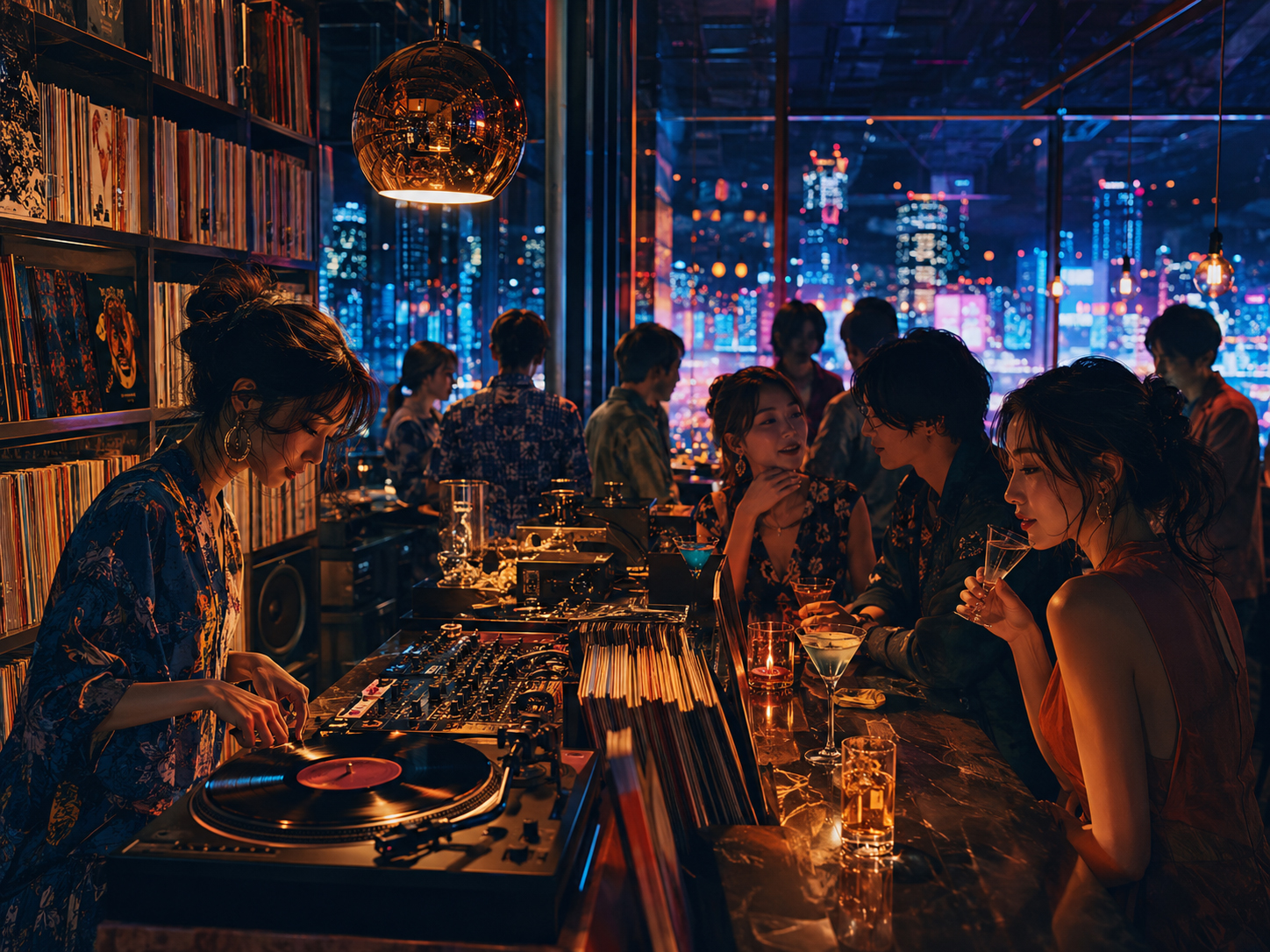
The first Osaka night usually arrives as a rush of surfaces: Dotonbori lights, camera phones, laughter, signs, takoyaki steam, the glow of convenience stores and the steady rhythm of people who seem to know exactly where they are going. But climb a narrow staircase or slip into a basement bar, and the city changes volume. A record sleeve comes out of the shelf. A turntable begins to turn. The room leans toward the speakers.
A record bar is not simply a bar with records. It is a place where music becomes the center of time. Drinks matter. Conversation matters. But the room is organized around listening. A new track can change posture. A bass line can quiet a table. A familiar chorus can make strangers look up at the same moment. The evening is curated in real time by someone watching the weather, the crowd, the hour and the emotional temperature of the room.
That makes Osaka especially interesting. The city is often described through food, comedy and bright nightlife. JNTO introduces Osaka as a relaxed city known for food, fun and night entertainment. But Osaka’s fun is not only loud. It can also be intimate. It can happen at a counter where the bartender chooses a record, someone asks the title, and a traveler realizes that the most memorable part of the trip may not be a landmark but a song heard in the right room.
What a traveler buys in a record bar is not just a drink. It is selected time, urban memory and an entrance into a Japan that cannot be reduced to sightseeing.
Why city pop became travel music
City pop grew out of Japan’s late-1970s and 1980s urban imagination. It absorbed AOR, funk, disco, jazz fusion, soul, yacht rock and American studio polish, then remade those sounds into Japanese songs about highways, hotels, late-night calls, seaside drives, loneliness and the shine of consumer life. It was music for a country imagining itself as modern, mobile and cosmopolitan.
The city pop heard by global listeners in the 2020s is both the same music and something different. Web Japan notes that the worldwide comeback of vinyl records beginning in the 2010s helped the rediscovery of city pop, as music fans searched for used records and DJs added the songs to playlists. In other words, city pop became a streaming-era gateway back into physical music. People discovered it online, then wanted to touch the jackets, hear the crackle, and find the rooms where it made sense.
For overseas listeners, city pop often sounds like a lost future. It evokes an imagined Japan of night highways, resort hotels, soft neon and beautiful album covers. Some of that memory is real; some of it was assembled by algorithms, fan videos and playlists. An Osaka record bar puts that fantasy back into a real city. The song is no longer just a thumbnail on a screen. It comes from a speaker, in a room, while rain hits the street outside.
Osaka listens a little closer
Tokyo’s listening bars often have a temple-like discipline. Sit quietly. Respect the sound. Let the selector guide the night. Osaka shares that seriousness, but its warmth is different. Tracks & Tales describes Osaka listening bars as places where jazz, whisky and laughter coexist. Tatler Asia highlights small counters, serious vinyl collections, carefully tuned vintage speakers and owners who cue records that fit the room.
For a traveler, that difference matters. In Tokyo, the guest often adapts to the room. In Osaka, the room may meet the guest halfway. A bartender may ask where you are from. A regular may tell you the title of the record. A stranger may laugh when a familiar chorus arrives. The city’s music culture runs through live houses, clubs, jazz kissaten, record shops and drinking counters. You do not need to be an expert. Curiosity is enough.
Time Out’s profile of Shinsaibashi’s Bar Jazz captures the point: the bar opened in 2003, holds around 2,000 titles, and the owner chooses tracks one after another to match the atmosphere. That is the essence of the record-bar experience. The playlist is not fixed. The algorithm is human. The selector reads the room.
The new luxury is listening
Inbound tourism often concentrates on what can be photographed: castles, temples, ramen, trains, night views. A record bar resists easy photography. It is dark, small, sometimes quiet, sometimes smoky with conversation. It may not welcome constant filming. The music may be unfamiliar. The point is not to capture it but to receive it.
This is why the experience can remain in memory. In a record bar, the traveler stops being only a consumer and becomes a listener. You order, sit down and let the room make the first move. Even if the lyrics are not fully understood, the voice, arrangement and atmosphere carry meaning. A saxophone can explain the city. A bass line can translate a decade. A chorus can make a visitor feel, briefly, as if they have been in Japan before.
City pop is perfect for this kind of listening tourism. It is bright, polished and melancholy. It is accessible without being simple. In Osaka, even music associated with Tokyo’s urban imagination takes on Kansai warmth. The song is no longer only retro. It becomes the soundtrack of the present trip.
Etiquette begins with respect for sound
Every record bar has its own atmosphere. Some welcome requests; others are built around the owner’s selections. Some allow photos; others prefer that phones stay down. The first skill is to read the room. Do not hold loud video calls. Do not block the speakers with luggage. Do not handle records or equipment without permission. Do not turn the evening into content while others are listening.
These are not severe rules. They are forms of respect. In a small Japanese bar, one customer’s volume can change the entire room. But when a visitor respects the space, the reward can be surprising. A song title. A recommendation. A conversation at the counter. A sense that the city has opened one more door.
How to enjoy an Osaka record bar
- Use the first drink to understand the room before asking for anything.
- Ask gently whether requests are welcome; do not assume.
- Do not touch records, equipment or speakers without permission.
- If a song catches you, ask at the right moment and quietly.
- Listen before documenting. The best souvenir may be the track you discover.
Japan.co.jp reads Osaka’s record bars as small cultural archives of the night. They preserve more than vinyl. They preserve the ear of the owner, the memory of regulars, the humidity of the city and the curiosity of travelers who arrive from far away because a song once found them online.
City pop was rediscovered on the internet, but music does not end on a screen. When the needle drops in a small Osaka bar, the sound has a place again. A visitor hears not only Japan’s past, but Japan playing now.
Sources and references
This Japan.co.jp Sunday Report draws on JNTO’s Osaka travel overview, Web Japan’s explainer on the global spread of city pop, and recent coverage of Osaka’s listening-bar and record-bar culture from Time Out Osaka, Tatler Asia and Tracks & Tales.