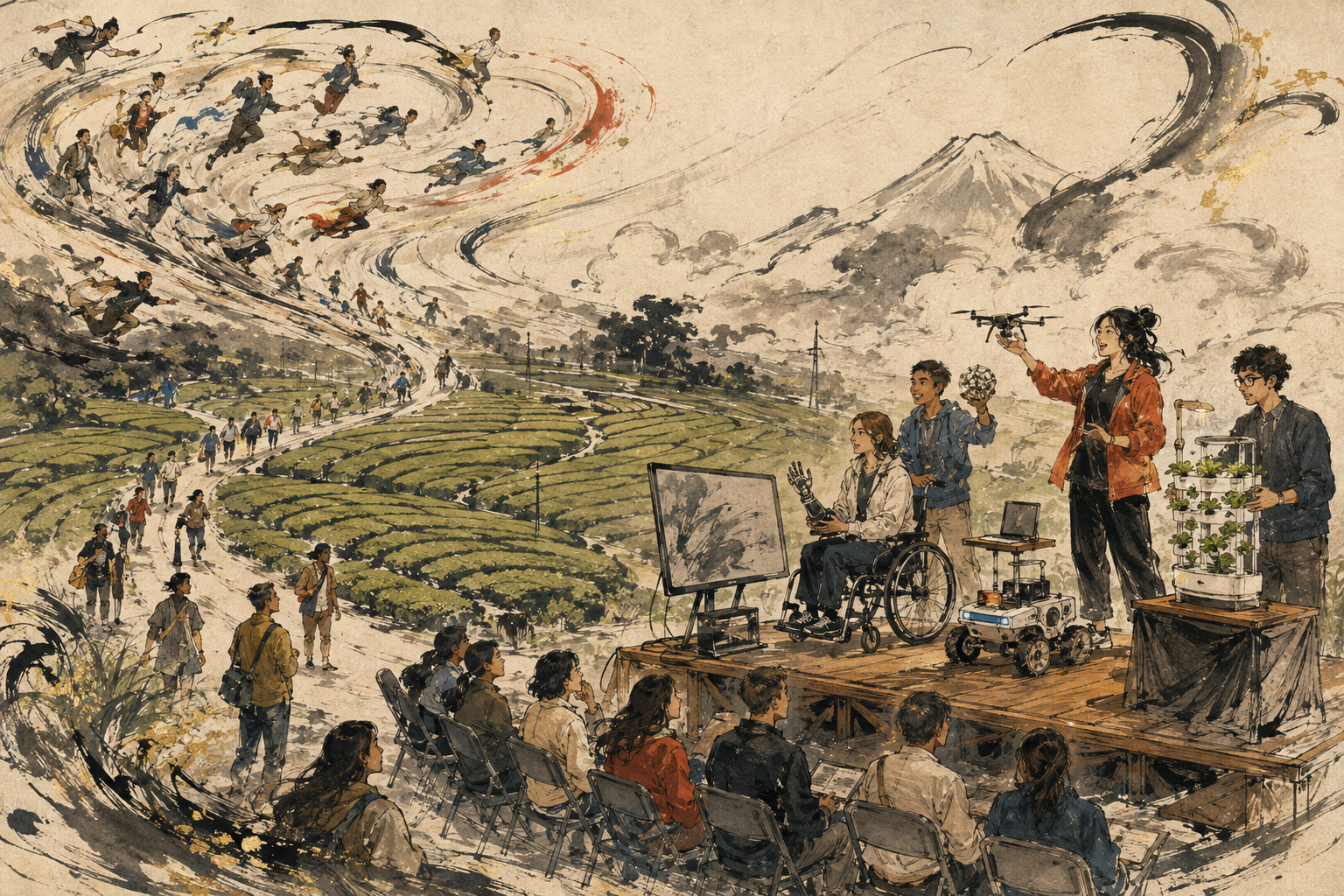
In 1869, former retainers of Tokugawa Yoshinobu entered the Makinohara Plateau after losing their occupation. They exchanged swords for hoes. A year later, the system of porters who carried travelers across the Ōi River was abolished; some of those newly unemployed workers joined the clearing effort. On a gravelly upland, they planted one of the young nation's important export crops: tea.
One hundred and fifty-seven years later, different instruments are arriving. From India comes a power-management chip that harvests tiny amounts of light, heat, vibration and radio energy to run frost sensors in tea fields. Korean applicants propose turning local tea into fermented cosmetic ingredients and sending a robot as far as three kilometers through aging pipes. Georgia supplies software that converts code into a company's “living memory” and shoes that guide people with visual impairments. A British entrant offers a natural coating to replace plastic on paper packaging.
On August 18, the fifth Makinohara City Challenge Business Contest, branded MakiChalle 2026, announced 40 semifinalists from 230 entries. The organizer reports 156 domestic and 74 overseas applications from 11 countries. The total is two and a half times the 91 entries in the first contest in 2022 and is the largest yet.
From 230 to 40: the numbers we can establish
Makinohara City is the host. The Makinohara City Society of Commerce and Industry plans and operates the program, with CF Startup Partners serving as the secretariat. Shizuoka Prefecture and the Kanto Bureau of Economy, Trade and Industry are supporters. An applicant must place a concrete collaboration proposal at the center of its plan—naming a sponsor, a local industry, the municipal government or a tourism asset.
The first round scored written submissions against six published considerations: fit with local industry or tourism and contribution to the region; novelty or competitive advantage; market size and growth; profitability and sustainability; management-team record and skill; and feasibility and risk. Forty, or 17.4 percent of the entries, advanced.
Japan.co.jp counted the locations in the released list: 29 semifinalists are domestic and 11 overseas. The foreign group contains five from South Korea, three from India, two from Georgia and one from the United Kingdom. The “11 countries” figure describes the complete applicant pool. It does not mean that the 40 semifinalists represent 11 countries.
The 40 proposals form a diagnostic image of the city
Read together, the list reveals Makinohara's needs before it reveals its technology. Tea farms face aging owners, missing successors, frost, the long unproductive interval after replanting and the burden of maintaining rice fields on the side. Factories face skills transfer, component-data management and predictive maintenance. A coastal tourism city with an airport needs transport, lodging, emergency water and stronger paths from a visit to a repeat purchase. The government must contend with infrastructure inspection, foreign-resident onboarding, care, disasters and youth outmigration.
| Regional theme | Examples among the semifinalists | What commercialization must answer |
|---|---|---|
| Tea succession | Atotsugi Bank proposes serial succession that preserves farm names and consolidates processing, accounting and export. MINORICA would test a foliar treatment to accelerate young tea plants. ineRobo would use fleets of small autonomous machines to remove the side burden of rice farming. | Farmer consent, yield and quality, cost allocation, materials regulation and who keeps operating the service. |
| More value from tea | A Korean cosmetics company proposes fermented ingredients; a sommelier would make “tea wine”; a lodging operator would turn hotel rooms into tea showrooms linked to cross-border e-commerce. | Ingredient standards, cosmetic or alcohol rules, repeat demand and how much margin remains in Makinohara. |
| Manufacturing and skills | AI for electronic-component data, 15-second audio-image records of expert judgment, and an Indian chip that harvests ambient energy for sensors. | Factory data access, safety certification, shop-floor adoption and a path from prototype to paid purchase. |
| Disaster and infrastructure | Atmospheric water machines, revenue-generating water-reuse containers that become emergency assets, shared maps for roads and pipes, and a Korean pipe-inspection robot. | Fit with disaster plans, water quality, durability, public procurement and division of work with incumbents. |
| Mobility and tourism | A zero-fare model using idle buses and care vehicles, regional products sold through sports fandom, and hotel stays that lead to recurring tea orders. | Transport law, insurance, seasonality, passenger density and conversion from visitor to repeat customer. |
| People and daily life | Foreign-worker onboarding, a local civil-service academy, AI interviews for youth-job matching, bereavement support for employees and an integrated care guide. | Privacy, fairness, public budgets, utilization and duplication of existing support channels. |
Other plans resist tidy categories. Twelve local middle- and high-school students would form a student event company and run a 500-person event at Jitōgata Seaside Park, from sponsorship sales through final accounts. A wine sommelier proposes steeping local leaves in Koshu wine at low temperature. Britain's MarinaTex would test a natural barrier coating on paper packs for tea and prepared food. The ideas sound different, but each becomes recognizably MakiChalle when a local counterpart is written into the plan.
Why would the world come to a city of 42,000?
Makinohara City was created in October 2005 through the merger of the former towns of Sagara and Haibara. It covers 111.62 square kilometers. Resident-register data at the start of 2025 put the population at roughly 42,000, and the number is declining. In April 2026, the mayor said Makinohara was losing population faster than surrounding municipalities and needed an administrative model capable of surviving 10 and 20 years from now.
Population alone conceals its industrial weight. A compilation of the economy and internal-affairs ministries' 2022 Economic Structure Survey puts manufacturing shipments and related receipts at ¥1.2044 trillion. Transport equipment accounted for 51.5 percent, beverages, tobacco and feed for 20.6 percent, and electrical machinery for 19.8 percent. Suzuki's Sagara plant and research facilities, tea and beverage factories and component suppliers sit behind the rural view. A startup can find an industrial customer as well as a farm.
The transport geometry is unusual too. The Sagara-Makinohara interchange on the Tōmei Expressway, the Port of Omaezaki and Mount Fuji Shizuoka Airport provide road, sea and air gateways. Shizunami and Sagara beaches draw surfers and swimmers. Tea fields, factories, logistics, coastline and airport occupy a compact area, allowing agriculture, materials, mobility, tourism and export to be combined in one test ground.
The earlier experiment: turning gravel into an export industry
The plateau's history is a warning against assuming that a “regional resource” exists naturally. The Kanto Regional Agricultural Administration Office says former Tokugawa retainers began clearing Makinohara in 1869. Shizuoka Prefecture says the opening effort covered perhaps 1,400 hectares at the start and, through difficult labor, transformed the land into more than 5,000 hectares of tea fields. Most of the plateau had been opened by the early Taishō era.
Tea was not chosen as scenery. After Japan's ports opened, raw silk and tea were major exports. The project connected underused land, displaced labor and foreign demand. Modern deep-steamed Makinohara tea continues the same habit of adaptation: leaves made thick by strong sunlight are steamed longer, reducing astringency and producing a rich green cup. Processing turns a difficult physical condition into an identity.
Past success does not secure the future. The Ministry of Agriculture says Japan's tea-growing area fell 5 percent in 2025 to 33,400 hectares. First-flush crude-tea production declined 10 percent, and Kagoshima ranked first for the first time. Makinohara must confront succession, abandoned plots, replanting, export products and the shift toward matcha inputs at the same time. That is why succession, seedlings, sensors, cosmetics, wine, packaging and hotel sales appear in one semifinal.
Applications have grown two and a half times in five contests
MakiChalle began in 2022 with 91 entries, three participating countries, 17 sponsors and a ¥1 million grand prize. Entries rose to 131 in 2023, 149 in 2024 and 168 in 2025. The city doubled the top award to ¥2 million during its twentieth-anniversary edition. This year's 230 applications are 62, or 36.9 percent, above 2025.
The source of growth is revealing. Overseas entries barely moved, from 73 to 74. Domestic applications rose from 95 to 156, an increase of 64.2 percent. The international story is real, but the record was made mainly by a new surge of interest inside Japan.
| Year | Entries | Countries | Grand prize | Grand-prize winner |
|---|---|---|---|---|
| 2022 | 91 | 3 | ¥1 million | S.Lab, Ukraine—packaging from tea plants and mycelium |
| 2023 | 131 | 5 | ¥1 million | ParaLux, Fukuoka—a wedding business built around local assets |
| 2024 | 149 | 8 | ¥1 million | Midwest Composites, Malaysia—composites using discarded tea plants |
| 2025 | 168 | 10 (another recruitment release says 11) | ¥2 million | roly-poly Organics, Shizuoka—circular fertilizer using woodlice |
| 2026 | 230 | 11 | ¥2 million | To be announced October 20 |
These are figures supplied by the secretariat rather than independently audited application statistics. Public documents also contain minor inconsistencies. The June recruitment release anticipated “about 30” semifinalists; 40 were eventually selected. The 2025 country count appears as either 10 or 11, and the 2026 sponsor total as either 32 or 33. The 2026 entry total, domestic-overseas split, 11-country claim, 40 selected names and principal dates agree across current materials, so those are the core facts used here.
What survived after the previous award ceremonies
A regional business contest can stage a photograph, hand over certificates and return the next year without changing the economy. Whether MakiChalle is different should be judged by what its earlier entries became inside the city.
The official contest site says 2023 winner ParaLux established M-Weddings with a local partner and began a wedding business using Makinohara's landscape. The 2024 Malaysian winner, Midwest Composites, developed pellets mixing kenaf and discarded tea plants and completed a prototype tea-based automobile interior part at a local injection-molding factory. An earlier sponsor-prize project helped turn abandoned tea fields into “Naminori Lemon” orchards; by 2026, the new roadside station was holding a product fair around the local lemons.
There is also an example that did not win the grand prize. The operator says technology from 2023 semifinalist GreatValue became part of the local MakiPay currency service. The incubation-center operator says seven companies, including previous entrants, have established a presence in Makinohara. These outcomes are not equivalent. A new company, a prototype, a product brand, a software deployment and an office tenancy represent very different depths of commercialization.
The first buyer is worth more than the ¥2 million prize
At the exchange rate shown in this edition—¥158.28 to the U.S. dollar—the grand prize is about $12,600. That will not by itself pay for a foreign deep-tech company to establish a Japanese entity, obtain approvals and run an industrial trial. The more valuable prize is access to a farmer or plant manager, a first testing site and a table shared with government and financial institutions.
The 2026 program adds another bridge. On October 21, the day after the ceremony, sponsors and applicants will meet at the Makinohara Incubation Center for the first collaboration meetup. The center opened in 2023 and combines workspace with accounting, tax, financial-institution and expert support. A municipal subsidy can help qualifying MakiChalle entrants use the facility.
A 2025 Ministry of Economy, Trade and Industry guide makes the logic explicit. Corporate-startup collaboration should move beyond events and joint study into “initial purchase and verification,” supported by internal ownership and workable contracts. A municipal-startup guide updated in 2026 likewise emphasizes trial orders and joint procurement. National policy is pointing at the step competitions often miss: create an employee who can buy the product, even in a small amount, rather than only an employee who can hear the pitch.
Four walls an overseas proposal must cross
Seventy-four foreign applications give a small city a large window. Online selection, an English-language site and an Indian partner lower the distance. Easy application, however, does not mean easy market entry.
- Regulation: Medical devices, cosmetics, food, alcohol, water quality, transport and construction each carry Japanese rules and approvals.
- Responsibility: Someone in Japan must maintain the product, answer when it fails and carry appropriate insurance.
- Commercial terms: The parties need to decide who pays for the trial, who owns data and intellectual property, and who can approve a full purchase.
- Continuity: Translation, incorporation, banking, tax, hiring and housing must be arranged so the project can continue after a founder flies home.
A battery-free frost sensor still needs communications, installation, maintenance, a monthly price a farmer can afford and integration with existing frost fans. A natural coating that succeeds in a sample must pass food-contact tests and work at production-line speed, through humidity and recycling, at a viable cost. Between technology and a market lies a collection of small jobs that a local company must help complete.
“Startup” is deliberately a broad word here
MakiChalle does not restrict entry to newly incorporated venture companies. It includes a second founding by the successor to an established firm, a new subsidiary, an internal venture and an existing regional business pursuing growth. The 40 therefore place overseas fabless semiconductor and materials companies, an OIST-born agritech and Tokyo software firms beside a sports club that has operated in Makinohara for 40 years and a local student team.
That broad definition means the headline total is not 230 newly founded startups. The public list does not standardize company age, funding, revenue or employee count. For the city, though, the distinction may be less important than it would be to a venture-capital database. A local swimming club testing prehabilitation for frail patients can create regional value. So can a platform that finds successors for tea farms. Neither needs to resemble Silicon Valley.
The road to October
August 18 — Forty semifinalists announced after the first written review.
August 19–September 18 — Second-round closed pitches.
September 24 — Approximately 10 finalists scheduled to be announced.
October 1 — Fully online public pitch on YouTube Live; free viewing and an audience vote.
October 20 — Ceremony at Sagara General Center Īra, announcing the grand prize, runner-up, mayor's and sponsor awards.
October 21 — First collaboration meetup at the incubation center.
The six written criteria are sensible. The public pages do not disclose precise weighting, every judge's score, conflict-management procedure or the supporting evidence submitted by applicants. An audience award can build attention, but popularity is not the same as viability. A strong finalist should identify the local counterpart, define a minimum test that can begin within 90 days and explain in advance when the parties would stop.
The scorecard to publish in 2027
Japan's 2022 Five-Year Startup Development Plan set a national goal of increasing annual startup investment from roughly ¥800 billion to about ¥10 trillion by fiscal 2027. There is no need to grade one rural contest against a nationwide financing target. Makinohara can use measures closer to the ground.
| Stage | Metric worth publishing | Threshold for substance |
|---|---|---|
| Connection | Meetings with local firms and agreed problem statements | A named owner and deadline, not a business-card exchange |
| Verification | Paid and unpaid pilots, budget, term and evaluation criteria | Operational metrics defined before the demonstration |
| Purchase | Initial orders, full contracts, renewals and private spending | A customer pays after subsidy support ends |
| Local value | Local procurement, jobs, incorporation, farm income and waste avoided | Value remains with the region as well as the startup |
| Failure | Projects stopped, the reason and lessons learned | Failure changes the requirements of the next trial |
The operator says more than 30 companies received follow-up after the 2024 event and that multiple past entrants have moved into the city. The next step is to publish this scorecard annually. The larger the entrance number becomes, the more transparent the exit should be.
The next clearing begins with a contract
The people who entered the gravel plateau in 1869 did not see a finished tea landscape. Over decades, they connected export demand, labor, land and cultivation. The 40 plans announced in 2026 remain closer to lines drawn across uncultivated ground.
Will a machine that makes water from air become part of coastal disaster preparedness? Can tea wood enter an automobile component? Will an Indian chip watch for frost through the night? Can a student-run event be inherited each year? The possibilities are genuinely exciting. But a region is changed not by a polished pitch. It changes when partners agree on a specification, divide responsibility, issue the first invoice and choose to buy again.
From sword to hoe, from hoe to tea field, from tea plant to industrial material: Makinohara's history is one of finding a new purpose for something whose old use has ended. Which founder will write the next line? The answer will matter less on October 20, when the winner is named, than in 2027—inside the city's factories, fields, coastline and accounts.
Reporting ledger: established and still unverified
| Established by public evidence | Not established in public evidence |
|---|---|
| The operator lists 230 entries—156 domestic and 74 overseas, from 11 countries—and publishes 40 semifinalists with proposal summaries. | Independent audit of applications; standardized company financials; independent testing, patent review or regulatory analysis of all 40 plans. |
| The city confirms the host, purpose, regional assets and examples from prior contests. Current dates are September 24, October 1 and October 20–21. | Scoring weights, full judge-level results, conflict controls, and the 2026 operating cost and public-funding breakdown. |
| Publicly described outcomes include incorporation, prototypes, a local currency and reuse of former tea land. | Project-level revenue, jobs, investment, renewal, post-subsidy profitability and the number of discontinued projects. |
| METI's collaboration guides emphasize initial purchase, contracts and trial or joint procurement beyond a pitch. | How many of the 2026 semifinalists will reach a paid pilot or full contract. |
- CF Startup Partners: 40 MakiChalle 2026 semifinalists and proposal summaries
- Makinohara City: MakiChalle 2026 program
- MakiChalle: program purpose and history
- Makinohara City: city profile
- Kanto Regional Agricultural Administration Office: history of the Makinohara Plateau
- Shizuoka Prefecture: Makinohara land opening
- Ministry of Agriculture: 2025 tea-growing area
- Ministry of Agriculture: 2025 first-flush tea production
- METI and Ministry of Internal Affairs: 2022 Economic Structure Survey
- GD Freak: Makinohara manufacturing shipments, compiled from government statistics
- Makinohara City: MakiChalle 2025 results
- METI: Co-creation Partnership Procurement Guidelines
- METI: practical guide to municipal-startup collaboration
Editor's note: Unless otherwise stated, entry totals, countries, proposal descriptions and past outcomes come from the host, secretariat or applicants. Japan.co.jp has not independently tested the 40 technologies, patents, legal compliance, finances or local adoption. The domestic 29/overseas 11 count is Japan.co.jp's calculation from the released list. Population and manufacturing figures have different reference dates and statistical scopes; they are not current sales or a live population count. The exchange rate is the value supplied for this edition.