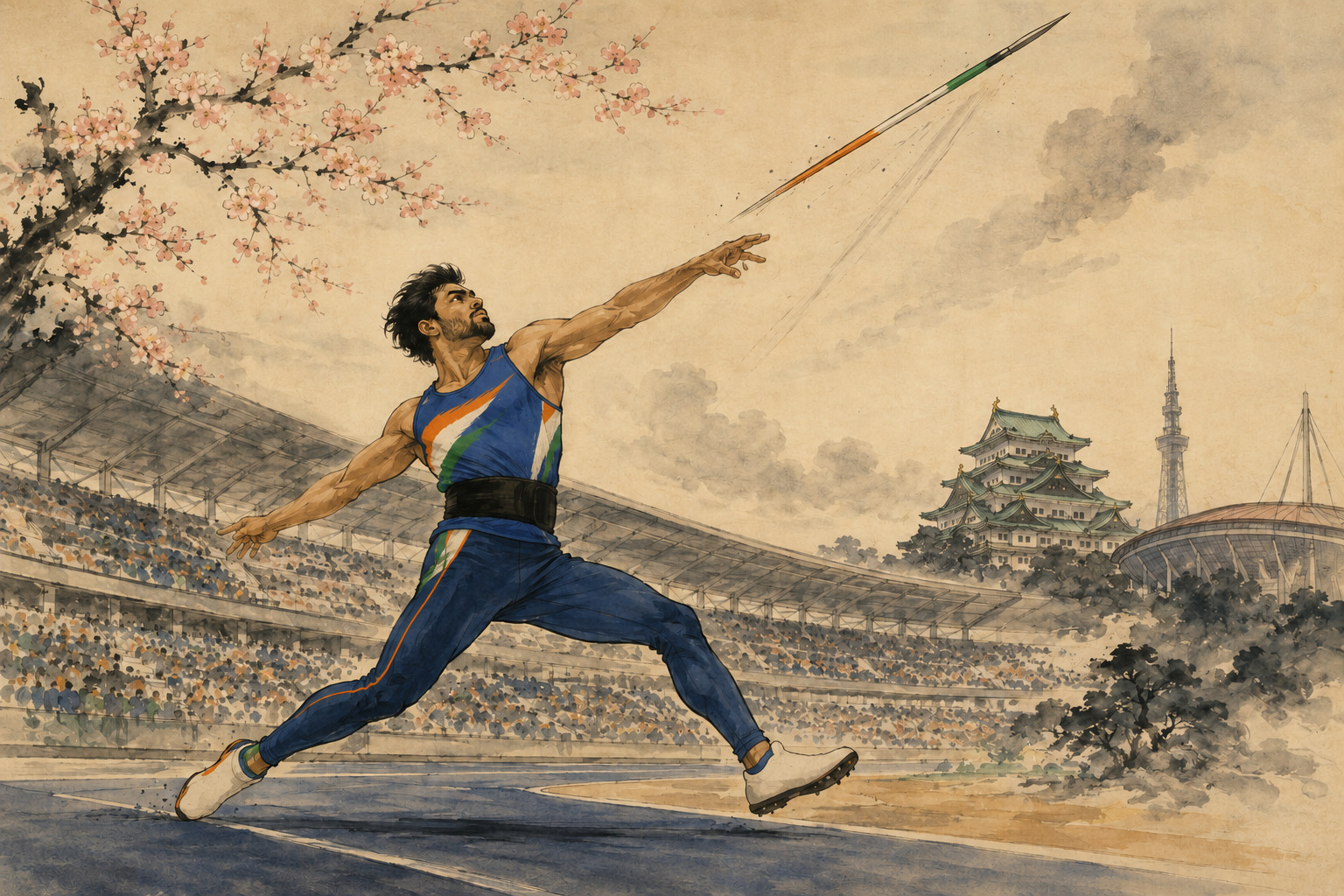
A third gold can sound like an extension of the first two, as if the champion needs only to carry the same title across one more border. Javelin does not work that way. The runway is empty at the start of every competition. Old throws remain in record books, not on the scoreboard. Neeraj Chopra will reach Aichi with Asian Games marks of 88.06m and 88.88m behind him—and with six new throws, at most, to create a third victory.
India named Chopra in its 73-member athletics squad on August 23. The Athletics Federation of India had already confirmed through its official account that he planned to defend his Asian Games title. The official English headline therefore points to a selected athlete coming to compete, not to a verified arrival in Japan: no primary source reviewed for this report established that Chopra was already in Aichi on publication day.
The distinction is more than pedantry. Selection, accreditation, travel, appearing on a final start list and taking the runway are separate stages. The men’s javelin start list was not yet available for verification. Chopra’s selection is established; his third gold is an objective; his participation on the day remains subject to the ordinary final-entry, accreditation, fitness and competition processes.
The champion is selected, not pre-crowned
Chopra’s place in the squad fits the AFI selection framework published in May. The federation scheduled trials for June 24–28, retained control over selection and management of the Indian athletics contingent, and allowed exemptions for leading athletes competing at high-level international meetings. An AFI social-media announcement in June specifically said Chopra would compete in Aichi-Nagoya to defend his title. Olympics.com’s August 23 squad report then listed him in the men’s javelin group.
His name also needs no speculative Japanese rendering. Olympics.com’s official Japanese athlete page uses ニーラジ・チョプラ; World Athletics uses Neeraj CHOPRA. Japan’s own federation, meanwhile, formally calls the discipline 男子やり投—men’s javelin throw—and uses 試技 for an attempt. These small choices matter in a bilingual edition because accuracy begins before the first statistic is compared.
Two evening sessions, three days apart
The 20th Asian Games run from September 19 through October 4. Athletics is scheduled for September 23–29 at Paloma Mizuho Stadium, the rebuilt athletics venue in Nagoya’s Mizuho Park. The Japanese Association of Athletics Federations places men’s javelin qualification in the September 26 evening session and the final and medal ceremony in the September 29 evening session.
The published program starts the September 26 evening session at 5 p.m. and the September 29 session at 5:15 p.m. Those are session opening times, not exact javelin start times. A session contains several concurrent or consecutive events. Reporting the session opening as Chopra’s throwing time would give readers precision the schedule does not provide.
Paloma Mizuho Stadium had a meaningful rehearsal in June: the 110th Japan Athletics Championships took place there and served as a Japanese selection competition. That gave home athletes competition experience on the runway that will be used in September. It did not freeze the conditions. Wind changes the relative airspeed and attitude of a javelin; weather from a June championship cannot be projected onto a late-September final.
| Date | Published program | Boundary |
|---|---|---|
| Sept. 19 | The 20th Asian Games open. | Athletics has not yet started. |
| Sept. 23 | Athletics begins at Paloma Mizuho Stadium. | JAAF lists seven days of athletics through Sept. 29. |
| Sept. 26 | Men’s javelin qualification is in the evening session beginning at 5 p.m. | 5 p.m. is the session time, not the exact event start. |
| Sept. 29 | The final and medal ceremony are in the evening session beginning at 5:15 p.m. | Chopra must first qualify; a medal is not presumed. |
| Oct. 4 | The Games close. | The athletics program has already ended. |
What an 800-gram spear asks of a body
The men’s javelin weighs 800 grams. For a throw to be valid under World Athletics rules, the metal head must strike before any other part of the implement, and it must land inside a sector of roughly 29 degrees. The athlete must release from behind the arc and leave the runway without invalidating the attempt. Distance is measured from the first point of contact back to the inner edge of the throwing arc.
Those rules turn a large stadium into a narrow problem. An athlete has to accelerate an awkward implement along the runway, preserve speed through crossover steps, brace the forward movement with the block leg and pass force through the hips, trunk, shoulder, elbow and hand. Too little speed limits the release. Speed without posture breaks the chain. A powerful throw that lands outside the sector or follows contact with the arc is not a shorter mark; it is no mark.
In a standard final, athletes receive three attempts before the field is cut to eight for three more. The best legal mark wins. A personal best is evidence of capacity, not a credit balance. Chopra’s 90.23m cannot be added to an Aichi result, and an athlete with a lower lifetime best can win by producing the longest valid throw that night.
The first gold was emphatic
Chopra entered the 2018 Jakarta-Palembang Games as one of India’s most visible athletes, carrying the national flag at the opening ceremony after winning the Commonwealth title earlier that year. In the javelin final on August 27, he threw 88.06m. AFI’s historical medal list records it as India’s first Asian Games gold in the men’s event.
The winning margin exceeded three meters. It was the clean outline of a championship performance: Chopra improved his own Indian record and separated from the field. That result can make his Asian Games history appear inevitable in retrospect. It was not. Two years earlier he had been an 18-year-old world U20 champion; two years later he would face a pandemic-disrupted Olympic cycle and elbow surgery in the intervening period.
His emergence had begun in Bydgoszcz, Poland, on July 23, 2016. Chopra’s 86.48m at the World U20 Championships was a world U20 record at the time, almost six meters beyond the silver medalist. World Athletics later ratified the mark. The performance did not make senior medals automatic, but it announced that an Indian teenager already possessed distance of senior international quality.
Hangzhou made him chase
The next Asian Games kept the official name Hangzhou 2022 even after a pandemic postponement moved it to 2023. Its men’s javelin final was less orderly than Jakarta. A measurement-system problem meant Chopra’s opening attempt did not initially produce a recorded mark, and he had to throw again. The disruption did not decide the medals, but it tested the competition rhythm that throwers build around recovery, feedback and the order of attempts.
The sharper challenge came from within India’s team. Kishore Jena moved into the lead with 86.77m in the third round. Chopra answered in the fourth with 88.88m. Jena then improved to a personal best of 87.54m and took silver. World Athletics’ official result and AFI’s competition report show an Indian one-two, not a champion strolling past passive opposition.
Jakarta and Hangzhou therefore belong to different competitive stories. One was a large-margin victory; the other required Chopra to reclaim the lead after a teammate raised it. A third title would add a consecutive gold to the record. It would not repeat either path.
2016 World U20 champion at 86.48m, then a world U20 record.
2018 First Asian Games gold, 88.06m in Jakarta.
2021 Tokyo 2020 Olympic champion at 87.58m.
2023 World champion at 88.17m; second Asian Games gold at 88.88m.
2024 Olympic silver in Paris at 89.45m.
2025 Indian record of 90.23m in Doha; eighth at the Tokyo World Championships.
2026 Commonwealth silver, followed by an 88.05m season best in Lausanne.
Olympic gold changed Indian athletics
At the Tokyo Games, staged in 2021, Chopra won with 87.58m. World Athletics describes him as India’s first Olympic champion in athletics. The formulation is precise enough to avoid erasing the unusual historical status of Norman Pritchard’s 1900 medals while identifying what Chopra’s victory meant in the modern Indian Olympic record. It was also India’s second individual Olympic gold in any sport, after shooter Abhinav Bindra in 2008.
Chopra followed with world silver in 2022 and world gold in Budapest in 2023, where 88.17m made him India’s first World Athletics champion. In Paris in 2024, he threw 89.45m—the second-best throw of his career at the time—and still lost. Pakistan’s Arshad Nadeem produced an Olympic record of 92.97m.
Doha in May 2025 delivered the distance that had shadowed almost every discussion of Chopra’s career. His third-round 90.23m broke his Indian record and carried him beyond 90 meters for the first time. Julian Weber then won with 91.06m. The landmark was real, and so was second place. The same distinction applies in Aichi: individual achievement and competitive rank can occupy different lines on the same result sheet.
Japan has already seen both versions
Chopra’s Japanese history contains the summit and the warning. Tokyo’s Olympic stadium was where he became an Olympic champion. Four years later, at the 2025 World Championships in the same city, he qualified at 84.85m but finished eighth in the final with 84.03m. Keshorn Walcott won. Chopra arrived as the defending world champion and left without a medal.
Calling Aichi a chance for redemption is Japan.co.jp analysis, not a phrase attributed to Chopra. Still, the sequence matters. A champion’s previous success in Japan does not confer venue immunity, and a difficult Tokyo final does not constrain what he can throw in Nagoya. Both results demonstrate the same rule: the competition recognizes the mark made that day.
The host team will bring athletes who know Paloma Mizuho more recently. JAAF’s list dated August 19 names Yuta Sakiyama—officially 﨑山雄太, read さきやま ゆうた—and Rin Suzuki, 鈴木凜, read すずき りん, as its provisionally selected men’s javelin athletes. JAAF has used “provisionally selected” because formal Team Japan status passes through Japanese Olympic Committee procedures.
Sakiyama threw a personal best of 87.16m at the 2025 Japan Championships and won the 2026 national title at Paloma Mizuho with 82.05m. Chopra’s Indian record is 3.07m farther than Sakiyama’s best. That is useful scale, not a forecast. The decisive comparison will be the set of valid marks each man produces in September.
A rival nine centimeters away
Chopra’s 2026 season supplies the strongest reason to resist coronation. At the Commonwealth Games in Glasgow, Sri Lanka’s Rumesh Tharanga Pathirage won with 89.75m. Chopra took silver at 85.83m. On August 21 in Lausanne, Chopra improved his season best to 88.05m, only for Pathirage to throw 88.14m. Nine centimeters—shorter than the width of a hand—separated them.
Those results establish that an Asian thrower has beaten Chopra twice this season. They do not establish that Pathirage will compete in Aichi. His final entry could not be verified by publication time. The same boundary applies to Paris Olympic champion Arshad Nadeem: authoritative pre-Games coverage has discussed him as a possible entrant, but a final Aichi start-list entry was not located.
This is not a reason to remove them from an account of the competitive landscape. It is a reason to use exact verbs. Pathirage has beaten Chopra in 2026. Nadeem beat him in Paris. Neither is presented here as a confirmed Aichi participant. The distinction keeps results, projections and entries from collapsing into one another.
| Athlete and meeting | Mark | What it establishes |
|---|---|---|
| Neeraj Chopra Doha 2025 | 90.23m | Personal best and Indian record—not an Aichi result. |
| Rumesh Tharanga Pathirage Glasgow 2026 | 89.75m | Beat Chopra for Commonwealth gold; Aichi entry unverified. |
| Neeraj Chopra Lausanne 2026 | 88.05m | Season best, nine centimeters behind the winner. |
| Yuta Sakiyama Japan Championships 2025 | 87.16m | Personal best; listed by JAAF for the host team. |
| Neeraj Chopra Hangzhou 2022 | 88.88m | His second Asian Games winning mark. |
The Games began in Chopra’s country
The Asian Games opened for the first time in New Delhi on March 4, 1951. The Olympic Council of Asia records that the event had been intended for 1950 but was delayed by preparation problems. Japan, excluded from the 1948 London Olympics and not invited to the Asian Games Federation’s founding meeting, was nevertheless permitted to compete in New Delhi. Korea could not attend during the Korean War.
AFI’s historical medal list reaches back to that first edition. It records India’s Parsa Singh winning men’s javelin silver at 50.38m. The implement and era make direct distance comparisons with the modern event misleading. The historical continuity is the point: Indian javelin was on the podium at the first Asian Games, and 75 years later an Indian Olympic champion is trying to win the event for a third consecutive edition.
Aichi-Nagoya will be Japan’s third Summer Asian Games, after Tokyo in 1958 and Hiroshima in 1994. That geography forms a quiet circuit. India hosted Japan’s return to a major postwar international multi-sport event. Tokyo received the Games seven years later. In 2026, an Indian athlete whose career was transformed in Tokyo returns to Japan as one of the continent’s defining champions.
The required distance has not been set
No honest preview can say what will win on September 29. The required mark will be created by the field, the wind, the order of attempts and the athletes’ ability to keep the spear legal. Chopra needed 88.06m in Jakarta and 88.88m in Hangzhou. A third final might demand more, less, or a late answer to someone else’s throw.
His résumé supplies reasons for confidence: an Olympic title, a world title, two Asian Games golds, a 90.23m national record and a history of responding when the lead changes. His recent results supply the counterweight: silver in Paris, second in Doha after crossing 90m, eighth in Tokyo, silver in Glasgow and second by nine centimeters in Lausanne.
That record does not diminish him. It defines the scale of elite javelin more accurately than invincibility would. A championship throw is an arrangement of speed, balance, nerve and aerodynamics that has to be rebuilt in seconds. Greatness increases the number of times an athlete has done it. It never makes the next attempt valid in advance.
When Chopra reaches the runway in Aichi, the first two golds will explain why the stadium watches. They will not move the javelin. A third title begins at zero, behind a white arc, with history waiting outside the sector until the metal head lands.
- Athletics Federation of India — Chopra’s Aichi-Nagoya participation announcement
- Athletics Federation of India — Aichi-Nagoya 2026 qualification guidelines
- Olympics.com — India’s 73-member athletics squad, August 23, 2026
- Olympics.com Japanese edition — official Japanese rendering of Chopra’s name
- Aichi-Nagoya 2026 Organising Committee — Games dates and official information
- Aichi-Nagoya 2026 Organising Committee — detailed athletics session schedule
- Japan Association of Athletics Federations — athletics dates, venue and schedule
- JAAF — provisionally selected Japanese athletes, current August 19, 2026
- JAAF — Yuta Sakiyama profile, official name and personal best
- JAAF — 2026 Japan Championships men’s javelin result
- World Athletics — Neeraj Chopra profile, personal best and major honours
- World Athletics — Glasgow 2026 men’s javelin report
- World Athletics — Lausanne 2026 men’s javelin report
- World Athletics — Chopra’s 90.23m in Doha
- World Athletics — 2016 World U20 men’s javelin final
- World Athletics — Hangzhou 2022 men’s javelin official result
- Athletics Federation of India — Hangzhou men’s javelin final report
- Athletics Federation of India — Indian athletics medal winners at the Asian Games
- World Athletics — javelin overview and valid-throw principles
- World Athletics — 2026 Competition and Technical Rules
- Olympic Council of Asia — New Delhi 1951
- Olympic Council of Asia — Asian Games timeline
Attribution boundary: Selection, dates, venue, marks, results and official names come from the organizations and records above. The interpretation of Lausanne’s nine-centimeter margin, the India-Japan historical arc and Aichi as a possible Japanese redemption are Japan.co.jp analysis, not statements attributed to Chopra. Pathirage’s and Nadeem’s Aichi entries were not verified from a final start list by publication time.