A man taking one knee on the ice usually means a choreographic transition or the end of a program. In one of the photographs Riku Miura and Ryuichi Kihara published on Sunday, it meant something else: Kihara faced Miura from that position while holding out a ring. Other photographs showed the two together and displaying the ring. Their accompanying message supplied the fact that the images alone could not—Miura and Kihara are engaged.
The joint statement appeared on both skaters’ official Instagram accounts on August 23. They wrote that happy and difficult periods had made each indispensable to the other, and that they intended to keep moving forward in their own way, one step at a time. Miura was 24. Kihara, born August 22, 1992, had turned 34 the day before the announcement.
That is the confirmed news. It is not a marriage announcement. The post did not state when or where the proposal occurred, when a romantic relationship began, whether a wedding date has been chosen, or what legal and domestic arrangements the couple may make. The rink and costumes in the photographs do not establish those details. This account does not turn old competition footage into a retrospective dating timeline.
The word “partner” carried physical weight
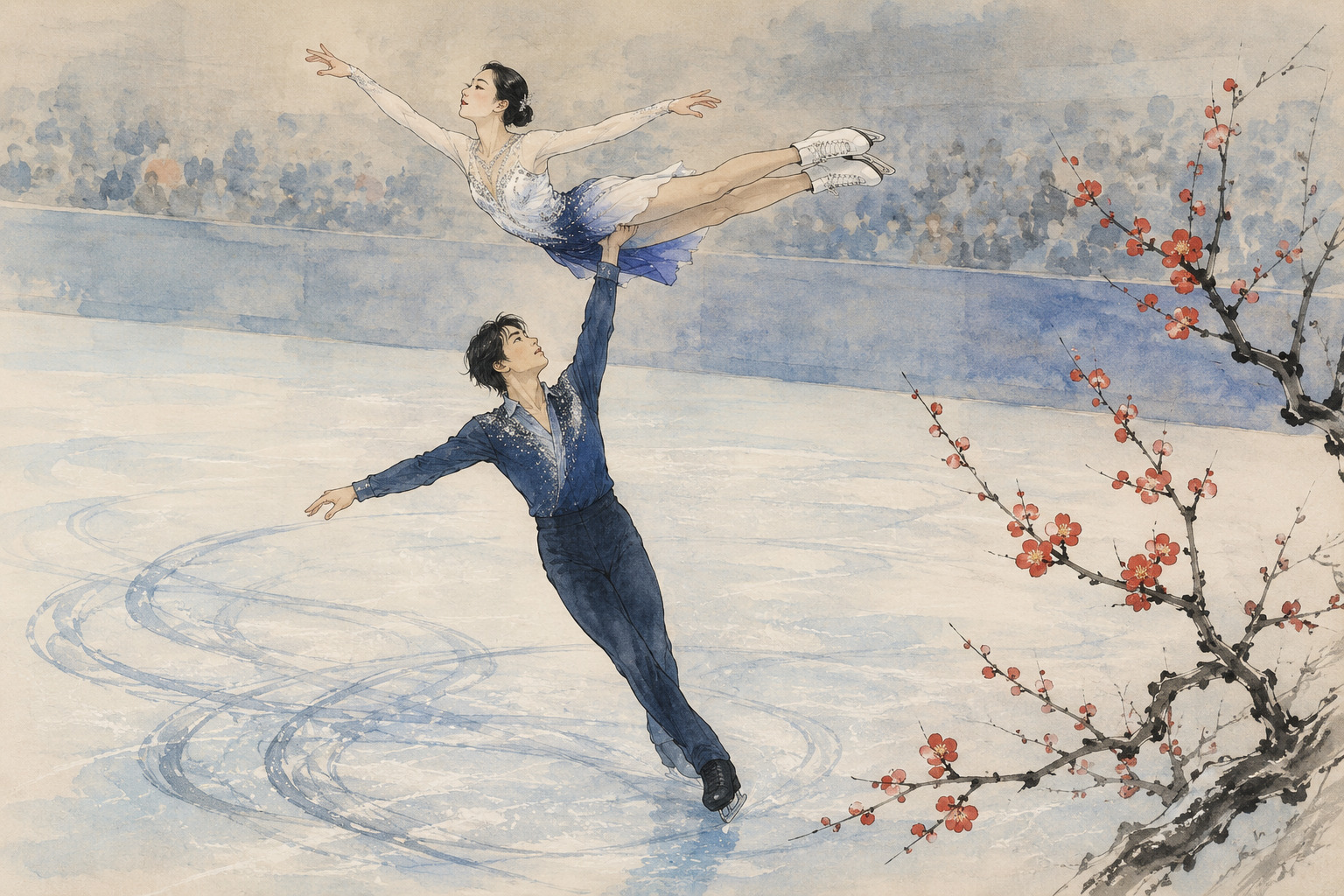
Pairs skating can make trust look effortless because its most difficult tasks are built to flow. A twist lift begins with shared speed, an assisted takeoff and a release above the man’s head; the woman rotates independently before the two reconnect for the catch. In a throw jump, the man adds force to the woman’s takeoff, then cannot control the landing for her. Overhead lifts require a secure grip, a moving center of mass and a legal exit while both skaters continue across the ice.
The International Skating Union assigns base values to required elements. A technical panel identifies elements and levels; judges award grades of execution on a scale from minus five to plus five. Program components assess skating skills, composition and presentation, including the unison and spatial awareness of a pair. “Supporting” a partner is not merely a sentimental description. It is visible in edge quality, timing, hand position, rotational control and the ability to make a correction before a small mismatch becomes a fall.
That technical reality explains the depth of Miura and Kihara’s work together. It does not prove anything about when their private relationship changed. Competitive unity and romantic compatibility are different propositions. The engagement is known because they announced it, not because a viewer can decode a lift, a glance or a celebratory embrace years later.
Before the history, a tryout
Kinoshita Group announced the new partnership on August 5, 2019. Its Japanese release verified Miura’s name reading—三浦璃来, Miura Riku—and said Kihara intended to train with her toward the Beijing Olympics. The ISU biography uses the official romanizations Riku MIURA and Ryuichi KIHARA and identifies their training base as Oakville, Ontario, under coaches Bruno Marcotte and Meagan Duhamel.
They arrived with different amounts of senior experience. Miura had competed with Shoya Ichihashi. Kihara had begun as a singles skater, then partnered Narumi Takahashi for the Sochi 2014 Olympics and Miu Suzaki for PyeongChang 2018. With Miura, he would reach Beijing 2022 and Milano Cortina 2026, four consecutive Olympic cycles with three partners. Those earlier partnerships should not be edited into failed prologues. They were separate careers and part of the technical experience Kihara brought to the 2019 tryout.
In a later Number interview, Kihara recalled immediate confidence when he and Miura first skated together in July 2019. The tidy origin story is real as a recollection, but it should not be mistaken for inevitability. The ISU biography records about 15 hours of weekly ice practice in Oakville during both low and high season. A promising test did not produce Olympic gold. Thousands of catches, throws, falls, corrections and video reviews did.
A Japanese discipline built partly abroad
The development of Japanese pairs has often depended on international partnerships and overseas training because suitable partners, specialist coaches and sufficient ice time are difficult to assemble in one domestic system. Narumi Takahashi and Canadian-born Mervin Tran demonstrated what that structure could produce when they won bronze at the 2012 World Championships—the first world medal for a pair representing Japan.
Takahashi’s account of that career describes early-morning practice, financial strain and training in Canada. Marcotte, who later coached Miura and Kihara, was among the specialists around Takahashi and Tran. The continuity matters. Miura and Kihara did not create Japanese pairs skating from nothing, and Kihara’s own Sochi partnership with Takahashi joins the earlier history directly to the team that later became “RikuRyu.”
What Miura and Kihara changed was the ceiling. At Beijing 2022 they finished seventh in the individual pairs event, the first Olympic top-eight finish for a Japanese pair. They also contributed to the team event medal that was ultimately reallocated to Japan as silver. They won world silver a month later and the Grand Prix Final that December. In 2023, victories at the Four Continents Championships and World Championships made them the first Japanese pair to win either title.
Kinoshita Group describes their sweep of the Grand Prix circuit, Grand Prix Final, Four Continents and Worlds during the 2022–23 season as an “annual Grand Slam.” That is the employer’s defined label; the underlying victories are official results. The distinction is small but important. Sports organizations and sponsors often organize achievements into branded phrases. Reporting should preserve both the accomplishment and the source of the terminology.
| Year | Verified milestone | Historical meaning |
|---|---|---|
| 2012 | Narumi Takahashi and Mervin Tran won World Championship bronze. | Japan’s first world medal in pairs. |
| 2019 | Miura and Kihara’s partnership was announced on August 5. | A new pair began with Beijing 2022 as its stated target. |
| 2022 | Seventh at Beijing; world silver; Grand Prix Final champions. | Japan’s first Olympic pairs top-eight finish and first GP Final pairs title. |
| 2023 | Four Continents and World champions. | The first Japanese pair to win both events. |
| 2025 | World champions for a second time. | A return to the title after an injury-disrupted season. |
| 2026 | Olympic gold; competitive retirement in April; engagement in August. | A competitive ending followed by a life decision disclosed on their terms. |
The season that stopped, then started again
A career summarized through medals hides the intervals in which there was no competitive program to watch. Kihara’s back injury kept the pair out of much of the first half of the 2023–24 season. They returned to win world silver in 2024, then regained the world title in 2025. Kinoshita Group’s own Golden Slam announcement acknowledges the injury-related absences rather than presenting the trajectory as uninterrupted ascent.
That interruption sharpens the meaning of pair-specific training. If one skater is unavailable, the other cannot rehearse a full twist catch, throw entry or pair lift alone. Timing is not stored permanently after it has been learned; speed, strength and confidence have to be synchronized again. A comeback in pairs is therefore not two parallel recoveries. It is the rebuilding of a shared instrument.
By the 2025–26 season, Miura and Kihara had won the Grand Prix Final again. Their free skate used music from the “Gladiator” films, according to the ISU record. The costumes visible in the engagement photographs appear to reference that program. What those costumes can establish is the visual choice the couple made for the announcement. They cannot establish the proposal’s date or location.
Fifth after the short, first after the free
Milano Cortina provided the competitive ending no writer needed to embellish. Miura and Kihara entered the individual pairs event as world champions and had already helped Japan win a second consecutive team-event silver. In the short program on February 15, a lift error proved expensive. They scored 73.11 and stood fifth, 6.90 points behind German leaders Minerva Fabienne Hase and Nikita Volodin.
The short program offers little room to replace a failed required element. A mistake does not merely look conspicuous; it removes base value and grade-of-execution opportunities from a tightly prescribed set of tasks. The deficit meant Miura and Kihara needed both a nearly complete free skate and help from the standings above them.
They supplied the first part themselves. Their free-skating score was 158.13, a personal best recorded in the ISU biography. The total reached 231.24. Hase and Volodin finished behind them, and Miura and Kihara became the first pair representing Japan to win Olympic gold.
Calling that reversal “the power of love” would flatten the sporting explanation. The record supports a more exact account: they restored the lift that had failed, completed a dense chain of pair and individual elements, and presented it with enough quality to create the highest total of their career. The scores do not disclose private feelings. The engagement announcement six months later does not retroactively change what the judges evaluated.
Golden Slam, then a stop
Olympic gold completed victories across the Olympic Games, World Championships, Four Continents Championships and Grand Prix Final. Kinoshita Group called the set a “Golden Slam,” defined it as wins in all four ISU-recognized major international events, and said Miura and Kihara were the second entry in Japanese figure-skating history to achieve it. The name belongs to that company statement; the component titles belong to the competition record.
The pair withdrew from the March World Championships. In April they announced the end of their competitive careers and a transition to professional skating. At their retirement news conference, they explained that the Olympic conclusion had left them with a sense of completion and that the decision had accompanied the choice not to compete at Worlds.
That timing changes the frame of the engagement story. They were not announcing a major private commitment in the middle of an Olympic campaign. The championship, withdrawal and retirement decision had already closed their competitive arc. The August post belonged to the next period of their public lives.
Professional skating may preserve their working partnership. Coaching or other future roles may extend it again. None of that supplies the missing details of their marriage plans. A job performed together, a public nickname and a shared medal history are not public ownership of a home life.
Why old footage cannot answer a new question
Pairs skating produces images that invite romantic interpretation: clasped hands, prolonged eye contact, an embrace after risk, one person literally lifting another. Those are also the sport’s grammar. A throw requires contact. A lift requires a catch. A score appearing in the kiss-and-cry can release months of pressure in a hug.
Once an engagement becomes public, viewers may be tempted to revisit every one of those moments as a clue. The method is unreliable. It confuses performance requirements with private disclosure, and it encourages a false precision the couple’s statement does not offer. There is no verified relationship start date in the announcement. There is no basis to assign one from a podium photograph.
This boundary does not make the engagement less meaningful. It makes the report more faithful to the couple’s agency. Miura and Kihara chose the fact, language and photographs they wanted to release. The public can celebrate that decision without manufacturing the chapters they kept private.
- Confirmed: Miura and Kihara announced their engagement jointly on August 23.
- Confirmed: Their published photographs include a ring and Kihara on one knee on the ice.
- Not disclosed: The proposal’s date and location, the start of the relationship, a wedding date or legal arrangements.
- Japan.co.jp analysis: Pairs technique explains the depth of their shared craft, but does not establish their private timeline.
A shared name, a self-chosen next step
“RikuRyu”—りくりゅう in Japanese—compressed two names into an affectionate public identity. It followed them from an uncertain 2019 experiment to Beijing’s seventh place, the first world title, injury, a second world title, and the Olympic free skate that erased a 6.90-point deficit. The nickname belongs to fans and headlines as much as any sports shorthand can. The decision announced Sunday belongs to Miura and Kihara.
Their seven competitive years demonstrate what two athletes made together: a safer catch, a faster entry, a program resilient enough to survive a short-program failure, and a sequence of firsts for Japanese pairs skating. Their joint post reveals what they chose to say about life after those competitive years: the partnership is also personal, and they intend to keep moving forward together.
There is an elegant visual reversal in Kihara kneeling rather than lifting, and it is understandable that the photograph became the announcement’s emblem. The deeper continuity is less picturesque. Throughout their career, the pair decided when to attempt, when to withdraw, when to rebuild and when to stop. In August, they decided when the public would know this.
For years, a successful element ended when each knew exactly where the other would be. Their engagement begins with a future neither a score sheet nor a photograph can map—and with the next step announced in their own time.
- Riku Miura and Ryuichi Kihara — Joint engagement announcement, August 23, 2026
- Kinoshita Group — Official announcement of the new pair, August 5, 2019
- International Skating Union — Official biography, personal bests and major results
- Japanese Olympic Committee — Japan’s first Olympic pairs gold
- Japanese Olympic Committee — Official Japanese names and readings, post-Olympic interview and seven-year chronology
- Olympics.com — Milano Cortina pairs free-skating result
- Kinoshita Group — “Golden Slam” announcement and definition
- International Skating Union — Figure-skating scoring and pairs requirements
- Olympics.com — Miura and Kihara’s April 2026 retirement news conference
- Olympics.com — Beijing 2022 pairs result
- Asahi Shimbun 4years. — Narumi Takahashi, Mervin Tran and the 2012 world bronze
- Number Web — The 2019 tryout and formation of the pair
- Olympics.com — Engagement announcement and career chronology
Attribution boundary: The engagement, wording and content of the published photographs come from the couple’s joint post. Official Japanese names and readings, formation date, scores, placements, titles, injury absence and retirement were checked against the organizations and records above. The analysis of trust as both a technical requirement and an inadequate basis for reconstructing a private relationship is Japan.co.jp’s; it is not presented as a statement by Miura or Kihara.