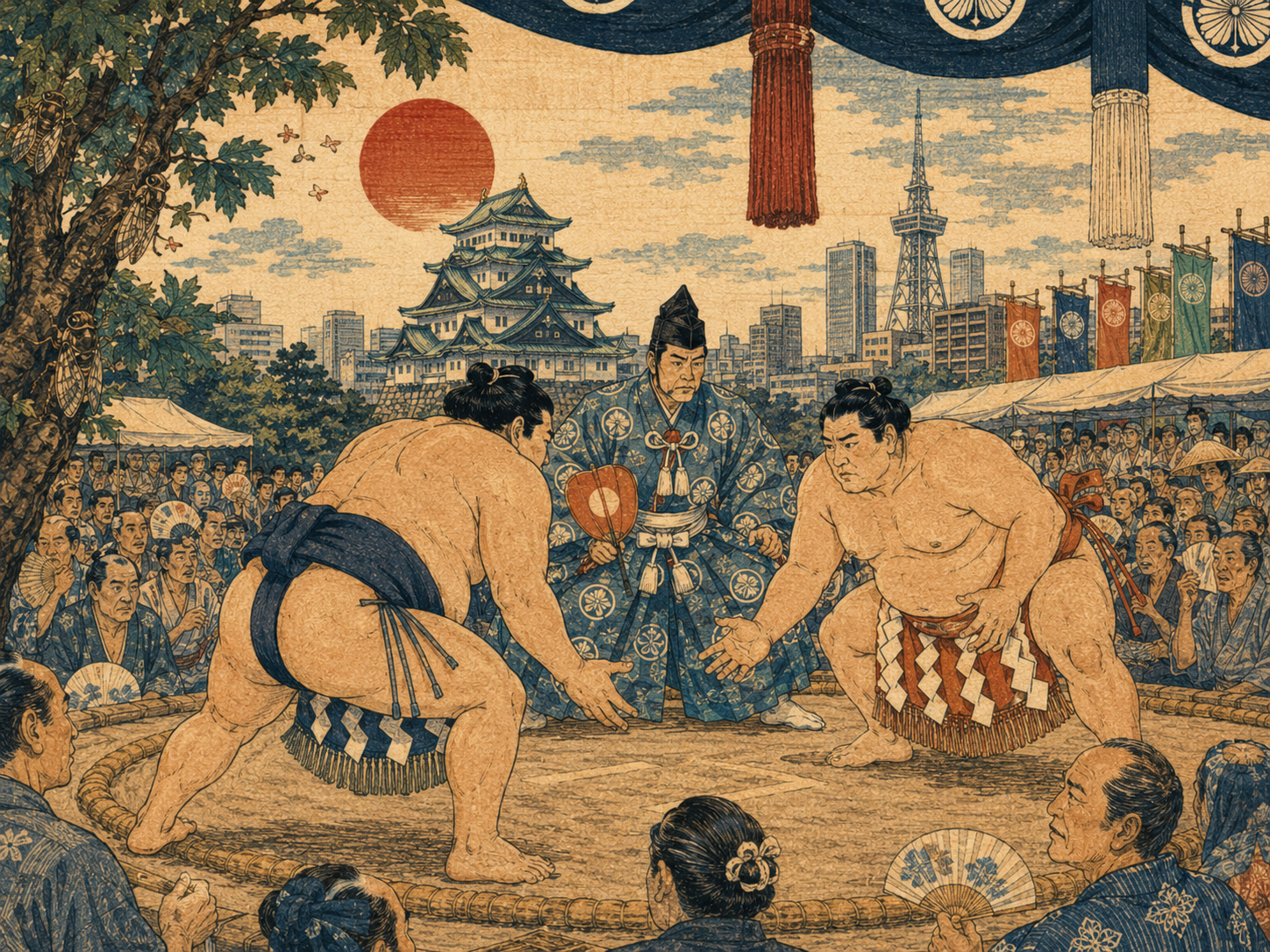
Nagoya waits for sumo in the heat. When the rainy-season dampness still clings to the subway platforms, when the moat around Nagoya Castle flashes white in the sun, and when the city begins to move at the slower rhythm of midsummer, the wrestlers return to the ring. The 2026 July Grand Sumo Tournament opens on July 12 and runs through July 26 at IG Arena in Nagoya. The rankings were announced on June 29. Tickets are already sold out. The summer basho is almost here.
The July tournament is not merely one stop on the six-tournament calendar. It has its own temperature, its own folklore, its own pressure. Tokyo has the old authority of the Kokugikan. Osaka has the feel of spring and appetite. Fukuoka has the autumn road to the year’s end. Nagoya has sweat, fans, cicadas, gold shachi, miso-rich food, and the sudden violence of two huge bodies colliding on clay.
This year’s tournament has two big stories before the first match is even fought. The first is the venue. After decades at the old Aichi Prefectural Gymnasium, the Nagoya basho has entered the new IG Arena era. The second is the banzuke. Hoshoryu stands as the East Yokozuna. Onosato stands as the West Yokozuna. One is Mongolian-born, sharp, proud and technically dangerous. The other is Japan-born, young, powerful and already symbolic of a new age. In Nagoya’s summer heat, they give the tournament its frame.
The 2026 July tournament at a glance
According to the Japan Sumo Association’s official schedule, the 2026 July Tournament will be held at IG Arena from July 12 to July 26. Advance tickets went on sale May 16, and the ranking list was released on June 29. The official Sumo Association homepage says tickets for all dates are sold out.
Ticket Oosumo notes that IG Arena normally opens at 8:45 a.m., with bouts starting in the morning and finishing around 6 p.m. The main matches involving the top-division wrestlers begin around 2 p.m. That is part of the wonder of a sumo day: the arena slowly thickens. Young wrestlers fight in the morning, the crowd fills in, the noise rises, the juryo division begins to matter, the makuuchi ring-entering ceremony changes the air, and by the final bouts the building feels like it is leaning toward the clay.
The new IG Arena era
IG Arena opened in Nagoya in the summer of 2025, near Meijo Park and Nagoya Castle. Its official site describes a 17,000-capacity venue with world-class specifications, modern facilities and a new kind of entertainment experience. It is not just a new building. It is a new container for one of Japan’s oldest sports.
Aichi Prefecture’s official tourism site notes that the Nagoya tournament had been held at Dolphins Arena, the former Aichi Prefectural Gymnasium, for 59 seasons before IG Arena took its place last year. That old venue carried the memory of Showa, Heisei and early Reiwa sumo: summer gymnasium air, old seats, paper fans, families, local sponsors, veteran spectators who knew exactly when the atmosphere would turn.
Sumo looks still, but it moves. The dohyo remains the same size. The salt is still thrown. The referee still calls the bout. Yet the world around the ring changes: lighting, access, screens, food, barrier-free design, foreign-language guidance, public transportation, tourism routes. The 2026 Nagoya basho is the second summer of that transition. It asks a quiet question: when tradition enters a modern arena, what changes, and what refuses to change?
The summer tournament once called tropical
No history of the Nagoya basho can avoid the phrase “tropical tournament.” From 1958 to 1964, the July honbasho was held at Kanayama Gymnasium. The building, reportedly converted from an aircraft hangar, became so hot that pillars of ice were placed in the aisles. The nickname stuck because it was true in spirit. Nagoya sumo was never only about rankings. It was about surviving the season.
From 1965, the tournament moved to Aichi Prefectural Gymnasium, later known as Dolphins Arena. But the emotional weather remained. Nagoya is the summer tournament. The heat becomes a hidden opponent. For wrestlers who must gain weight, train hard, travel, recover and still produce one explosive match every day, humidity is not background. It is part of the contest.
Most sumo bouts are short. Some end in a few seconds. But those seconds sit on top of everything that came before: morning practice, meals, sleep, treatment, injuries, stable life, mental pressure and the fatigue of the road. To win the July tournament, a wrestler must defeat more than the man across the shikiri lines. He must defeat the summer.
A two-yokozuna tournament: Hoshoryu and Onosato
The top of the 2026 July banzuke tells the story plainly. Hoshoryu is listed as East Yokozuna. Onosato is listed as West Yokozuna. The Japan Sumo Association’s ranking page places them above a powerful chasing field that includes Kirishima and Kotozakura at ozeki.
Hoshoryu is a wrestler of angles and danger. His family connection to former Yokozuna Asashoryu is always mentioned, but his own sumo is what matters now: footwork, throws, counters, balance, and a fierce competitive face that can change the mood of a match before contact. He does not always look like the largest man on the dohyo. He often looks like the man who understands where the next opening will appear.
Onosato carries a different kind of symbolism. From Ishikawa Prefecture and Nishonoseki stable, he became Japan’s 75th yokozuna after one of the fastest rises in modern sumo. His ascent came at a time when many fans were waiting for a Japan-born grand champion who could define the next era. His home region’s suffering after the Noto Peninsula earthquake has added emotional weight to his victories.
Two yokozuna make a tournament luxurious. They also make it severe. Every upset becomes a headline. Every day of clean winning raises the expectation of a final-week collision. Every loss is read not only as a result, but as evidence. In a two-yokozuna Nagoya basho, the tournament does not simply unfold. It tightens.
Ozeki, sanyaku and the younger wave
The official July banzuke lists Kirishima and Kotozakura at ozeki. Below them, names such as Atamifuji, Kotoshoho and Wakatakakage give the sanyaku ranks their danger. This is where sumo becomes merciless. A wrestler near the top faces elite opponents almost every day. One mistake can start a losing week. One hot streak can change a career.
Ozeki is a rank with two roads. One road points upward toward yokozuna. The other road points downward toward survival. To the public, an ozeki is already a star. Inside the sport, the rank is a constant examination. Win enough and the rope becomes imaginable. Lose too much and the rank begins to wobble.
Nagoya often creates openings. The summer road is hard. Bodies are sore. Young wrestlers can catch fire. Veterans can steal a match with one grip, one pull, one shift of hips. The banzuke is printed in elegant order, but the clay does not always obey paper.
Why sumo still feels ancient and new
Sumo’s roots run into ritual. It grew from prayers for harvests, court ceremony, warrior training, Edo-period public entertainment, Meiji-era national symbolism, postwar reconstruction, television fame, and now international curiosity. The sport has changed constantly while guarding a small circle of clay as if it were a shrine.
The gestures tell the story. The clapping of hands, the stomping of the feet, the throwing of salt, the crouch before impact, the referee’s voice, the purification of the ring. They are ritual actions, but they are also competitive actions. The same movement can be religious memory, psychological warfare and athletic preparation.
That is why sumo is so easy to recognize and so hard to exhaust. A first-time visitor understands the collision. A lifelong fan watches the feet, the breathing, the hand placement, the delay before the charge, the expression of a wrestler who knows he has been moved half an inch too far.
How to watch the Nagoya basho
For new spectators, the best advice is simple: do not watch only the final result. Watch the time before the match. Who puts his hands down first? Who makes the other man wait? How much salt does he throw? Does he look angry, calm, theatrical, tired? Does the crowd feel the tension before the wrestlers move?
The lower divisions matter too. A morning match may involve a young wrestler whose name is unknown to tourists but deeply important to his stable. A win can move him closer to salary. A loss can delay a career. Sumo’s pyramid is steep. The glamour of the top division rests on hundreds of quieter matches.
In Nagoya, the city adds a second stage. Nagoya Castle, Kinshachi Yokocho, miso katsu, kishimen, hitsumabushi, coffee-shop morning sets, summer streets and fans moving through the subway toward Meijo Park. The best regional basho are never only indoor events. For fifteen days, the city itself becomes the outside of the dohyo.
Japan.co.jp view
The 2026 July basho feels like a tournament about continuity and change. The arena is new. The audience is more international. The tickets are sold out. The wrestlers are global. The screens are modern. But the test remains brutally old: one ring, two bodies, one instant of truth.
Japan’s traditions do not survive by being placed under glass. They survive when people gather, argue, cheer, sweat, eat, travel, remember and return. Nagoya sumo does all of that. It is old enough to carry ritual and popular enough to fill a new arena.
Opening day is only days away. The rankings are published. The venue is ready. The heat is coming. The yokozuna are in place. Now the summer waits for the clay to answer.
Reader’s guide
| Item | Detail |
|---|---|
| Dates | Sunday, July 12 to Sunday, July 26, 2026 |
| Venue | IG Arena, Meijo, Kita-ku, Nagoya |
| Banzuke release | June 29, 2026 |
| Key names | Yokozuna Hoshoryu, Yokozuna Onosato, Ozeki Kirishima, Ozeki Kotozakura |
| Historical frame | Nagoya’s July tournament has long been remembered as the summer basho, once nicknamed the “tropical tournament.” |
| Watching tip | Arrive early if possible. The full day, from lower divisions to the final match, tells the real story of a honbasho. |
Sources and references
この記事は、日本相撲協会、Ticket Oosumo、IGアリーナ、愛知県公式観光サイト、相撲史に関する公開資料を参考にしました。
- Japan Sumo Association: July 2026 banzuke, news, ticket status.
- Japan Sumo Association tournament schedule: 2026 July Tournament at IG Arena, July 12–26.
- Ticket Oosumo: July Grand Tournament visitor information and daily schedule guidance.
- IG Arena: venue opening, capacity, location and facilities.
- Aichi Now: Nagoya Grand Sumo Tournament overview, venue history, access and ticket status.
- Japan Sumo Association introduction to sumo: ritual and historical background.