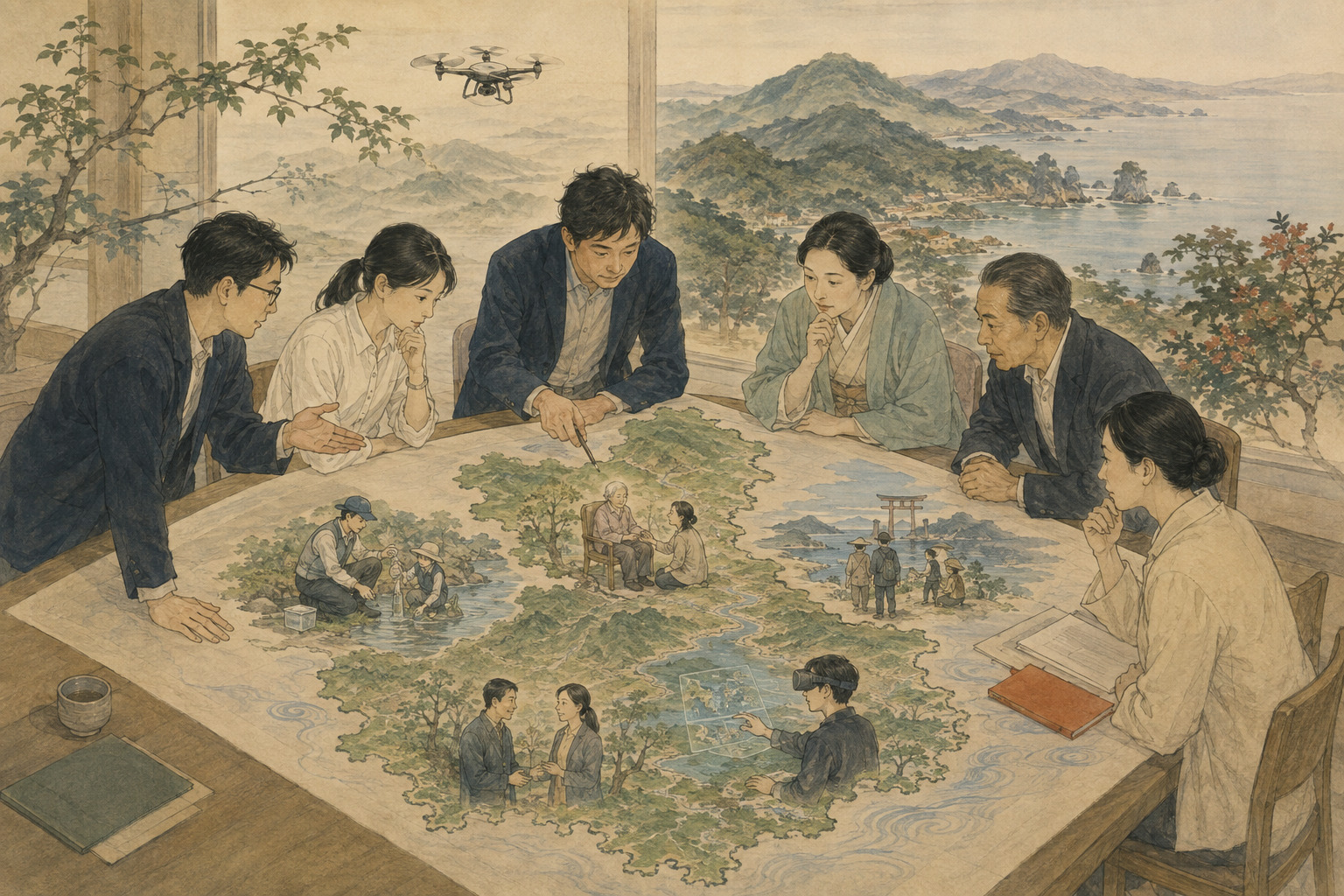
A founder seeking a proving ground can read Mie Prefecture like a catalogue. There is a major industrial port at Yokkaichi and a chain of smaller ports along Ise Bay and the Pacific. There are dense northern cities, aging inland communities, farms and forests, fishing settlements, the pilgrimage economy of Ise, the resort economy of Shima, and the long cultural corridor toward Kumano.
A catalogue is not a laboratory. A port manager must approve flights and access. A care provider must find participants and staff time. A tourism business must turn a story into a bookable product. A municipality must decide whether residents’ heart-rate, conversation, location or health data can be collected under terms that are genuinely understood.
That distinction is essential to reading MIE StartUp FIELD, the prefecture’s new demonstration-support program. On August 20, Mie announced six selections from a pool of 24 companies. The winning proposals came from amulapo Inc., e-lamp. Inc., WizWe Inc., DAOWORKS Inc., FishPass Inc. and micro development Inc. All are based outside Mie, as the program requires.
The announcement did not say that six pilots were running. It launched the search for the organizations that could host them. The prefecture plans experiments from October 2026 through February 2027 and a results event in February. First comes a September 18 meeting in Yokkaichi, where each startup will have five minutes to pitch to Mie companies, municipalities and other possible partners.
Six proposals, six different burdens of proof
“Pilot” can conceal more than it reveals. A children’s experience in an event hall and an AI-generated inspection report for a breakwater do not require the same evidence. A drone can fail because of wind or image quality. A behavior-support program can appear to succeed because its least comfortable participants quietly leave. A story can attract online readers without creating one additional room night.
| Selected company and Mie’s official theme | What the company says it does | The local question that remains |
|---|---|---|
| amulapo Inc. “Space-experience content using digital technology” | The Tokyo company says it produces CG and interactive space experiences, operates events and educational programs, and supports regional space-business projects. | Does the experience create measurable learning, paid attendance or an extra stop in a visitor itinerary? Who operates and maintains the equipment after the demonstration? |
| e-lamp. Inc. “Matching through heart-rate and conversation analysis, followed by date plans that generate circulation through the region” | Its ematch service uses an original device to make pulse changes visible and presents conversation and matching support, according to the company. | Does the intervention improve a clearly defined outcome over an ordinary event, and do matches lead to consensually measured visits and spending? How are biometric, conversation and profile data deleted? |
| WizWe Inc. “A dementia-prevention program for older people combining AI and human support” | WizWe centers its business on habit formation. In a separate project, it described support combining LINE, personal health records, a dedicated human supporter and AI conversation. | Can older participants continue using it, and at what staff cost? A short program can measure behavior and retention; it cannot by itself establish a reduction in dementia incidence. |
| DAOWORKS Inc. “Port-facility inspection by drone and AI analysis, including automated report generation” | The Gifu company says its port project combines machine-learning review of imagery, three-dimensional data stored in the cloud and support for repair planning. | How do defect detections compare with qualified inspectors? How many images require reflying, how much report correction remains, and can a port authority accept the output in its maintenance workflow? |
| FishPass Inc. “Low-cost wildlife-damage countermeasures through biodiversity monitoring using environmental DNA” | FishPass says DNA in water or air can indicate species, distribution and diversity, with results shown on a digital map over time. | Which target animal, sample medium and intervention will connect DNA detection to wildlife damage? Detection is not automatically proof of abundance, causation or crop loss. |
| micro development Inc. “An overnight-tourism model using story content based on local history and food culture” | Public materials describe its Kūsō Tabi Bunko project as converting regional material into novels or picture books and connecting the story to a stay in its setting. | Do stories produce additional nights, off-season demand and spending outside the hotel? Who controls the line between documented history, local tradition and fiction—and how is revenue shared? |
The quoted themes above reproduce Mie Prefecture’s published Japanese titles in translation. The product column summarizes corporate or project descriptions, not prefectural findings. The final column is Japan.co.jp analysis of what a credible local evaluation would need; Mie has not published those as the official scorecards.
What “the whole prefecture” actually means
Mie’s claim is organizational before it is geographic. The prefecture defines a test field as a place where companies, universities, financial institutions, municipalities and other regional actors collaborate on an experiment leading toward social implementation. It promises to match startups across the prefecture through the Mie Startup Support Platform.
The platform’s March 2026 roster gives that promise substance. It contains 88 institutions: the prefectural government, business associations, professional and startup-support firms, coworking spaces, four universities, the national colleges of technology in Toba and Suzuka, regional and national banks, credit unions, government agencies—and all 29 municipal governments.
The program operator, AlphaDrive Inc., subsequently reported 89 participating institutions as of the end of May 2026. The two figures have different reference dates. This article therefore uses the prefecture’s 88-member March roster for the named composition and confirmation that all 29 municipalities are included, while treating 89 as the operator’s newer total.
A network containing every city and town is unusual leverage for a founder who does not know whether the best first customer sits in industrial Yokkaichi, rural Ōdai, coastal Owase or a tourism business in Shima. It can shorten the search for authority, data and a physical site.
But membership is not consent. None of the listed institutions should be counted as a committed host unless it accepts the project-specific burden. An institution may be willing to attend a conference yet unable to expose infrastructure data, recruit residents, obtain flight permissions, negotiate intellectual property or allocate procurement money.
The prefecture is not the test lab because it has a border. It becomes one only when the person with the problem, the person with the site, the person with the legal authority and the person who can buy the result agree on the same experiment.
Why Mie offers more than a convenient map
The port-inspection proposal has an obvious regional canvas. Mie has 20 ports under Japan’s Ports and Harbors Act. Yokkaichi is an international hub port managed by the Yokkaichi Port Authority. The prefecture directly manages the major ports of Tsu-Matsusaka and Owase plus 17 local ports. Breakwaters, quays, revetments, piers and port roads create a large maintenance inventory exposed to salt, weather, waves and disasters.
DAOWORKS has already said its broader development work uses machine-learning analysis of imagery, cloud-based three-dimensional records and maintenance-planning support. A Mie test could be valuable if the same structure is independently inspected by a qualified person and by the proposed workflow, with misses, false alarms, time, access restrictions and report editing counted. Mie has not identified a port for the pilot, and the selection should not be read as permission to fly over one.
FishPass’s idea is both promising and less defined. Environmental DNA can detect biological traces without capturing an organism. The company presents uses including species surveys, invasive-species detection and resource monitoring. Mie’s selected title connects that method to cheaper wildlife-damage control. The public material does not say which terrestrial or aquatic animal is at issue, whether water or air will be sampled, or how a detection will trigger fencing, patrol, capture or habitat action.
That missing bridge is the experiment. A useful design would compare DNA with cameras, sightings, capture records and mapped agricultural or forestry damage through time. Otherwise the pilot could produce an elegant biodiversity map without proving that a single field was better protected.
The tourism proposals operate against a large but easily misunderstood baseline. Mie estimates 36.96 million tourism and recreation visits in 2025 and tourism consumption of ¥569.7 billion. The visits are an aggregate count, not 36.96 million distinct people. The prefecture also added VISON to the survey sites in 2025 and cautions that the methodological change affected the year-on-year comparison.
That makes “more participants” a weak goal for the space experience, story-led lodging and post-match itineraries. The question is whether the products add a visit, add a night, shift demand into a quiet period or direct spending to businesses that would otherwise be bypassed.
Two pilots will test governance as much as software
e-lamp. and WizWe will work closest to human identity, emotion and health. Their pilots cannot be evaluated only through an engagement dashboard.
Heart rate is biometric information. Conversation and profile data may reveal relationships, preferences and location. A system may calculate a “match” or an emotional response, but that output is a model-dependent inference—not a verdict about compatibility. Participants need a plain-language explanation of what is measured, who receives it, whether a conversation is transcribed, how long data remain, and how they can withdraw or delete them. Tracking a subsequent itinerary introduces another layer of consent.
WizWe’s official Mie theme uses the term “dementia prevention.” In a separate company project with NTT Docomo Business, WizWe described a program using LINE, walking and sleep data, frailty scores, a dedicated supporter and an AI conversation feature. That earlier design helps explain the combination of automation and people; it does not establish that Mie will use the same intervention.
Mie has not published the target population, sample size, clinical involvement, outcome instrument or data plan. Over four or five months, the program may be able to observe retention, exercise, sleep, self-efficacy, accessibility and supporter workload. It would be a category error to turn those short-term outcomes into proof that dementia cases were prevented.
This is why dropout data matter. If the oldest, least digitally confident or most impaired participants leave early, a high completion rate among those remaining can conceal the very exclusion a local program needs to solve.
A three-year institution, not a one-day startup contest
MIE StartUp FIELD extends a regional system that began in 2023. On August 28 of that year, Mie launched the Mie Startup Support Platform to bring government, universities, economic groups, financial institutions and support organizations behind startup creation and growth within the prefecture. A contemporaneous prefectural document described 49 industry-academia-finance-government members.
A one-stop consultation service followed in June 2024. Conferences, matchmaking and business support expanded the prefecture’s published roster to 88 by March 2026; AlphaDrive reported 89 participating institutions at the end of May.
The 2026 program reverses part of the original direction of travel. Rather than concentrating only on startups born in Mie, it searches urban innovation hubs—including SHIBUYA QWS in Tokyo and STATION Ai in Nagoya—for companies that have already moved beyond an idea. The operating specification targets products or services with a minimum viable form and some earlier evidence that the proposed method can address a regional problem.
August 28, 2023 — Mie establishes its startup-support platform, initially focused on creating and growing ventures in the prefecture.
June 2024 — A one-stop entrepreneurship and business consultation service begins operating.
March 16, 2026 — The published platform roster reaches 88 institutions, including all 29 municipalities.
End of May 2026 — Program operator AlphaDrive reports 89 participating institutions.
June 2–July 22, 2026 — MIE StartUp FIELD accepts applications; an interview with the program office is required before applying.
August 20, 2026 — Six companies are announced from 24 applicants, and recruitment of test-field hosts begins.
October 2026–February 2027 — Planned demonstration period, followed by a prefectural results event in February.
There is a second institutional history in the background. Mie’s 69 municipalities at the end of fiscal 1998 were consolidated into the present 14 cities and 15 towns during Japan’s Heisei-era merger wave. The startup platform now overlays one network across all 29. In principle, it can search beyond the internal boundaries of the larger post-merger municipalities as well as across municipal borders.
The ¥21.5 million number is not a pot divided six ways
The prefecture’s procurement notice set a maximum contract value of ¥21,486,896, including tax. That ceiling covers the commissioned operation: identifying outside startups and possible fields, matching and coordination, accompaniment, events, consultation services, communications, measurement and final reporting. AlphaDrive Inc. is the contracted program operator.
It is not a disclosed six-way grant fund. Mie’s June recruitment notice says participating startups generally bear their own demonstration costs, although a separate prefectural startup subsidy may be available. The August selection does not identify which of the six has obtained another subsidy or state a budget for any individual test.
The original operating specification also reveals the program’s minimum ambitions. The contractor was to identify at least 10 interested outside startups, aim to collect at least 10 available fields and target at least three experiments. The final competition attracted 24 applicants and selected six. That is strong entrance activity. It is not yet proof that the target of three operating experiments has been met.
- ¥21,486,896: the ceiling for the full commissioned support operation, not the direct pilot awards.
- 24 companies: the applicant pool, not a pool of independently validated technologies.
- Six companies: selected plans, not completed pilots, purchases or deployments.
- 88/89 institutions: the prefecture’s March roster names 88; the operator’s end-of-May statement reports 89. Neither figure counts confirmed hosts for this program.
- Four months or more: the specification’s planned duration for a pilot; duration alone does not create rigorous evidence.
The public scorecard Mie should publish in February
Mie says its accompaniment will emphasize prior agreement on purpose, roles and expected outcomes. That is the correct architecture. The public version should go further. A results event needs comparable evidence, not six unrelated slide decks optimized by the participating companies.
| Pilot | Minimum comparison | Evidence of an exit from pilot mode |
|---|---|---|
| Digital space experience | Learning, satisfaction, staff time and cost against an ordinary program | Paid attendance or a repeat order from a school, facility or tourism operator |
| Heart-rate and conversation matching | Match, satisfaction, withdrawal and harm indicators against a conventional event | Consensually measured visits, spending or continued contact, plus data-deletion performance |
| Dementia-prevention support | Pre/post behavior, retention, accessibility gaps and complete staff workload | A per-user price a municipality or care provider will fund; clinical claims remain subject to a stronger study |
| Port drones and AI | Human and machine inspection of the same asset, counting misses, false alarms, time, reflight and report corrections | An output the responsible authority accepts, a maintenance workflow and a procurement price including support |
| Environmental DNA and wildlife | DNA signals compared over time with cameras, sightings, captures and mapped damage | A changed intervention with measurable effect on damage or patrol work, priced over a full season |
| Story-led stays | Incremental room nights, length of stay, local spending and quiet-season occupancy | A product that lodging and food businesses can resell, with local editorial control, rights and revenue share |
Every project should publish a baseline, eligibility and exclusion rules, data-collection method, failure threshold, total public and private cost, and the date on which the host will decide whether to buy, continue or stop. If commercial confidentiality limits raw disclosure, the program can still report standardized ranges and reasons.
Failure should be visible too. A drone may not fly often enough. Older participants may find the interface unusable. DNA patterns may not predict damaged fields. People may enjoy a story without booking a room. Those results are not an embarrassment if they prevent a larger bad purchase or redirect the next trial. Learning is the product of a demonstration.
The first experiment is matching, on September 18
The six companies will meet possible hosts at cafe neuf in central Yokkaichi on September 18 from 4:30 to 6:30 p.m. The event is free, limited to 60 people and will not be streamed. Each startup gets five minutes; the final hour is for direct exchange.
No five-minute pitch can settle flight rules, a biometric consent process, clinical governance, sample design or the ownership of a regional story. Its useful outcome is a second meeting with a named problem owner, a site, a deadline, a preliminary budget and authority to negotiate.
For the startups, Mie should not become merely a low-cost setting in which to add another logo to an investor deck. The regional party needs evidence it can use to purchase, reject or redesign the product. A good host receives more than a demonstration; it gains a decision.
Mie has assembled unusually broad ingredients: every municipality, universities and colleges, financial institutions, industrial and fishing ports, major tourism, rural communities and an operator tasked with accompaniment beyond the field test. The risk is that those ingredients produce meetings rather than customers.
For now, the six proposals are pins resting on a prefectural map. The next questions are practical. Where will each pin be placed? Who will stand beside it? What will be measured before and after? Who will pay the invoice when the support period ends?
The answer to whether Mie became a prefecture-sized test lab will not be found in the six selections announced in August. It will be found in 2027 contracts, budgets, staff hours, resident outcomes—and in the pilots Mie is willing to say did not work.
- Mie Prefecture — Selection of participating startups and recruitment of test fields, August 20, 2026 (Japanese)
- Mie Prefecture — Launch of the fiscal 2026 demonstration-support program and one-stop consultation service, June 2, 2026 (Japanese)
- Mie Prefecture — Procurement notice for the fiscal 2026 startup demonstration-support operation (Japanese)
- Mie Prefecture — Operating specification for the demonstration-support program, eight pages (Japanese PDF)
- Mie Prefecture — Mie Startup Support Platform members as of March 16, 2026, listing 88 institutions (Japanese PDF)
- Mie Prefecture — Establishment of the Mie Startup Support Platform in 2023 (Japanese)
- Mie Prefecture — Mie’s 20 ports and their management categories (Japanese)
- Mie Prefecture — 2025 tourism and recreation visit and spending estimates (Japanese)
- Mie Prefecture — Municipal mergers and the current 14 cities and 15 towns (Japanese)
- AlphaDrive Inc. — MIE StartUp FIELD launch announcement, reporting 89 participating institutions as of the end of May 2026 (operator statement, Japanese)
- AlphaDrive Inc. — Operator’s announcement of the six selected companies and planned schedule (corporate statement, Japanese)
- amulapo Inc. — Projects and service descriptions (company self-description, Japanese)
- e-lamp. Inc. — ematch service description (company self-description, Japanese)
- WizWe Inc. — Description of a separate cognitive-function support project for older people (company self-description, Japanese)
- DAOWORKS Inc. — Port drone-inspection service description (company self-description, Japanese)
- FishPass Inc. — Environmental DNA methods and services (company self-description, Japanese)
- SHIBUYA QWS — Project description for micro development’s Kūsō Tabi Bunko (Japanese)
Editor’s note: Company names, official Japanese readings, selected themes and dates were checked against Mie Prefecture’s Japanese primary materials. This edition does not reconstruct Japanese quotations from English. Company technology and prior projects are labeled as self-descriptions and are not treated as findings from Mie. Platform totals are identified by reference date and source: 88 on the prefecture’s March roster and 89 in the operator’s end-of-May statement. The ¥21,486,896 figure is the ceiling for the commissioned support operation, not a six-company grant pool. Suggested metrics and procurement conditions are Japan.co.jp analysis based on the disclosed program design. The supplied exchange-rate timestamp of August 23 at 3:06 p.m. UTC converts to August 24 at 12:06 a.m. JST.