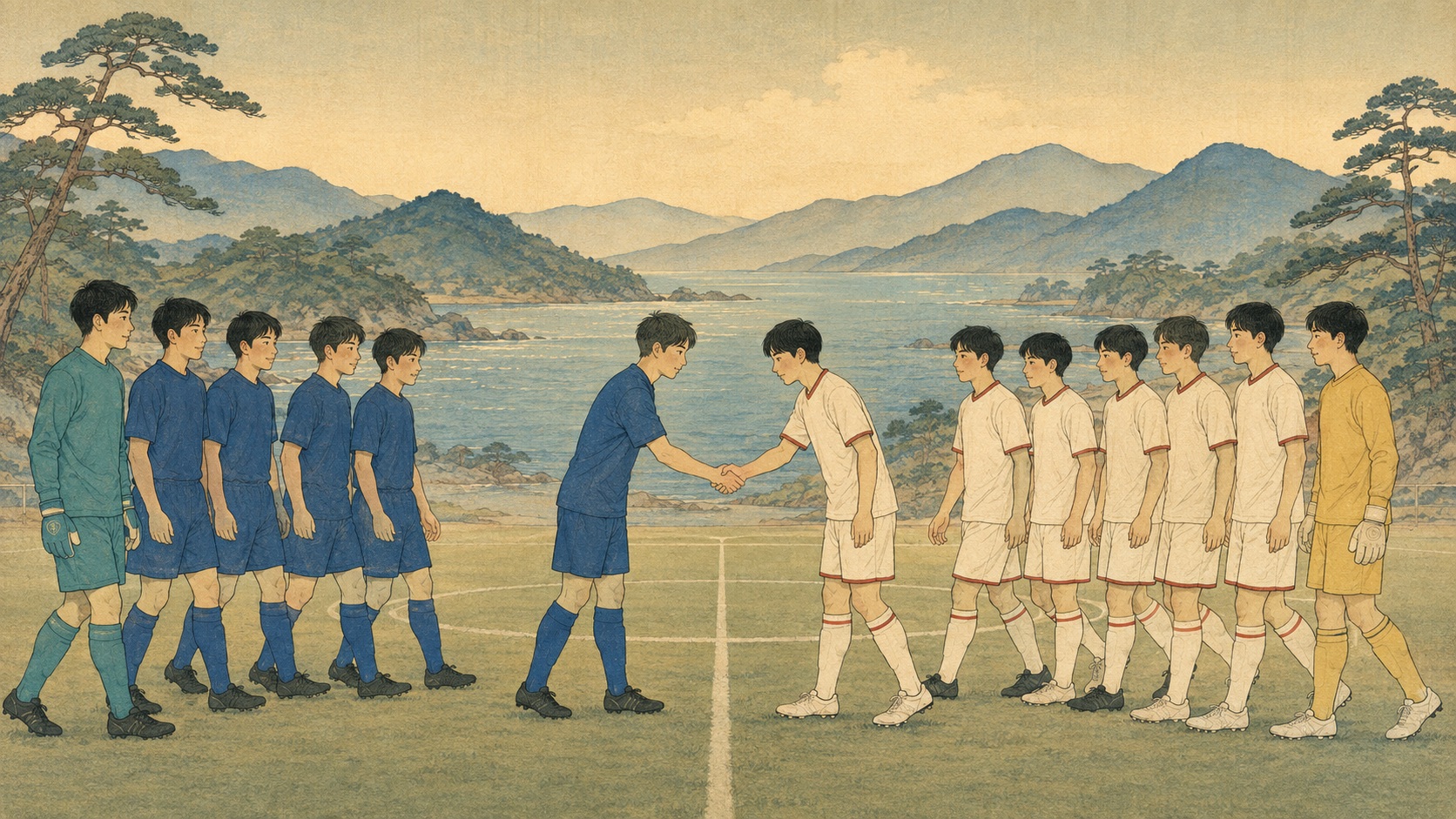
Later this morning, young athletes in Mie will begin with practice rather than a final. A pass will arrive from someone whose instructions they may not fully understand. A table-tennis rally will make translation unnecessary for a few seconds. In a gym or on a field in Suzuka, Tsu or Yokkaichi, children from Japan and South Korea will discover that the person wearing the other colors also worries about missing, laughs at the same mistake and wants one more attempt.
The official plan for the 30th Japan–Korea Youth Summer Sports Exchange matches a 218-member Korean delegation with 218 Japanese participants. Each side is structured around 184 athletes, 26 coaches and eight headquarters officials. The athletes are primary and middle-school age—generally 11 to 15—and the five sports are football, volleyball, basketball, table tennis and badminton.
The six-day Mie host program runs from August 16 through 21. A basic timetable published during planning places joint practice on August 18, formal matches and a shared recreational or educational program on August 19, and cultural exploration and a farewell gathering on August 20 before departure. That order is the argument of the event in miniature: practice together, compete, then remain together after the score is known.
This is publicly supported sports diplomacy, but its unit of work is very small. It is a returned serve, a shared meal, a coach demonstrating a movement with two hands, a child learning the sound of another child’s name. Governments created the frame. Whether the frame becomes a relationship depends on what happens inside it.
A World Cup promise made before the World Cup
The exchange began not as an afterthought to the 2002 FIFA World Cup but during the difficult work of preparing to share it. FIFA’s decision in 1996 made the 2002 tournament the first World Cup awarded to joint hosts and brought the competition to Asia for the first time. The youth summer exchange started in 1997, five years before the opening match.
Co-hosting did not dissolve history. Japan colonized Korea from 1910 to 1945. Diplomatic relations were normalized in 1965, but legal, historical and territorial disputes continued to shape public trust. The importance of the 1998 declaration signed by Japanese Prime Minister Keizo Obuchi and South Korean President Kim Dae-jung lies in the fact that it did not present exchange as a substitute for memory.
Obuchi stated that Japanese colonial rule had caused “tremendous damage and suffering,” expressing deep remorse and a heartfelt apology. Kim accepted the statement and called for a future-oriented relationship based on reconciliation and cooperation. The declaration also said the young generation needed a deeper understanding of history. Only then did it turn to the World Cup, cultural and sports cooperation, and expanded youth programs.
That sequence matters. “Future-oriented” cannot mean a future emptied of the past. In the declaration, historical recognition and human exchange were parts of the same architecture: face what happened; create the conditions in which people can know one another; do not assume that official language alone produces trust.
The World Cup opened in Seoul on May 31, 2002, and ended in Yokohama on June 30. It was the first held in Asia and the first shared by two hosts. At a summit the following month, the governments agreed on Japan–Korea Joint Projects for the Future to preserve the event’s cooperative spirit. The program began in January 2003 with a broader target of supporting youth and sports exchanges involving more than 10,000 people annually.
1965 Japan and the Republic of Korea normalize diplomatic relations.
1996 FIFA chooses Japan and South Korea to co-host the 2002 World Cup.
1997 The bilateral youth summer sports exchange begins.
1998 The Obuchi–Kim declaration links historical understanding, youth exchange and World Cup cooperation.
2002–03 The co-hosted World Cup is followed by the Joint Future Projects.
2020–22 In-person summer exchange stops; online programs preserve a thread of contact.
2023 Physical exchange resumes in Gwangju and Tokushima.
2026 The 30th summer exchange and 30th anniversary of the wider sports relationship are marked in Daejeon and Mie.
Thirty editions, and a counter that needs explanation
The Japan Sports Association says the summer youth program has accumulated 10,632 participants. Its footnote is important: the counter adds Japanese delegation members sent to Korea and Korean delegation members received in Japan. It is an administrative measure of cross-border travel, not a count of every Japanese host athlete, Korean host athlete, coach, volunteer or family member who entered the exchange.
Even within that narrow definition, the persistence is notable. The program moved through changes of government and periods of severe bilateral tension. The pandemic canceled the planned 2020 exchange. In 2021, 84 young people in Kagawa and 93 in Daejeon joined a one-day online program involving training, nutrition, quizzes and cultural exchange. In 2022, 367 participants gathered in Japanese and Korean gyms connected by video. Physical exchange returned in 2023.
Two alumni illustrate that the program can contain elite futures: former Japan football international Hiroshi Kiyotake participated in the fifth exchange, and Japan basketball captain Yuki Togashi in the ninth. But producing national-team athletes is not the best way to justify the program. Most participants will not become professionals. Its broader value has to survive that ordinary outcome.
A 2023 study by Yeon-Soo Kim and Jun-Ho Cho at Korea National Sport University reconstructed the program’s history through documents and interviews. The authors identified friendship, mutual understanding, trust, athletic development and regional benefits, and urged youth-centered digital communication and a durable archive. Their work is useful historical evidence, but it was not a randomized or longitudinal impact evaluation. Its conclusions should guide questions, not close them.
Why Mie is more than a neutral venue
Mie did not simply inherit a touring event. In 2025, it supplied 111 members in basketball, table tennis and badminton to the Japanese delegation that traveled with Gifu teams to Korea’s North Jeolla Province. This August, Mie supplied the football and volleyball groups for the outbound delegation to Daejeon, while Hyogo supplied the other three sports. For the return program, Mie is responsible for Japanese participants in all five sports.
The work is distributed across Suzuka, Tsu and Yokkaichi. The host network includes the Japan Sports Association, the Mie and Hyogo sports associations, five national sport federations, the national junior-high sports federation, local sport bodies, the prefecture, three cities and their education boards. The base of the Mie Sports Association at the Mie Kotsu Group Sports no Mori Suzuka complex makes visible what “exchange” requires before the children meet: fields, gym time, buses, rooms, meals, interpreters, medical planning, insurance and safeguarding.
There is a local poignancy to Mie hosting an international sports week. The prefecture spent years preparing the 2021 Mie Tokowaka National Sports Festival and National Sports Festival for People with Disabilities, only for both to be canceled during the pandemic. Its later sports plan treated recovery not as recovering one lost ceremony but as keeping activity, facilities and participation alive. The 2026 exchange is smaller, but it uses the same civic muscle for a different purpose.
Local selection gives the large delegation a human scale. In the Iga area, elementary and middle-school athletes were chosen for football and volleyball; one second-year middle-school volleyball player spoke publicly about accepting the responsibility of representing Japan, making every teammate a central participant and taking on new challenges. That is the official language of representation. The week’s deeper lesson may be learning when it is safe to stop representing a country and simply become a teammate, opponent or friend.
The choreography matters more than the slogan
Sport does not automatically create peace. It can produce solidarity, but it can also intensify national categories, magnify disputed officiating and turn a neighboring child into a symbol of an entire country. A photograph of a handshake says nothing about the conversation after the game.
Research on intergroup contact explains why the Mie schedule is more thoughtful than a tournament bracket. A major body of work covering 515 studies and more than 250,000 participants found that positive contact generally reduces bias. Sport researchers Nico Schulenkorf and Emma Sherry emphasize four classic conditions: equal status in the encounter, cooperation across groups, common goals and clear institutional support. They add a warning especially relevant to sport: these conditions do not appear by themselves. Unmanaged competition can have little effect or worsen tension.
Joint practice changes the geometry. Instead of two national blocks confronting each other, athletes share a drill, solve the same problem and receive instruction in the same space. Recreation changes it again by offering a goal that cannot be reduced to the score. Meals and cultural visits create time for individual details to emerge. Repeated contact over six days allows the child first perceived as “a Korean player” or “a Japanese player” to become the person with a particular serve, joke or favorite song.
| Program element | What it can create | What can go wrong |
|---|---|---|
| Joint practice | Cooperation, shared instruction and recognition of skill | Hosts dominate; language and ability become hierarchy |
| Formal match | Respect earned through effort and common rules | The national score overwhelms the individual encounter |
| Recreation | Mixed roles, humor and a goal not owned by one side | Groups remain separated and contact stays ceremonial |
| Cultural visit | Questions, context and memory beyond the venue | Tourism becomes a one-way display rather than dialogue |
| Post-event contact | Friendship can survive the official program | No safe channel, translation help or follow-up structure |
The design also has visible limits. Football’s 40 athlete positions are assigned to boys, while volleyball, basketball, table tennis and badminton include boys and girls at both primary and middle-school levels. Equal status between countries is not the same as equal access within them. A 30th-anniversary program that speaks for the future should be able to explain that gap and establish how it will close.
Access is selective in another sense. Participants generally come through registered junior sports clubs or recommendations from prefectural sports bodies. For Japanese athletes, the published participation fee is ¥20,000 for the outbound exchange and ¥15,000 for the Mie program; families may also bear travel to the assembly point, passports for outbound travel and personal expenses. Public support pays most program costs, but the exchange is not cost-free or open to every child.
What the surveys show—and what they cannot
The Japan Sports Association’s summary of its 2025 participant survey says agreement increased with statements about feeling close to Korea and the importance of sports exchange, while more than 90 percent agreed that they wanted to participate again. That is encouraging. The published press summary, however, does not provide enough methodological detail to treat the result as national evidence: it does not show the full sample, response rate, attrition, question order or long-term follow-up.
Participants are selected athletes who chose an international experience and completed a heavily supported program. Their increased warmth cannot prove that six days caused durable change, still less that the effect spreads to families, schools or the wider public. A post-event smile is data of one kind. Whether a friendship lasts a year is data of another.
The need for patience appears in a 2026 online opinion poll by International House of Japan and South Korea’s East Asia Institute. Among 1,552 Japanese respondents, 35.3 percent reported a good or somewhat good impression of South Korea, up 10.5 percentage points from the prior year. Yet 44.1 percent reported an unfavorable impression. Only 24.5 percent called South Korea trustworthy, while 50.2 percent called it untrustworthy. Asked about priorities, 26.4 percent selected expansion of people-to-people exchange and mutual understanding, especially among younger generations.
No youth sports event can close that national trust gap. Its realistic contribution is smaller and more durable: it creates a set of people whose next judgment begins with lived experience rather than only a headline, historical grievance, entertainment image or social-media dispute.
The hardest word is “friendship”
Institutional documents often use friendship as an outcome: bring young people together, and friendship is deepened. Real friendship is less obedient. It may begin, or it may not. Children may remain shy, cluster by language, dislike an opponent or go home remembering mostly the match. Requiring a diplomatic emotion would make the program another performance.
A better standard is opportunity. Did the schedule create equal, repeated and safe contact? Were children mixed in meaningful activity, not merely assembled for photographs? Could they ask honest questions? Did interpretation work outside official speeches? Were coaches trained not to turn every game into a test of national superiority? Could a child choose whether to exchange contact information, with safeguarding and parental consent?
Evaluation should also move beyond the visitor’s satisfaction form. Survey participants before the exchange, immediately after it and six or twelve months later. Compare changes in knowledge, anxiety, trust and willingness for future contact. Record new friendships without publishing children’s identities. Ask host athletes and families, not only travelers. Publish the number invited, selected, participating and responding. Include negative experiences. A credible program learns from discomfort rather than editing it out.
- Continuity: How many participants have safe, voluntary contact six and twelve months later?
- Inclusion: Who is absent because of gender, disability, selection routes, cost or family circumstance?
- Balance: Do both sides teach, host, question and choose—not merely perform assigned national roles?
- History: Does cultural learning help young people understand difficult history without turning them into diplomats?
- Evidence: Will organizers publish methods, response counts and results, including findings that complicate the celebration?
After the final whistle, the program begins its real test
By Friday, the Korean delegation will leave Mie. Equipment will return to storage. Coaches will carry home lists and photographs. The official match results may remain on a page, but the public purpose of the week will be decided elsewhere: in whether a name remains in memory, a message is answered, a stereotype becomes harder to repeat, or a young athlete asks to visit again.
There is humility in a program that has continued for 30 editions. It does not wait for bilateral relations to become perfect before allowing children to meet. It also should not claim that children’s goodwill has made the relationship perfect. The exchange occupies the harder middle ground—where history remains, politics changes, trust is incomplete and contact is still worth arranging.
On a field, the center line separates two sides because a game requires it. Before the whistle, two captains cross that line to greet each other. After the whistle, they cross it again and again: chasing the same ball, testing the same boundary, learning the same person by movement.
That is what Mie offers this week. Not reconciliation scored in goals. Not friendship commanded by a ceremony. A structured chance for Japanese and Korean children to meet beyond competition—and to carry one real encounter into whatever comes next.
- Japan Sports Association: 30th Japan–Korea Youth Summer Sports Exchange (July 30, 2026). Dates, delegations, sports and 30th anniversary.
- Japan Sports Association: Japan–Korea exchange history. Program origin, annual record, pandemic interruption and formats.
- 30th exchange implementation guidelines. Eligibility, delegation structure, gender composition, fees and costs.
- Mie Sports Association: basic host schedule. Joint training, matches, recreation and cultural program; published as a planning document.
- Mie Sports Association: fiscal 2026 business plan. Host cities, sports and delegation plan.
- Mie Sports Association: fiscal 2025 business report. Mie’s role in the 29th exchange.
- Iga Town Information You: local athletes selected (August 1, 2026). Regional participation and a student’s stated goals.
- Republic of Korea Ministry of Culture, Sports and Tourism search record. Korean delegation dates, age groups and roster structure.
- Japan Sports Association: 29th exchange and participant survey summary (July 29, 2025). Previous roster and survey findings.
- Kim and Cho: History and Development of the Korea–Japan Youth Sports Exchange Program, Sport Science 41(1), 2023, pp. 187–200; DOI 10.46394/ISS.41.1.22.
- Japan–Republic of Korea Joint Declaration (October 8, 1998). Historical recognition, youth exchange and World Cup cooperation.
- Japan Foreign Ministry, Diplomatic Bluebook 2004. Creation and scale of the Joint Future Projects after the World Cup.
- FIFA: official history of the 2002 Korea/Japan World Cup. First World Cup in Asia and first co-hosted tournament.
- Japan Foreign Ministry: 60th anniversary of normalization (June 19, 2025). Bilateral exchange since 1965.
- International House of Japan and East Asia Institute: 2026 joint opinion poll preliminary report. Sample, impressions, trust and youth-exchange priority.
- Schulenkorf and Sherry: Applying intergroup contact theory to sport-for-development, Sport Management Review 24(2), 2021. Conditions and risks of sport contact.
- Mie Prefecture: Third Mie Sports Promotion Plan. Pandemic cancellation and the prefecture’s post-event sports strategy.
- Japan Sports Association overview. Institutional history and the National Sports Festival’s place in Japanese sport.
Editor’s note: The Mie host timetable cited here was published as a basic draft during procurement; individual venues and times may be revised. “218 + 218” describes the planned delegation structure, not independently audited attendance. JSPO’s cumulative 10,632 figure counts Japanese delegation members dispatched to Korea plus Korean delegation members received in Japan; it is not a count of every host participant. The 2025 participant-survey summary does not publish enough methodological detail to establish causation or national representativeness. The 2026 IHJ–EAI results cited here are from an online opinion poll and the Japanese preliminary report. Public information was checked through August 17, 2026 at 4:29 AM JST. The currency display is the editorially supplied value.