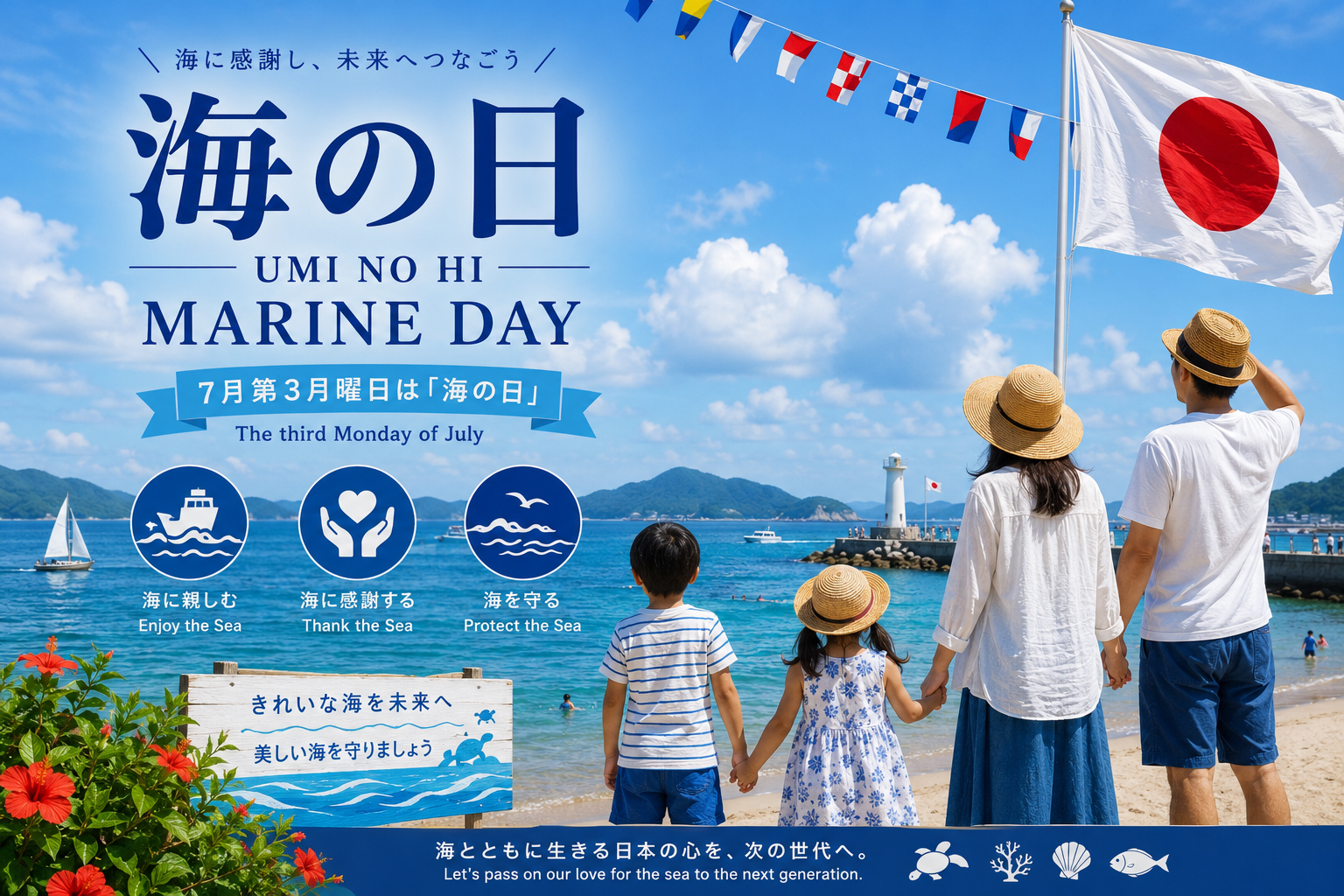
Marine Day is Japan’s blue opening trailer for summer
Japan has some beautifully poetic holidays. There is Mountain Day. There is Marine Day. The country has not yet created Air-Conditioning Day, which frankly deserves urgent legislative attention. Still, Marine Day does a lot of work. In 2026 it falls on Monday, July 20, turning the weekend into a three-day invitation to beaches, ports, aquariums, ferries, seafood and the annual national emergency known as “Where did we put the beach towels?”
Marine Day, or Umi no Hi, is officially a day to give thanks for the blessings of the sea and to wish for the prosperity of maritime Japan. It is also, in practice, a very good excuse to go near water. Families pack sandals, umbrellas, cold tea, sunscreen, toys, snacks and somehow seventeen items nobody will use while forgetting the one thing everyone needs.
GO TOKYO’s public-holiday guide lists Marine Day in 2026 as July 20 and describes it as a day to give thanks for the bounty of Japan’s oceans. Among Japanese national holidays, Marine Day is relatively young. It was first observed as a public holiday in 1996, and since 2003 has been celebrated on the third Monday of July. The calendar date may be modern, but the theme is ancient: Japan is an island country shaped by ports, fisheries, shipping, trade, salt, seafood, shipbuilding, lighthouses, sea gods and, during summer weekends, traffic reports that sound like tragic poetry.
The origin story: Meiji Maru and the return to Yokohama
Marine Day’s roots lead back to an imperial voyage. In 1876, Emperor Meiji traveled through the Tohoku and Hokkaido regions and returned to Yokohama by sea aboard the Meiji Maru, a lighthouse inspection ship. Nippon.com explains that he boarded the Meiji Maru at Aomori and arrived in Yokohama on July 20; the date was later memorialized in 1941 as Marine Memorial Day.
The Meiji Maru itself survives as a major piece of maritime history. Tokyo University of Marine Science and Technology preserves the vessel at its Etchujima campus as part of the Meiji Maru Maritime Museum. The ship is more than a handsome historic object. It belongs to the story of Japan’s modernization: ports, lighthouses, navigation, marine education and the infrastructure that made safe maritime travel possible.
So yes, Marine Day can mean shaved ice, aquariums and kids sprinting toward the water as if they have been personally called by Poseidon. But behind that weekend feeling is a serious memory: Japan’s relationship with the sea is industrial, cultural, spiritual and practical. Knowing that makes the holiday richer. It may not make your cooler lighter, but it gives your beach trip some historical dignity.
Why July: rainy season, beach openings and the three-day weekend
Marine Day lands at exactly the moment when much of Japan is tipping into full summer. The rainy season is ending or nearly over in many areas. Beaches have officially opened. School holidays are close. Fireworks, festivals, baseball, typhoon forecasts and heroic quantities of barley tea begin to dominate the calendar.
The long weekend is popular, which means planning matters. Beachside hotels can fill early, parking lots can disappear, and trains back from the coast can become quiet galleries of exhausted people carrying sandy bags. Everyone is cheerful on the way to the beach. On the way home, humanity becomes more philosophical.
The best Marine Day plan is not necessarily the biggest plan. Move early. Rest during peak heat. Swim only in lifeguarded areas. Drink water. Use shade. Leave time for the return trip. If you are traveling with children or older relatives, plan bathrooms, meals and transportation before romance takes over. “We’ll figure it out” is not a strategy. It is how families end up negotiating with a vending machine at 7:40 p.m.
Where Marine Day feels right: Yokohama, Hayama, Zushi and Enoshima
Because Marine Day’s origin is tied to the Meiji Maru’s return to Yokohama, the port city is one of the best places to feel the holiday’s story. Yamashita Park, the Red Brick Warehouse, Minato Mirai, Shinko Pier and the cruise terminal all make the sea visible as harbor, industry, promenade, hotel view and evening skyline. Yokohama is not only about swimming. It is where the sea becomes urban theatre.
For a more beach-centered version, Hayama, Zushi, Kamakura and Enoshima offer classic Tokyo-area summer escapes. Think beach houses, families, surfers, umbrellas, cold drinks, sunset and people pretending they are not checking the return train schedule. Isshiki Beach, Morito Beach, Zushi Beach, Yuigahama and the Enoshima coast all fit the Marine Day mood, though crowds should be expected.
Yokohama Hakkeijima Sea Paradise is another Marine Day-friendly option. Its official English guide describes it as a marine leisure complex on Hakkeijima island in Yokohama’s Kanazawa Ward, combining aquariums, a theme park, shopping, restaurants and a hotel. It is ideal for travelers who want ocean feeling without necessarily becoming one with the ocean. This is valid. Not every Marine Day hero needs wet hair.
- Sunscreen. Forget it and tomorrow you will understand grilled fish at a spiritual level.
- Water and salt. Sea breeze feels wonderful; heatstroke does not.
- Cash. Beach houses, lockers and parking lots can still enjoy analog traditions.
- A trash bag. If the holiday says “thank the sea,” do not leave the sea your snack wrappers.
- A return plan. Evening “we’ll manage” often becomes group suffering in sandals.
Real places to stay and eat
Marine Day trips become easier when lodging and meals are planned early. Below are real seaside or harbor-area bases and restaurants that fit the holiday’s Yokohama-Hayama coastal story. Confirm hours, rates, availability and reservations directly before visiting. Holidays change everything, especially the confidence of people who thought arriving without a booking would be charming.
Address: 2-14-1 Shinko, Naka-ku, Yokohama, Kanagawa 231-0001 Japan
Phone: +81-45-307-1111
Website: https://www.icyokohama-pier8.com/en/
A waterfront hotel on Shinko Pier, surrounded by sea on three sides. Good for turning Marine Day into a harbor-view weekend rather than a sand-in-the-shoes mission.
Address: 10 Yamashita-cho, Naka-ku, Yokohama, Kanagawa 231-8520 Japan
Phone: +81-45-681-1841
Website: https://www.hotel-newgrand.co.jp/english/
A classic hotel facing Yamashita Park. Ideal for travelers who want port history, old-school Yokohama atmosphere and a dignified alternative to beach chaos.
Address: 1-1-3 Minatomirai, Nishi-ku, Yokohama, Kanagawa 220-0012 Japan
Phone: +81-45-522-0008
Website: https://thekahala.jp/en/yokohama/
A luxury Minato Mirai stay for people whose Marine Day plan includes the sea, but also air-conditioning, spa time and not losing a sandal.
Address: Yokohama Red Brick Warehouse Building 2, 1-1-2 Shinko, Naka-ku, Yokohama, Kanagawa 231-0001 Japan
Phone: +81-45-650-1266
Website: https://www.billsjapan.com/en/locations/yokohama
A harbor brunch stop at the Red Brick Warehouse. Pancakes by the water: not a historical necessity, but civilization has advanced for a reason.
Address: 24-2 Horiuchi, Hayama-machi, Miura-gun, Kanagawa 240-0112 Japan
Phone: +81-46-875-6683
Website: https://lamaree.chaya.co.jp/
A seaside French restaurant in Hayama. Good for a Marine Day meal that says “coastal holiday” without requiring everyone to eat yakisoba in swimwear.
Address: Hakkeijima, Kanazawa-ku, Yokohama, Kanagawa 236-0006 Japan
Phone: +81-45-788-8888
Website: https://www.seaparadise.co.jp/en/language/en/index.html
A marine leisure island with aquariums, attractions, shops, restaurants and a hotel. A strong option when the forecast says “beach,” but your soul says “dolphins and shade.”

If you thank the sea, do not exhaust it
The star of Marine Day is not the traveler. It is the sea. If you go to the coast, carry out trash, swim in supervised areas, follow local rules, avoid risky water, respect living habitats and give other visitors space. These are simple rules, but beaches have a strange power to make everyone feel like the main character of summer. The sea has been here longer than your playlist.
The sea supports Japan’s food, ports, islands, fisheries, shipping and tourism. But it is also under pressure from marine debris, coastal development, rising temperatures, changing fisheries and climate risk. Marine Day can be fun without becoming careless. Gratitude is more convincing when it does not leave plastic behind.
A holiday as a small letter to the ocean
Marine Day does not need to be overcomplicated. Go to the beach. Walk a harbor. Take a ferry. Visit an aquarium. Eat fish. Watch sunset. Sit in the shade with a cold drink and feel, for one brief moment, that the inbox is someone else’s problem.
But if you look a little deeper, the day connects the Meiji Maru, Yokohama’s port history, lighthouses, sailors, fisheries, ferries, beach houses, lifeguards, seafood restaurants, family trips and the annual mystery of how sand gets inside a car that was definitely parked 200 meters from the beach.
On July 20, 2026, Marine Day is Japan’s small letter to the ocean: thank you for food, travel, weather, work, beauty, islands, ports and summer memories.
And thank you, sunscreen. Truly. Only the forgetful understand your mercy.
Sources and references
This feature is based on public information from GO TOKYO, Nippon.com, Tokyo University of Marine Science and Technology, Yokohama tourism sources, Yokohama Hakkeijima Sea Paradise, and official/direct hotel and restaurant sources.